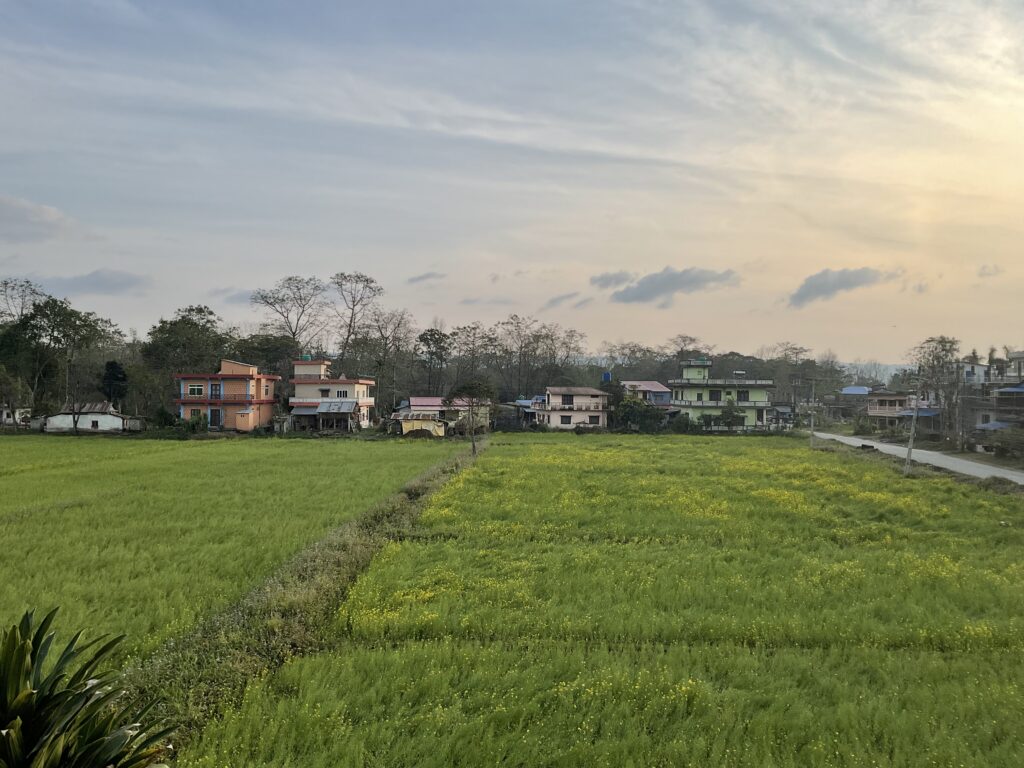
Feature image: Valparai plateau in the Western Ghats is surrounded by tea plantations (Photo credit: Vijay Ramesh)
Hearing a forest awaken with chirps of its feathered inhabitants makes each morning feel like a blessing (less so if you prefer to sleep in!). This melodious orchestra of bird vocalisations as the horizon lightens is referred to as the ‘dawn chorus’. This peak in vocal activity is followed by a lull later in the day, and again, a subtler affair, the ‘dusk chorus’ in the evening. You must have observed the difference in bird vocalisations throughout the day, but have you wondered why that’s the case?
Some researchers attribute high vocal activity earlier in the day to better transmission conditions, while others propose that the early morning flurry of vocalisations serves to deter intruders. There is also a hypothesis that suggests that low light levels at pre-dawn and post-dusk hours make it difficult for birds to forage for food, so they vocalise instead. However, other researchers suggest that searching for food and informing their mates about it may be how birds prefer to start the day. People have been searching for answers to this question for over a century, but the jury is still out.
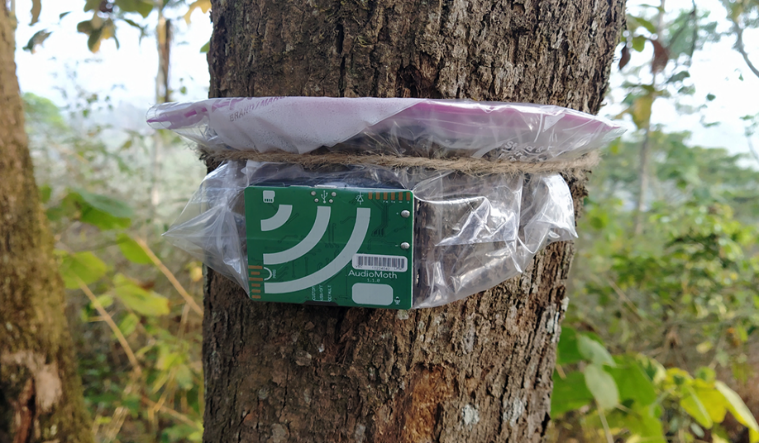
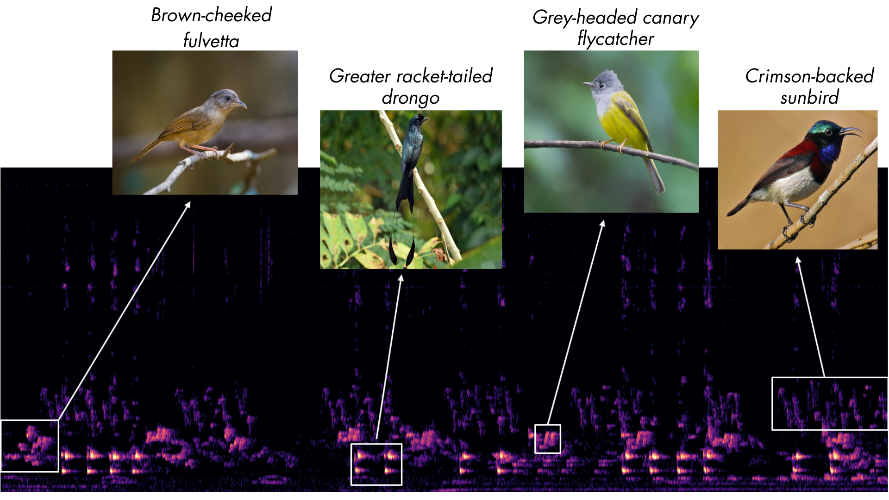
We, at Project Dhvani, a research collaboration that uses sounds to study biodiversity, were puzzled by this question as well. So, we set out to the Valparai plateau—located in the Anamalai Hills in India’s Western Ghats—to listen to what the birds had to say on this matter. We left audio recorders in the field to capture the sounds of the rainforest. This technique of using remote devices to record sounds without direct observation is called passive acoustic technology. Then, using spectrograms—visual representations of the loudness of sounds at different frequencies across time—we visualised and marked bird vocalisations. And we used these vocalisations to test the different hypotheses for the dawn chorus.
We could decipher so much of the forest drama from sounds alone! As soon as the sun rose, the environment filled with notes of the choral explosion. A pair of Grey-headed Canary-flycatchers let out squeaky whistles, while a Malabar Whistling-thrush chipped in with its melody. Meanwhile, Indian White-eyes and Brown-cheeked Fulvettas engaged in a flurry of vocal activity. Come evening, the dusk chorus kicked in with the calls of Malabar Grey Hornbills. And Dark-fronted Babblers rattled while scrambling through the understory, and an Indian Pitta uttered two-note whistles.
Our results showed that most birds vocalised more at dawn than at dusk. Species that fiercely maintain and defend territories, such as the White-bellied Treepie, and those that are omnivorous, such as the Yellow-browed Bulbul, tended to vocalise more at dawn than dusk. In the Western Ghats, omnivores and insectivores have been observed to form mixed-species flocks, where species flock together and hunt in groups to stay protected from predators and become more efficient foragers. These flocks may vocalise to alert others about predators, and they tend to be more active at dawn than dusk. Overall, our results suggest that vocalising at dawn plays a role in advertising and defending territories, and it is also driven by the availability of food, such as insects.
Our research shows how passive acoustic technology could help us answer one of the most fundamental scientific queries—why do birds sing so much in the morning? The audio recorders also helped us study birds at multiple sites simultaneously over long periods. Going ahead, we look forward to integrating field observations with acoustic technology to provide deeper insights into behavioural patterns.
So maybe next time, remember the idiom as ‘The early bird gets the worm, and its territories stand firm’.
Further Reading
Ramesh, V., P. Sundar, M. Srivathsa and L. Symes. 2025 Why is the early bird early? An evaluation of hypotheses for avian dawn-biased vocal activity. Philosophical Transactions of the Royal Society B 380: 20240054. http://doi.org/10.1098/rstb.2024.0054.