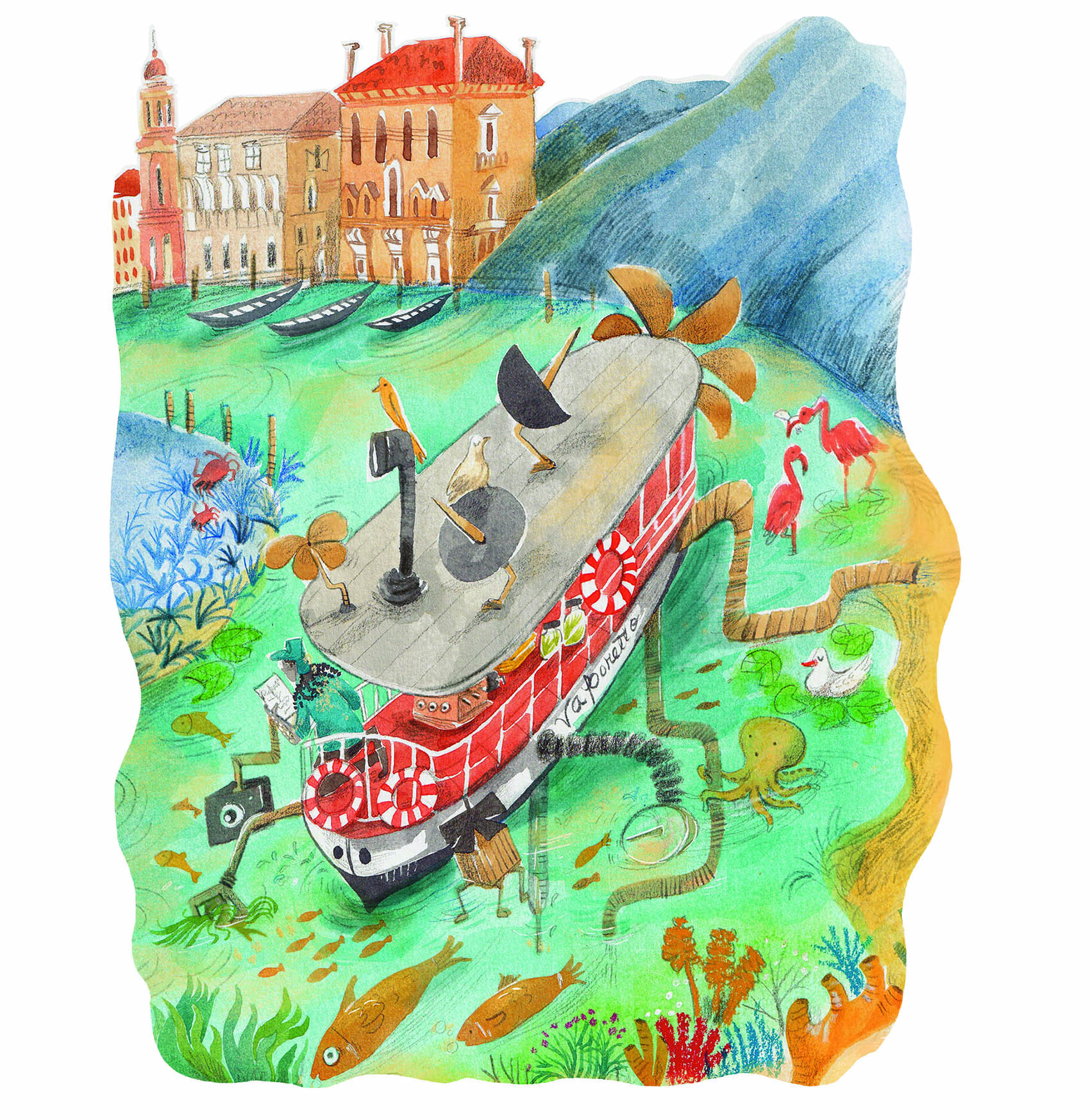
On a typical Monday in May, the Vaporetto of the Imagination is charting the Venice lagoon. The morning air is cool and peaceful and the surrounding environment appears pristine: it is difficult to encounter anyone at this hour. The Vaporetto, however, is on a mission. Equipped with state-of-the art sensors, underwater microphones, probes, and cameras, the large vessel monitors and records the richness of the Venetian landscape, today threatened by pollution and changes in water, air, and soil conditions.
Located in northeastern Italy, the lagoon is an enclosed bay of the Adriatic Sea. This fragile ecosystem, in which the city of Venice is situated, is constantly shaped and influenced by natural and artificial elements. Water and land meet here, creating a rich habitat spanning 550 square kilometres—that’s larger than some countries, including Andorra, Palau, Barbados, and the Maldives. But by its very nature, the lagoon is at risk because of two dangers that are related to one another: subsidence and eustatism. What terrifying names, what complicated words!
Subsidence is the gradual sinking of an area of land or the seabed. Eustatism, on the other hand, relates to worldwide changes in sea level (which is currently increasing due to the melting of glaciers, for example). These two ‘cousins’ interact with one another at an incredibly slow pace. Thankfully so! It takes geological eras—a very long time—for them to achieve their aim and erase the lagoon from the map.
However, human activity—with its industries, buildings, and heavy carbon footprint—has accelerated the effects of subsidence and eustatism, making their mission easier. It is humanity that has caused the pollution of these waters: the fish and birds of this place can no longer find food in abundance. The plant life too is under great strain due to the discharge from boats and is slowly fading.
And all of this is happening at a particularly difficult time: when climate change, which is resulting in higher temperatures and warmer seas, is making everything even more complicated. What a mess! What can be done? How can we return to a healthier natural environment? How can we restore biodiversity and avoid further degradation of our planet?
A mysterious captain
The Vaporetto of the Imagination was not originally born to be the guardian of the Venice lagoon. At the time of its construction, it wandered through the waterways of Venice, ferrying busy passengers to and from their occupations. Then one day, it retired: too old to continue in public service, yet strong enough to take on a new profession. The city council declared it “fit to monitor the surrounding environment”, and from that day forward it has faced the horizon, brimming with instruments.
At its helm is a mysterious captain—always wearing a sailor’s cap, she speaks very little and she feasts with the lagoon’s wild plants. Every day, she sails the Vaporetto between faraway islands, looking for clues about what is changing in the lagoon. Those who have seen her piloting the Vaporetto say they caught glimpses of shimmering reflections in her hair, like fish scales. Who knows? Perhaps it is true! The captain builds, calibrates, and repairs every on-board device when needed. Her mission is clear: to understand where the lagoon suffers the most and to alert the scientists and engineers who can help preserve it.
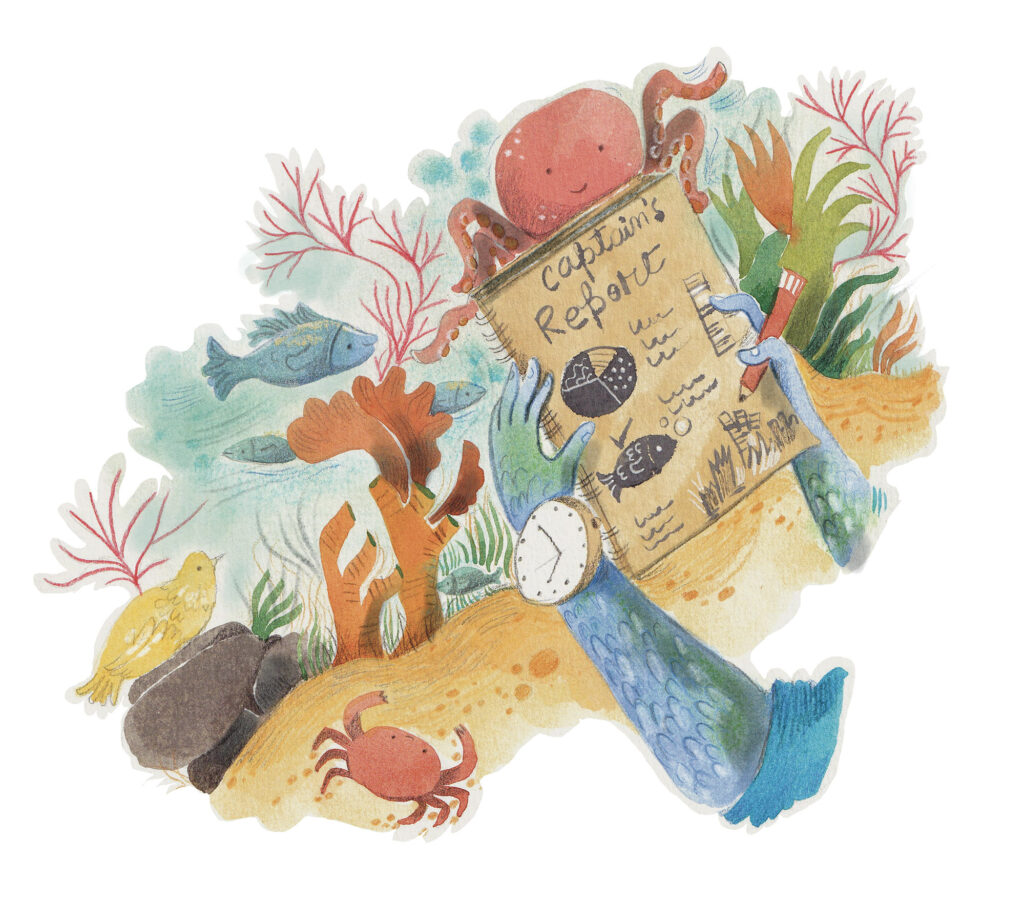
As the Vaporetto traverses vast stretches of water, it records the sounds made by animals (and plants!). The analysis of the frequency and intensity of these sounds helps determine whether a particular species is disappearing or in need of support. The underwater cameras follow marine life in the shallows and observe the speed of interactions between different fish species, along with their habits and rhythms. The sensors constantly monitor the temperature of both water and air, as well as the presence of pollutants and materials that may contaminate this delicate habitat. The captain never loses track of a single instrument and compiles a detailed report each day, transmitting it to headquarters—even from afar.
A never-ending mission
The conservation and restoration of the lagoon’s habitat begins with its protection. The instruments carried by the Vaporetto of the Imagination across the waters, even to the most remote islands, can detect the earliest warning signs of danger and suggest where and how urgent intervention is needed. This is how scientists, for example, discovered the complete disappearance of certain native species and the arrival of “alien plants” that tend to become dominant.
Monitoring by the Vaporetto has provided scientists with two crucial insights: native species are highly sensitive to the salt concentration in the water, and the rising external temperatures—caused by climate change—make survival even harder for them.
Each day, researchers receive the data the captain processes from the Vaporetto. Punctually, at 8 PM every evening, a report filled with figures, notes, and recommendations arrives in their hands.
Then one day—no different from the rest, yet somehow special—they ask her: where does the name Vaporetto of the Imagination come from? The captain smiles and replies, “Because the lagoon we dream of—clean, bright, and full of singing birds and swimming fish—is not on any map. But if we imagine it, as we must, we can make it real.”
And so the Vaporetto puffs along, brave and proud, toward the furthest island, carrying hope and imagination on every wave.
Further Reading
Bertolini, C. and J. da Mosto. 2021. Restoring for the climate: a review of coastal wetland restoration research in the last 30 years. Restoration Ecology 29(7): e13438. https://doi.org/10.1111/rec.13438.
Proença, V., L. J. Martin, H. M. Pereira, M. Fernandez, L. McRae, J. Belnap, M. Böhm et al. 2017. Global biodiversity monitoring: from data sources to essential biodiversity variables. Biological Conservation 213: 256–263. https://doi.org/10.1016/j.biocon.2016.07.014.
The Vital Project. https://www.v-i-t-a-l.org/en/about. Accessed on June 19, 2025.