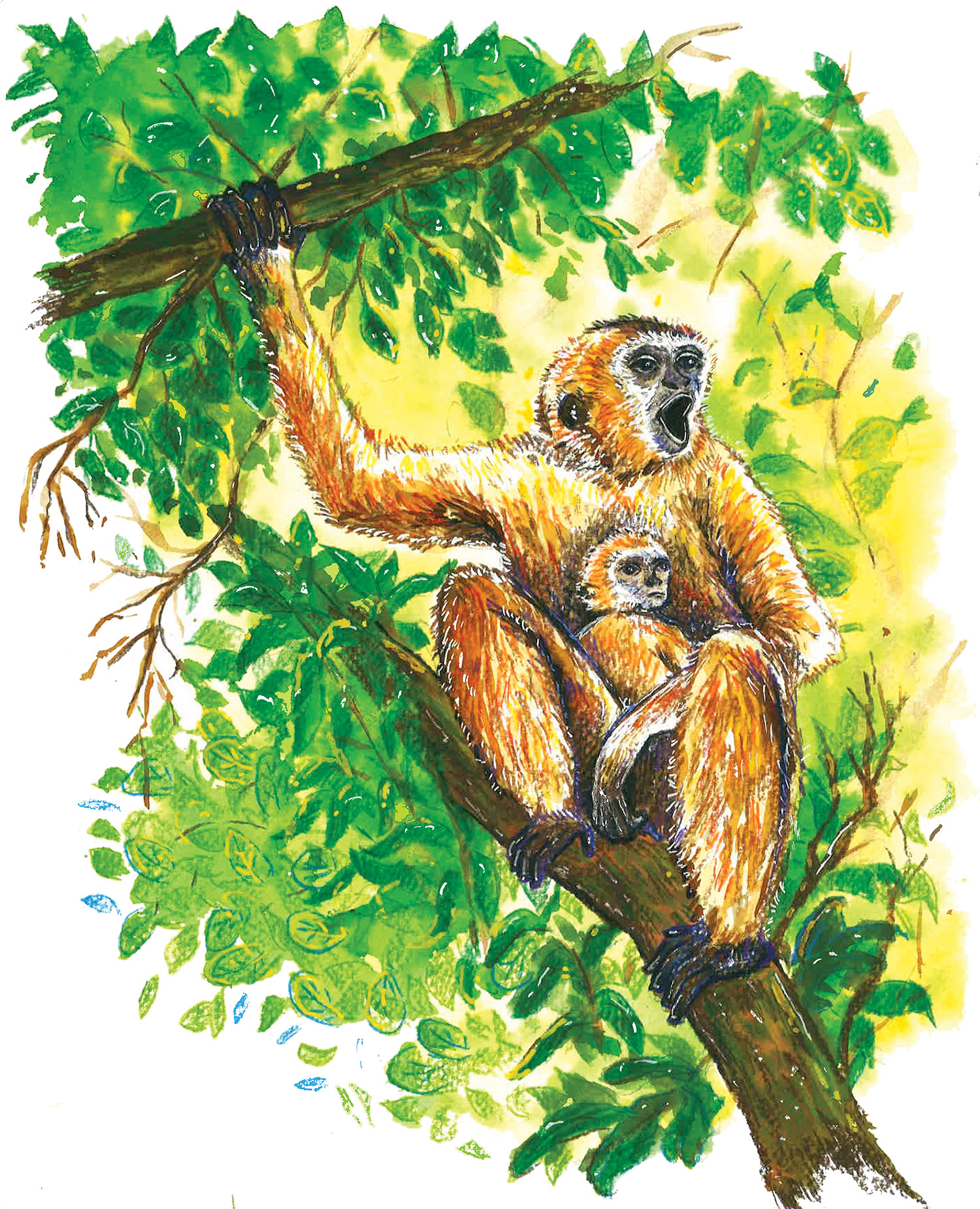
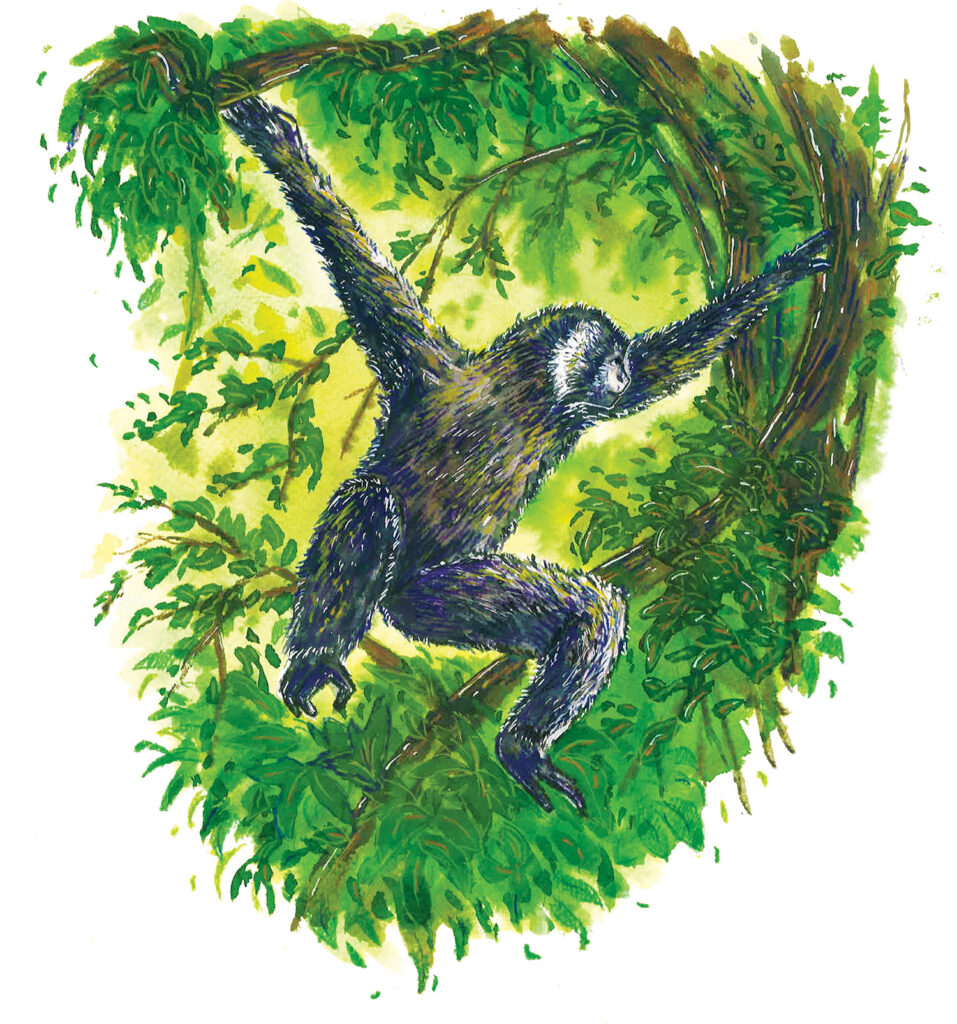
The first rays of the sun feel warm on my fur. The early morning light starts to filter through the leaves at the tops of the trees in the forest canopy. The night before, I had fallen asleep with my legs curled up to my chest and my arms crossed over my knees. My bed was the fork between two big branches in a very tall tree. I reach my long arms above my head to stretch and grasp the branch extending above me. Where is my family? Every day, my mother, father, younger brother, and I travel through the forest together. When the sun starts to set, we find our own beds for the night.
“Ooooooooooooo-aahk…wak….wak….wak….wak…wick-u…wick-u…wick-u…”
That’s my dad! He’s letting us know where he is.
“Ooooooooooooooo…wup…..wup…..wup……wy..wy..wy..wy.”
There’s mom! Mom and dad like to sing together in the morning. When a mom and dad gibbon sing together, it’s called a duet. I try my best to imitate my mom’s voice.
“Oooooooooooooooo…wup…wup…”
She taught me how to sing. When we sing together, all the other gibbons in the forest know where our family is. I hear the sound of leaves rustling and branches creaking. I catch a glimpse of shiny black fur overhead as my dad makes his way over to me.
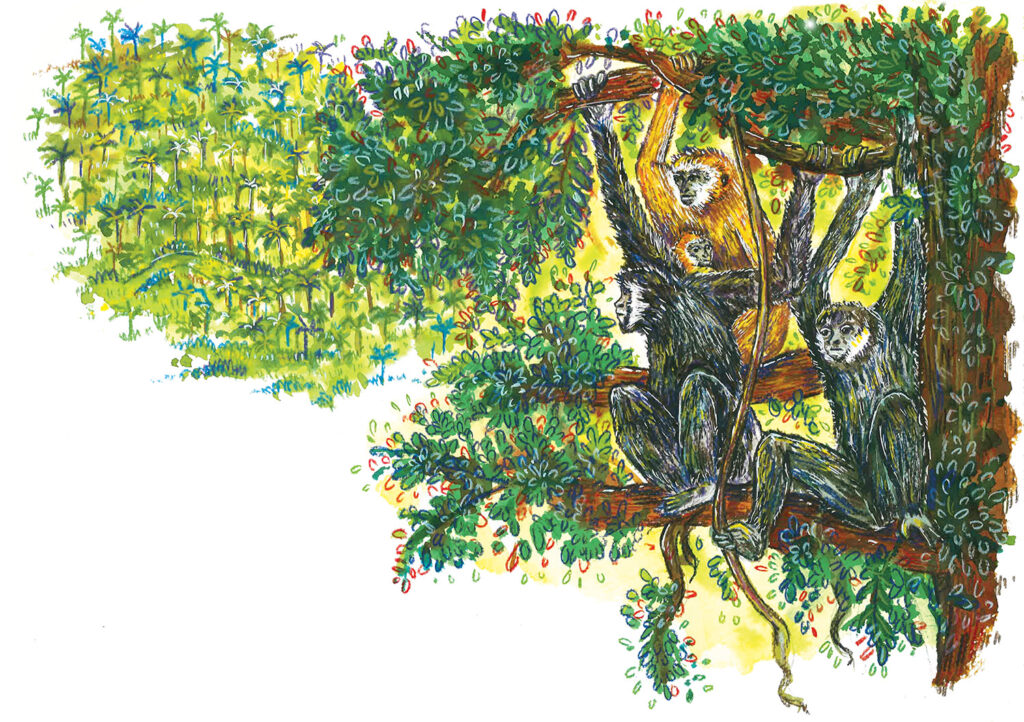
On the branch below, my mom sits with my brother clinging to her belly with his dark eyes looking up at me. His fur is a creamy tan colour and blends in perfectly with my mom’s. Their colours match, so predators can’t see him while my mom carries him around. In about a year, his fur will turn black like my dad’s and mine. Once I grow up, my fur will turn back to a creamy tan colour to match my mom and the other adult girls. My brother’s fur will stay black.
“Wick-u…wick-u…wick-u…” My brother is just learning how to sing, but he likes to practice!
My brother is just learning how to sing, but he likes to practice! The song of another gibbon family echoes ours as they announce their territory and greet the day. Singing takes a lot of energy, and my empty stomach tells me it’s time for breakfast. My hand grips the branch above me a little tighter. I stretch my curled up legs and push off the branch to start my swing. I move through the trees the same way you climb across monkey bars, even though I am not really a monkey. I’m part of the ape family. My ape cousins, the orangutans, live in the trees with me here in Southeast Asia.
With my right hand, I grab one branch while my left reaches for the next one. Apes like me do not have tails to help balance on branches, but my strong arms help me dangle from the trees. I stretch my long arms as far as I can to swing from branch to branch and tree to tree. The way we move is called brachiation.
I spend most of my life up in the trees, so I have learned to move very fast and travel very far without ever having to touch the ground.
My favourite foods
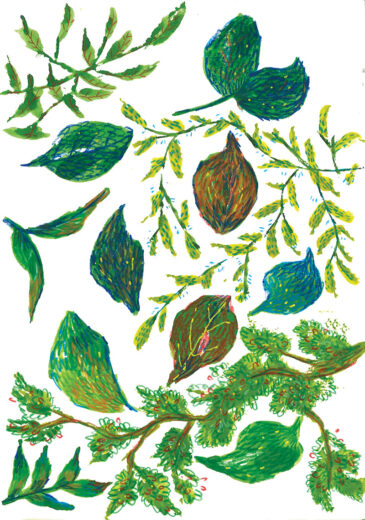
With one final swing, I fly through the air grabbing the branch of a new tree where I will find my breakfast. I am lucky to live in a place where so many yummy fruits grow on trees, but these figs are one of my favourites. I slowly swing through the branches, looking carefully at the colours of the fruits until I find a bunch of sweet, ripe, purplish black figs. Dangling from a branch with one arm, I use my other hand to pick the sweet figs and start eating.
My brother also picks a ripe fig and sits balanced on a branch to eat his food. My dad sits down next to him and starts using his long fingers to inspect my brother’s fur while he eats. We call this grooming. My dad is removing bugs and parasites from my brother’s fur. Grooming is a way that we take care of each other.
Now that I’m full from snacking on a variety of fruits in nearby trees, I’m ready to play! I tag my brother with my hand and then nudge him with my foot, daring him to chase me. I take off, flying and swinging through the trees. I can hear him crashing through the leaves behind me. He is still young, but has already learned to brachiate very fast!
Daily log
My parents join in as they chase us through the trees. My mom catches up to my brother and grabs his foot as he swings by. She pulls him down to a bundle of branches where they wrestle. My whole family likes to play! We spend most of our days in the trees in our territory. We eat, we play, we groom each other, and we rest.
We also have to watch out for danger and predators. Being high up in the trees keeps us safe from big cats like tigers that stay closer to the ground. But eagles and hawks may be prowling from the sky looking for smaller gibbons like my brother, so we stay under the top layer of the forest canopy. The leaves make it hard for birds of prey to see us.
As we travel, we see our primate relatives in the trees. Some, like the slow loris, are nocturnal, which means they are awake at night. Our orangutan cousins are active during the day, like us. We sometimes fight with our relatives over the best food since we like a lot of the same things. But most of the time, we stay away from each other and continue on our way, swinging through the trees.
We travel all around our territory every day and, as we travel, we have an important job to do in the forest. Just like every other animal, sometimes we have to poop. The seeds from all the fruits we eat drop to the forest floor in our poop and find a place to start growing a brand new tree. Since we are always on the move, we are also spreading these seeds all around the forest so new trees can continue growing.
Tree troubles
One day, we were travelling towards the sun rising in the sky. The branches opened up to a place where there were no more tall trees. On this end of our territory we had seen another kind of primate, but they did not live in the trees like us. They stayed on the ground and only had fur on their heads. When they first arrived, they cut down some of our favourite fruit trees and started growing new ones called oil palm trees.
These oil palm trees grow fruit, but not the kind that we like. They are also shorter than the trees where we feel safe, and they are planted too far apart for us to swing from one to another. We could walk on the ground to get to the next tree, but there are a lot more predators down there. And we’re not as fast at walking as we are at swinging. This new kind of planted oil palm forest makes it hard to find fruits to eat or safe places to rest. The first time we got to this part of our territory, we realised we would have to go in a different direction to find food and safety.
Today, we are chasing each other through our territory, but this time we are moving in the direction of the setting sun. My father is winning the race, but I see him starting to slow down. The branches once again open up and the primates without fur are here, too. I think they are called ‘humans’. In this part of our territory, the humans have also planted new oil palm trees. But here, by the setting sun, these humans left a lot of our favourite fruit trees growing nearby. We can still find food and move safely through the branches without having to walk on the ground. I feel safe here.
As the sun continues to set, I look for the branch that will be my bed for the night. I settle in and look around at the oil palm trees nearby. There are two humans moving by the trees. They are hiding and chasing each other around the trees and playing. I start to fall asleep as I watch them play and realise maybe we are not so different from one another.
The singing, swinging apes in this story are northern white-cheeked gibbon (Hylobates leucogenys), a species that lives in parts of Southeast Asia.