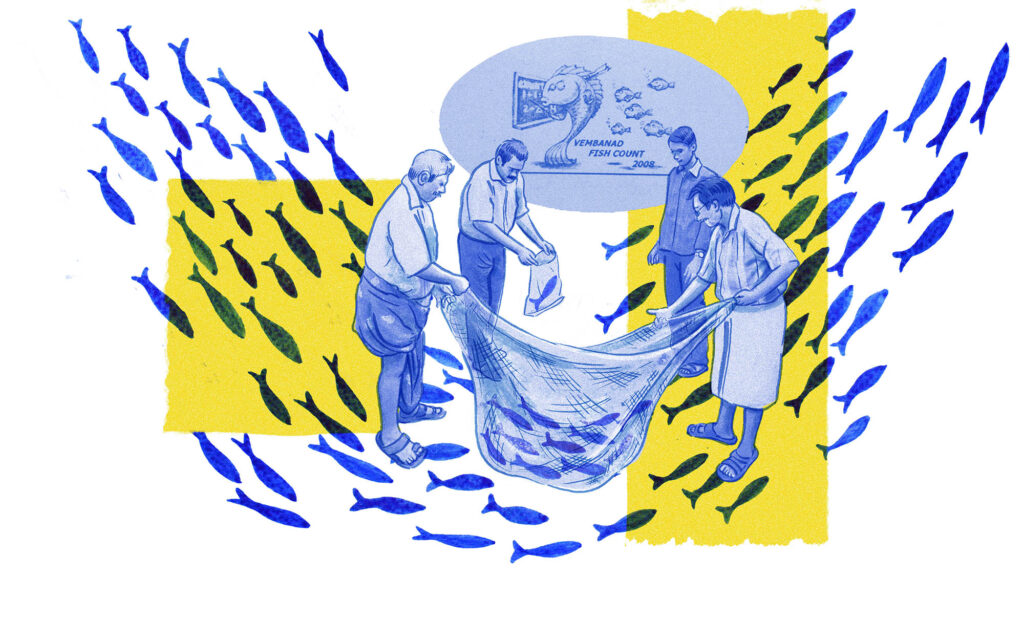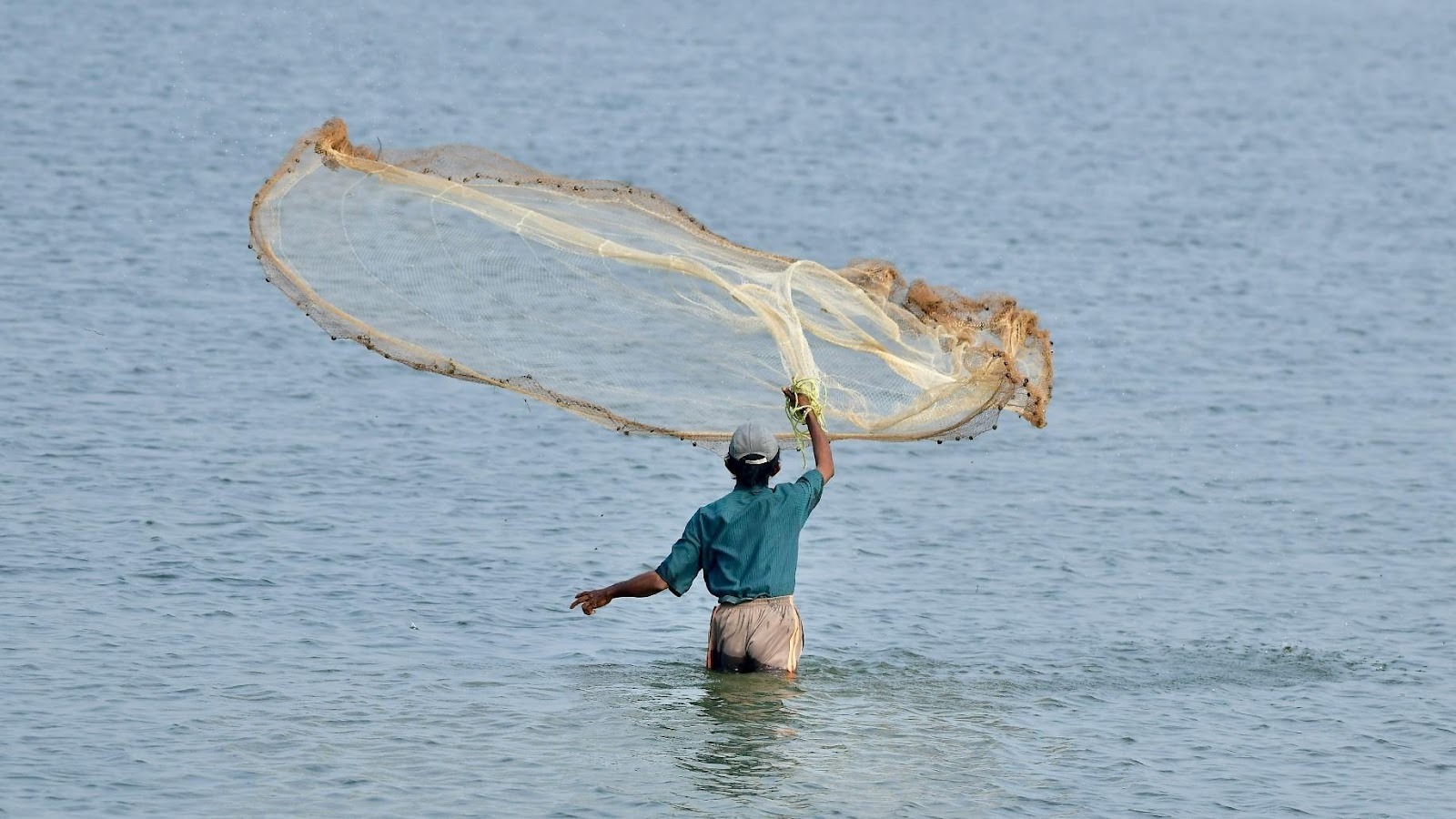
Feature image: For coastal fishing communities, nature is not an object of observation but a site of daily labour, livelihood, and survival, shaped by conservation and development decisions. (Image source: Rohan Solankurkar/Unsplash)
In a recent article titled ‘Nature for nature’s sake: Arguing for non-humans in the Anthropocene’ the author, Dr. Harish Prakash, makes a thoughtful case for expanding our ethical concern beyond humans to the vast range of non-human species with whom we share evolutionary history. The piece argues that we must value nature not only for its instrumental or relational importance, but for its intrinsic worth, independent of human benefit. It calls for cultivating awe, curiosity, and direct engagement with biodiversity, through observation, citizen science, and an ecocentric worldview that places humans on equal footing with all other species.
It is a compelling argument, and one that is essential in a time of accelerating extinctions, climate instability, and large-scale ecological loss. Arguments of this kind draw from long-standing debates within environmental philosophy and ethics, particularly those between anthropocentric and biocentric or ecocentric approaches that emerged strongly in the 1970s. These traditions were crucial in challenging extractive worldviews and foregrounding the moral standing of non-human life. At the same time, they have been widely critiqued for the ethical and political consequences that follow when universal moral claims are applied across deeply unequal social landscapes. Yet the ethical expansion the article calls for raises an unresolved question: whose humanity is being invoked, and whose relationship to nature is being assumed?
While reading the article, I found myself feeling uneasy, not because I disagreed with the call to value non-human life, but because the framing rests on a familiar but problematic assumption: that ‘humans’ form a single, homogeneous entity equally responsible for environmental destruction and equitably positioned to respond.
In reality, the category of ‘human’ is not flat. Nor is it neutral.
The Anthropocene is unevenly produced and unevenly experienced.
To speak of ‘humanity’ as the driver of environmental decline risks blurring the profound inequalities that structure who extracts, who benefits, who pollutes, and who suffers. As the historian Ramachandra Guha pointed out in his early critique of Deep Ecology, such universalising ethical claims often travel poorly in postcolonial contexts, where conservation has historically intersected with questions of land, livelihood and displacement.
This is not an abstract point. Consider India alone. The same Delhi air pollution index that registers as a health concern for the middle class becomes a crisis of breath for construction workers who inhale the dust 12 hours a day. The same rising temperatures that prompt an urban office worker to adjust their AC force migrant workers on agricultural fields to labour through heatwaves that are deadly. The same urban water scarcity projected for 2050 is already the lived reality in informal settlements, where tankers arrive unpredictably and women spend hours queuing for basic supply.
Environmental degradation does not land on everyone equally. It lands where caste, class, landlessness, and precarious labour already exist.
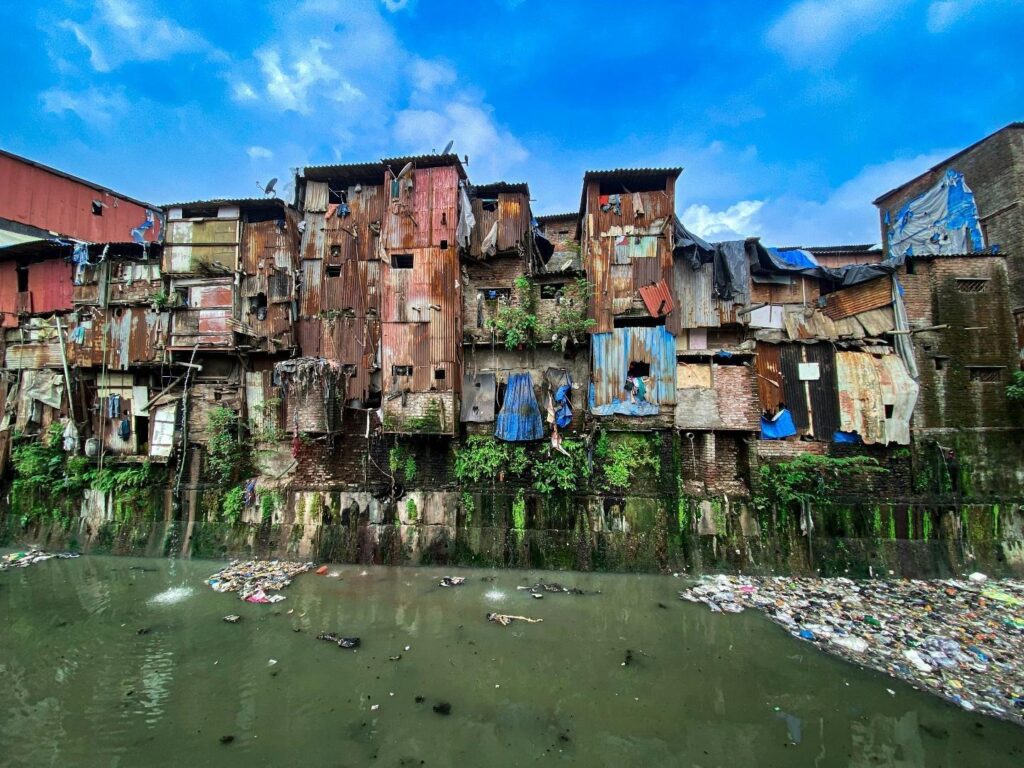
Environmental degradation is unevenly experienced, with marginalised communities often living alongside polluted water bodies and ecological risk they did not create. (Image source: vinay manda/Unsplash)
This is why a universal ‘we’ in ecological writing can be misleading. It unintentionally reproduces a middle class, urban, protectionist standpoint, one in which humans stand outside nature and must learn to reconnect with it, often through leisure, observation, or personal curiosity. This framing echoes a broader conservation discourse in which nature is imagined as something “out there” to be preserved, rather than as a lived and worked-in landscape. Citizen science platforms such as eBird and iNaturalist are wonderful, but they reflect a particular subject who has time, access, mobility, and distance from nature as labour. For many rural and working class communities, being visible to conservation often means surveillance rather than participation.
Many communities in India do not connect to nature by going outdoors to observe biodiversity, they live in biodiversity. For Adivasi communities, forest dwellers, pastoralists, fishing communities, and Dalit agricultural labourers, nature is not an aesthetic object of awe but a site of livelihood, heritage, and survival. When the article uses the example of gathering wild berries to illustrate “relational value”, it overlooks that for many, foraging is not a recreational act; it is culture, subsistence, and autonomy. Such practices are often criminalised or restricted under conservation regimes, even though these communities have long histories of coexisting with and sustaining local ecologies.
Similarly, the call to appreciate the evolutionary kinship between humans and other species is powerful, but the erasure of unequal human suffering sits uneasily beside it. In the same decades that we mourn the decline of sparrows or ghost crabs, Dalit sanitation workers are dying in manholes, Adivasi families are displaced for mining projects, and coastal fishing communities are witnessing the ocean they depend on being swallowed by port expansions and industrial fisheries. These developments are not incidental to environmental decline; they are central to how ecological harm is produced and distributed.
These losses are ecological and social.
To speak of non-humans without acknowledging the socio-political structures harming marginalised humans risks narrowing environmental ethics to a form of conservation elitism, one where species matter, but people on the peripheries remain invisible. Yet this critique is not a rejection of ecocentric thinking. Rather, it echoes a long-standing argument within environmental ethics that moral concern for non-human life must be grounded in social context. Philosophers such as Bryan Norton have described this position as “weak anthropocentrism”, an approach that recognises the intrinsic value of non-human life while insisting that conservation ethics remain attentive to human values, cultural relationships with ecosystems, and especially the needs of the most vulnerable. This integrated approach also informed the Millennium Ecosystem Assessment published in 2005, which framed ecosystem health and human well-being as inseparable rather than competing goals.
Yet the original article by Dr. Harish Prakash is not wrong. It is incomplete.
Intrinsic value is essential. Awe is essential. Understanding evolutionary interconnectedness is essential. But none of these can afford to exist in an abstract conceptual world where all humans stand equally alongside all other species. Environmental responsibility is stratified. Ecological harm is stratified. And therefore, ecological care must also be stratified.
The challenge before us, then, is not to choose between non-human protection and human justice, but to insist that they are indivisible. Fighting to conserve the ghost crabs must not mean overlooking the fisher families whose huts are razed for “beach cleaning”. Saving a wetland must not mean evicting the very communities who have protected and cultivated it for generations.
Conservation that ignores inequality risks reproducing the very hierarchies it seeks to dismantle. As scholars of environmental justice remind us: ecology without society is incomplete, and conservation without justice becomes elitist.
If we are to argue for non-humans in the Anthropocene, we must also argue for the humans pushed to its margins. Paying attention to species is critical, but so is paying attention to who is allowed to live near them, who is removed to protect them, and who is blamed for their decline.
The article invites us to widen our moral circle. My hope is to widen it further: not only to include non-human life, but also to recognise the unequal human worlds in which that life is embedded. Only then can we truly speak of care, responsibility, and the future we hope to preserve.
Further Reading
Guha, R. 1989. Radical American environmentalism and wilderness preservation: A third world critique. Environmental Ethics 11(1): 71–83.
Norton, B. G. 1989. The cultural approach to conservation biology. In: Conservation for the Twenty-First Century. (eds. Western, D. and M. Pearl). Oxford University Press.
Shanker, K. and Oommen, M. A. 2021. The authoritarian biologist reloaded and deep ecology redux: conservation imperialism and the battle over knowledge, money and space. In: A Functioning Anarchy. (eds. Sundar, N. and S. Raghavan). Penguin Random House India.