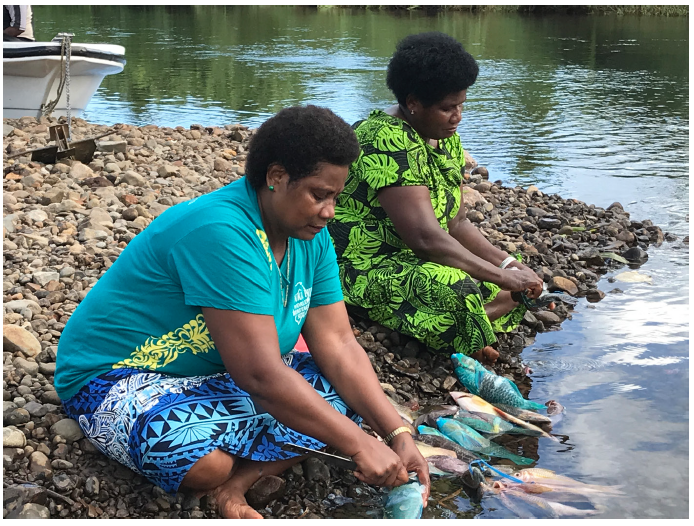
Feature image: Women cleaning their fish catch in Fiji (Photo credit: Sangeeta Mangubhai)
Healthy seas and oceans are fundamental to our survival—providing food and livelihoods, absorbing carbon, and regulating the water cycle. Working to protect them is therefore essential, as is understanding the impacts of different resource management initiatives on these marine ecosystems and the local people who rely on them.
Locally Managed Marine Areas (LMMAs) are Indigenous-led marine management initiatives that have spread rapidly over the past two decades and are now present in almost 1,000 communities across 15 countries. Local communities create plans and set fishing rules to support their fishing needs, alongside recovery of the ecosystem.
In Fiji, support and guidance for these areas is coordinated under the Fiji Locally Managed Marine Areas (FLMMA) network. Participation in the network is voluntary and decided by the community. This raises the question—why do some villages join the network while others don’t? And what are the effects of participation on communities and ecosystems?
This is what our research set out to uncover. We wanted to understand what motivates villages to engage and what impacts participating in the network has on them. This understanding is important for designing future initiatives that are both positive for the community and the environment, and likely to have widespread adoption and wide-ranging impact. And so, we spoke with people in 146 coastal villages in Fiji who were or weren’t engaged in the FLMMA network.
Common denominator
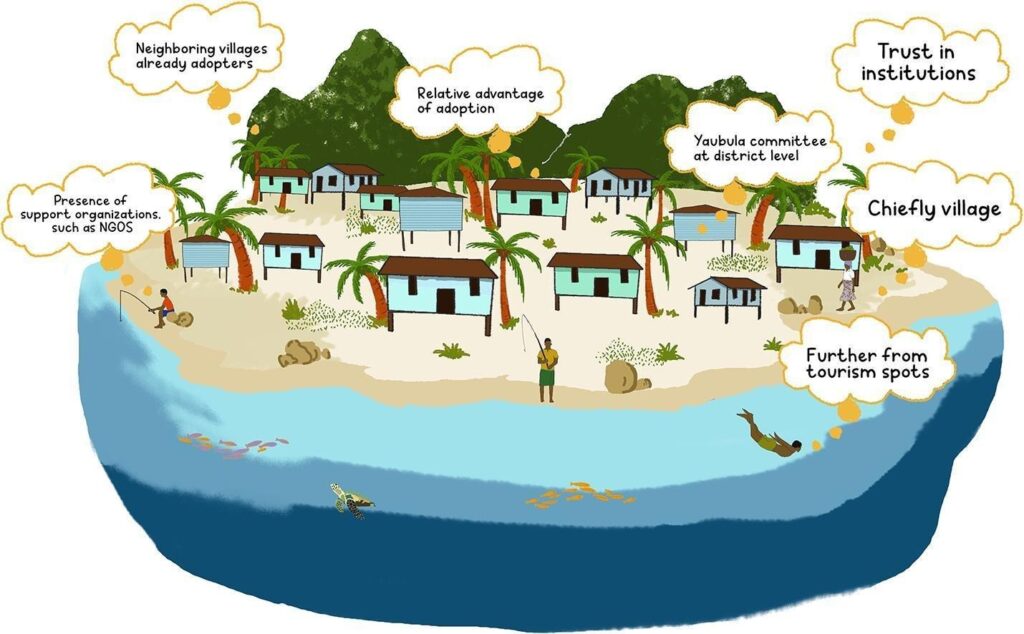
Villages that participated in the network shared certain characteristics. For example, nearly three-quarters of engaged villages had a neighbouring village that had also engaged, highlighting that word of mouth and learning from each other may be an important factor in helping initiatives to spread. Villages who had support from organisations such as NGOs or had a resource management committee at the district level (yaubula) were also more likely to engage. These structures may help sustain initiatives through facilitating local stewardship and formalising management.
Interestingly, villages that engaged with the FLMMA network were also further away from tourist resorts and were more likely to be associated with Indigenous groups of greater influence. This could reflect the way in which NGOs select villages to partner with, alongside other livelihood opportunities available to villages in tourist hotspots.
Local benefits
We found that villages who engaged with the FLMMA network participated in making decisions about fishing rules more frequently and took greater ownership over management of resources. For example, they were more likely to have fishing rules in place and enforce penalties for breaking them. FLMMA villages also reported increased financial support, for instance, through investment in infrastructure, and an increase in perceived knowledge about marine resources, particularly among women and youth.
However, we found no effect of participation on perceived ecological health of the reefs, on fish catch, food security, or on village or household wealth. So, while resource governance is improving, these aren’t necessarily being translated into desired long-term outcomes.
Interestingly, participation of women has multiple benefits yet is generally low. Villages where women participated in decision-making about fishing areas reported catching more fish, greater satisfaction with food from the sea, and greater household wealth compared to villages with lower numbers of participating women. Although women often felt excluded from management committees, the value of their input was recognised within the community.
Conservation initiatives must respond to the needs of communities, while collaboratively protecting and restoring natural resources. The FLMMA network shows us that communities are willing to engage when the right support is in place. However, there is still room for improvement—programmes can work better if they are more inclusive, and more robust data are needed to effectively assess long-term effects on people and nature.
Further Reading:
Ferguson Irlanda, C. E., S. Mangubhai, E. Waqa, H. Govan, A. Jagadish, S. E. Lester, M. Mills et al. 2025. Insights on the roles of women in effective and procedurally just environmental governance from coastal fisheries management in Fiji. Conservation Biology: e70121. https://doi.org/10.1111/cobi.70121.
Jagadish, A., A. Freni-Sterrantino, Y. He, T. O’ Garra, L. Gecchele, S. Mangubhai, H. Govan et al. 2024. Scaling Indigenous-led natural resource management. Global Environmental Change 84: 102799. https://doi.org/10.1016/j.gloenvcha.2024.102799.
O’Garra, T., S. Mangubhai, A. Jagadish, M. Tabunakawai-Vakalalabure, A. Tawake, H. Govan and M. Mills. 2023. National-level evaluation of a community-based marine management initiative. Nature Sustainability 6: 908–918. https://doi.org/10.1038/s41893-023-01123-7.