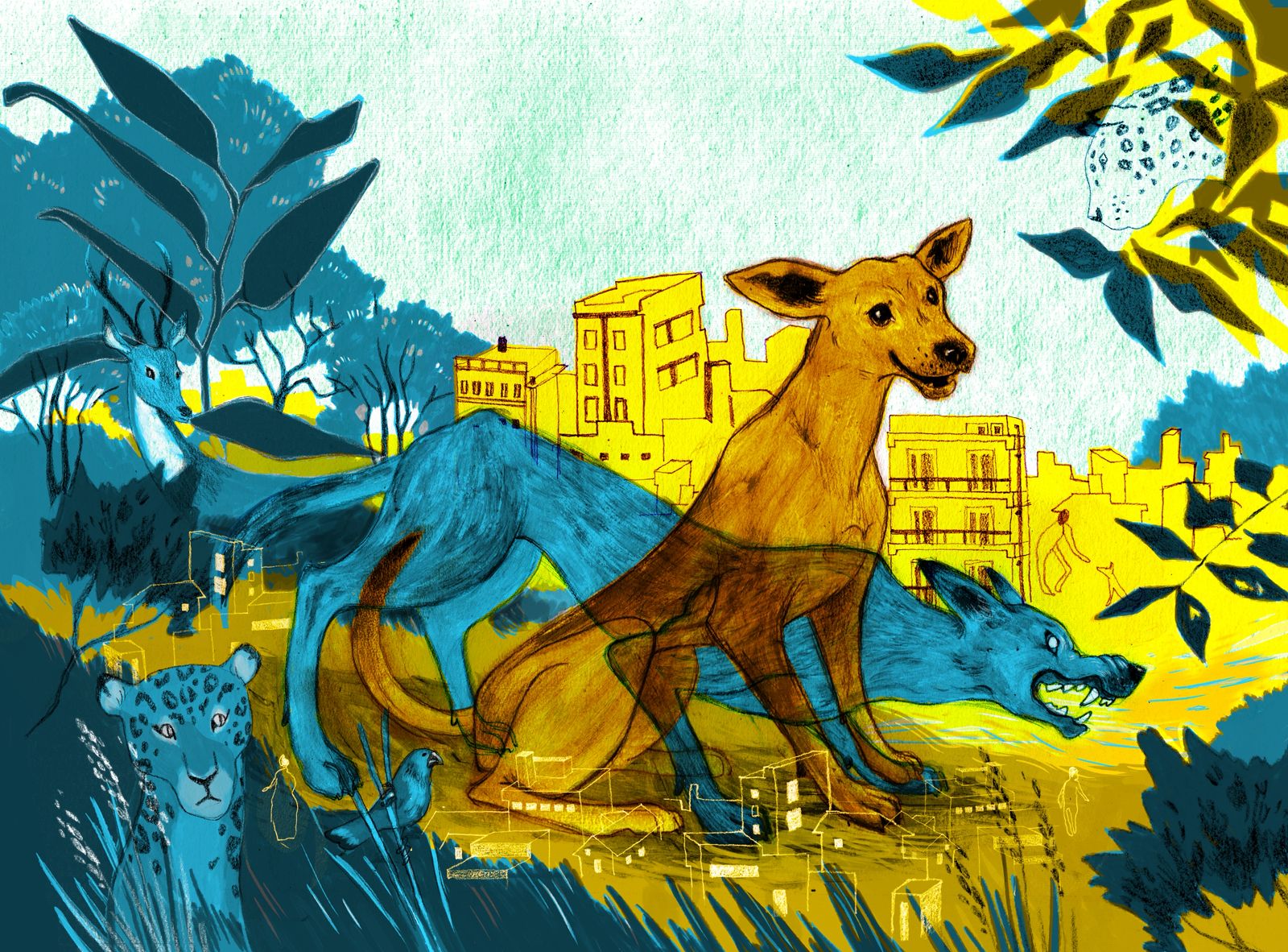
I’ve been adopted by a dog.
He’s a nice tan with white front stockings, a white bib, and a happy white-tipped tail. When he sees me, his ears flatten excitedly, his tail wags itself into a blur as he jumps up at my face, and his dark, liquid eyes brim with friendliness. He religiously accompanies me to and from the field station in Mudumalai Tiger Reserve at meal times, waiting patiently outside or next to me on the veranda while I eat. In between, he settles down outside my door to bark at passing cows, goats, langurs, and other dogs, and alerts me to the field station staff who’ve worked here for years entering their own room next to mine.
As a nod to the cheap price of this devotion, I’ve temporarily named him Biscuit. As a companion, he is undoubtedly affectionate and easy to like; as a study animal, he’s quite unsuitable, because he’d happily let anyone remove any GPS collar I place on him without protest. But why would a wildlife ecology student be collaring dogs?
On a personal level, I’m fond of animals and dogs in particular. As a kid, I used to pet any and all street dogs I came across. When we later adopted our own dog, I was the one who trained her, trimmed her fur, and walked her on the beach. I even borrowed books from the school library about dog training, behaviour, and sensory abilities—not quite common reading fare for a 13-year-old. I toyed with the idea of becoming a veterinarian, but ultimately decided against it—I wasn’t too confident about the surgery bit. Since my fondness for animals encompassed wild ones as well, it was natural to turn to studying
wildlife ecology.
And somewhere along the way, I learned that domestic dogs are, in fact, relevant to wildlife conservation. While I was delighted to discover this bridge between the personal and professional, dogs—specifically free-ranging dogs, or unconstrained and unmonitored dogs—can actually be a serious problem for wildlife.
Man’s best friend, wildlife’s enemy?
The first and most common complaint is predation. Dogs have been companions and protectors for thousands of years, following where humans go; therefore, when humans settle near natural ecosystems, dogs are usually right there with them. The most abundant carnivore on Earth, they have contributed—as invasive predators—to the extinction of 11 vertebrate species. Some dogs have been reported to kill hundreds of individuals of a species, like a German shepherd who killed an estimated 500 kiwis in New Zealand in 1988.
Of course, not all dogs kill in this indiscriminate way. But since dog populations are subsidised by the food and shelter provided by humans, they can reach considerable sizes. Even occasional hunting can add up to serious damage to an endangered species, if the dog population is large enough. Additionally, the presence of so many human-supported predators means that wild predators must suddenly face strong and well-fed competition, affecting their ecology, behaviour, and perhaps even population size. Even if dogs scavenge rather than hunt, enough of them doing so can result in other animals dependent on the same resources, such as jackals, vultures or foxes, going hungry more often than they otherwise would.
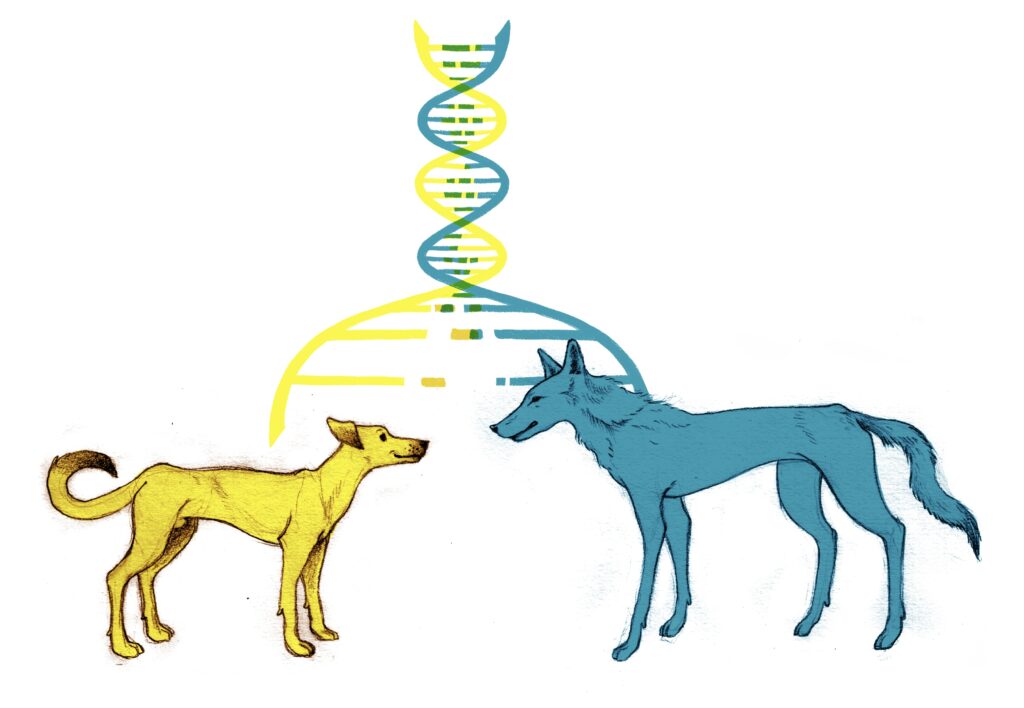
While predation is the most widely reported negative impact, there are several other facets to dog interactions with wildlife. Free-ranging dogs have been known to hybridise with wild canids like wolves and jackals, posing a potential threat to the wild gene pool. While the majority of such reports are from Europe, an Indian wolf-dog hybrid was reported for the first time in 2023 from the savannas near Pune.
Dog populations near wildlife areas may also exacerbate human-wildlife conflict, since many wild species across the world have been documented to prey on dogs, including grey wolves (Europe, Asia, and North America), coyotes (North America), pumas (North and South America), Amur tigers and leopards (Asia), and lions and spotted hyenas (Africa). As a result, large dog populations may attract these predators close to human settlements. Leopards, in particular, have been documented to prey on dogs since the colonial period in India, even entering houses to do so. This could lead to wild predator populations rising sharply, sustained by the abundance of dogs as prey, increasing the risk to humans and livestock; or, conversely, the strong emotional bond between dog and owner could lead to retaliatory killing of wild predators that hunt dogs.
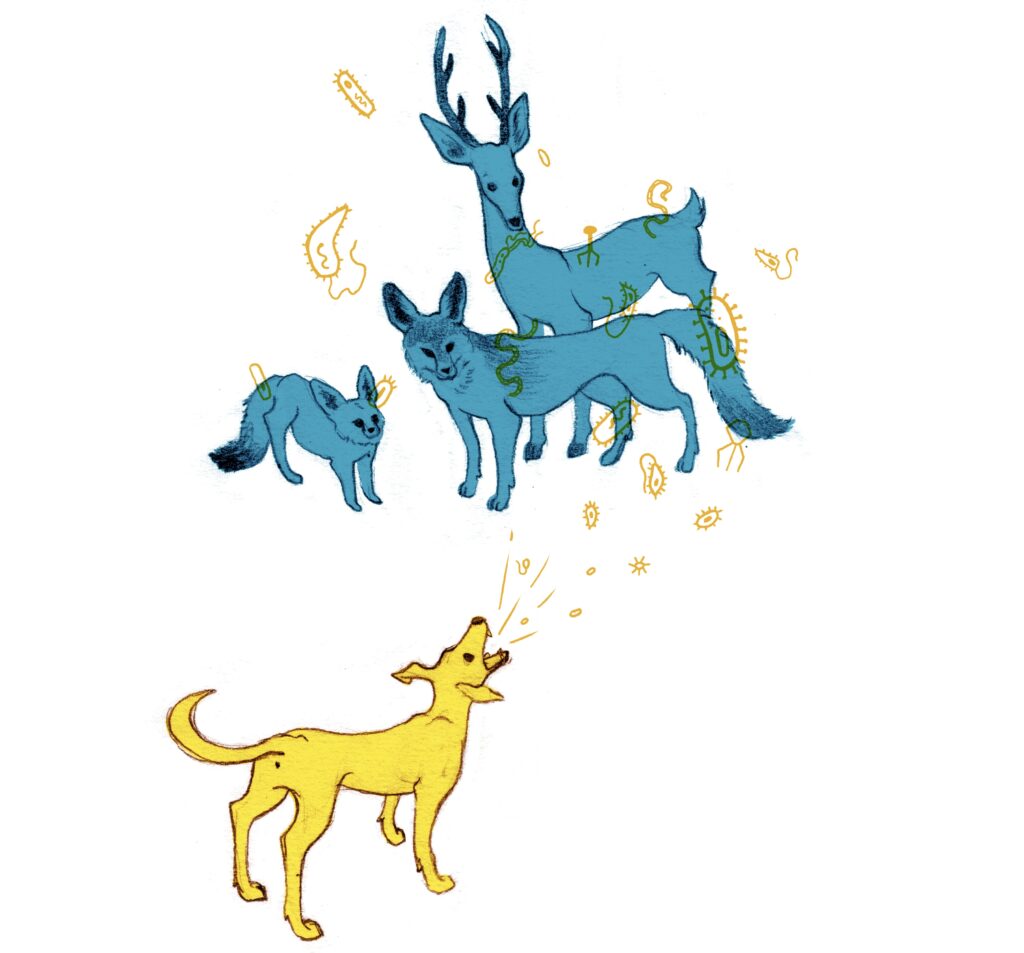
Lastly, dogs may act as reservoir hosts of dangerous, highly contagious diseases, most notably rabies, canine parvovirus, and canine distemper, increasing the chances of transmission to wildlife. For example, in a particularly high profile case, the lion population in the Serengeti dropped by around 30 percent between 1993–94 after an outbreak of canine distemper that was attributed to transmission from domestic dogs.
The Indian context
India hosts one of the largest dog populations in the world, of which a majority is and has historically been free-ranging—British complaints about ‘pariah’ dogs thronging the streets of colonial India are not difficult to find. Dogs are also more likely to be free-ranging in rural areas than urban areas, and India’s wealth of diverse wildlife is inevitably never too far away from a rural human settlement, given the size of our human population. Therefore, free-ranging dogs have and will continue to interact with wildlife near protected area boundaries.
Are dogs a problem for Indian wildlife, then?
The answer, it turns out, depends on the socio-ecological context. Despite the many ways in which dogs can potentially affect wildlife, studies abroad have found that dogs might pose anything from a dire threat to no threat, depending on the ecology of the wild species in question, density of the dog population in the area, and level of care and food the dogs receive. In the Americas, for example, dogs were found to pose no threat to the common, widespread white-tailed deer, but a potentially severe one to the vulnerable, restricted southern pudu (a small South American deer), as they were encouraged by their owners to kill wildlife. The case studies that are so detrimental to dogs’ ecological reputation are from relatively limited literature when compared to similar research that exists for, say, feral cats. There is sizable scope for studies that go beyond merely identifying impacts to investigating their severity and persistence, with explicit reference to local ecological context.
In India, published research that quantifies the impact of dogs on wildlife is mainly from two landscapes: the Trans-Himalayan mountains (specifically Spiti and Ladakh) and the grasslands of Maharashtra. In the Trans-Himalayas, food availability fluctuates seasonally—restaurants and hotels open in summer to cater to tourists and close in the harsh winters, leaving free-ranging dogs with no alternative food sources. In their search for food, dogs have been documented to form large feral packs, attacking and killing endangered wildlife, valuable livestock, and even humans. They remain a persistent threat in this landscape.
In Maharashtra, studies near the Great Indian Bustard Sanctuary found that dogs influence which parts of the landscape Indian foxes use, as well as how vigilant the foxes are while foraging, potentially increasing the energy cost of foraging. One disease-focused study also found that canine distemper virus, parvovirus, and adenovirus are all enzootic (self-sustained) in dog populations in the area. Indian foxes, on the other hand, were somewhat susceptible to parvovirus and adenovirus, and highly susceptible to canine distemper virus, with high rates of mortality. Dogs could therefore play a role in transmitting these diseases to foxes in the area.
Additionally, a large-scale survey-based study on domestic dog attacks on wildlife in India found that dogs have attacked 80 wild species across the country, with most of these incidents occurring near protected areas.
However, we still have very few multidimensional studies that focus on other landscapes in India. While dogs are certainly likely to negatively impact wildlife, a much larger foundation of scientific evidence about how exactly they affect specific ecosystems or species is sorely needed to evaluate the overall risk that they pose to Indian wildlife.
Management woes
Dog management in wildlife adjacent areas is complex, not only because of the range of ecological issues—from predation and disease to hybridisation—that must be addressed, but because of the socioecological context of dog keeping as well. Different cultures have vastly different attitudes towards dogs and dog keeping practices.
In most Western cultures, for instance, dogs are either pets or working dogs, and are the property of their owner. As strays exist outside this boundary, they can be euthanised as a matter of course, depending on local laws. In these countries, wildlife-related dog management includes policies such as compulsory leashing near sensitive wildlife areas, specific dog-friendly trails in national parks, or restricting dogs to human-use areas like camping grounds or visitor centres. Where trained dogs are used for hunting, the extent to which they are involved (only chasing versus actually killing) is usually regulated for humane reasons. In such cases, managing dog impacts on wildlife can be done by targeting the dog’s owner—for example, implementing educational programmes to facilitate behavioural change of the owner.
On the other hand, free-ranging dogs that belong to no one (feral dogs), everyone (community/village dogs), or even to a single owner, are widespread and particularly abundant in developing countries. Such dogs can sometimes fall under multiple of these categories, and pose a much more nuanced—and therefore difficult—problem to solve. On an individual level, with respect to owned free-ranging dogs, many people like having a loyal, furry friend around; a farmer or jeep driver or shopkeeper from a village near a protected area can certainly love their dogs just as much as someone in a metropolitan city apartment.
Dog keeping can also be a matter of survival, since dogs in rural areas are usually kept to herd and protect livestock, chase crop-raiding wildlife away from farms, or alert their owner to the presence of wildlife near homes. In this role, they may help reduce human-wildlife conflict by averting incidents of livestock lifting, crop loss or even human death. Does this balance out the increased presence of wild predators that come to prey on dogs? We don’t know, but the bottom line is that simply telling people living near protected areas not to keep dogs, or even to keep their dogs permanently caged or leashed, is not a viable solution to dog-wildlife issues when free-ranging dogs help protect people’s families and livelihoods.
On a broader level, emotions tend to run high when dog management is discussed. Though Indian laws only allow Animal Birth Control (ABC) or surgical sterilisation as a legal form of population control, “We should just kill all the dogs!” is repeated vehemently and often in conservation circles. While there is assuredly good reason to say that dogs should be removed from wildlife-sensitive areas with endangered species, and humane euthanasia should remain an option in the absence of any others, culling is not sustainable in the long term and will increase the rate of population turnover as adult dogs are removed. As the proportion of young increases, and dogs from nearby populations move in, the spread of disease can increase because contagious diseases are often more prevalent in younger animals and immigrating dogs may carry new pathogens. This is not only a risk to dogs and wildlife, but an issue of public health for humans, especially in an India burdened by a high rabies caseload.
What then is a solution? People concerned for animal welfare, whether conservationists or not, usually advocate for ABC and vaccination programmes, but these require effort, personnel facilities, and long-term funding to be even slightly effective. These resources are not easily accessible in rural India. The issue remains a bitterly contested one with no easy answers, and suggestions from scientists can be overshadowed by public perception of which side of the issue they land on.
Sniffing out coexistence
Unaware of the political nature of his existence, Biscuit trots ahead as we step out for breakfast. On the way, he barks at langurs, chasing them up trees, before returning to me with a proudly wagging tail. Last week, a friend at the field station showed me a photo of a dead langur, the corpse covered with flies. “Killed by that pack of black dogs,” he said. I know that pack, and I know they’re owned. Though they too accept the occasional biscuit and pat on the head, they’re overall fiercer and hardier than Biscuit; perhaps understandably, since that household has lost multiple dogs to leopards. The ones that remain do their job, guarding their owner’s cattle, just as Biscuit does his job as self-appointed guardian of my doorstep.
If they see other animals, they chase. If they catch them, they might kill. The outcome is the same, whether they go to the wildlife or the wildlife come to them—both can happen, at these porous village-forest boundaries. Indeed, I would later analyse my GPS collar data to find that owned free-ranging dogs spent 96 percent of their time in human settlements or agricultural fields, with about 98 percent of data points being within 500 metres of the owner’s home. And yet Mudumalai Tiger Reserve has previously been in the press for reports of dogs chasing wild animals. Do you then blame the dog for chasing the deer it sees near its home, the deer for avoiding natural predators by approaching village boundaries, or the humans for building their settlements in the middle of a forest and bringing their dogs with them?
Regardless of whether we see them as affectionate, indispensable companions, or a nuisance and menace to humans and wildlife, the dogs themselves are ultimately just doing what dogs do. It’s up to us to research dog ecology—from movement and disease to behaviour and diet—in the context of natural ecosystems. Learning more about this interface is the only way to eventually be able to implement effective, sustainable management strategies that benefit all the species involved, whether wild or domestic.
Further Reading
Gompper, M. E. 2014. Free-ranging dogs and wildlife conservation. New York: Oxford University Press.
Gompper, M. E. 2021. Adding nuance to our understanding of dog–wildlife interactions and the need for management. Integrative and Comparative Biology 61(1): 93–102. https://doi.org/10.1093/icb/icab049.
Young, J. K., K. A. Olson, R. P. Reading, S. Amgalanbaatar, and J. Berger. 2011. Is wildlife going to the dogs? Impacts of feral and free-roaming dogs on wildlife populations. BioScience 61(2):125–132. https://doi.org/10.1525/bio.2011.61.2.7.