Are names just words? As children, most of us would have wondered why certain things are called what they are called. Why is a cat called a cat? Or a crow a crow? We are given names, we use names to refer to people, animals, and all kinds of objects—even creating new names for things that catch our fancy. Names can reflect the values of our ancestors, as well as the cultures and societies they were a part of. The process of naming varies across communities and changes over time and over space. Thus, names serve a range of purposes—to identify, to describe, to indicate, to honour, and to value.
There is a saying in Kerala: Kadalile meenu arayanitta peru (fish in the sea are named by the fisher). Our project as part of the Coexistence Fellowship—jointly run by the University of Trans-Disciplinary Health Sciences and Technology (TDU) and the Coexistence Consortium—was to document the traditional ecological knowledge of fishers in Thrissur and Kollam in Kerala. We came across various local names for flora and fauna and learned their origins. How fishers name species has changed over time and across different locations. Here, we focus on a marine mammal group that is occasionally sighted along Kerala’s coast: whales.
The common Malayalam word for whale is thimingalam, derived from the Sanskrit word timiṅgila, which refers to a large fish. But what did this name signify to fishers? Oil, meat, blubber? Or is there another narrative? We collected stories and experiences of traditional fishers with whales, their ecological knowledge, the different names they use for thimingalam, and how each one points to a distinct relationship with the whale—as a father, a child, and an elephant.
Kadalachan
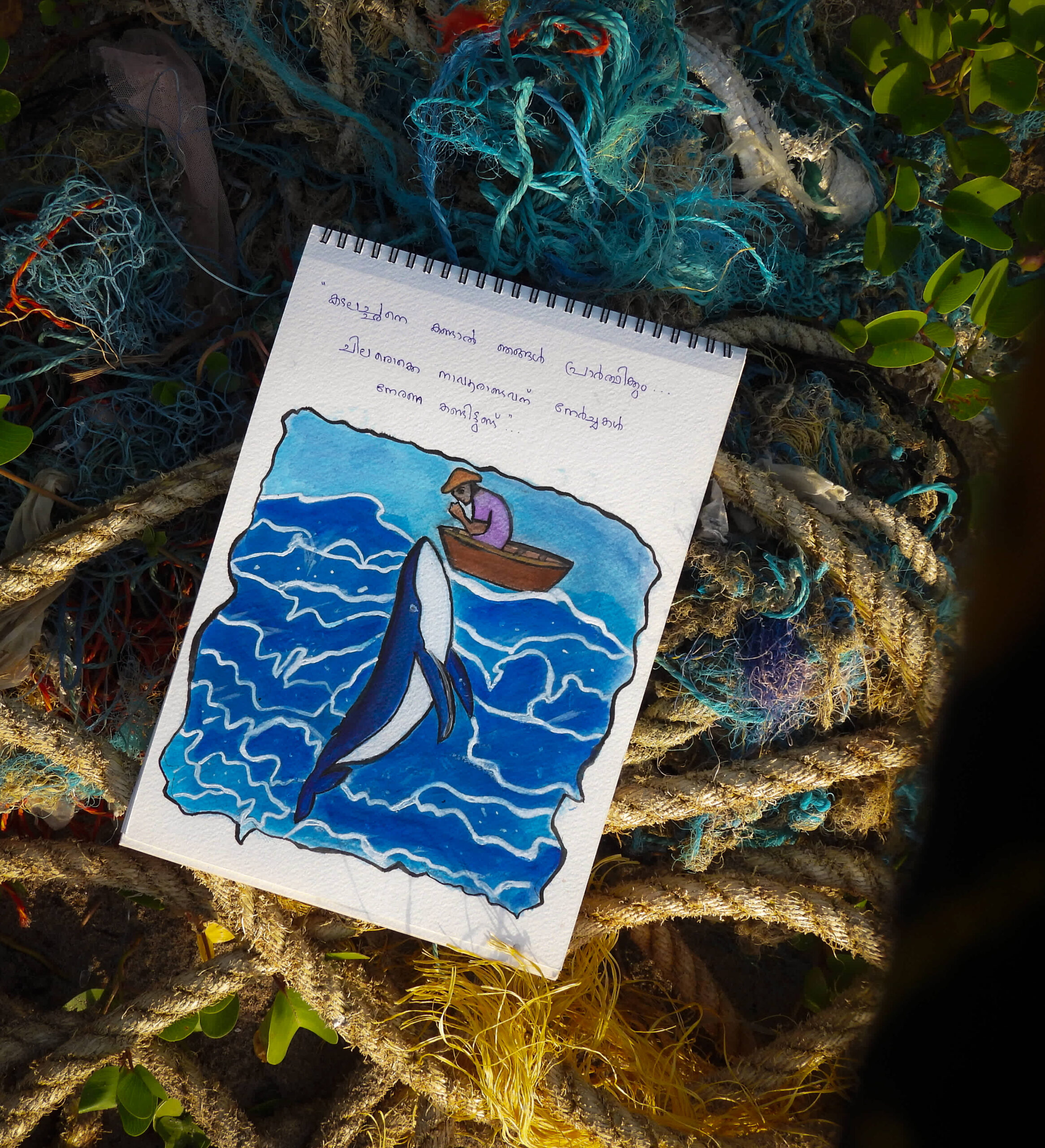
The concept of the sea as a mother is deeply embedded in many fishing communities. They refer to her as ‘Kadalamma’ and see themselves as the children of the sea. If the sea is the mother, then for some fishers, the whale is ‘Kadalachan’, the sea father. Hence, they hold the whale in high regard.
Some fishers silently acknowledge its presence, a few pray to it, and some even make offerings to temples when they see one during a fishing trip. They often remark, “The father of the sea is guiding the fish towards the coast to help us.” A belief that explains the respectful interactions that fishers have with whales. For them, Kadalachan represents strength, guidance, and devotion. The term also encapsulates the belief that a father will not harm a child and vice versa; hence we coexist.
Chellapillai
Amongst some traditional fishers, the roles attributed to the father and child are reversed: the fisherman becomes the father, and the whale becomes the child. For instance, in the southern part of Kerala many fishers use the term, ‘Chellapillai’ which means ‘dearest child’. It is quite ironic to call the whale, one of the largest animals on Earth, a small baby! They believe that whales are as harmless as a small baby, and that they seem to be crying, smiling, or singing.

For the fishers, this majestic creature conjures up feelings of overwhelming joy and love, and creates an innate desire to protect them. Often, they regard the whale as a childish soul trapped in a gigantic body and the name brings together the concepts of parenthood and protection.
Kadalaana
During our time at school, we once heard that a whale had washed ashore at the beach and we wanted to see it. Until that point, the largest animal that we had ever seen was the elephant. We were in for a surprise when we reached the beach. What we saw was a different type of giant—our teacher said that its tongue alone weighed as much as an elephant.
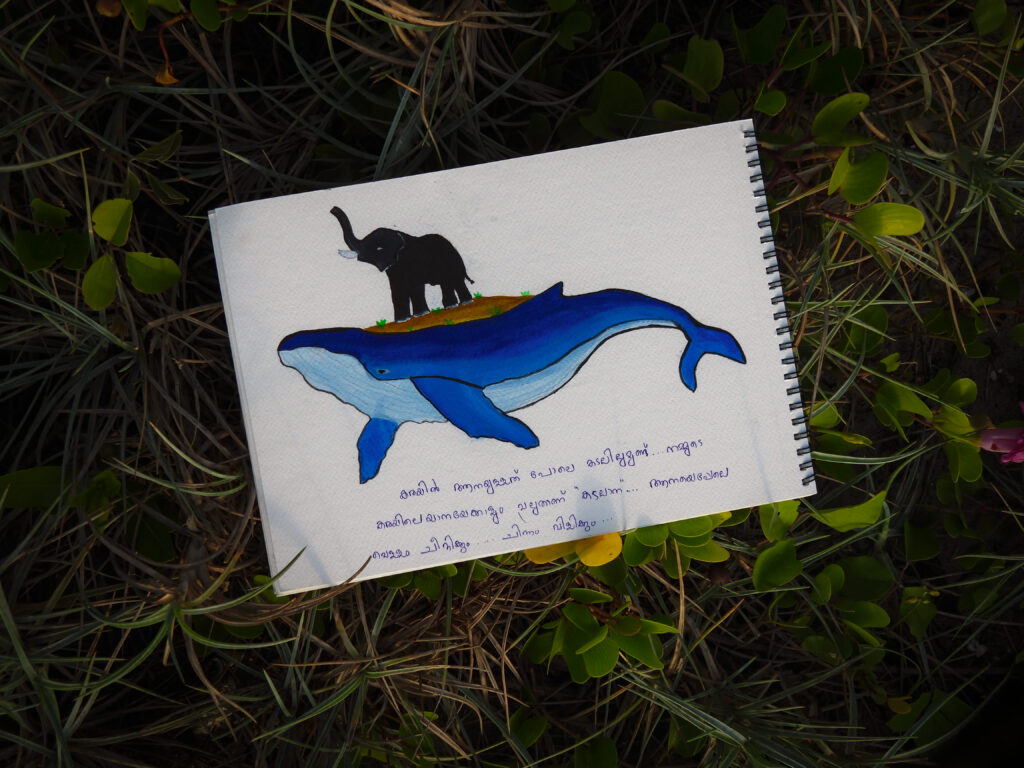
With its massive size, the way it spouts water, and its trumpeting sounds, the name ‘Kadalaana’ or ‘elephant of the sea’ seemed fitting. Even though they were large creatures, they, like elephants, were considered to be graceful and gentle. For the fisher community, the whale was Kadalaana.
Why do whales matter?
The well-being of whales is the well-being of the ocean. Right from birth to decades after death, whales play a vital role in maintaining the health of marine ecosystems. When, after feeding in the deep ocean, they move to the surface to breathe, they transport nutrient-rich materials from the depths. And at the surface, they release waste that is also rich in nutrients. This cycle, known as the ‘whale pump’, helps promote the growth of phytoplankton.
And there is whale fall: when they die and sink to the ocean floor, their bodies become a rich habitat for diverse kinds of organisms, from worms to sharks, and they also act as a long-term carbon sink for centuries.
India became a member of the International Whaling Commission in 1981 and has been an active participant ever since. Whales are listed under Schedule I of the Wildlife (Protection) Act, which affords them the highest level of legal protection in the country. In the realm of marine conservation, whales are regarded as flagship species because of their ability to evoke deep emotional and socio-cultural responses.
In a community-based participatory approach to conservation, it is important to recognise both their ecological and socio-cultural significance. Names such as Kadalachan, Chellapillai, and Kadalaana reflect the traditional reverence for whales. Their size, intelligence, and majestic presence make whales an integral part of the community’s imagination, long before modern ideas of conservation or flagship species were introduced.
Lost history
Fishers pointed out that many fish have disappeared from the waters. However, when they explain this, they use old names that scientists, authorities, and conservationists do not recognise. This poses a conservation challenge because how can we protect a species when we don’t even know it’s gone! And so, preserving local names and their origins becomes important for researchers. As renowned British nature writer Robert Macfarlane explains: “Names—good names, well used—can help us see, and they help us care. We find it hard to love what we cannot give a name to. And what we do not love we will not save.”
Names are an expression of culture, a complex concept that includes shared beliefs, values, traditions, and behaviours. They have the ability to shape how a person thinks, behaves, and views the world. The animistic belief systems held by local communities are a way of feeling and experiencing the nature around them. This may be rooted in emotion, but in conservation practice, emotions are important, and values are significant.
Through the different names of the whale that symbolise father, child, and elephant, we can see a certain way of understanding human-wildlife coexistence. Few people are aware that whales exist along the coast of Kerala, and among them, only a handful are aware of the local names. In a rapidly changing world, local knowledge, stories, songs, and names truly matter!
Further Reading
Kumar, A. B. and R. Anitha. 2017. Traditional knowledge of fisher folk of Kollam district, Kerala on coastal and marine biodiversity and conservation. Journal of Traditional and Folk Practices 5(2): 37–49. https://doi.org/10.25173/jtfp.90.