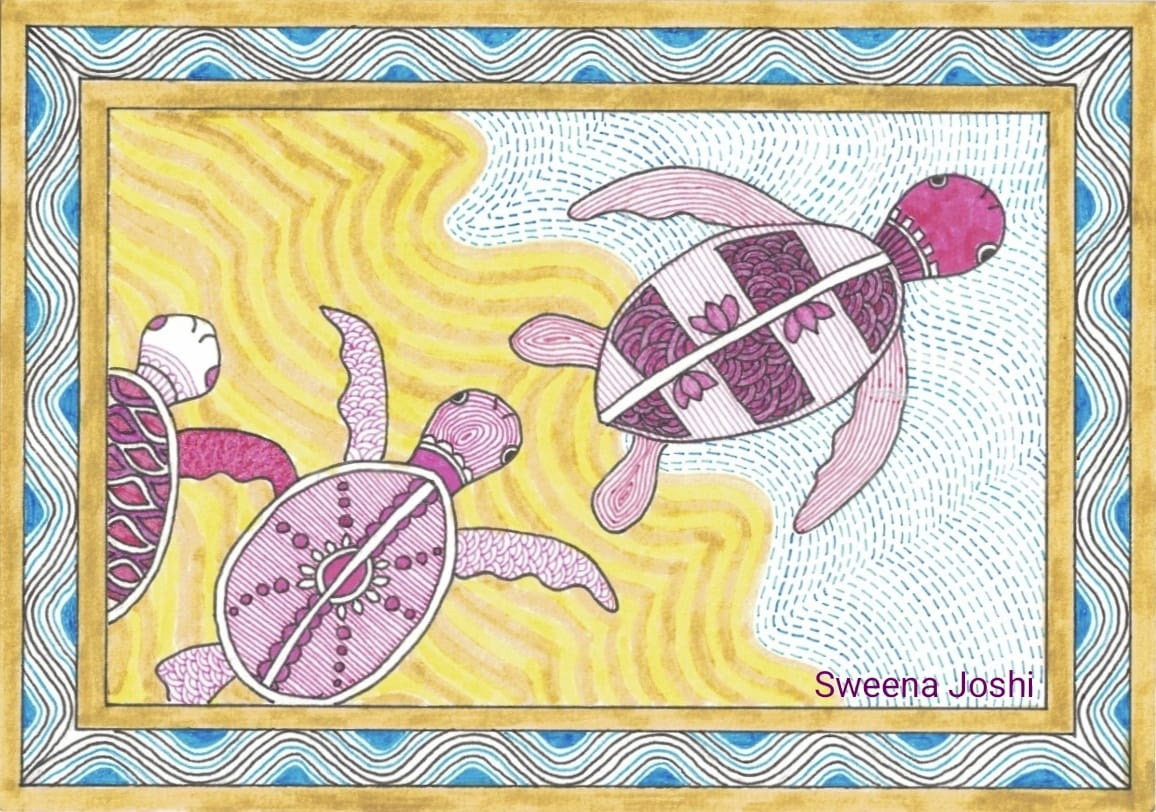
Sea turtles are reptiles that spend most of their life in the sea, but return to the shore to reproduce. They have a shelled body and flippers, helping them adapt to marine life.
Do you remember the father-son sea turtles Crush and Squirt cruising along the Eastern Australian Current in the Pixar movie Finding Nemo? Crush is the definition of ‘cool’ and offers sage advice to Marlin, claiming to be young at 150 years old. Squirt is the adorable and energetic turtle baby that stole our hearts. In real life, sea turtles are as cool and adventurous as Crush, but in many other ways. Let’s dive in to find out how.
1. There are seven different species of sea turtles
They are the leatherback, green, loggerhead, flatback, hawksbill, olive ridley, and Kemp’s ridley sea turtles.
The leatherback sea turtle has a leathery shell and is the largest sea turtle, reaching a length of 2 metres and a weight of 500 kg. That’s as heavy as a large bear or a small rhino!
The other six turtles have a hard shell. The Kemp’s ridley turtle is the smallest among the lot and grows up to 60 to 90 cm in length. A sea turtle cannot separate from its shell (unlike what you see in cartoons). The shell is part of its skeleton and is made up of more than 50 bones, including its ribs and spine.
2. Turtles cannot breathe underwater
Turtles breathe air like us and not through gills underwater. This means that they must return to the water’s surface regularly for air. However, they can hold their breath underwater for very long periods—up to 40 minutes while searching for food, and up to 7 hours while sleeping!
3. They shed tears to get rid of excess salt
Turtles need to maintain a hypotonic environment in their body—that means the amount of salt in their body must be lower than in the ocean water around them. Their kidneys are not capable of excreting such high amounts of salt from their body. Hence, special glands around their eyes, called lachrymal glands, help excrete the excess salt in the form of salty tears.
4. Turtles migrate long distances using an internal GPS
Turtles migrate large distances—over thousands of kilometres—each year, in search of food, mates, and for nesting. Thanks to a sense called magnetoreception, they are able to detect and use the Earth’s magnetic field as a natural compass, which allows them to reliably navigate in the open ocean against strong currents.
5. Female turtles nest on sandy beaches
Sea turtles spend their entire lives at sea, but females return to shore to lay eggs, usually at night. A female finds a sandy spot on the beach and uses her flippers to dig a hole about 50 cm deep. She then lays her soft-shelled eggs in this nest. The eggs are laid in a set called a clutch. Each clutch may have 100–200 eggs, depending on the species. She then refills the hole and uses her flippers to smooth the sand. She may also spread vegetation over the spot to camouflage the nesting site, after which she goes back to sea.
Females can return to the beach to lay more eggs, sometimes up to eight clutches in a season.
6. Hundreds and thousands of turtles synchronise their nesting
Kemp’s and olive ridley sea turtles arrive at beaches in large numbers, sometimes in the hundred thousands, to lay eggs communally. This spectacle is called arribada (meaning arrival in Spanish).
Another interesting phenomenon called natal homing means that females of certain turtle species undertake long journeys to lay their eggs at the same beach where they were born.
7. Turtle sex is determined by temperature
The eggs hatch within 60 days of being laid. The hatchlings are around 6 cm in length at birth. Warmer temperatures during nesting produce female babies, whereas cooler temperatures produce males. Climate change has led to warmer temperatures, leading to skewed sex ratios—more females than males.
8. Only one in a thousand turtles makes it to adulthood
Naturalists have found that of a thousand eggs that hatch, only one turtle reaches adulthood. As the hatchlings make their way from the nest to the ocean, they fall prey to birds and other animals. Even in the ocean, they are targeted by predatory fish. Harsh lights, sounds, and human activity at the beach endanger the eggs as well as the hatchlings as they make their way back to the ocean.
Human activity also endangers adult turtles. They are hunted for consumption and for their body parts (including shells) in many parts of the world. They also get entangled in nets meant for catching fish. Coastal redevelopment, pollution, and increased activity at the shore lead to habitat loss and threaten their survival.
The IUCN Red List, which determines a species’ conservation status, classifies loggerhead, olive ridley, and leatherback turtles as Vulnerable; green turtles as Endangered; and the Kemp’s ridley and hawksbill as Critically Endangered (the most severe category for a living species).
Turtle conservation projects around the world focus on demarcating exclusive hatchery zones to provide undisturbed nesting for turtles during nesting season. Efforts are also being undertaken to reduce unnecessary human activities, pollution, and illegal fishing that harm turtle numbers. We can each contribute in our own small ways—raise awareness and be a responsible turtle warrior.