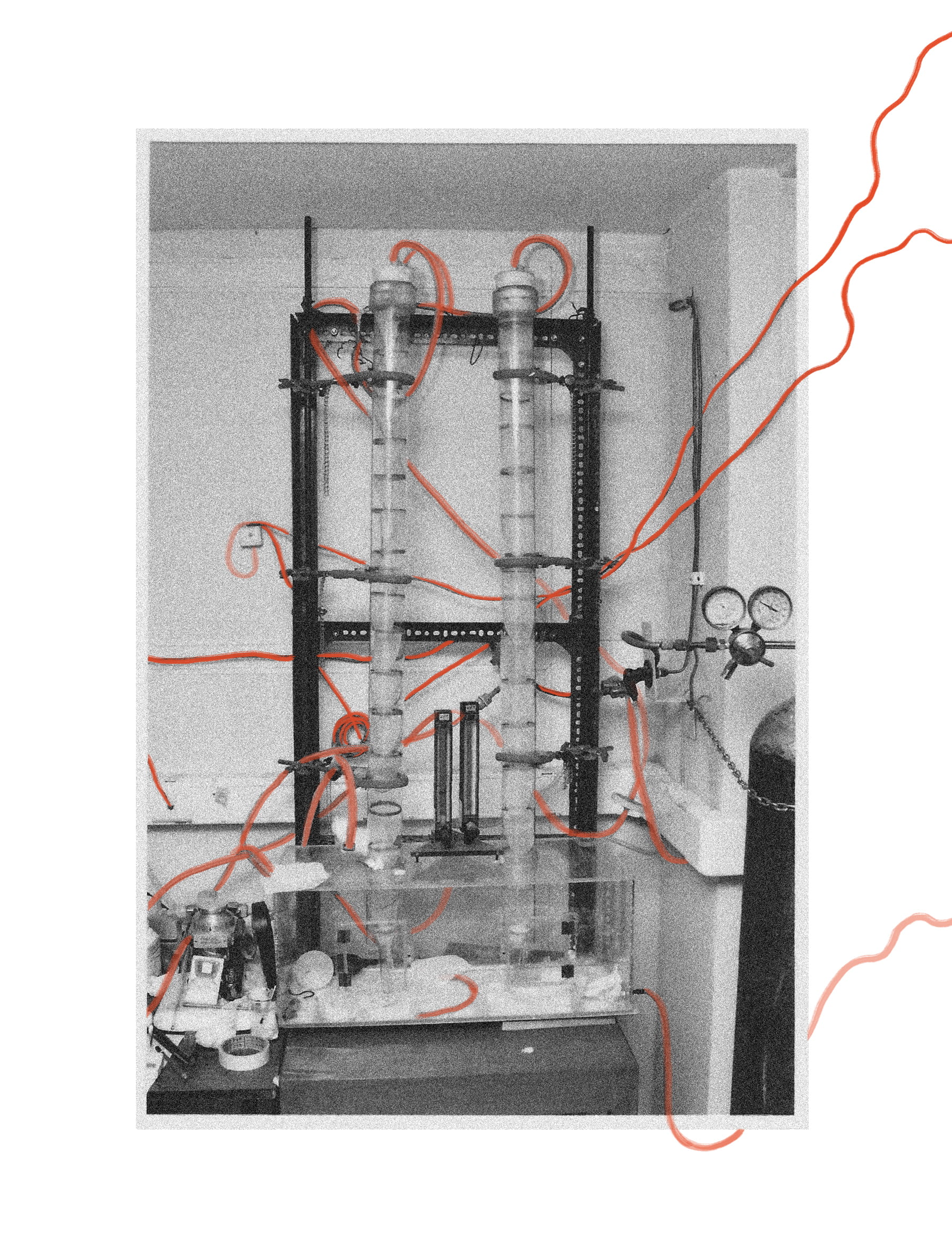
Featured image: An inebriometer housed within the Archives at NCBS
In the Archives at the National Centre for Biological Sciences, in Bengaluru, India, I recently came across an apparatus made up of a pair of graduated glass columns, with coloured pipes running here and there—it had an ad hoc aesthetic, and on enquiring, I was told that it was an ‘inebriometer’. I felt compelled to look up what this strange fitting was doing in an otherwise sober archive of science. In the process, I discovered how tiny fruit flies have contributed to our understanding of a series of interconnected questions about the different levels of brain functioning. For example, what happens when an organism is intoxicated, anaesthetised or sleeping versus irrevocably dead?
But first, a bottled history of science and the fruit fly. If geneticists had to choose a totem animal, the tiny Drosophila melanogaster would probably top their list. D. melanogaster is one of the 12 species of fruit flies in the world. All of them are widespread human commensals that mostly feed on overripe or decaying fruits and vegetables. Despite these uncharismatic traits, scientists have spent not just hours but centuries studying D. melanogaster, beginning with T. H. Morgan in 1909. In fact, an entire journal, Drosophila Information Service, was created in 1934 to promote the exchange of research-related information on this singular insect and it continues to remain in print.
There are several reasons for this scientific fascination with Drosophila. Fruit flies are tiny insects that can be sustained on overripe bananas or tomatoes. This makes them easy to maintain in large colonies that can be housed in typical laboratory glassware, and they are also easily anaesthetised. The entire cycle from egg to sexual maturity takes around 10 days and adult females can lay hundreds of eggs. Hence, several generations of fruit flies can be studied within the span of a few months. This is especially useful for studies tracing heritable versus non-heritable characteristics. And finally, in an odd twist of convergent evolution, the Drosophila genome, although it contains just four pairs of chromosomes, bears genes that closely resemble several human genes. The molecular makeup of its central nervous system too is remarkably similar (or even identical in some cases) to that of humans.
Hence, experimental studies on fruit flies have played a major role in shaping our understanding of how human sensory systems (touch, vision, smell, etc.) function, as well as human health problems such as cardiac and mental illnesses, obesity and ageing. In fact, studies of Drosophila have made such significant contributions to the domains of physiology and medicine that they have garnered the Nobel Prize six times so far: in 1933 (genetic regulation), 1946 (mutagenesis), 1995 (embryonic development), 2004 (olfactory mechanisms), 2011 (innate immunity), and 2017 (circadian rhythms).
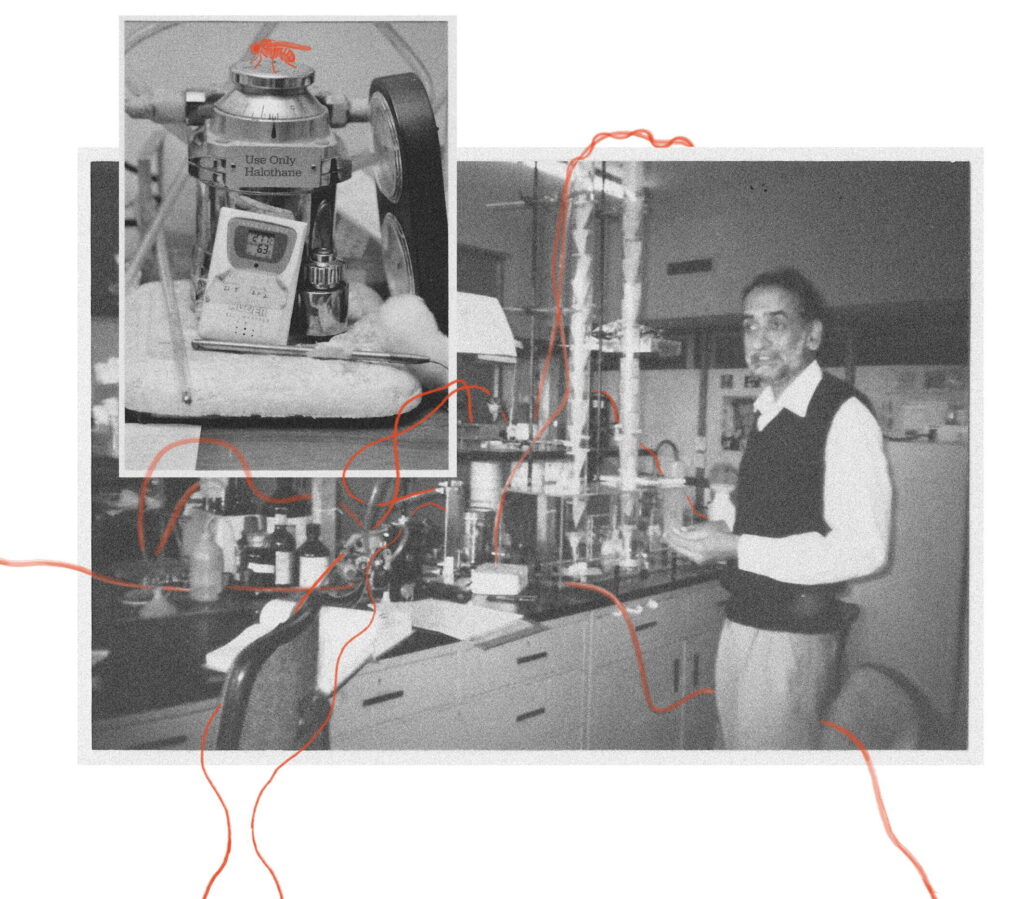
To return to the inebriometer, it was put together in 1988 by a graduate student named Kurt Weber, who aimed to study the effect of alcohol on fruit flies. However, the apparatus that caught my eye was a version that had been redesigned by the molecular biologist K. S. Krishnan to study how fruit flies responded to a gaseous anaesthetic, halothane. Although halothane had been in use since 1956, the genetic and molecular pathways through which it triggered a ‘reversible loss of consciousness’ were largely a mystery.
In fact, similar to Drosophila, scientific interest in anaesthetic compounds spans several centuries because their ability to ‘knock out’ an organism raises fascinating questions about states of consciousness, the functions of the brain, the connection between the brain and sense organs etc. For instance, far back in the 1860s, Charles Darwin used different anaesthetic compounds on plants to explore how plants sense and respond to their environment, even though they don’t have a brain or nervous system the way animals do.
Many of his studies involved administering chloroform to a Venus flytrap (Dionaea muscipula) to study how its sensitivity to touch was affected. The flytrap is an insectivorous plant with hairy leaves. As soon as an insect lands on these hairy leaves, the plant immobilises and consumes the insect by immediately snapping its leaves shut and releasing digestive enzymes. Darwin was interested in how these leaf movements changed when he used different chemicals and varied the dosage—usually rendering the flytrap’s sensitive triggers and leaves temporarily unresponsive, with recovery depending on the dose and duration of exposure. He eventually published a book in 1875 titled Insectivorous Plants, which became a bestseller for the time because it sold 1700 copies in the first edition.
In the case of animals too, anaesthetic compounds are able to create a state in which the organism is no longer awake, aware or responsive. However, this state is different from sleep because it is a disruption in how the brain normally functions. For example, certain reflexes are suppressed and the brain becomes static (it does not even show the typical cyclical activities associated with sleep). Most importantly, anaesthetics temporarily block the ability to feel pain and hence are widely used during surgical procedures. However, if the dosage of the anaesthetic is not gauged correctly, the animal can die.
Krishnan’s work then, seems to have brought these two hoary traditions together—the study of Drosophila and the study of anaesthetics. He was interested in uncovering the molecular and genetic pathways that determined how fruit flies responded to a commonly used anaesthetic, halothane. For this, he collaborated with geneticist Howard Nash from 1988 onwards. Using the modified inebriometer, they were able to identify the exact mutations that caused resistance to anaesthesia and prove that it was a heritable trait. It is through such painstaking work of numerous scientists that our knowledge of how to use anaesthesia to minimise pain during surgery has been built up. So the next time you hear of someone undergoing a root canal treatment or cardiac surgery, remember to give thanks the Drosophila, Dionaea, and other uncharismatic creatures that nevertheless improve the quality of human life.
Further Reading
Darwin Correspondence Project. https://www.darwinproject.ac.uk/letters/darwins-works-letters/insectivorous-plants. Accessed on July 20, 2026.
Krishnan, K. S. and H. A. Nash. 1990. A genetic study of the anesthetic response: mutants of Drosophila melanogaster altered in sensitivity to halothane. Proceedings of the National Academy of Sciences 87(21): 8632–8636.
Krishnan, K. S. 2011. Beginnings of neurogenetics in the Nash laboratory. Journal of Neurogenetics 25(3): 64–68.
Weber, K. E. 1988. An apparatus for measurement of resistance to gas-phase reagents. Drosophila Information Service 67: 90–92.