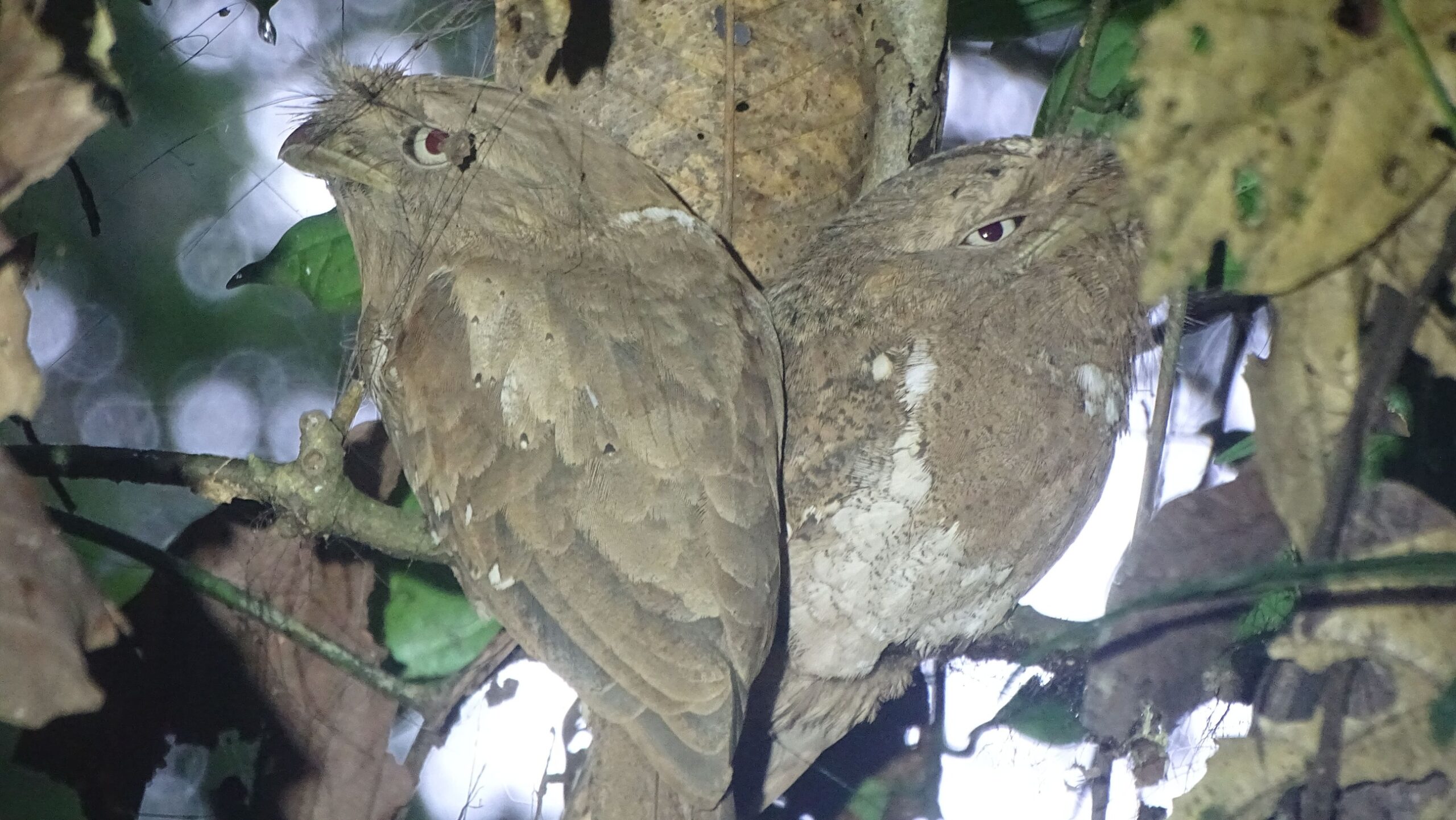
Feature image: A pair of Sri Lanka frogmouths (Photo credit: Preeti Swaminathan)
In a world of flashy peacocks and melodious bulbuls, the Sri Lanka frogmouth (Batrachostomus moniliger) plays a different game—it disappears.
If you have never seen one, you might mistake it for dried leaves fused to a branch. It’s a bird that doesn’t sing like a bird, doesn’t look like a bird, and often leaves even seasoned birders staring at tree trunks in vain. I was not looking for the Sri Lanka frogmouth when I first saw it at the Bhagwan Mahavir Wildlife Sanctuary in Goa. But like all accidental discoveries, it changed the way I look at forests—and at myself.
One morning in early December 2021, the forest was alive with the soft hum of cicadas and the smell of damp earth. I had come hoping to spot hornbills. But my guide, Adesh Shivkar, a seasoned birder and naturalist from Nature India Tours, suddenly paused mid-trail. He gestured silently toward a cluster of branches. “Look closely,” he whispered. “There’s someone watching us.”
At first, I saw nothing. Then two shapes materialised from the shadows—a pair of Sri Lanka frogmouths, roosting side by side, their feathers mimicking dried leaves so perfectly that even my binoculars struggled to separate the birds from the branch. Their half-lidded eyes blinked slowly, beaks curled slightly upwards in that permanent Mona Lisa smirk. They sat utterly still. I stared, enchanted. For the next ten minutes, nothing else in the forest mattered.
What makes the frogmouth so fascinating?
The Sri Lanka frogmouth is one of the most unusual nocturnal birds of the Indian subcontinent. Restricted to the Western Ghats and Sri Lanka, it belongs to a small and distinctive group of birds related to nightjars. For a long time, the species remained something of an enigma. Although scientifically described in the 19th century, it all but vanished from records for decades—largely because its call was unknown, making it extremely difficult to detect in dense rainforest.
Once its vocalisations were finally documented, ornithologists realised the bird had been present all along. Today, it is understood to be widespread in low and mid-elevation rainforests of the Western Ghats, though its secretive habits keep it largely out of sight.
What truly sets the frogmouth apart is its extraordinary appearance and behaviour. Cryptically patterned plumage allows it to blend seamlessly with tree bark, rendering it nearly invisible during the day. Individuals often roost singly or in pairs, perched upright and motionless for hours, relying on camouflage rather than escape to avoid detection. This odd, statuesque posture contributes to its reputation as one of the strangest-looking birds in the forest. At night, they become active, emitting soft, eerie chuckles that sound more like the forest laughing than a bird calling. Their diet consists mainly of flying insects, which are snatched silently under cover of darkness.
Interestingly, modern genetic studies have revealed that frogmouths and nightjars are part of a broader evolutionary group that also includes hummingbirds—an unexpected relationship that adds yet another layer of fascination to this remarkable bird.
They are, quite literally, shadows in the foliage.
Second glance
In December 2024, I travelled to the Thattekad Bird Sanctuary in Kerala, drawn by stories of resident frogmouths. Unlike the serendipity of my first sighting, this was a planned search. I had learned by then that seeing a frogmouth was not about walking fast or covering ground—it was about slowing down.
This time it was a team effort, led by Girish Chandran, son of the legendary local birder Sudha Chandran, whose sharp eyes and deep forest knowledge are part of Thattekad lore. Girish represents a growing group of skilled local guides at Thattekad who have become exceptionally adept at locating camouflaged frogmouths, much like forest guards in parts of Sri Lanka where the species is found. Alongside him was Mandar Khadilkar from Nature India Tours, another expert with a remarkable ability to spot birds that most observers would easily overlook.
They guided me through dense undergrowth, pointing out subtle clues—a tail feather barely twitching, a shape that looked too symmetrical to be just a leaf. We approached a thicket, eyes trained to spot patterns, not birds. And there they were again—a male and female roosting in a shady patch of bamboo. The female’s rufous plumage carried subtle white spots; the male was greyer, duller but equally dignified in stillness.
What struck me this time was not only the birds themselves, but the shrinking forest around them—a result of the steady expansion of human demands on the landscape, driven by resource use, development, and broader economic forces. The frogmouths remained as they always had, perfectly adapted to stillness and concealment. It was the world around them that had changed.
Camouflage for survival
The frogmouth’s greatest trick is its stillness. Evolution gave it feathers that mimic leaf patterns, but the bird completes the illusion by freezing—sometimes for hours—even mimicking the swaying of a branch in the wind.
But herein lies the problem. Although frogmouths are remarkably adaptable and often do well in degraded or fragmented secondary forests, their survival still depends on the availability of suitable roosting trees and adequate forest cover. When key roosting sites are lost to firewood collection or conversion to plantations, even exceptional camouflage is no longer enough.
In the Western Ghats, rapid development has sliced once-continuous forest corridors into isolated green patches. While this poses a broad challenge for wildlife across the region, species with specialised habitat requirements are particularly affected, as the loss and alteration of forest structure can reduce the availability of suitable roosting and nesting sites.
Why does this bird matter?
The Sri Lanka frogmouth may not be a tiger or a hornbill, but it is an indicator species. Its presence suggests a healthy insect population and a heterogeneous forest with sufficient structural diversity to support a wide range of species, even in disturbed areas. Protecting the frogmouth means protecting the intricate web of life it represents: the moths it feeds on, the trees it relies on for roosting, and the nocturnal forest systems that remain largely invisible to most human activity.
As birdwatching becomes increasingly popular in India, particularly at well-known sites such as Thattekad, the Sri Lanka frogmouth has emerged as a powerful focal point for curiosity and wonder. Encounters with this extraordinary bird often leave a lasting impression—turning a moment of wonder into something more sustained. Such experiences are possible because knowledge, access, and local expertise have grown over time, allowing people to connect meaningfully with a species that might otherwise remain unseen.
The conservation message here need not be one of restraint alone, but of thoughtful engagement. Responsible nature tourism, built on local expertise and genuine connection with a species, can strengthen the resolve to protect the forests these animals depend on.
On my last morning at Thattekad, I went back for a final look. The frogmouth pair was there, exactly where they had been the day before. I watched from a respectful distance—no camera, no checklist—just a moment of shared quiet.
As I left, I realised this was no longer just about birding. It was about paying attention to what we cannot always see, valuing the overlooked, and protecting habitats before they vanish—leaf, bird, and all.
Lessons from the frogmouth
What did I learn from my encounters?
Stillness reveals more than speed. In a world obsessed with checklists and sightings, the frogmouth teaches patience.
Not everything beautiful is loud. Some marvels prefer to exist quietly, beyond Instagram grids.
Conservation needs the same camouflage. It’s not always about grand gestures—it is about protecting undergrowth, respecting forest rhythms, and keeping tourism sustainable.
Quick facts: Sri Lanka frogmouth
- Scientific name: Batrachostomus moniliger
- Range: Western Ghats (India) and Sri Lanka
- Habitat: Tropical forests, dense primary and secondary forests
- Diet: Flying insects, moths, beetles
- Conservation status: Least Concern globally, but habitat-restricted
- Fun fact: Its ‘laughing’ call sounds like the forest giggling.
Further Reading
Prum, R., J. S. Berv, A. Dornburg, D. J. Field, J. P. Townsend, E. M. Lemmon and A. R. Lemmon. 2015. A comprehensive phylogeny of birds (Aves) using targeted next-generation DNA sequencing. Nature 526: 569–573. https://doi.org/10.1038/nature15697.
Subramanian, S. 2018. In quest of the frogmouth. Frontline. https://frontline.thehindu.com/environment/wild-life/in-quest-of-the-frogmouth/article23593576.ece. Accessed on January 16, 2026.