In the mist-wrapped hills of Mizoram, in northeastern India, where clouds rolled down into forests like tired travellers, people spoke in hushed voices of a strange creature. A spirit with the face of a child and eyes that contained oceans. They called it the Forest Spirit Munla.
Most had never seen him, and those who had had only caught a glimpse of those eyes. They said the eyes were shiny black, circled with a white outline—as if drawn by a child with chalk. Munla’s eyes had an expression of eternal astonishment, as if seeing the world for the first time, or of having seen far more and holding it all inside.
The spirit walked around at night, in such hushed steps that no one would know even if it was right behind them. They said it didn’t jump—it glided between treetops, as if floating. Those who saw it either fell to the ground and mumbled a soft prayer, or ran as fast as they possibly could. No one dared to say Munla’s name aloud, except for one.
Her name was Lalian, a nine-year-old Mizo girl with unmissable eyes, shaped like perfect almonds and hidden behind thick glasses. She was always covered in dirt from climbing anything even remotely climbable. Her dark hair, tangled like the vines on trees, often carried bits of the forest. With bubbling excitement, she listened closely to every story the villagers told about Munla. Then she would run home and tell her grandmother everything, who smiled as she pumped air into the earthen chula (stove).
“I will see it one day, Amma. I will ask him where all the animals went,” Lalian would say every day. It was no secret that the animals who once roamed the periphery of the village had slowly started to disappear. Lalian had heard over the radio about people, called poachers, taking them away. The only logical solution according to her was to speak to the forest spirit directly.
Lalian would try to stay awake each night, waiting for Munla, so she could ask for the whereabouts of the poachers and talk to them. They would obviously release the animals. It must be a misunderstanding that they had taken them, she thought. Slowly, her eyes would grow heavy with sleep, and she would wonder when the forest spirit would come to meet her.
And finally, it happened—on a full moon night.
Nocturnal spirit
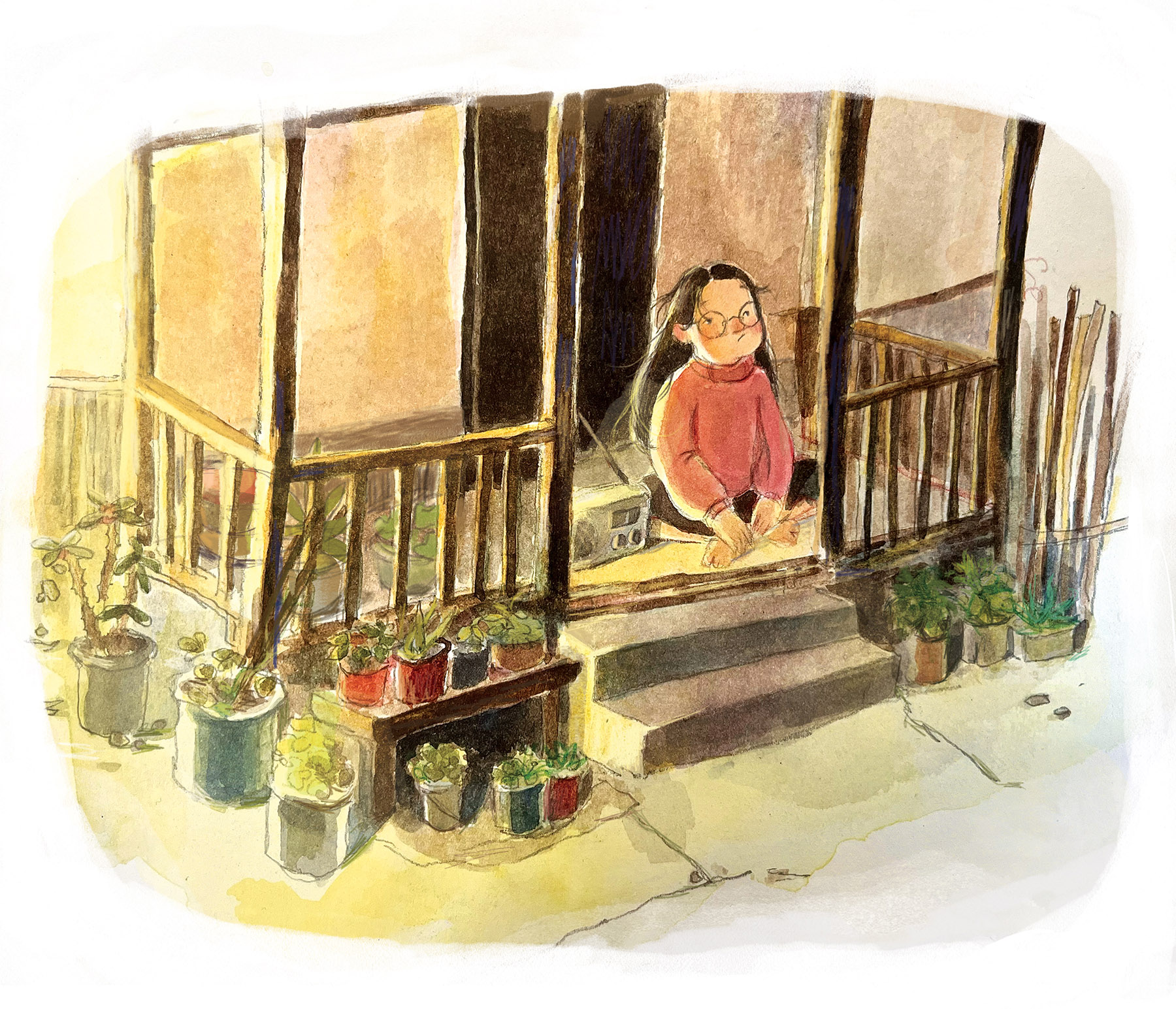
Lalian stood on her grandmother’s porch, looking into the forest as she often did. The night was still. No frogs. No crickets. Nothing. Just silence.
That’s when she saw it. The Forest Spirit.
Its slender body moved slowly from one treetop to another. It looked like it was flying, its fur brushing the leaves like feathers. Lalian didn’t think twice—she quietly followed.
She walked through the moss-covered trees, going deeper and deeper into the forest. The moonlight faded as the canopy thickened.
She slipped once. Maybe twice. She couldn’t remember. Her eyes were fixed on the forest spirit gliding above. At times, as the forest grew denser around her, she thought she had lost Munla—but then, soundlessly, it peered out from behind leaves. As if guiding her, as if saying, “You aren’t alone.”
The secret grove
After walking for what felt like an eternity, her rush of excitement began to fade. Tired, confused, and a little afraid, she crossed a creaking natural bridge fashioned from the living roots of trees and entered a clearing. A grove.
She was sure the spirit was gone. “Hello? Anyone here?” she called out. As if on cue, there was a movement in the shadows. The spirit slowly lowered itself from a tree in front of her. Lalian stared in amazement.
Munla stepped into the moonlight. Its body was covered in deep bluish-brown fur. It was on all fours, a long tail swishing slowly behind it. Then she saw its face. A round, haggard face covered in ashy fur. And the eyes. The same eyes from the stories. They looked sad, almost filled to the brim with something. What were they filled with? she wondered.
“Memories,” came the answer.
Lalian gasped. The spirit hadn’t spoken—but she had heard it. How? she thought. “You and I are connected, Lalian. Through this,” it said, gently touching the soil and raising its hand toward the trees. “And so are they.”
Suddenly, as if a fog had lifted, Lalian saw what she had only dreamed of.
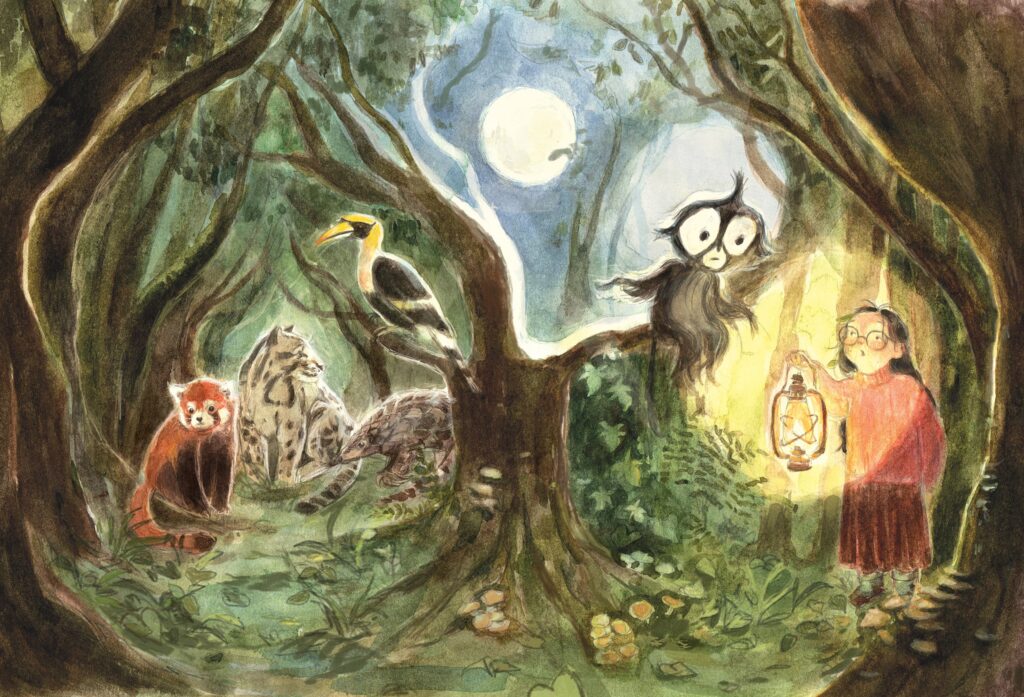
In the clearing behind the forest spirit lay a red panda, perched on a root, its eyes bright with thought. A hornbill, its beak glowing golden. A pangolin curled up and humming softly. Even a clouded leopard, shy but watching closely, its eyes reflecting stars. They weren’t afraid. They were waiting. Lalian pinched herself. But this wasn’t a dream.
“What is this place?” she asked. “This is the Grove of the Forgotten. Where the endangered dream, and the hunted find peace. Where stars listen,” said Munla. His lips didn’t move but his eyes spoke somehow. Lalian looked at all the faces of the creatures—the ones who were lost, the ones they were still losing. And she sobbed.
It felt like a sudden sadness had engulfed her—a sadness not of this life. The sadness of her ancestors, of these creatures. As if the forest itself was calling to her. “Why me?” she whispered. What could she do?
She looked at her small hands and clenched her tiny fists. She thought about fighting off poachers. She would protect these creatures. She had to. But the spirit smiled gently. “You don’t have to fight for us, Lalian,” its eyes said.
She looked deep into them. “Why me?” she asked again.
And the eyes answered: “You are the first human to witness this. Because you followed, not to take, but to know. You carry the seed of our story. You carry these memories, so we are never forgotten.”
As if on cue, the animals began to leave. One by one, they walked deeper into the forest. The spirit stepped into the shadows. They vanished, like mist at dawn. The last to leave was the pangolin. It paused by Lalian’s feet, tapped them gently. And disappeared.
The return
Lalian walked out of the forest as the first rays of sun lit the hills. No one believed her, of course.
Not the schoolmaster.
Not the forest officer.
Not even her mother.
But her grandmother smiled. “Ah. So you met him,” she said.
“You know him? He’s a forest spirit! Everyone was right!” Lalian couldn’t stop mumbling.
Still smiling, her grandmother opened an old, illustrated book The Mammals of the Northeast. She flipped the pages slowly. Then stopped. As if knowing exactly which page to stop at, a habit developed over years.
A pair of white outlined eyes stared back at Lalian from the page.
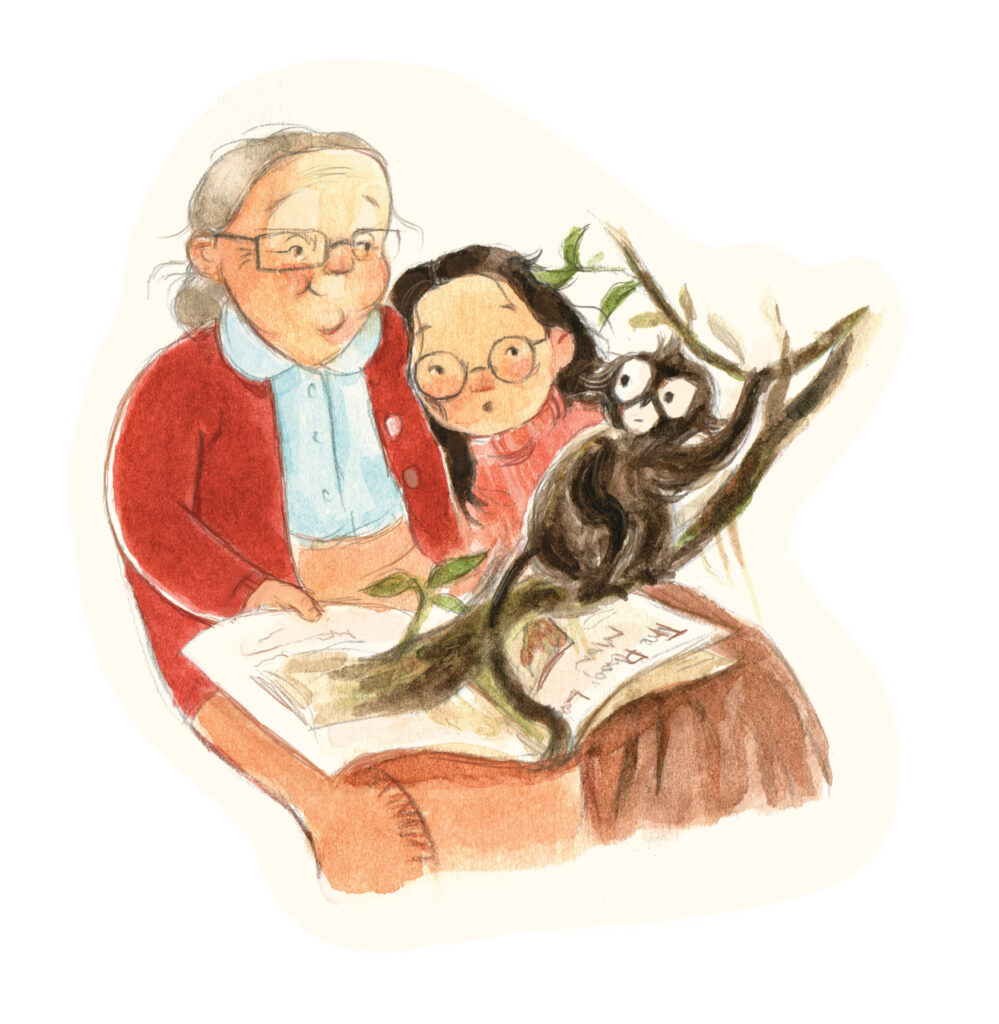
The page read, “Phayre’s leaf monkey: Known for its expressive, wide-rimmed eyes and elusive nature, this endangered monkey is most active at night and glides silently through the upper canopy.”
She read it again. And again. And again. And then she understood. Why her grandmother always smiled at the name Munla. She always knew.
It wasn’t a spirit after all. Just an endangered creature. Carrying the memories and sorrows of its forest friends in its eyes. Lalian never tried to find the grove again. Instead, she drew it. Painted it. Wrote about it.
In school. In books. In competitions.
She wrote about animals with starlight in their eyes and a forest that remembered. And slowly, people began to listen.
A wetland was protected.
A poacher’s trap was removed.
A girl in another village started a rescue centre for hornbills.
Lalian’s stories spread like seeds in the wind.
Years later
When Lalian was grown and her name was known, a small child once asked her, “Did the Phayre’s leaf monkey give you magic?” She smiled.
“No,” she replied. “The monkey didn’t give me magic. It gave me something much more important—a memory to hold onto.”
And far away, in the forest where trees whispered together in fog, a pale figure leapt between the branches—its eyes shining like two orbs containing oceans.