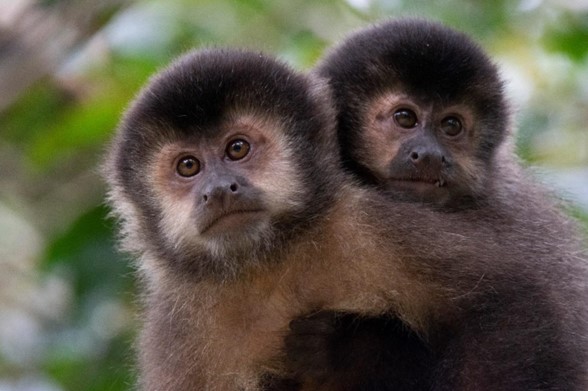
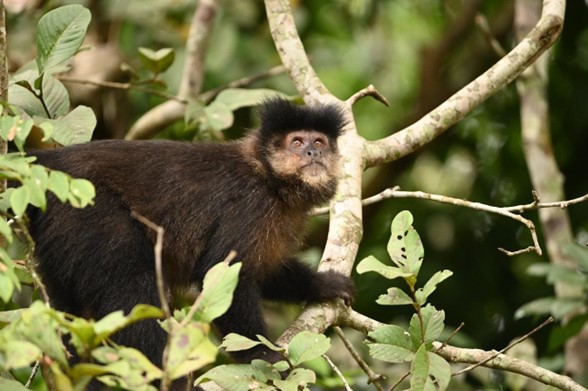
Feature image: Juvenile black capuchin monkeys in Iguazú National Park, Argentina (Photo credit: Stephanie Meredith)
What happens to wild primates when their native forests turn into commercial plantations? In northeastern Argentina, black capuchin monkeys (Sapajus nigritus) face that question every day. Their lush Atlantic Forest has been largely replaced by vast pine monocultures—orderly, quiet, and lacking much of the rich life that once filled the forest canopy.
Using GPS collars and field observations, we followed capuchin groups living either in native, continuous protected forests or in plantation-dominated landscapes. We studied how individuals move, where they rest, and how they find food across these contrasting environments.
What we discovered was both surprising and concerning.

Capuchins living in pine plantations traverse much more ground each day than those in protected forests. They need to travel far and wide to find enough food and shelter, moving through territories nearly three times larger than their counterparts. Yet most of their vital activities, such as eating, sleeping, and resting, still depend on the small remnants of native forest scattered throughout the sea of planted pines.
Just imagine the extra energy it takes to climb, jump, and hang while moving through the canopy across such vast distances, day after day! In fact, researchers have estimated that it takes up to twice as much energy to travel through the trees as it does to cover the same distance on the forest floor. But capuchins usually avoid travelling through the forest floor because it increases their vulnerability to predators such as wild cats and dogs, as well as to human presence in plantation areas. Staying in the canopy, though energetically costly, keeps them safer.
So although native forest fragments make up only a fifth of the plantation-dominated landscape, these scattered regions mean everything for the monkeys. In fact, 95 percent of all capuchin sleeping sites were found in these green islands.
But the story doesn’t end there. Our findings show that these resilient capuchins have learned to exploit the planted pine trees for food. They peel back the pine bark to eat the sugary tissues underneath, particularly during late winter and early spring, when the bark is softer and easier to remove, and the layer underneath is thicker. This allows them to gain more energy with less effort. This behaviour, known as ‘bark stripping’, can cause significant damage to the pine and leads to conflict with forestry companies.
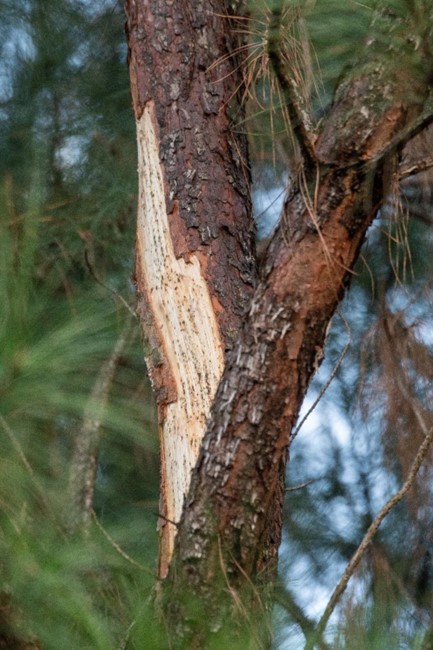
During the bark stripping season, we observed a shift in the monkeys’ movements: they began spending more time in pine stands—large expanses of pine trees—frequently using them as feeding grounds, and thus reducing their reliance on native forest fragments and corridors. This highlights just how adaptable capuchins can be, and how their survival strategies can lead to conflict with humans.
What’s happening in Argentina is part of a global story. Across the world, forestry plantations and other production landscapes are occupying increasing amounts of land, fragmenting habitats for many species. Nearly 60 primate species are known to occupy tree plantations, though many of them rely on nearby remnant forests to survive. The patterns we observed in capuchins mirror challenges faced by primates across the world—from Argentina to Borneo.
The message is clear: if we want wildlife to be able to persist in human-altered landscapes, we need to plan and design at the landscape level. Native forest fragments must be preserved, and connected by corridors, allowing wildlife to move between these protected areas. In order to support biodiversity and species conservation, the forestry industry and conservation scientists need to collaborate to create connected habitats, thereby reducing conflict and allowing for the survival of wildlife.
Further Reading
Zárate, V., I. Torge, M. P. Tujague, M. C. Baldovino, J. P. Arrabal, E. A. Vanderhoeven, I. Agostini and M. S. Di Bitetti. 2025. Movement ecology and conservation of capuchin monkeys in pine plantation landscapes. Biological Conservation 309: 111304. https://doi. org/10.1016/j.biocon.2025.111304.