Picture a leech, a tick, or a tapeworm. You probably flinched. Most people associate parasites with harm and disease. This is largely due to how parasites are depicted in the media, with mainly highly (human) pathogenic species causing problems making it to the spotlight. But the story is more complex than that.
A parasite is an animal, plant, fungus, single-celled organism, virus, or bacterium that causes some harm to another species in or on which it lives—the host—and which needs it to complete its life cycle. The host-parasite relationship can ecologically be classified as “antagonistic”, though in comparison to true predators (for example, a tiger) they typically only have a single victim in each life stage. About 99.9 percent of animal parasite species are found in/on wildlife, leaving humans and domesticated animals untouched. You can breathe a sigh of relief.
Most parasites don’t kill their hosts, as they rely on them. Many parasites are so well adapted to their host that they do not even cause disease. More often than not, it is in their best interest to keep the host alive. After all, the host means a house and a meal for the parasite. However, some parasites need to move to a new host to continue their life cycle and to do so some may let their current host—that served its purpose already—be eaten by the next host.
Bright side
In fact, parasites can be beneficial to host individuals, populations, and ecosystems. But since the ecological roles of parasites are complex, the benefits for one species can mean harm to another. Host individuals benefit from the exposure to parasites because this enhances the development of the immune system, and may reduce the risk of autoimmune diseases and mitigate the infection by other parasites. Also, some parasites such as spiny-headed worms remove heavy metals and other toxic pollutants from the host.
Parasites can regulate the growth of animal or plant populations. Without them, some populations might grow unchecked and disrupt the ecosystem balance. For example, the crab hacker barnacle (Sacculina carcini) surgically castrates the introduced European green crab (Carcinus maenas). This makes infected crabs infertile and unable to become “weedy”. However, the same parasite also reduces native populations of flatback mud crabs (Eurypanopeus depressus), affecting the ecosystem services these crabs provide.
Exotic species, which also unbalance ecosystems, are slowed or hampered by parasites when they arrive to new areas. For example, the blister rust (a parasitic fungus) affects the exotic white pine more severely than the native European pine. This prevented the exotic pine from North America from invading forests in Europe.
Parasites can also lead to the coexistence of different species. For example, normally the confused flour beetle (Tribolium confusum) is decimated by the red flour beetle (T. castaneum). But when a single-celled coccidian parasite infects them, the red flour beetle is debilitated and preys on fewer confused flour beetles. With the parasite in play, both beetles are able to share the same environment.
Certain parasites have the ability to manipulate host appearance and behaviour, favouring predation of infected hosts with consequences at ecosystem level. For example, infected crickets are induced by horsehair worms in their intestine to seek water and throw themselves in ponds and rivers. This allows the worm to swim away and complete its life cycle. Meanwhile, fish can enjoy a free “home delivered” cricket lunch. This forges a connection between terrestrial and freshwater food-webs, boosting the flow of energy through the ecosystem.
While parasites can deliver food, they can also be a food source themselves, with their mass sometimes exceeding that of free-living organisms. For example, crabs eat the larval stages of flukes (a group of flatworms), which are an important part of their diet.
Parasites can also be useful for science. Researchers can use parasites as indicators of environmental quality. For example, laboratory analysis of spiny-headed worms in fish can warn us about lead contamination in water. Parasites can be used as biological tags to reconstruct host population histories. For instance, the DNA of flukes revealed the migratory origins of populations of steelhead trout (Oncorhynchus mykiss irideus). And parasites can also be a potential source of medical compounds. For example, the anticoagulant hirudin was isolated from leeches.
Knock-on effects
If parasites disappear, we will also lose their important effects on host individuals, populations, and ecosystems, as well as their future use for research and medicine. Habitat loss, pollution, introduced or invasive species, and climate change are all threats to both free-living and parasitic organisms. In addition, parasites also face threats from the decline or extinction of their hosts. Many endangered species are those with a close relationship with another species, such as parasites and mutualists (including pollinators).
When available host individuals are scarce, transmission of parasites may not be sufficient to keep a viable parasite population. Two outcomes are then possible: switch to another host and thrive, or follow the host’s decline and eventually go extinct. Generalists and parasites needing a single host species for their entire lifecycle might be able to leave the sinking boat, but specialists and parasites needing multiple host species for different life stages are more likely to be doomed.
Parasite extinction may sound like good news for host individuals. But it is certainly bad news for populations and ecosystems. Think of the horsehair worm again: if it disappears, crickets would safely avoid water. A field experiment in Japan showed the cascading effects of this. With crickets out of the menu, fish started predating aquatic invertebrates. Because of the increased predation, aquatic invertebrates declined by two-thirds. Fewer invertebrates ate less algae. As a result, algae were able to proliferate. And so, the entire aquatic community was reorganised as a consequence of the missing horsehair worm!
About 3–5 percent of parasitic worms are estimated to become extinct in the next 50 years. These estimates might be optimistic, since they only consider known parasitic species. However, because of their tiny size and hidden lifestyle, many parasite species are yet to be discovered. It is extremely sad that some parasites may be forever lost before being found, described and named by parasitologists. Another sad truth is that even known parasite species are still not well understood. Most parasitic worm species that are scientifically described are never observed again or studied further. Information on their population size, geographical distribution, temporal trends, and host range is often missing. Therefore, the extinction risk of parasites is largely unknown and hard to quantify.
The conservation status of only two parasitic animals has been formally assessed for the IUCN Red List: the pygmy hog-sucking louse (Haematopinus oliveri) and the Manx Shearwater flea (Ceratophyllus fionnus), both of which are now classified as Critically Endangered. But about 40–70 percent of the 3–10 million estimated species on Earth are parasites, so we have a long road ahead of us!
New hope
Here is the good news: parasite conservation can start now and in great style! We can profit from the experience we gained so far from vertebrate conservation and avoid many mistakes. Also, we can couple parasite conservation with conservation of their hosts, saving resources and making conservation more effective and inclusive.
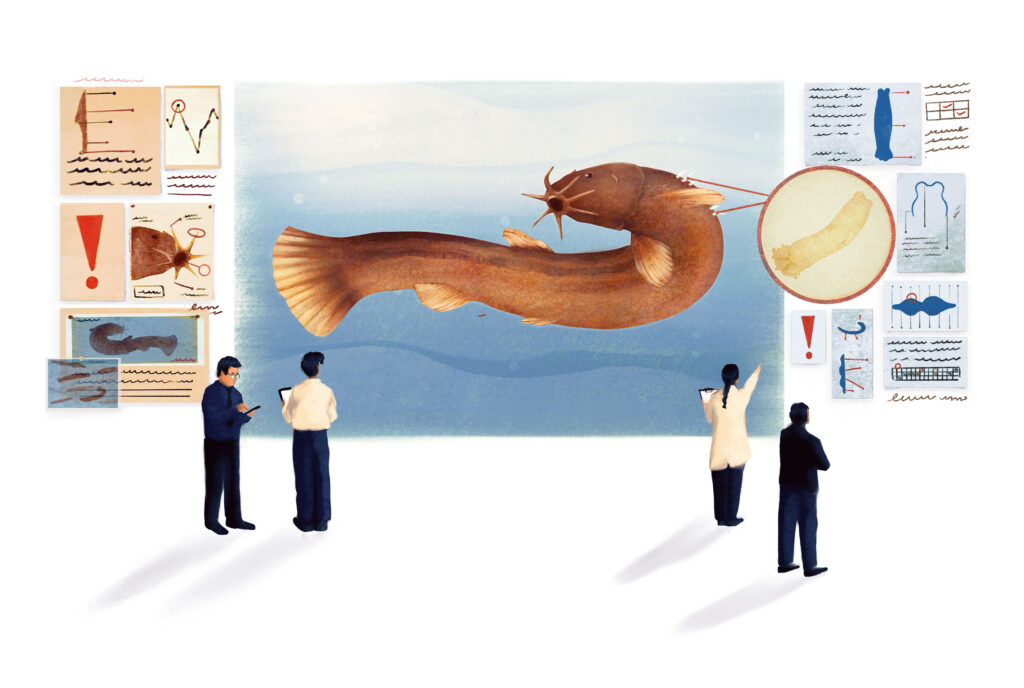
There’s an example of such co-conservation from Belgium. While breeding the endangered European weatherfish (Misgurnus fossilis) to release them back into the wild, three parasitic flatworms were found on their skin or gills. These flatworms were previously suggested to be endangered in Eastern Europe. When fish populations were kept under captive conditions imitating natural ones, the infection remained low and did not negatively affect the fish population. And since infection did not hamper fish conservation, the three potentially endangered flatworms were allowed to persist alongside their host. This was done simply by avoiding worm-killing treatments and providing fish with living conditions that avoid high numbers of parasites.
But while co-conservation is a reasonable win-win solution for endangered albeit harmless parasites, it will be more challenging to decide whether to conserve a pathogenic parasite of an endangered host. These cases need to be individually considered as there is no one-size-fits-all solution.
We need to take three necessary steps to advance parasite conservation. First, we need baseline data on the existence and occurrence of as many parasite species as possible. To assess extinction risk, we need to know whether a parasite is declining over time or across regions, and why. A Red List of threatened parasites will help determine and prioritise species for conservation. Second, collaboration with conservation experts should be encouraged. The above example illustrates an ongoing collaboration between parasitologists and fish conservation practitioners.
Third, we need to gain the support of the general public, which has been shown to positively influence conservation outcomes. Knowing how people perceive parasites would help us better communicate the importance of parasite conservation. The World Archives of Species Perception-Parasites (WASP-P) is an ongoing project that aims to understand what traits make a parasite species appealing, potentially choosing flagship species for initial public engagement, and to test whether public perception is linked to knowledge on parasites. The ultimate goal is to advise on how to switch from negative to positive perception by better communicating the critical role of parasites in the ecosystem.
And after reading this article, you will hopefully see beauty and value in these hidden creatures, knowing they are overlooked heroes.
Further Reading
Carlson, C. J., S. Hopkins, K. C. Bell, J.Doña, S. S. Godfrey, M. L. Kwak, K. D. Lafferty, M. L. Moir, K. A. Speer, G. Strona, M. Torchin and C. L. Wood. 200 A global parasite conservation plan. Biological Conservation 250:108596.
Truter, M., B. C. Schaeffner and N. J. Smit. 2025. Aquatic parasite conservation. In: Aquatic Parasitology: Ecological and Environmental Concepts and Implications of Marine and Freshwater Parasites (eds. Smit, N. J. and B. Sures). Pp. 325-360. Cham: Springer Nature Switzerland.
Wood, C. L. and P. T. Johnson. 2015. A world without parasites: Exploring the hidden ecology of infection. Frontiers in Ecology and the Environment 13(8): 425–434.