Islands are quite something. They are the picture-postcard image of a perfect holiday, the setting for marvelous films like Castaway and Madagascar, and more importantly, the inspiration for one of the greatest scientific breakthroughs in the world—the theory of evolution. However, it seems like apart from holidayers, moviemakers, and naturalists their allure is rarely appreciated.
Great Nicobar is a tropical island located in one of India’s seismically active zones. It is home to two historically isolated Indigenous communities (the Shompen and the Nicobarese) and teems with rare flora and fauna. 6.8° N, 93.86° E is where Galathea Bay is situated—one of the world’s largest nesting sites of the leatherback turtle and the coordinates deemed ideal by mainland India to plonk a massive transshipment port.
As Peter Wohlleben states in The Secret Network of Nature: “It’s important for us to realise that even small interventions in nature can have huge consequences, and we’d better keep our hands off anything that we have no pressing reason to touch.”
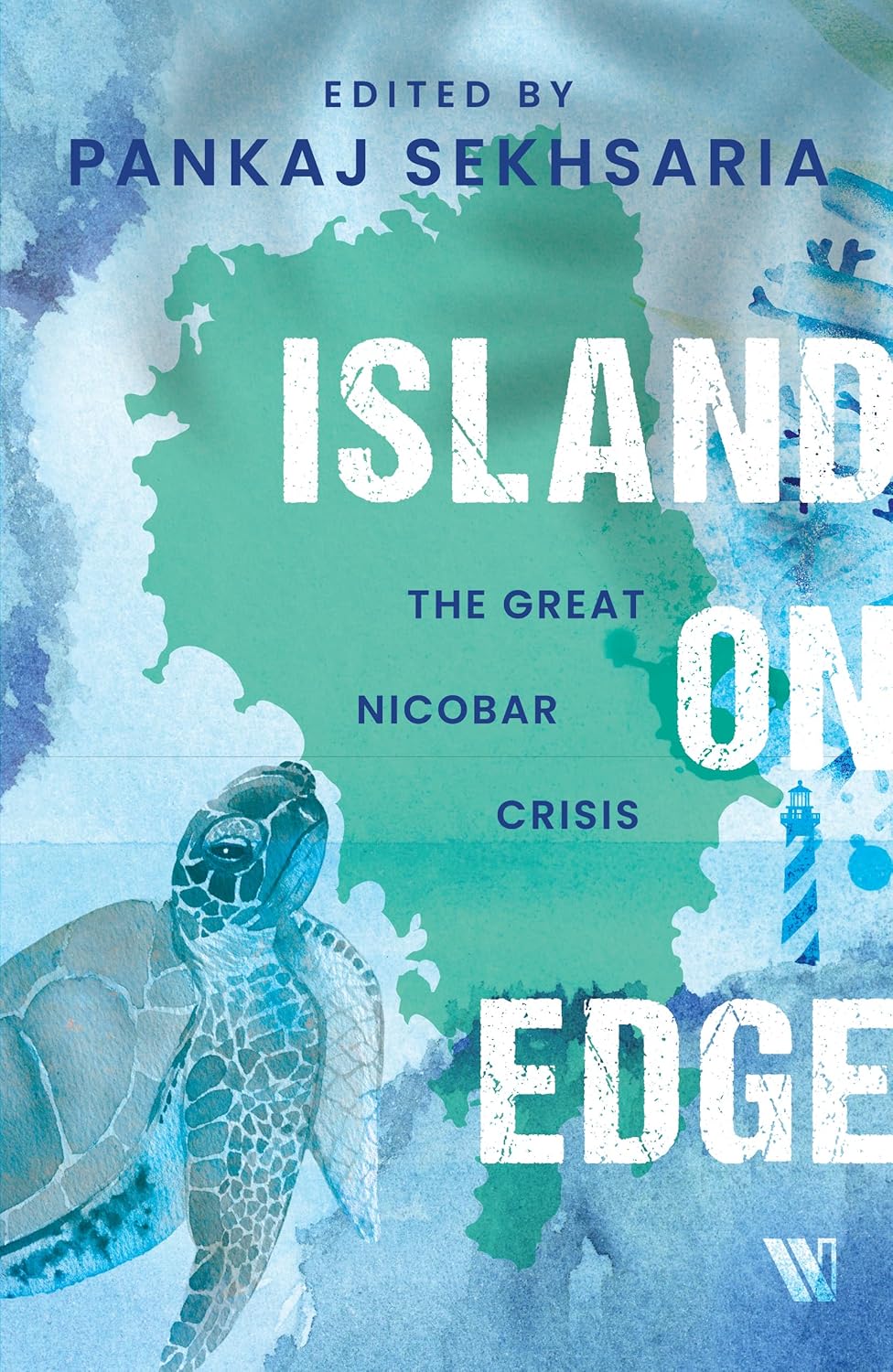
In the context of the Great Nicobar mega project, the ‘pressing reason’, quite ironically, seems devoid of reason. Island on Edge follows The Great Nicobar Betrayal, a book that brought together diverse perspectives on the ecological and cultural damage threatening the island in the name of development.
This time again, through its various authors, Island on Edge is able to showcase the absence of reason in the room. The editor Pankaj Sekhsaria is persistent. He brings us incisive analysis and lucid commentary on the impending catastrophe, and one hopes that both books would snowball into a broader movement.
Island on Edge also takes care to construct a case for vicariousness among those not directly affected by the project. To feel compelled to resist a mega project more than 2,000 kilometres away from mainland India requires a different kind of attentiveness. It asks readers to listen for distant thunder and realise that tempests forming far offshore do not remain contained.
Where money meets the wind
Since the mega project was announced, its components largely remain the same—a transshipment port, a power plant, a township, and an airport. What keeps changing though is the project cost. Initially pegged at INR 72,000 crores (around USD 7.6 million), the project estimate is now at INR 80,000 crores (around USD 8.5 million) and is likely to go up in the future.
Who is going to foot the bill, asks M Rajashekar in his powerful article that gives us details of the monies involved in having such a structure in place. The Galathea Bay transshipment port is expected to save India up to $200 million a year in foreign exchange and secure its place in the global maritime economy, but Rajashekar’s research steadily unravels this optimism. On Great Nicobar, where construction costs run two to three times higher than on the mainland, the arithmetic begins to falter. The port might also be unable to charge more than established rivals like Colombo; therefore, the projected volumes (four million containers a year) would not suffice to earn enough to service its own interest payments.
Suman S and Rishika Pardikar also highlight several red flags of the project and talk about the imminent strain on the island due to violations on many fronts and the lack of autonomy of the companies involved in the project. With murky commercials and strong competition from other regional ports, larger institutions like banks and foreign investors might show signs of hesitation. The funding burden then shifts to the Indian government, which might have to tap into the national budget to prop up the project.
When distant storms become local
Patai Takaru (Big Island) is what the Indigenous tribes call the Great Nicobar island which has evolved in a timeline that is unfathomable to the human mind. Its forests date back to the Pleistocene period, that is, around 2.5 million years ago or 34,400 human lifetimes (given an average lifespan of 75 years). Most humans cannot even imagine what the world was like 150 years ago, or on a more relatable note, the lives of their great grandparents.
What happens when Indigenous people are wiped out of their lands?
The project proponents probably took the term ‘uncontacted tribes’ too literally for the mega project. Tribespeople claim that they were not informed about the full scope of the project, despite a Social Impact Assessment (SIA) having been conducted. Vaishnavi Rathore covers an interview with a leading anthropologist who is able to extract a list of concerns from the Shompen tribesmen. Destruction of soil erosion systems, diminishing water resources, and an influx of outsiders on their land are just some of the issues that they are able to articulate or rather what we are able to comprehend.
The SIA, a legal requirement for projects of this scale, has been done in haste and secrecy. It is deeply concerning that there are no qualms about upsetting a million-year-old system in order to dock ships.
“Do not come near our hills,” one Shompen tribesman says in the interview transcript.
The mega project is not Great Nicobar’s first rodeo. The island has been subjected to earthquakes, tsunamis, marine debris piling along its coasts, and bio-invasions through introduced species. Its final problem could be the mega project.
Ajay Saini and Anvita Abbi’s analysis hits the nail on the head. The loss of native people, flora, and fauna cascades to losses of many kinds—of language, ecology, wisdom, and survival strategies. They reference Manish Chandi’s earlier work on mapping tribal lands, which is crucial to understand where borders were drawn but marked for erasure now.
Compared to The Great Nicobar Betrayal, Island on Edge covers more ground on humanitarian issues, seeking to strike a chord of concern with readers that resonate with the tragedies of displacement.
‘20 Christmases After the Tsunami’ by Leena K Nair shows us how a natural calamity paved the way for a human-made one. When the 2004 tsunami struck, little did the islanders know that the devastation would carry on for years. Displacement, forced labour, and other hardships continue to plague tribespeople who have had to learn new and arguably unnatural ways of survival due to the lack of official support. The proposed port would be located in a seismically active zone that experiences about 44 earthquakes (major and minor) every year, but this hasn’t shaken the confidence of those backing the project.
Rumbles through the rainforest
What is the big deal about island biodiversity? Island flora and fauna have evolved in isolation, slowly adapting to their local environments and occupying ecological niches. Because they don’t experience the conditions of life found on continents, they aren’t good at coexisting in altered habitats and with introduced plants and animals.
There is the idea of treating Great Nicobar’s natural ecosystems as movable parts—akin to getting humans to live on Mars without research on Martian systems that support life.
The problem with the compensatory afforestation programme in mainland India’s Haryana is quite basic—top biologists say that it is unlikely to succeed. T. R. Shankar Raman and Rohan Arthur, eminent voices in Indian conservation, write about the folly in their poignant piece for Frontline magazine, aptly titled An Obit for Patai Takaru. They give the reader a glimpse of the nuances of restoration and ask some pertinent questions, such as how meaningful forest and coral restoration efforts would be, the metrics used to evaluate outcomes, and costs of interventions. Current coral reef relocation plans are drawn without accounting for broader ecological impacts like soil erosion, for example. A more logical restoration proposal would be to work within degraded areas of the Andaman islands, given that they share similar ecological characteristics with the Nicobar islands.
It’s not just the Shompen and Nicobarese. Saurav Harikumar in ‘A Threat to Wildlife’ gives us a non-exhaustive list of probable victims of the mega project. Species on the edge include the Nicobar megapode, Nicobar treeshrew, Omura’s whale, saltwater crocodile, along with others that are possibly unknown to science.
In essence, Island on Edge is a book about human folly. The painstaking work of scientists, researchers, and journalists on the impacts of the mega project provides an early warning of the many disasters that may unfold. Despite caution thrown to the wind, decisionmakers choose to look the other way. The book also carries an interesting annexure section, featuring letters between people in power who are interested in the project—but for different reasons. Timelines and earlier reviews of The Great Nicobar Betrayal give the reader a snapshot of the project, purported to bring ‘development’ to the region.With the recent ruling of the National Green Tribunal, one can now associate the word development with the tone of a storm forecast: delivered with confidence, laden with numbers, and subtly bracing everyone for loss. These are the storms of our own making.