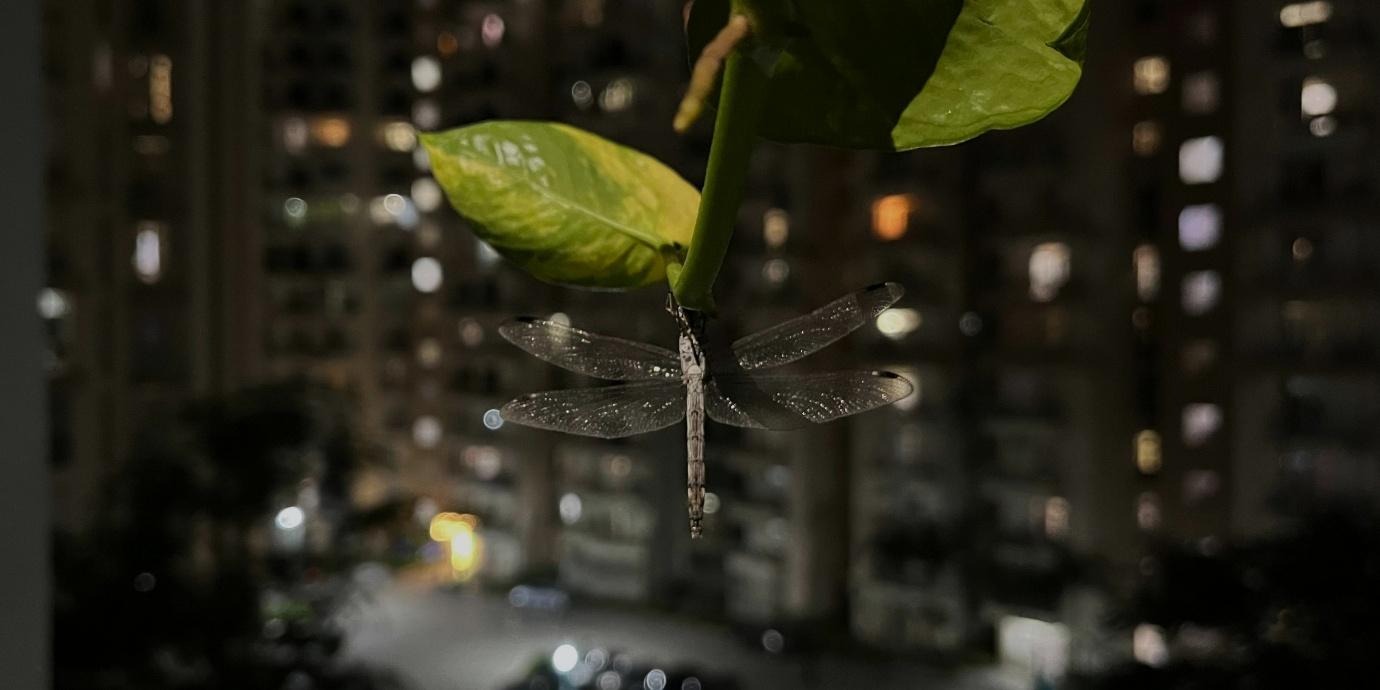
Feature image: A dragonfly resting on my balcony in a high-rise apartment building, highlighting nature’s presence in urban spaces. (Photo credit: Nirjesh Gautam)
Sahibi sat still on a branch one hot afternoon. Soaking in the sunshine to warm up her tiny body—a natural behaviour among cold-blooded creatures.
But above her, danger circled quietly.
A mighty bird swooped down, silent as a shadow—ready to snatch her.
But Sahibi wasn’t just any insect.
She wasn’t slow like a snail or bouncy like a grasshopper.
She could zip, zoom, dive, and dart!
That’s right—Sahibi was a dragonfly. A flying super-insect.
“Look at me go!” she buzzed, spinning through the air like a tiny helicopter.
But Sahibi didn’t always have wings.
Life in the pond
Before she could fly, Sahibi lived underwater.
And guess what? She had gills near her bottom that helped her breathe!
This is one of the three stages in the life of a dragonfly. Inside the pond, Sahibi was in larval stage. She had a brown bulky body, big eyes, small antenna, and six legs—perfectly adapted to live underwater.
She was a naiad—that’s what a baby dragonfly is called in scientific terms. But she wasn’t just any pond creature.
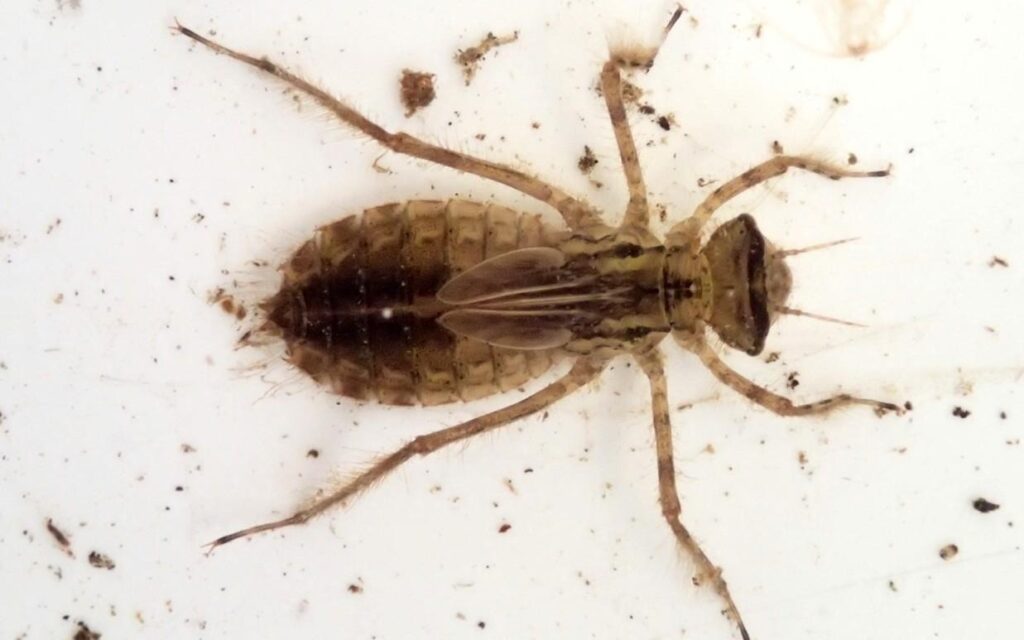
While most bugs tried not to get eaten, Sahibi was busy being a fierce little predator, snapping up mosquito babies, tadpoles, and even tiny fish! She launched surprise attacks by shooting out her jaw and grabbing her prey in a flash.
And she was always hungry—so much so that she sometimes mistook one of her own kind for a snack!
“Catch me if you can,” she’d gurgle underwater before lunging at a tadpole.
The big change
One night, Sahibi looked up through the pond water.
The moonlight sparkled at the surface.
Something stirred inside her.
After living nearly a year underwater, it was time to change.
She crawled out of the pond and climbed up a reed.
High above the water, she waited, still as a statue.
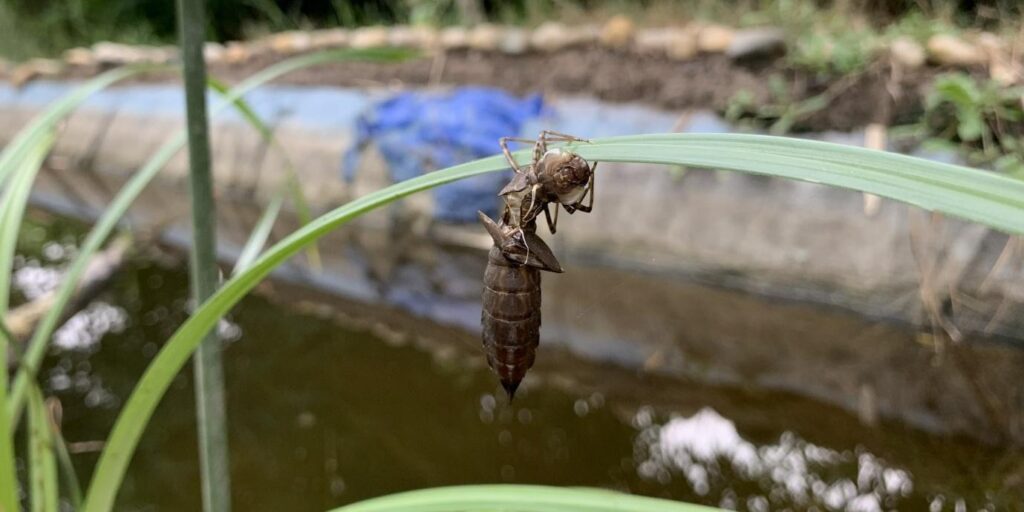
Pop!—her back split open under the dim moonlight.
She wiggled and pushed. First came her head.
Then her thorax—the part of her body like our chest.
Finally, her long abdomen and delicate wings slid free from her old skin, called the exuviae.
The sun peeked over the horizon just as she finished.
But Sahibi couldn’t fly yet.
She had to dry her wings in the morning sun. If she didn’t, she might never fly.
She waited. She flapped.
And then—ZOOOOOOOOOOOOOOOOOOOOOOM!
She was flying.
Her second life had begun.
Expert flier
Sahibi could fly forward, backward, sideways, and even hover and dart—movements which helicopters try to replicate.
She could twist and turn midair in ways even jets could not.
And her eyes?
Two giant compound eyes helped her see nearly all around.
And three tiny ones helped her detect light and motion.
It’s like having super vision!
Just as she was in the pond, Sahibi was a fierce hunter in the sky.
She snatched tiny flies and mosquitoes right out of the air, using her legs like a net!
She could eat hundreds of mosquitoes in a day, helping control their populations as well as those of other insects that humans consider as pests.
Love in the air
One sunny afternoon, Sahibi met another dragonfly with shiny wings and dazzling blue eyes.
He zoomed beside her and said, “Will you fly with me?”
Sahibi zipped around in circles and giggled, “Only if you can keep up!”
They chased and danced through the sky, like little stunt helicopters.
Then came the dragonfly hug. He gently held her by the neck in what’s called a tandem hold.
Together, they formed the shape of a heart in the air. This is a special dance called a mating wheel.
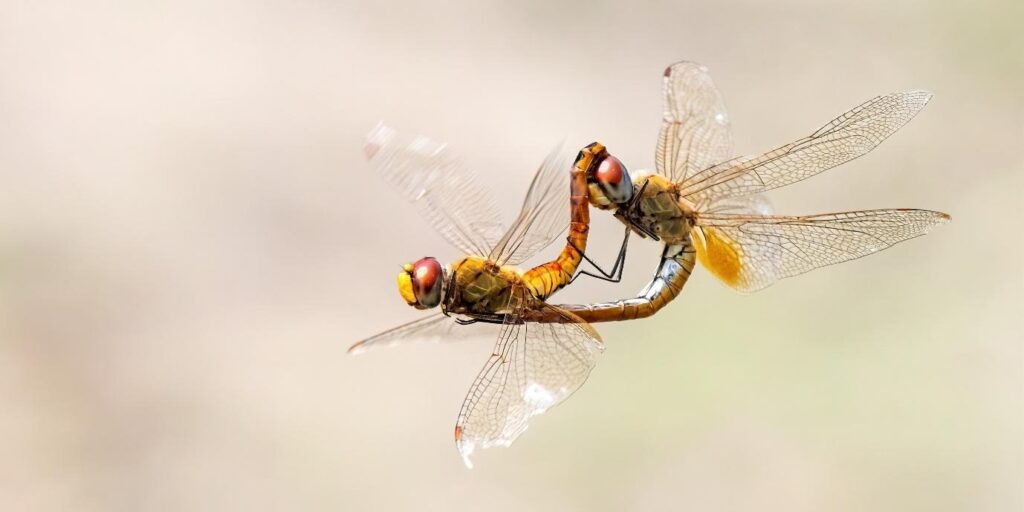
After their sky ballet, they returned to the pond.
Sahibi laid her eggs gently on the water’s surface. Her partner hovered above, guarding her and their future young.
“Go on, little ones,” she whispered. “The pond is full of adventures.”
Urban surprise
You might think dragonflies, like Sahibi, live only near jungles or big rivers. But Sahibi lived in the middle of a noisy city buzzing with cars, buildings, and people.
Still, she found a quiet waterbody amid all the noise. This waterbody was sheltered from wind by aquatic and semi-aquatic plants, and was full of food and sunlight.
It is difficult to imagine. Yet, even in a busy city, there was space for someone as magical as Sahibi.
Don’t believe me? Go check for yourself!
Look around ponds, lakes or stagnant water. From July to November is the best time to spot dragonflies dancing in the sunshine.
So, the next time you see one gliding by, remember Sahibi—the insect who flew better than a helicopter, hunted with precision and reigned the city’s sky.
FUN FACTS
- Dragonflies have been around on the Earth since before dinosaurs. And one dragonfly fossil had a wingspan of 70 cm!
- A female can lay up to 400 eggs in one go.
- Dragonflies catch their prey 97 percent of the time—making them one of the best hunters in the animal kingdom!
- They can fly at speeds between 34–56 kilometres per hour (as fast as a car in a city).
- Some species migrate over thousands of kilometres.
- Dragonflies eat hundreds of mosquitoes each day.
- Both pairs of their wings can move independently, giving them incredible control.
- Dragonflies use motion camouflage—a sneaky trick that makes them look like they’re not moving, even when they are!
- Dragonfly naiads help scientists monitor pollution, especially mercury contamination in wetlands.
QUIZ
Answer these questions and see what you remember from Sahibi’s story!
- What is a baby dragonfly called?
- Where do dragonflies begin their life?
- What helps a young dragonfly breathe underwater?
- What amazing flying skills does a dragonfly have?
- What is motion camouflage?
- Where did Sahibi the dragonfly live?
- How are dragonflies helpful to humans?
Suggested answers:
1. Naiad 2. In freshwater / in a pond or wetland 3. Gills near their bottom 4. Flying forward, backward, sideways, hovering, and making quick turns 5. A sneaky trick where the dragonfly looks still while flying toward its prey 6. In the middle of a noisy city, near a quiet waterbody 7. They eat mosquitoes and help control pests and diseases