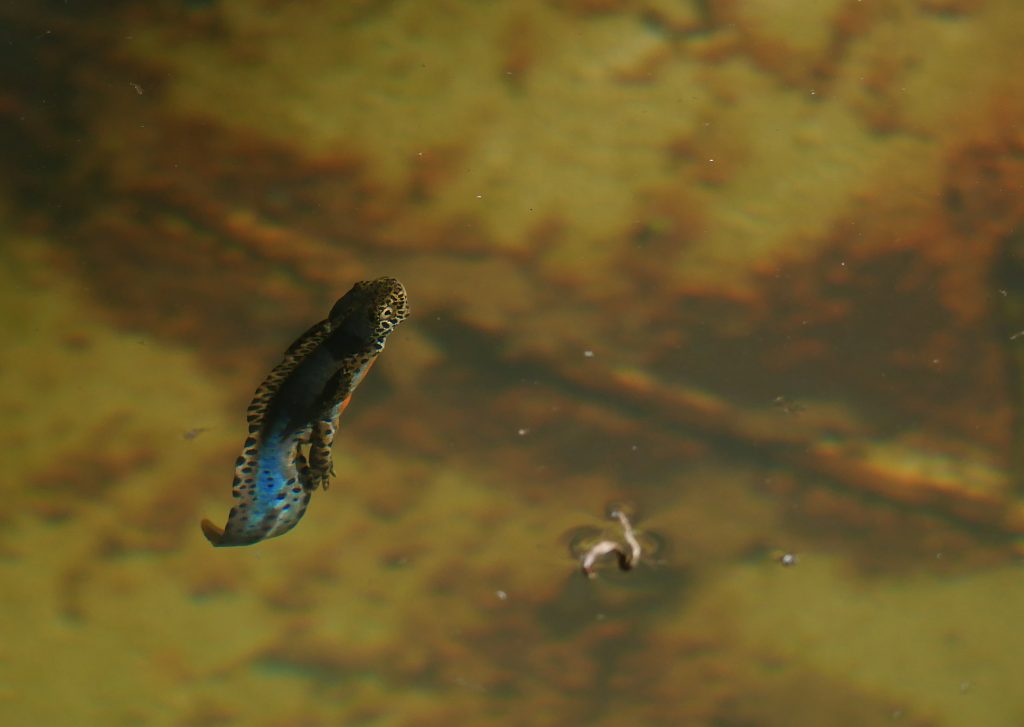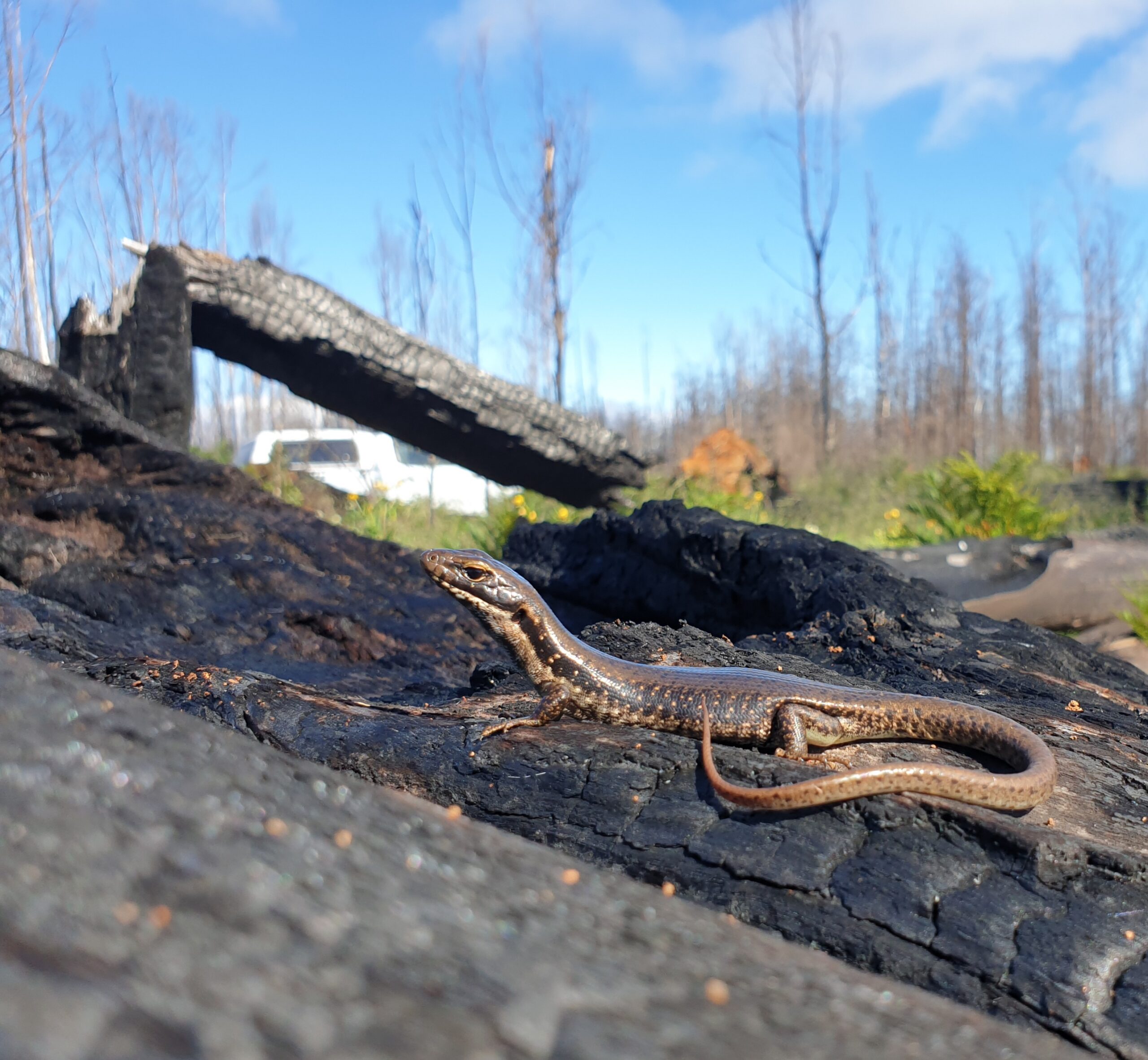
Feature image: A southern water skink (Eulamprus tympanum) basking on a charred log after the 2019–20 Australian megafires (Photo credit: Kristina Macdonald)
Wildfires often leave mineral earth with skeletal blackened stems, making it hard to imagine that wildlife might survive. But surprisingly, often what matters more than the shocking fire event is the history of past fires, which can influence, among other things, vegetation structure, logs, and tree hollows.
Our new study analysed field data we collected after the 2019–20 Australian megafires. The megafires swept through 10.3 million hectares of forest, the largest area burnt in a single fire season until then. We aimed to discover whether the chances that small animals persist after a megafire are based only on the fire itself, or the landscape’s habitat and fire history. To do so, we selected 162 sites divided among unburnt sites and those burnt at different fire severities.
We measured habitat features including moss, logs, and weed cover, and used online data to find out how many times each site had been burnt in the past. We then surveyed the sites to count the number of skinks across four species—glossy grass skink (Pseudemoia rawlinsoni), alpine water skink (Eulamprus kosciuskoi), southern water skink (Eulamprus tympanum), alpine grass skink (Pseudemoia cryodroma)—and to find signs of the threatened broad-toothed rat (Mastacomys fuscus). We surveyed each site three times, allowing us to account for the risk of not detecting a species during a survey, even though they are present.
Some of the results were straightforward. There was almost no chance of finding the glossy grass skink (P. rawlinsoni) and broad-toothed rat in sites that experienced high fire severity in the 2019–20 megafires. These species live in the vegetation and if fire obliterates that, they die out.
But surprisingly the other three skinks that live in the same habitat were unaffected by fire severity. Two are water skinks, the threatened alpine water skink (E. kosciuskoi) and southern water skink (E. tympanum), which is a common species. These species can use water and crustacean burrows as refuges, potentially explaining their ability to survive through extreme fire. However, as shown by another study, when those refuges dry out before a fire, such as during extreme drought, the southern water skinks have nowhere to hide and do decline with fire severity.
We suggest that the alpine grass skink (P. cryodroma) also uses burrows and water to avoid fire and to shelter afterwards, while its congener P. rawlinsoni does not—thus making the latter vulnerable to decline when fire is severe. But we were unable to explain why congeneric species using similar habitat would not all use burrows to escape fire.
We also found that the broad-toothed rat and southern water skink (E. tympanum) declined as the number of past fires increased. But if a site had many logs, these two species actually increased with more frequent fire; the opposite pattern to when there are no logs. Logs can provide important protection from fires. Frequent fires may also promote more shrubs, in which the broad-toothed rats shelter, and more exposed logs, which benefits the southern water skink.
A critical insight was that the alpine water skink (E. kosciuskoi) only achieved high numbers in sites that had high moss cover and were rarely or not burnt in the past 80 years. They also declined as the number of logs and weed cover increased, making rarely burnt, mossy sites with few logs and low weed cover important refuges. Moreover, both the threatened alpine skinks, E. kosciuskoi and P. cryodroma, declined with increasing weed cover. This could be because invasive weeds reduce habitat quality by altering the structure and distribution of vegetation.
To protect these threatened skink species, managers could map rarely burnt mossy areas then exclude them from planned burns, target them for active defence during bushfires, and aim to exclude infrastructure development and feral herbivores from their habitat to limit the risk of increasing weed cover. This further highlights how studying the interactions between fire and habitat attributes helps to characterise wildfire refuges.
By incorporating the needs of native species into management, we can increase their resilience to extreme fires driven by climate change. However, this will only be a stopgap solution as extreme fires become increasingly frequent. Governments, businesses, and communities around the world need to urgently act to mitigate the impacts of climate change.
Further Reading
Letnic, M., B. Roberts, M. Hodgson, A. K. Ross, S. Cuartas, Y. Lapwong, O. Price et al. 2023. Fire severity influences the post-fire habitat structure and abundance of a cool climate lizard. Austral Ecology 48 (7): 1440–1453. https://doi.org/10.1111/aec.13410.
Driscoll, D. A., K. J. Macdonald, R. K. Gibson, T. S. Doherty, D. G. Nimmo, R. H. Nolan, E. G. Ritchie et al. 2024. Biodiversity impacts of the 2019–2020 Australian megafires. Nature 635: 898–905. https://doi.org/10.1038/s41586-024-08174-6.
Driscoll, D. A., Z. Walker, D. A. Whisson, E. G. Ritchie, C. Sato and K. J. Macdonald. 2025. Megafire severity, fire frequency and their interactions with habitat affect post-fire responses of small mammal and reptile species. Biological Conservation 307: 111206. https://doi.org/10.1016/j.biocon.2025.111206.