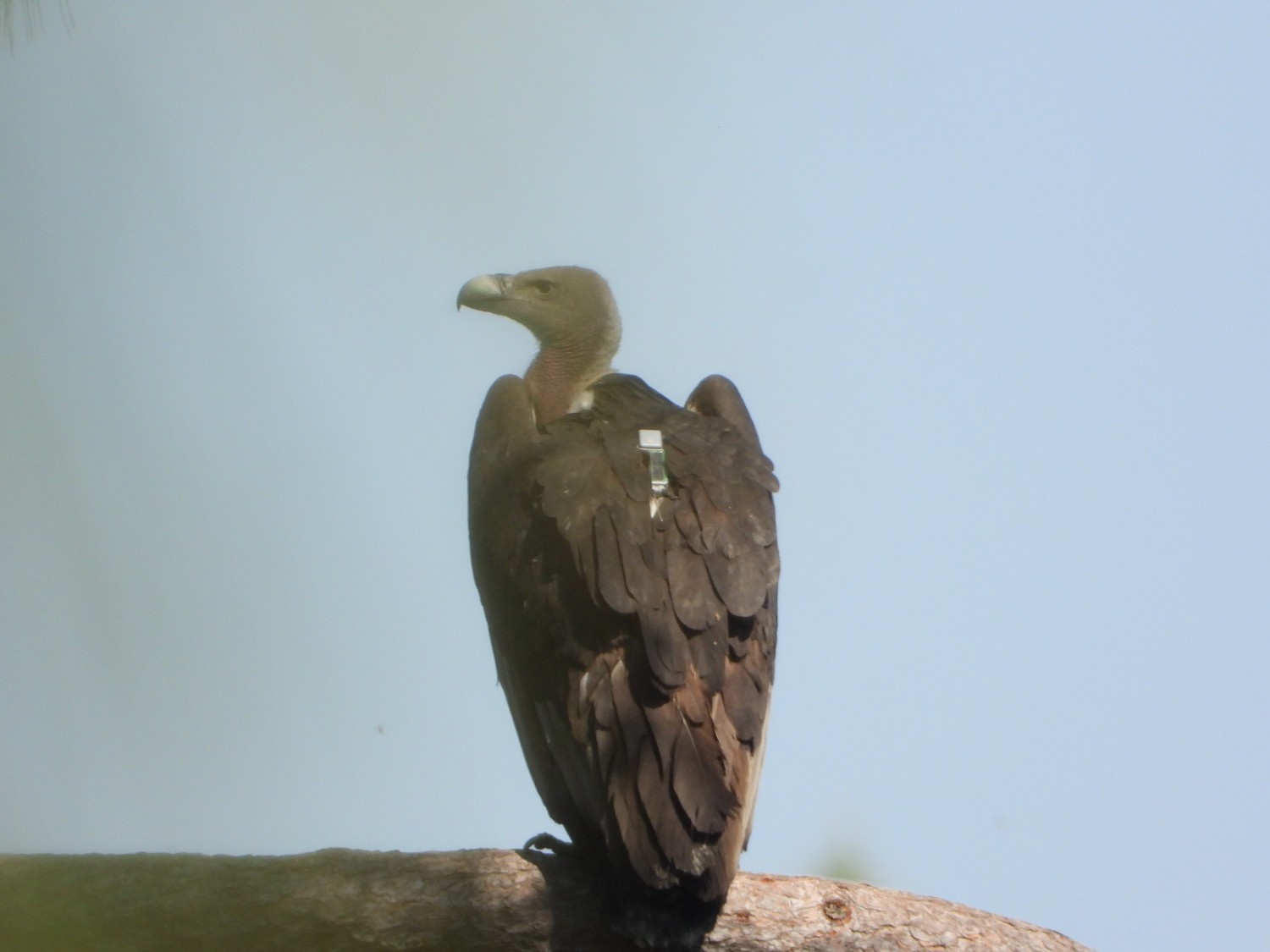
Feature image: Satellite-tagged adult white-rumped vulture near a nesting site in Himachal Pradesh, India. Photo credits: Malyasri Bhattacharya
The word ‘scavenger’ often carries the weight of misunderstood creatures that feed on the dead. In many traditions, such beings are tied to death, decay, and bad omens. At first glance, scavengers may not inspire awe or admiration. But perhaps it’s time we looked at them through a fresh lens.
Picture a vast sky, where a majestic bird with powerful wings glides silently in slow spirals. Is it a scene of desolation that comes to mind, a grim dumping ground below, littered with carcasses? Or do you see the quiet grandeur of the white-rumped vulture (Gyps bengalensis), a striking Old World raptor, its broad wings catching the light, and its white rump gleaming against the sky?
With piercing eyes fringed by delicate lashes and a long and slender neck, it cuts an unforgettable figure. These vultures are more than symbols of death; they are nature’s tireless clean-up crew, keeping ecosystems healthy and disease-free as they rise high on thermals, scanning the land below with quiet dignity.
On the edge
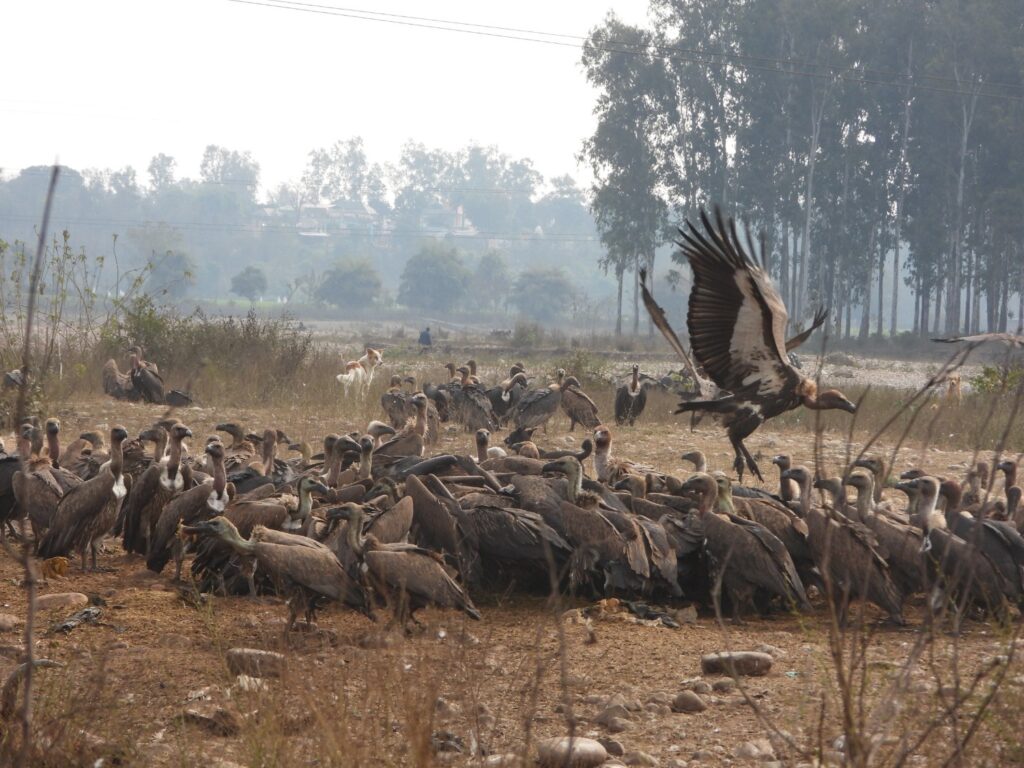
Once a familiar sight soaring across Indian skies, vultures have now become rare and alarmingly absent. Between 1992 and 2000, vulture populations in India declined by over 99.9% for white-rumped vulture (Gyps bengalensis) and 97% for Indian (Gyps indicus) and slender-billed vultures (Gyps tenuirostris)—a devastating decline for one of nature’s most vital scavengers. The culprit? A common non-steroidal anti-inflammatory drug (NSAID) called diclofenac, used to treat sick cattle. It turned out to be fatally toxic to vultures feeding on treated carcasses.
After the link was discovered through extensive research, diclofenac was banned for veterinary use in 2006. But the danger didn’t end there. Other drugs from the same family—aceclofenac, ketoprofen, and most recently, nimesulide—were also found to be harmful. Bans on these drugs followed, including nimesulide in 2024. On the other hand, meloxicam and tolfenamic acid have been scientifically tested and confirmed as safe for vultures.
But, despite these regulatory steps, vulture populations have not yet recovered. In fact, according to recent trends reported on eBird, numbers for the Critically Endangered white-rumped vulture continue to decline by 4 percent every year. The issue isn’t just the presence of toxic drugs, but the lack of proper enforcement and awareness at local levels.
Surveys conducted across 13 Indian states highlight the fragile state of vulture populations—only 106 white-rumped vultures were recorded across 152 transects. While the dangers posed by NSAIDs are well established, information on other critical threats, such as habitat loss due to deforestation and power line collisions, remains limited and underexplored.
The vultures of Himachal
“They’re almost extinct now; you hardly ever see them anymore. But back in the day, when we were on our way to school, they were everywhere. Sometimes they’d spread their massive wings right in the middle of the road, blocking our way. We used to get scared and run away,” said a farmer from Kangra district in Himachal Pradesh. Nestled in the Western Himalayas, this Indian state is known for its breathtaking landscapes, snow-capped peaks, and a rich diversity of wildlife. The Kangra district is not only the spiritual home of His Holiness the Dalai Lama, but also a symbol of peace, resilience, and harmony between nature and culture. Yet, amid the buzz of popular hill stations and hiking trails, there’s one story that almost no one hears about: the story of vultures.
Recent research has revealed that Himachal hosts one of the largest populations of the Critically Endangered white-rumped vulture in the country (Bhattacharya et al., 2024). And yet, these majestic birds are hardly noticed. Since 2019, I’ve been carrying out my PhD study on the species in the state. Over the past few years, I’ve surveyed nearly the entire Kangra district, studying the vulture’s nesting habits, movement patterns, and the threats the species faces.
One unforgettable moment was in September 2021, when I, along with my field associate Manoj Kumar and a forest guard, managed to capture and fit a GPS-GSM tag on a wild white-rumped vulture for the first time, with the support of the Wildlife Institute of India and the Himachal Pradesh Forest Department. We had waited for days, and it was only after a rainy afternoon that our chance finally arrived.
Even though I had prior experience with bird telemetry, having worked on hornbills in Arunachal Pradesh, this was something entirely different. The sheer size of the vulture, the weight of its presence, and the sharp but unforgettable smell that lingered after the capture left a lasting impression. I remember feeling nervous; it’s not every day you hold a Critically Endangered species in your hands. But the bird wasn’t aggressive. It was calm but frightened, more than anything else. We completed the tagging process in under 20 minutes and released it safely.
That moment changed something in me. It wasn’t just about studying a species anymore. It became about understanding the whole ecosystem: the forests the birds nest in, the people who live nearby, and how communities could be involved in protecting these vital scavengers before they disappear completely.
Unlikely allies
One of the major threats to vultures is how they are perceived by people, often with fear, disgust, or complete indifference. But in the remote corners of Himachal, I found an unlikely group of allies in my conservation journey: the local communities traditionally tasked with the disposal of cattle carcasses.
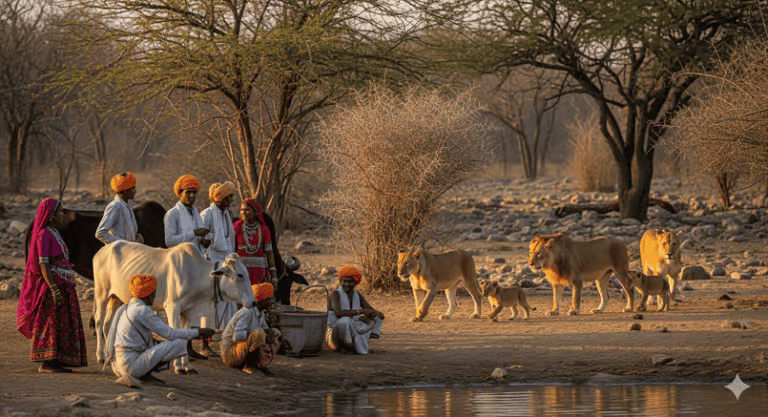
These communities, often pushed to the margins of society due to their work with dead animals, hold a wealth of knowledge about vultures that rarely finds its way into mainstream conservation discussions. For generations, they have played a critical ecological role, providing food sources for vultures by dumping carcasses in open areas. Their understanding of vultures is both intimate and invaluable.
Yet, their struggles are immense. Many face social exclusion, and their work is seen as ‘impure’, despite being vital for both public health and ecological balance. Even today, they often must fight just to keep a piece of land where they can leave animal remains for vultures to feed on. It’s a battle for dignity, tradition, and survival.
Some from these communities have shifted to other livelihoods, such as working in tourist hotels in Dharamsala, seeking stability and respect. But the transition hasn’t been easy, especially for their children, who continue to face discrimination in schools and society. Even today, the age-old practice of carcass disposal in the landscape goes on, deeply embedded in the cultural and ecological fabric of the region. As part of our vulture conservation work, we are now planning to integrate the traditional knowledge and lived experiences of these communities.
Ground realities
Coming from Kolkata, West Bengal, one of the first questions I’m often asked is, “Why would a girl travel so far just to work on vultures?” A bird that most people barely even notice, let alone care about.
Sometimes in the villages of Himachal, people don’t immediately understand my dialect of Hindi. My field associate, Manoj, often needs to step in and patiently explain: “Ay ji ithu illain pr kam karna ayo, pichley kuch sala tey illain ik dum ghat hoyi gayiain, pr sadey kangrey ch Ina illain di tadaad aley v khari hai” This girl has come to study vultures in your area. Over the years, the number of vultures has declined drastically across the world, but here in Kangra you can still see them.
Degrees and work experience don’t matter much out here. What counts is how well you connect with people, how deeply you understand their lives, their beliefs, and how your work can include their voices and perspectives.
My fieldwork is physically demanding. It often involves long hours of walking through forests, surveying vulture nesting sites or tracking satellite-tagged vultures at feeding grounds. Some days are spent speaking with local communities who have traditionally managed cattle carcass disposal. Despite being marginalised for their work, they hold incredible local knowledge that has greatly enriched my research.
Through our surveys, we documented 36 community-managed feeding sites, and three official “vulture restaurants” established by the Himachal Pradesh Forest Department. What’s been most heartening is how some of the local community members have embraced the vultures, sending us mobile phone pictures of rare species like the cinereous vulture (Aegypius monachus) or red-headed vulture (Sarcogyps calvus), which are rarely found in the landscape, visiting their dumping sites. In local Kangri or Pahadi, they call them ill. Their interest often comes with a simple hope: “If only there was a permanent income source,” they say, “we’d gladly continue this practice and help save the vultures.”
But working in these open carcass-dumping areas hasn’t been easy. There’s often suspicion that I’m there to shut the system down. In staunch dominant-caste communities, the death of a cow is seen as the end of its sanctity, and skinning a dead cow is considered culturally ‘impure’. Sometimes, villagers won’t even let us into their homes, fearing we’ve come from places they deem as ‘unclean’, or they even ask us to discontinue the entire open carcass disposal system, considering it a foul-smelling and unhealthy site.
Addressing these deep-rooted, casteist prejudices isn’t simple. But what keeps me going are the conversations with older community members who still remember how carcass disposal used to be, how things have changed over time, and how, maybe, things can change again for the better.
The vultures may not be glamorous. But they matter. And the people who live closest to them matter just as much. Together, their stories have taught me more than any textbook ever could.
Toxic NSAIDs
Through covert pharmacy surveys conducted across multiple panchayat (village council) divisions in the region, we found that 95 percent of the pharmacies stocked only meloxicam, a vulture-safe drug—an encouraging sign for vulture conservation. Himachal, being largely rural, has livestock owners who primarily rely on government veterinary doctors, often requesting home visits or taking their animals to government facilities. In most cases, these doctors do not prescribe toxic drugs, as such medications are already banned. This is a positive outcome, as no potentially harmful NSAIDs were detected in the region, indicating its strong potential to be declared a Vulture Safe Zone.
However, in many rural areas, both doctors and pharmacy owners remain unaware of bans on other harmful drugs, such as aceclofenac, ketoprofen, and nimesulide. Continuous outreach to veterinarians and farmers about safe veterinary practices is essential to ensure that these bans are well understood and consistently enforced. Bridging the gap between farmers and veterinarians on the use of toxic veterinary drugs is key to safe veterinary practices.
Other threats
Why does Kangra have so many vulture nests? One key reason is that the district still harbours extensive tracts of chir pine (Pinus roxburghii) forests, some of the most continuous tracts in the region. Although these forests fall under Territorial Forest Divisions rather than protected areas, they have still provided crucial nesting sites for vultures over the years.
However, widespread road development has fragmented many patches, reducing the availability of undisturbed habitat. From my PhD research, I’ve found that white-rumped vultures show a clear preference for old-growth chir pine trees, particularly those with a larger girth at breast height (GBH) and surrounded by dense shrub cover, an indicator of reduced human disturbance.
Unfortunately, these very forests are under threat. Forest fires, often during the dry season, and resin tapping activities weaken these vital nesting areas. Despite this, vultures continue to return each year for the breeding season from October to March. But vultures are slow to breed, with white-rumped vultures laying just one egg per year. And this makes their survival precarious.
Changing landscape
Alarmingly, open carcass disposal sites are rapidly disappearing. With changing practices, people now often choose to bury dead cattle rather than hand them over to traditional carcass handlers. Urbanisation and village development have also left little to no open and dedicated spaces for natural carcass decomposition, further reducing vital feeding grounds for vultures.
There is still hope ahead. Safeguarding vultures in Himachal will demand more than simply protecting traditional feeding grounds and the last remaining forest patches. It requires a change in mindset, dispelling the long-standing notion of vultures as bad omens and fostering recognition of their vital role in the ecosystem. This must go hand in hand with sustained efforts to protect nesting habitats, raise awareness about vulture-safe carcass disposal, and ensure the exclusive use of safe veterinary drugs.
This is not the work of one group alone. It will take a coordinated effort between local communities, the broader Pahadi society, forest managers, veterinarians, and conservation organisations. Targeted awareness campaigns, school outreach, veterinary training, and community-led nest and habitat protection can help. If these efforts align, there remains real hope for the survival of vultures in Himachal.
As His Holiness the 14th Dalai Lama once said, “It is our collective and individual responsibility to protect and nurture the global environment.”
Acknowledgements
This research was supported by the Wildlife Institute of India, The Habitats Trust, and the EDGE of Existence Programme, ZSL.
Further Reading
Bhattacharya, M. and G. Talukdar. 2024. Nest site selection and threats to nesting colonies of white-rumped Vulture (Gyps bengalensis) in Himachal Pradesh. Forest Ecology and Management 573: 122335.
Frank, E. and A. Sudarshan. 2024. The social costs of keystone species collapse: Evidence from the decline of vultures in India. American Economic Review 114(10): 3007–3040.
Prakash, V., H. Bajpai, S.S. Chakraborty, M.S. Mahadev, J.W. Mallord, N. Prakash, S. P. Ranade et al. 2024. Recent trends in populations of Critically Endangered Gyps vultures in India. Bird Conservation International 34: e1.
SAVE. 2025. India issues gazette notification of veterinary nimesulide ban. https://save-vultures.org/2025/01/india-issues-gazette-notification-of-veterinary-nimesulide-ban/. Accessed on March 30, 2026.