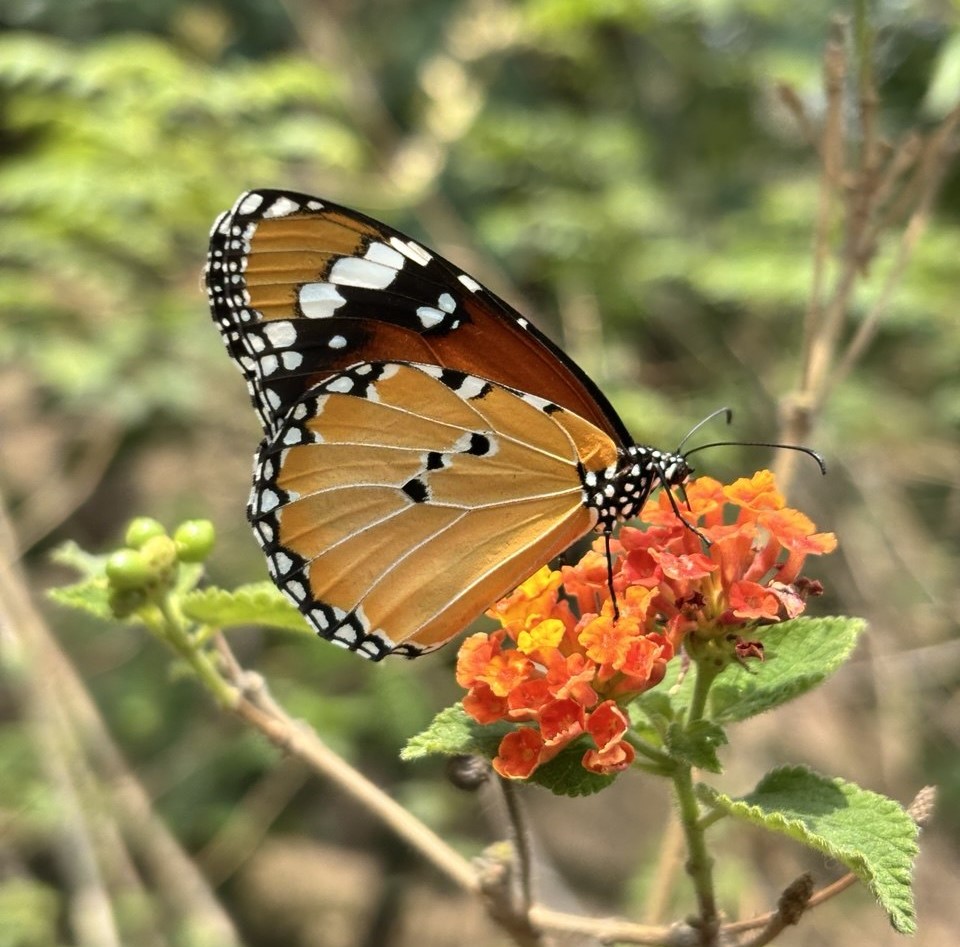
Featured image: An adult butterfly feeding on invasive Lantana camara flowers illustrates the ecological relationship between butterflies and nectar-producing plants. Photo credits: Diksha Chopra
Butterflies are often treated as signs of beauty. A flutter of wings over a flowering patch can make even an ordinary landscape feel alive. Yet butterflies are more than decorative visitors to a garden or woodland edge. They are closely tied to the health of the habitats they occupy, and their presence can reveal far more than we usually notice. A butterfly is easy to admire in its adult form. It visits flowers, basks in sunlight, and flutters through open spaces. However, the adult stage is only one part of its life. Before transforming into a winged insect, it passes through egg, larval, and pupal stages, each of which relies on specific ecological conditions.
If we pay attention only to adults, we miss the bigger picture of what butterflies need to survive—and thrive. This matters because a habitat that appears suitable for adult butterflies may still fail to support their full life cycle. A place may have flowers, sunshine, and open vegetation, yet remain unsuitable for breeding. To understand why, we need to look beyond nectar and pay closer attention to the less visible relationships that shape butterfly life.
Host plants matter
The most important of these relationships is the link between butterflies and their host plants. A host plant is the species on which a butterfly lays its eggs and on which the caterpillar feeds after hatching. For many butterfly species, this choice is crucial. A female butterfly does not lay eggs at random on any available leaf. Rather, she selects plants that can support larval feeding and development. The choice of host plants differs from species to species.
This also means that flowers alone are not enough. Nectar may attract adult butterflies, but host plants determine whether a butterfly population can persist in a region. A butterfly may visit a flowering garden for food, but if its caterpillar cannot feed there, the garden functions only as a temporary stop. It may look butterfly-friendly, yet offer no real opportunity for reproduction.
This distinction is often overlooked in popular discussions of butterfly conservation. Many people associate butterfly-friendly habitats with colourful flowers, landscaped gardens, and ornamental shrubs. Such spaces can be useful to adults, but do not automatically support breeding populations. A more complete butterfly habitat is one that supports the entire life cycle, from egg to adult.
Reading a landscape
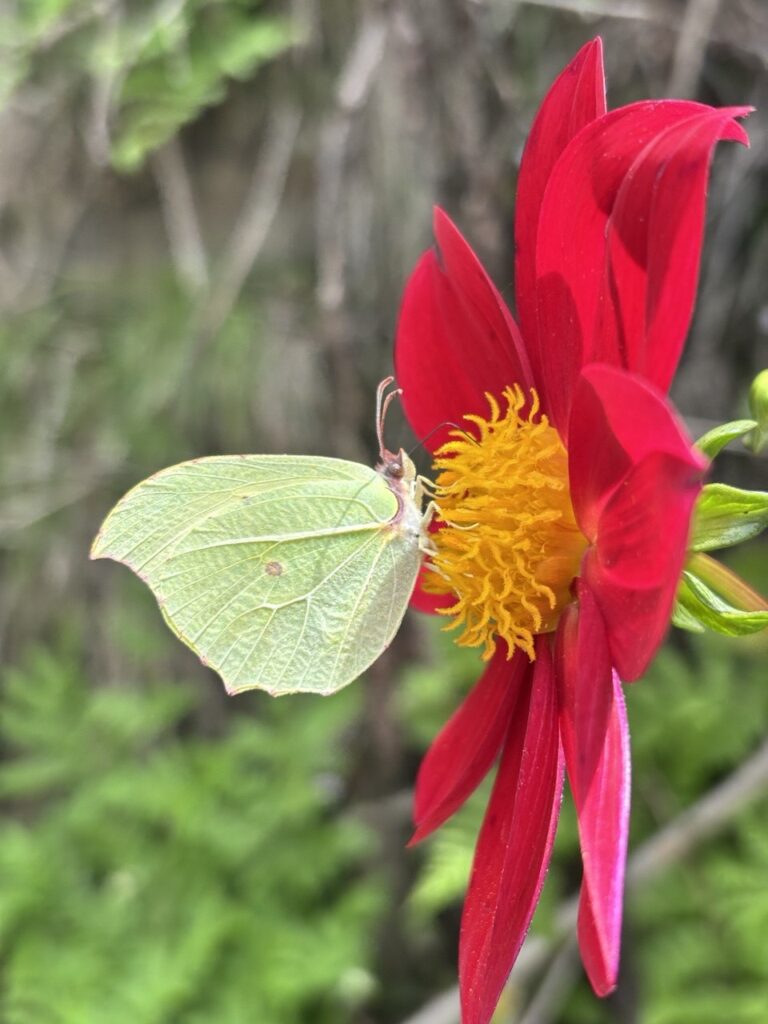
Butterflies are often described as indicators of habitat quality, and for good reason. Their survival depends on a combination of resources that includes host plants, nectar sources, shelter, sunlight, and suitable microclimatic conditions. Because they rely on all of these factors combined, butterflies respond quickly to habitat changes.
A landscape does not have to become barren in order to be unsuitable for butterflies. In many cases, ecological decline begins with simplification. Since modern landscapes often reward tidiness, native vegetation may be removed and replaced with ornamental plants. Climbers are cut back, and scrub and edge growth may be cleared because they appear untidy. Grasslands may be turned into lawns, and shrubs are trimmed into uniform shapes. Small, weedy patches of spontaneous vegetation that once supported caterpillars may be eliminated in favour of cleaner-looking spaces. From a human perspective, these actions may seem harmless or even beneficial. From the point of view of butterflies, the landscape may no longer function as a living habitat.
This is especially important to consider in urban and peri-urban environments. Cities are often seen as distant from conservation, yet many butterflies continue to survive in campuses, home gardens, roadside vegetation, parks, and remnant scrub patches. These spaces may seem small or ordinary, but they can serve as breeding sites, feeding areas, and movement corridors. Their value depends not on how neat they look, but on whether they still contain the plants and structures that butterflies require.
Many plants that support caterpillars are not showy and do not fit the idea of a neatly designed garden, and hence are rarely planted intentionally. Yet these ordinary plants can be essential for butterfly reproduction and the entire life cycle. This reveals an important ecological truth: not all greenery has the same value. A managed lawn and a patch of mixed native vegetation may both appear green, but they do not support the same forms of life. Butterfly conservation depends on recognising this difference.
From flowers to full life cycles
If butterfly conservation is framed only around adult nectar feeding, it remains incomplete. The real test of habitat quality is not whether butterflies visit a place, but whether they can complete their life cycle there. Do females lay eggs? Are caterpillars feeding and pupae present? Do new adults continue to emerge from the site?
These questions shift the focus from appearance to function. They also make butterfly conservation more practical. Instead of planting only nectar flowers, habitat restoration can include local host plants. Instead of clearing every edge and understory patch, managers can retain vegetation that supports immature stages. Instead of valuing only ornamental design, gardens and campuses can be planned with ecological use in mind. This approach is relevant not only to protected areas, but also to everyday landscapes. School grounds, institutional campuses, urban parks, small gardens, and even roadside strips can all become more meaningful for butterflies if they include suitable host plants and retain some habitat complexity.
Reshaping the conservation narrative
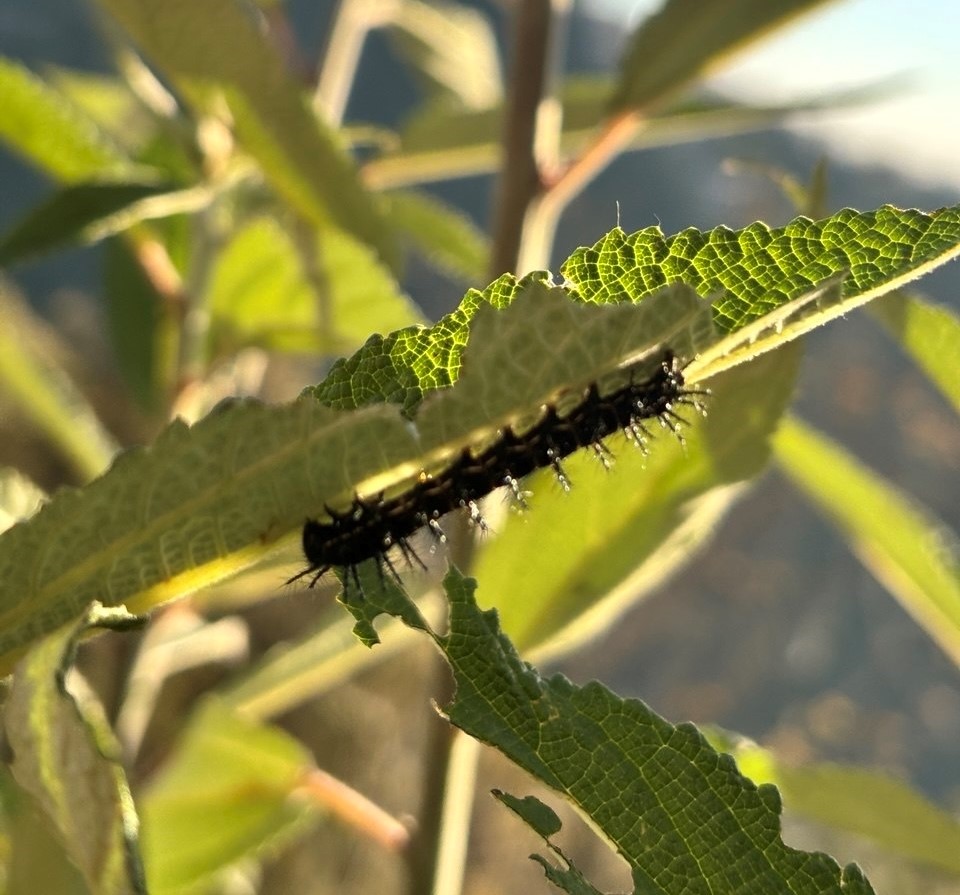
Butterflies invite a form of conservation rooted in close observation. Watching a female circle a shrub, seeing a caterpillar feed on a particular leaf, or noticing the absence of butterflies can reveal important ecological changes. Such observations may appear small, but they help us understand whether a habitat is merely attractive to adults or genuinely supportive of breeding populations. This is where natural history remains valuable. In a time when conservation is often discussed through large-scale plans and broad environmental crises, butterflies remind us that ecological understanding also begins with attention to detail. A single plant, a single larva, or a single act of egg-laying can reveal the kind of relationship on which a species depends.
Butterflies also help connect science with public engagement. They are familiar, noticeable, and widely appreciated. People who may not respond to abstract discussions of biodiversity loss often respond to butterflies. This gives butterflies unusual power as ambassadors for conservation. They can draw attention to larger issues such as plant diversity, habitat simplification, and the value of native vegetation.
In the end, butterflies show us that conservation is not only about protecting individual species. It is about protecting relationships. A butterfly depends on plants, seasons, shelter, and landscape continuity. When these relationships are disrupted, the species may disappear even if some elements of the habitat remain. Thus, although butterflies are often seen as delicate creatures, they are also useful indicators of ecological change. They tell us whether a habitat still functions as a living system or whether it has been reduced to a decorative surface. If we learn to read them carefully, butterflies can help us understand not only their own needs, but the broader health of the landscapes we share with them.
Further Reading
Dennis, R. L. H., J. G. Hodgson, R. Grenyer, T. G. Shreeve and D. B. Roy. 2004. Host plants and butterfly biology: do host-plant strategies drive butterfly status? Ecological Entomology 29(1): 12–26.
Mahata, A., R. M. Panda, P. Dash, A. Naik, A. K. Naik, and S. K. Palita. 2023. Microclimate and vegetation structure significantly affect butterfly assemblages in a tropical dry forest. Climate 11(11): 220.
Nitin, R., V. C. Balakrishnan, P. V. Churi, S. Kalesh, S. Prakash, and K. Kunte. 2018. Larval host plants of the butterflies of the Western Ghats, India. Journal of Threatened Taxa 10(4): 11495–11550.
Tiple, A. D., A. M. Khurad, and R. L. H. Dennis. 2011. Butterfly larval host plant use in a tropical urban context: life history associations, herbivory, and landscape factors. Journal of Insect Science 11(1): 65.