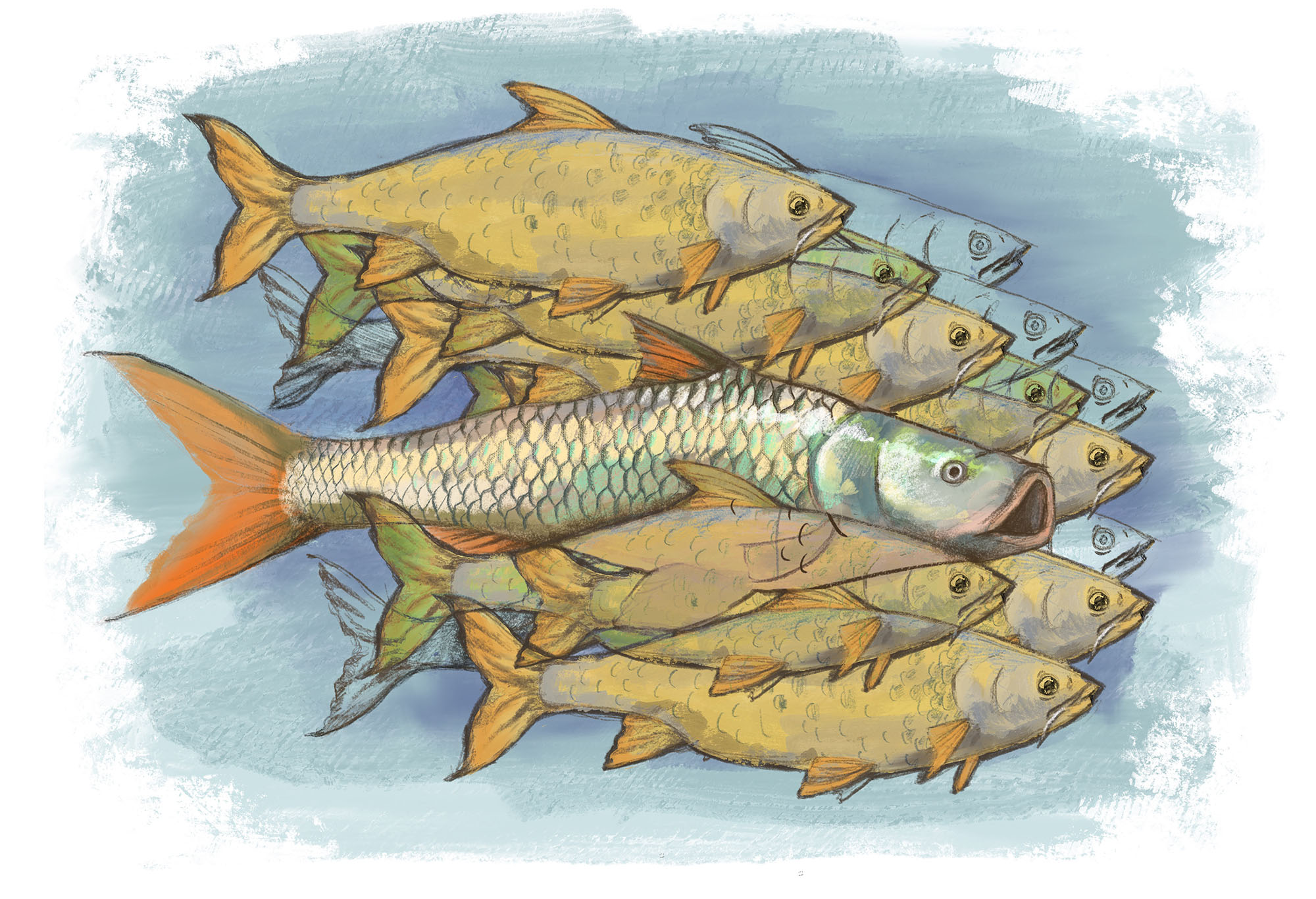
To be the largest of your kind should confer status. But does status itself bring increased awareness? Not when that animal lives its whole life below the water.
Known as the Mightiest Mahseer among a family of fishes collectively called ‘tigers of the river’, the hump-backed mahseer (Tor remadevii) is not only the largest species of the family, it is also the most highly threatened. This leviathan, weighing up to 55 kg, has a geographic range limited to the basin of the Cauvery river in South India—and that is part of the problem. The usual catalogue of issues affecting rivers in Asia adds to the species’ troubles, but there are some unique threats compounding the woes of this special fish.
Cloud of confusion
It was only in 2018 that the species was indisputably named as Tor remadevii. For decades confusion reigned. Indeed, the fish that was initially called the hump-backed mahseer was not a mahseer at all. It was one of India’s large river carps: Hypselobarbus mussullah. And the fish of the Cauvery river basin has few features in common with the river carp of Maharashtra.
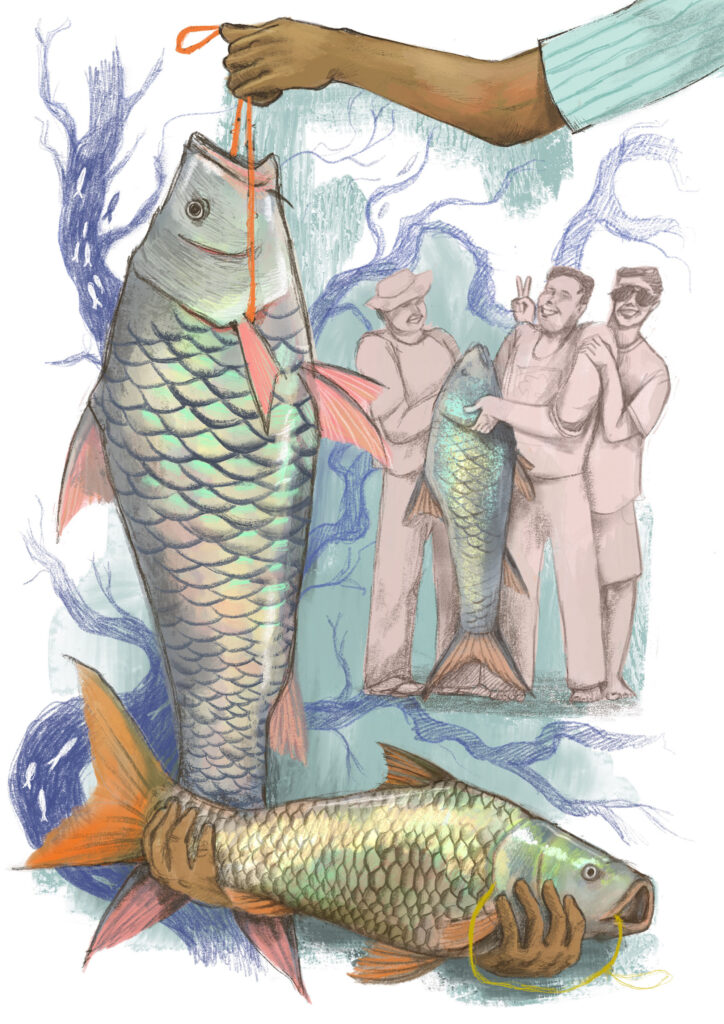
But a much greater number of people know about the hump-backed mahseer of Cauvery river than the giant carp of Ghod river, thanks to more than a century of anglers visiting the far south. Proud colonial era photos of huge individuals strung up on poles show the importance of this fish as a sporting trophy. Museums around the world hold dried skins and preserved specimens. At the Regional Museum of Natural History in Mysore, there are hundreds of sets of the throat teeth of the hump-backed mahseer—relics of a time when all fish were taken to “prove” the skill of the angler.
Equally confusing is to identify different species using colour. Hump-backed mahseer are sometimes called “orange-finned” but they can also be melanistic, while others have pinkish fins. A stress response in common with many other fish, the mahseer’s colours can quickly dull—depending upon water conditions and stress levels—appearing almost white. But we can be sure that of all the known photos and specimens collected from the Cauvery river system, all are hump-backed mahseer until recently.
Within my lifetime, the hump-backed mahseer has gone from “common” according to J. Juan Spillett’s 1966 Bombay Natural History Society survey, to a well-researched Critically Endangered status on the IUCN Red List. In the last four decades, an entire host of factors have conspired to pile pressure on this world-renowned species.
Multiple threats
Invasive species have caused huge damage to ecosystems in India—not only plants, introduced animals have also brought increased competition for resources, as well as novel diseases. We know from history the range of problems that can be caused by invasives.
The translocation of the golden mahseer (Tor putitora) in the 1850s and 1870s likely played a lead role in the local extinction of an endemic fish in Bhimtal, Uttarakhand. Those translocated fish were later used in the development of a fish hatchery, and the descendants of the introduced golden mahseer are now spreading south, including into Kabini river—a prime territory of the hump-backed mahseer.
There are many who believe that to conserve a freshwater fish simply means to throw more of them into a river. And the ability to breed a threatened species in captivity is, of course, a very valuable strategy—a buffer against extinction risk. However, this approach needs to be part of a carefully considered plan because conservation is very different from farming. We also need to consider the impacts of habituation upon animals bred in captivity. How well are we equipping the animal to survive in the wild? Are the actions of those overseeing the early-life development of the animal helping or harming its longer-term survival once that animal is released into the wild?
Mahseer fish have to learn to hunt. During early life stages in the wild, juvenile mahseer will seek out insect larvae. Later, they start to ambush other fish and root out crabs. If, as has been the case, fish that are reared in a concrete tank are fed from a static block of vegetable matter, they will not be fit to survive in their natural habitat. They will also not have an innate fear of humans or other predators, which is a key survival tool.
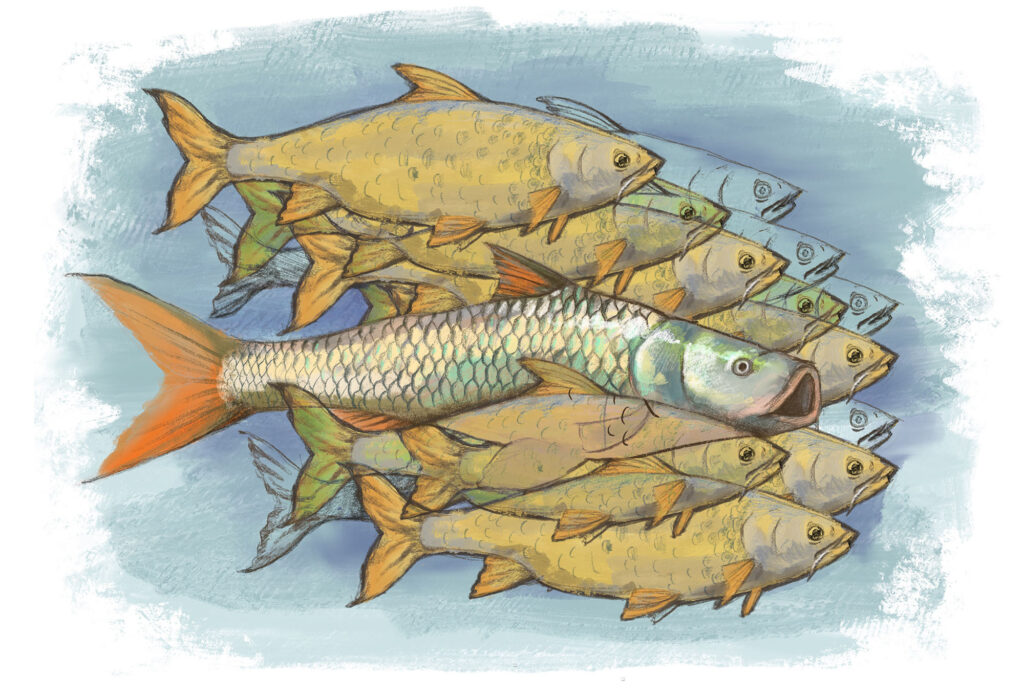
From the mid-1970s, a programme began to stock mahseer into the Cauvery river and various tributaries. The stock population comprised Deccan mahseer (Tor khudree) from Maharashtra, commonly known as the black mahseer. But a large number of the introduced fish had brightly-coloured fins, and soon became known as the blue-finned mahseer. Indian scientists have now proven that all of the Deccan mahseer and their offspring found in the wild trace their origins back to a single hatchery near Pune. This presents a clear danger of genetic bottleneck: the loss of natural diversity because of inbreeding. Hybridisation between genetically-weak introduced stock and native mahseer, may let those inherited genetic “faults” become embedded in the native population.
A matter of time
The fragmentation of rivers over the last hundred years is certainly one of the most damaging human actions. While most fingers will, rightly, point at dams, agricultural use is a major threat in the Cauvery. Multiple canals, drainage and irrigation ditches, and the huge and ancient anicuts (check dams) downstream have all drawn excessive amounts of water from the river.
The relentless growth of the human population throughout the river basin has pushed wildlife to the fringes. It is the same fate for endemic mahseers. They have had to escape to the hills and remote stretches of river. When the population of Bengaluru city doubled over 20 years starting from 1991, unexpected changes in climatic patterns were accompanied by a rise in demand for river water.
The years 1998, 2001, 2002, and 2003 are blips on charts—outliers on long-term trends and short-term norms—for being dryer and hotter in the Cauvery basin. What we do not know with any degree of accuracy is how these unusual years may have impacted the ability of hump-backed mahseer to spawn successfully. Conventional wisdom suggests that mahseers move into tributaries during high water, to spawn in gravel. But this may not be the whole story. While there are mahseers of other species found in spawning condition or seen rolling on gravel during low water conditions, we must not discount other reproduction strategies. If we take the spawning in tributaries argument, then hotter and dryer years may have restricted access to suitable gravel beds.
One thing we do know is that in Cauvery Wildlife Sanctuary, where meticulous angling records were kept over many years, hump-backed mahseer numbers crashed in 2004/5 and the numbers of introduced Deccan mahseer exploded. The hump-back population became older and there were precious few young fish caught, apart from the introduced species. The fish had survived previous droughts, like the Great Famine of 1876 to 1878. The human response to that suffering was to play a part in the eventual downfall of the hump-backed mahseer when huge dams were built. How humans operate dams during periods of extreme weather affects species. Sudden, unseasonal releases of water can wash away fertilised eggs or juvenile fish. Holding back water during drought will result in fragmentation of channels used by the fish to access spawning grounds. Indeed, fish may simply run out of water for all of their ecological needs.
But the irony is that dams have also allowed a few hump-backed mahseer to survive in isolation. Those fish of the hills hide behind concrete and are safe from introductions of other mahseer species downstream. For now.
Conservation plans
To paraphrase M. Krishnan: to save tigers, you have to know how many deer there are. For the hump-backed mahseer, the first conservation step is to study aquatic insects, freshwater crabs, and smaller fish species, and to map riparian fruiting trees.
There is no one-size-fits-all solution because there are conflicting reasons for wanting to conserve the fish, other aquatic life, or the river itself. Why do local people want to protect the hump-backed mahseer? We have worked with Adivasi groups who worship the species, while others conserve the fish and river for economic gain through ticket sales for recreational, catch-and-release angling. There are also others, including Indigenous Peoples inside protected forest areas, who rely on the fish as a food source.
We must be respectful of this range of needs, in particular if a part of the conservation plan is to halt access to this resource. A recent academic paper showed that fish across a wide range of species in the Yangtze river had recovered thanks to a strict ban on fishing. The ban and firm enforcement had been accompanied by a well-funded employment scheme to allow impacted fishers to survive without their livelihood. This kind of governmental input could be considered at the river basin scale in India. But there are inherent problems due to inter-state tensions and inter-departmental conflicts. Less remarked upon from this Chinese study is that the fishing ban was accompanied by wider, habitat-level actions. Both in the water and along the riparian buffer, ecosystem function was improved.
Science and traditional knowledge
Conservation is easier than restoration, so we need to ensure no further decline in numbers. But to demonstrate conservation success, we also expect to see increased fish numbers in a healthier river. Developing monitoring protocols that include the study of relationships between native mahseers, other fish, and invertebrates, will inform us of potential bottlenecks.
There has to be a habitat-level understanding, if the National Biodiversity Targets are to be met. The use of environmental, or e-DNA, is increasing and its accuracy improving. This non-intrusive sampling technique can give quick insights into whole species populations within a river. To increase understanding of interactions between riparian habitats and riverine species, we could also explore stable isotope testing in India. An agreement between Bournemouth University, UK, and the Kerala University of Fisheries and Ocean Studies is introducing knowledge-sharing approaches across multiple novel technologies. Ancient, or a-DNA, means that those museum specimens can shed new light on species integrity and population changes.
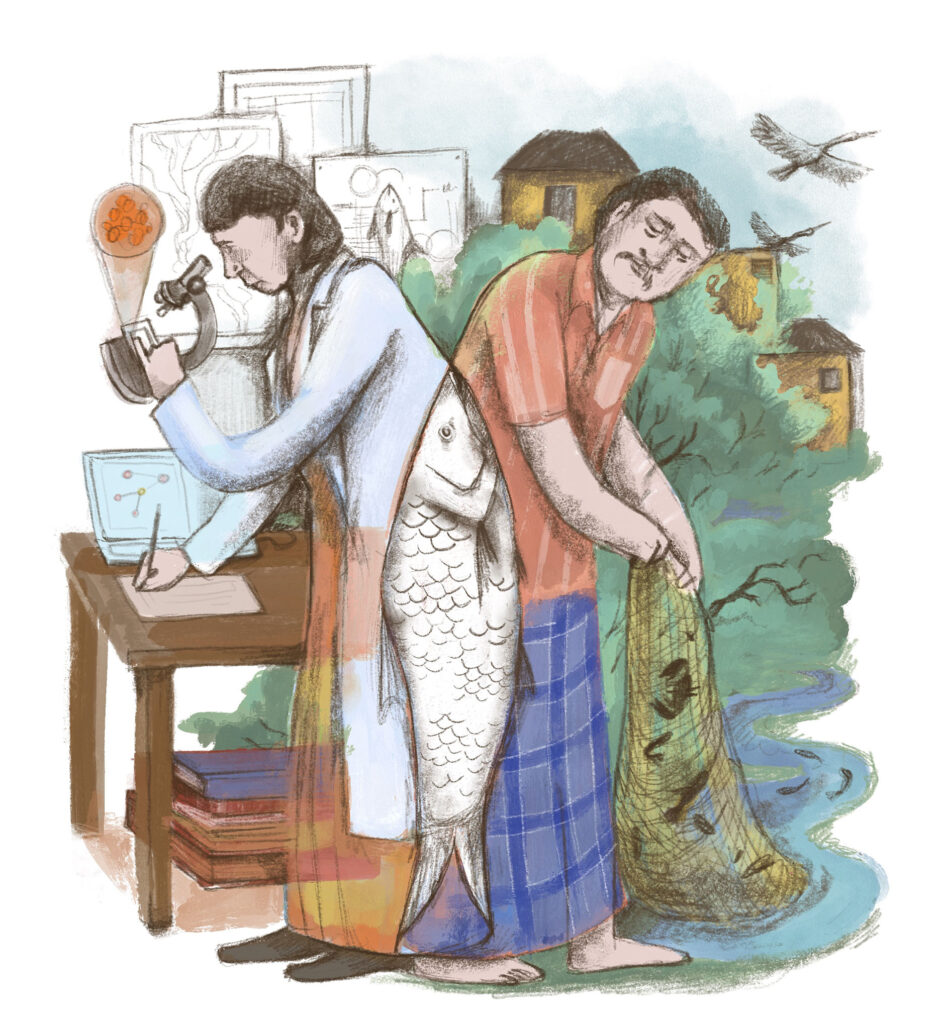
There are parts of the hump-backed mahseer’s domain lying just beyond the protection of government notification. Those places offer hope. Rivers running through protected landscapes are still vulnerable to pollution from upstream, or even from inside a protected area. Where humans engage deeply with their landscapes, they are in tune with the moods of the rivers and streams. Community protection has proven to be effective in parts of the Cauvery basin, including in Kodagu and Wayanad, and ecological monitoring is an area where locals can be employed. This will be a double win if poachers can become gamekeepers. Age-old wisdom offers clues for how and where to target efforts; we can then deploy modern technologies.
Forging ahead
For a little over seven years, the Mahseer Trust has been working to build a coalition in support of a conservation plan for the hump-backed mahseer. There have been issues along the way and some false starts. But now we have interest from local communities, special interest NGOs, and government departments at both state and centre-level. The time seems right to push for a new way of protecting freshwater and this umbrella species.
A soft touch combined with a deeper understanding of the fish’s ecological needs is where we are heading. Left to their own devices, fish and rivers both will sustain themselves. So: hands off, let those who are allowing them space continue to do so; let others follow their lead. The more room we give to hump-backed mahseers, the better their chances to recruit and thrive.
While we and those we work with consider Tor remadevii to be an umbrella species, there is merit in seeing it as a flagship species. Like the tiger of the forest, the tiger of the river is but a crucial part of a fragile habitat whole. We must focus on the habitat if we are to conserve the last few of these majestic fish and all of the other life sharing those rivers. There is still a long way to go, but it is made easier by forging strong partnerships. We can be sure that throwing even Critically Endangered fish species into a river solves nothing, but extending viable habitat gives them a chance.
Further Reading
Dutt, B. 2019. Once I caught a fish alive. In: Rewilding: India’s experiments in saving nature. Pp 90–108. Oxford University Press.
Harper, S. 2021. The mightiest mahseer. Norfolk, UK: Harper Fine Angling Books.
Lockett, S. A. 2021. Tales From Velimeen Land. https://www.mahseertrust.org/post/tales-from-velimeen-land. Accessed on January 30, 2026.
Pinder, A., Manimekalan, A., J. Knight, P. Krishnankutty, J. Britton, S. Philip, N. Dahanukar et al. 2018. Resolving the taxonomic enigma of the iconic game fish, the hump-backed mahseer from the Western Ghats biodiversity hotspot, India. PLoS ONE 13(6): e0199328. https://doi.org/10.1371/journal.pone.0199328.