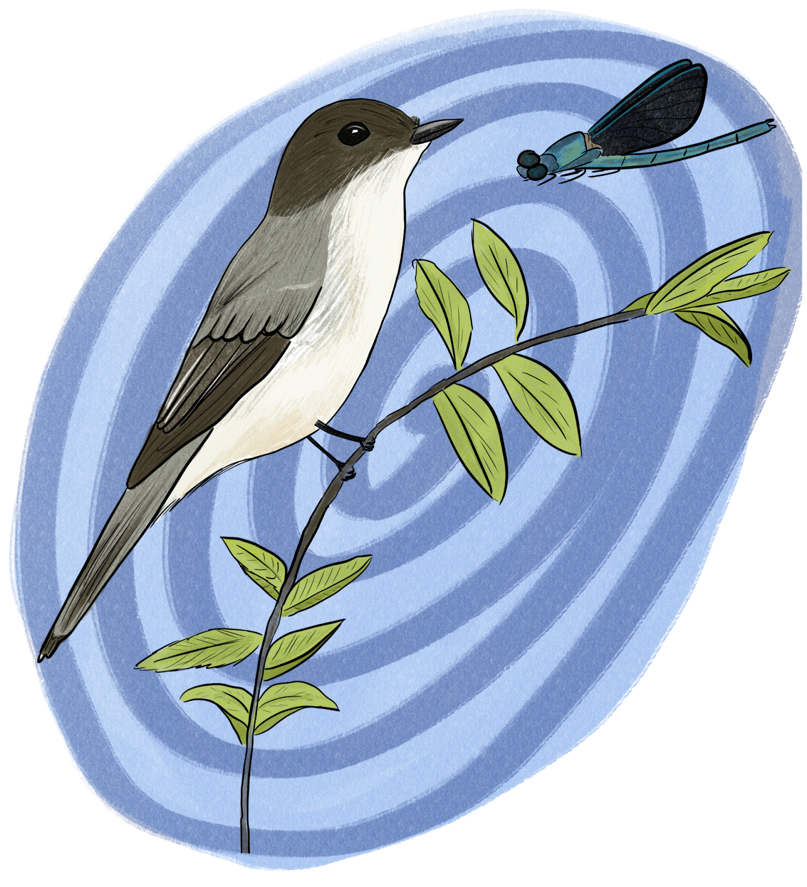
Feature illustration: An eastern phoebe perched on a branch, eyeing up a dragonfly
We like to say “one swallow does not make a summer”, but as aerial insectivore populations—as well as the insects that they depend on—decline globally, future generations may be lucky just to catch a glimpse of a swallow. Undoubtedly, these trends are linked to human activity in a changing climate, highlighting a pressing need to improve biodiversity conservation efforts. But how can we do this more strategically?
Many governments maintain steadily growing lists—often legislatively mandated—of threatened species within their borders. Those who are tasked with prioritising habitat conservation on a ‘one-species-at-a-time’ basis find themselves like Sisyphus, trying to roll an ever-larger rock up a steepening hill. However, with modern mapping tools and state-of-the-art genetic techniques, it is now possible to streamline conservation priorities across multiple species.
As a COVID-19 pandemic era project undertaken at the Canadian Rivers Institute at the University of New Brunswick, we set to work coupling biodiversity observations and high performance computing to inform the protection of entire groups of interacting species, while also addressing the role they play within the larger ecosystem. We focused on two distinct groups of species that naturally occur together: flying insect-eating birds and their food—aquatic insects—which are a rich source of essential fatty acids for fledgling development.
Rather than managing or conserving habitats for a single species, this strategy integrates the habitat needs of multiple species across both terrestrial and aquatic environments, while preserving the functional link between these birds and their food. This work follows a previous study, which examined how nature-based restoration, commonly known as rewilding, can heal broken watersheds by restoring basic food provisioning and other support services of natural ecosystems.
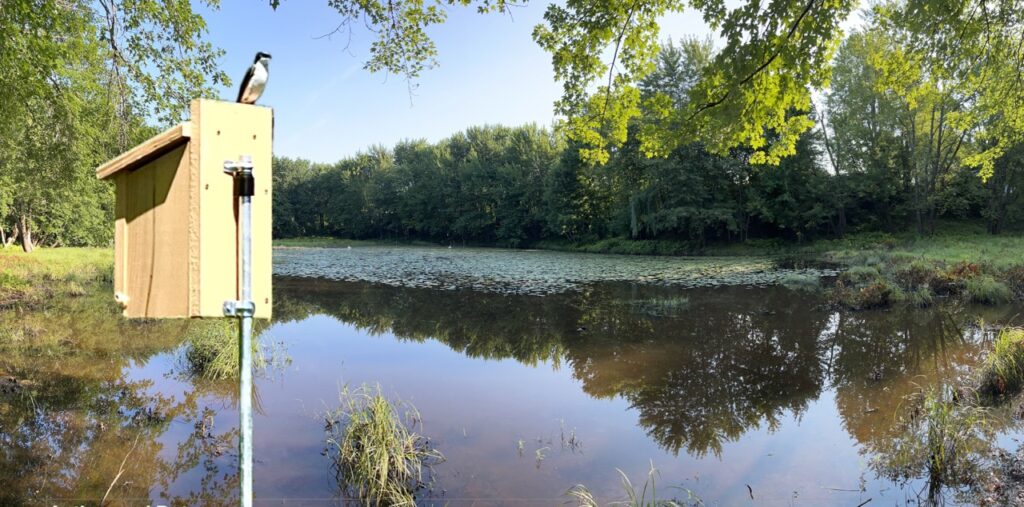
Our study (Wegscheider et al., 2025) focused on Wolastoq, a large watershed straddling the eastern US-Canada border and flowing into the Bay of Fundy. To map insectivorous bird habitat, we employed data from the Maritimes Breeding Atlas for five species: barn, tree, and cliff swallows, eastern phoebe, and eastern kingbird. Data on aquatic insect distributions, such as, mayflies, caddisflies, and stoneflies, were obtained in association with Canada’s community-based river biomonitoring program, CABIN, in collaboration with whom we collected environmental DNA. These are traces of freely occurring genetic material available in the environment that can be used to identify individual species presence. This process enabled us to detect environmental DNA corresponding to 95 different insects and allowed us to simultaneously model the distributions of many insect taxa at unprecedented detail.
Biodiversity data in hand, we mapped distributions of the five insect-eating birds and aquatic insects in our study. This enabled us to explore different conservation strategies to protect aquatic insect biodiversity and productivity, thereby supporting insectivorous birds. We evaluated scenarios following two targets for habitat conservation: (i) the UN Biodiversity Convention’s Aichi Targets at 17 percent of land area under conservation, and (ii) Canada’s national target of 30 percent land conservation by 2030 (‘30×30’).
We found that existing conservation areas were insufficient to ensure protection of either aquatic insects or insect-eating birds, according to the 17 percent and 30 percent area targets. Equally importantly, we found that prioritisation of bird habitat alone did not equally protect insects, and vice versa. Just as one swallow does not make a summer, focusing on single species or even closely-related groups of species will not halt losses across the full spectrum of biodiversity. By expanding conservation to include groups of organisms that contribute essential underlying ecosystem functions, we can develop smarter, more resilient, and efficient strategies to protect biodiversity in a rapidly changing world.
Further Reading
Rideout, N. K., N. Alavi, D.R. Lapen, M. Hajibabaei, G. Mitchell, W.A.Monk, M. Warren, S. Wilson, M. Wright and D.J. Baird. 2025. Quality versus quantity: response of riparian bird communities to aquatic insect emergence in agro-ecosystems. Frontiers in Sustainable Food Systems 8: 10.3389.
Rideout, N.K., B. Wegscheider, M. Kattilakoski, K. McGee, W.A. Monk and D.J. Baird. 2021. Rewilding watersheds: Using nature’s algorithms to fix our broken rivers. Marine and Freshwater Science 72: 1118–1124.
Wegscheider, B., N.K. Rideout, W.A. Monk, M.A. Gray, R. Steeves and D.J. Baird. 2025. Modelling nature-based restoration potential across aquatic-terrestrial boundaries. Conservation Biology 39(5): e70046. https://doi.org/10.1111/cobi.70046.