“There’s no way I’m touching that!”
“Why does it look like that?”
“Ewwww!”
These are things that I commonly hear at Butterfly Pavilion, the zoo where I am employed. We showcase a variety of invertebrates—animals with no bones—but our spider collection is one of our highlights. The spiders on exhibit range from tiny jumpers to giant tarantulas. Public reactions to them are as varied as the animals themselves, but it’s not unusual to encounter someone who finds our exhibits terrifying.
Arachnophobia (the fear of spiders) is one of the most common phobias. The Cleveland Clinic reports that approximately 3–15 percent of the population is arachnophobic. Yet only 0.5 percent of spider species found globally are harmful to humans. With at least 50,000 species of spiders found on the planet, that leaves only 250 with medically significant venom. Whether you think they are cute or creepy, the majority of spiders aren’t dangerous.
Yet the number of people who tell me they hate spiders or kill them on sight continues to grow. As a recovering arachnophobe myself, I can empathise with those who find them scary. But regardless of how a person feels about them, spiders are an essential part of our ecosystems, and rampant fear can have devastating effects on their conservation. Invertebrates as a whole are woefully underrepresented when it comes to conservation, and spiders are frequently overshadowed by pollinating insects when it comes to conservation action.
After several years of research and teaching about spiders, I’ve compiled a few strategies to use when I talk to people about them, to help these fascinating creatures seem more relatable and less scary. By studying what traits make specific animals likable, we can use that information to help people learn to love spiders.
What is charisma?
‘Charismatic’ animals are those that inspire interest, affection, or attraction. While animal preferences can be highly subjective, there are certain traits that charismatic animals tend to share. Large, forward-facing eyes, interesting colours or patterns, and beauty or “cuteness” are all considered important when evaluating charisma. Large size is also fairly important, but only when combined with other desirable traits. Big cats are generally considered charismatic, but big spiders are not.
Relatability is also crucial. We can more easily empathise with animals that live in family groups, engage in play, and use tools because their behaviour mirrors our own. It’s much harder for us to relate to an animal when its behaviour doesn’t make sense to us.
Non-charismatic animals are those considered ugly, gross, or scary. Spiders frequently top the list, along with insects and snakes. Spiders are at a distinct disadvantage when it comes to charisma—their bodies are very different from ours, and their behaviour can be difficult to understand and relate to. They aren’t the sort of animals that people want to pet or cuddle.
But we can use what we know of animal charisma and apply it to spiders. It might not be immediately apparent, but spiders can meet the definitions of charisma—you just have to look at them through a different lens.
Emphasise our similarities
Spiders may live very different lives from humans, but ultimately they want to survive, just like us. They build homes, find partners, look for food, and care for their offspring. While the majority of spider species are solitary, several social species have been discovered. Indian social spiders (Stegodyphus sarasinorum) and African social spiders (Stegodyphus dumicola) build communal webs and hunt together. Socotra Island blue baboon tarantulas (Monocentropus balfouri) can even be kept in communal enclosures under human care.
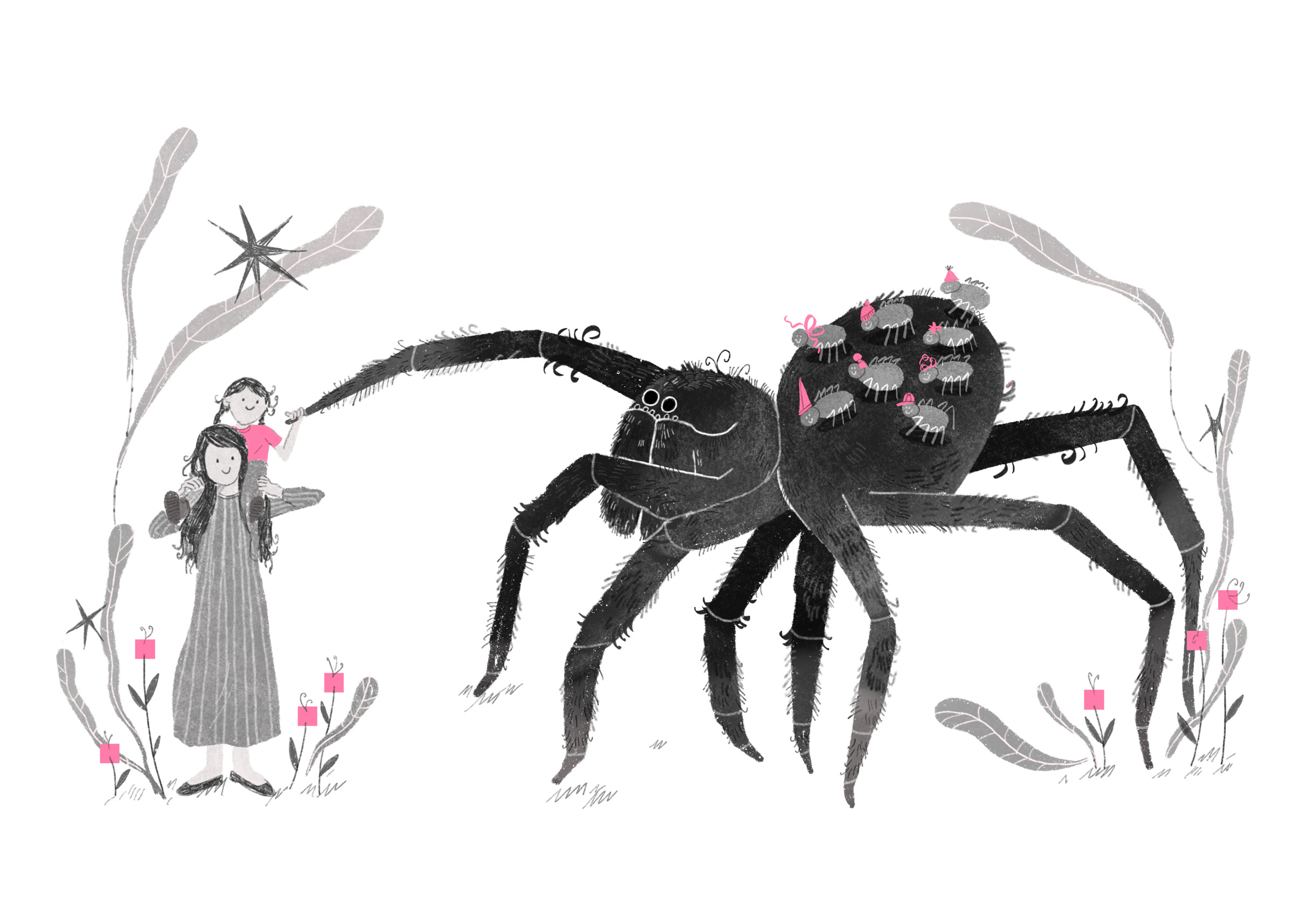
Spiders aren’t known for their strong maternal instincts, but some species do care for their offspring. Wolf spiders (Hogna sp.) carry their spiderlings on their backs for up to two weeks after hatching. Nursery web spiders (Pisaura mirabilis) spin a silk chamber for their young to have a safe place to complete their early molts. In 2018, for the first time, an ant-mimicking jumping spider (Toxeus magnus, a species native to Southeast Asia) was observed ‘nursing’ its offspring with a nutritious milk-like substance secreted from the egg-laying organ.
Finally, there is evidence suggesting that jumping spiders may be capable of dreaming. A 2022 study found that they experience a REM-like sleep state, which in humans is associated with dreaming. It’s possible that other spider species also experience REM-like sleep, though jumpers are particularly easy to study because of their large eyes. While we may never know for certain, the possibility remains.
You may have to look closely, but spiders are more similar to us than expected!
Focus on how they help us
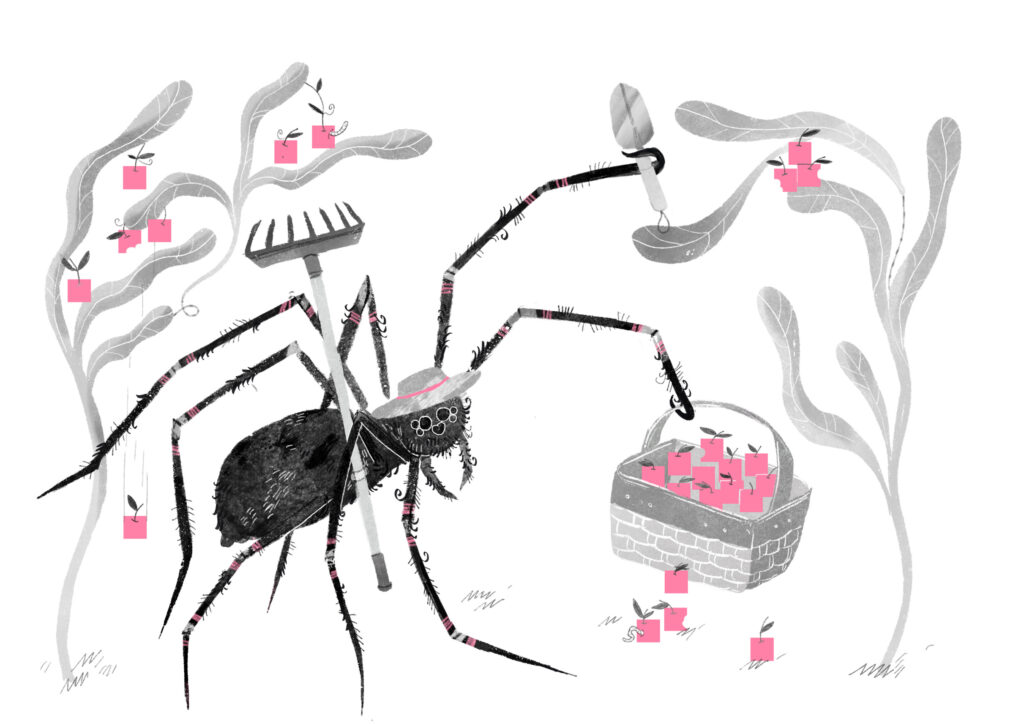
A world without spiders would be very different. For one, there would be a lot more pests! Spiders prey on flies, cockroaches, grasshoppers, and other undesirable insects. Multiple studies have shown that the presence of spiders in orchards can reduce pests and increase fruit yield.
While spiders alone are not enough to eradicate agricultural pests, they are an important part of keeping the ecosystem balanced. They are also an important food source for many animals, including birds, reptiles, amphibians, and mammals.
Get excited!
Finally, I have found that my own enthusiasm for spiders can be infectious. I try to head off any declarations of disgust by gleefully sharing how cute I find tarantulas or huntsman spiders. This typically stops people in their tracks and forces them to re-evaluate the animal they are looking at.
I still get skeptical looks, but more often than not, I receive a positive response. The animals I work with may not be attractive in the traditional sense, but a little enthusiasm can go a long way!
Surprise yourself
Spiders are incredible animals. I, for one, am glad that I took the time to conquer my own arachnophobia and learned to love them. Now I’m able to utilise my own passion for spiders to help people fall in love with them too.
Spiders may not be as relatable as chimpanzees or as majestic as African elephants, but they can be considered charismatic—if we are willing to look closely. They contribute to the health of our ecosystems and enrich our lives simply by existing.
The next time you find a spider in your home, try to push past any initial fear. Take a moment to observe it, and feel compassion for it. You may be surprised by what you discover.
Further Reading
Cardoso, P., S. Pekár, K. Birkhofer, A. Chuang, C. S. Fukushima, E. A. Hebets, Y. Yann Henaut, et al. 2025. Ecosystem services provided by spiders. Biological Reviews 100(6): 2217–2236. https://doi.org/10.1111/brv.70044.
Eisenhauer, N., A. Bonn, C. A. Guerra. 2019. Recognising the quiet extinction of invertebrates. Nature Communications 10(1): 50. https://doi.org/10.1038/s41467-018-07916-1.
Fordahl, C. 2024. Beyond animal charisma: A sociological approach to charismatic species. Conservation & Society 22(1): 14–24. https://doi.org/10.4103/cs.cs_118_22.