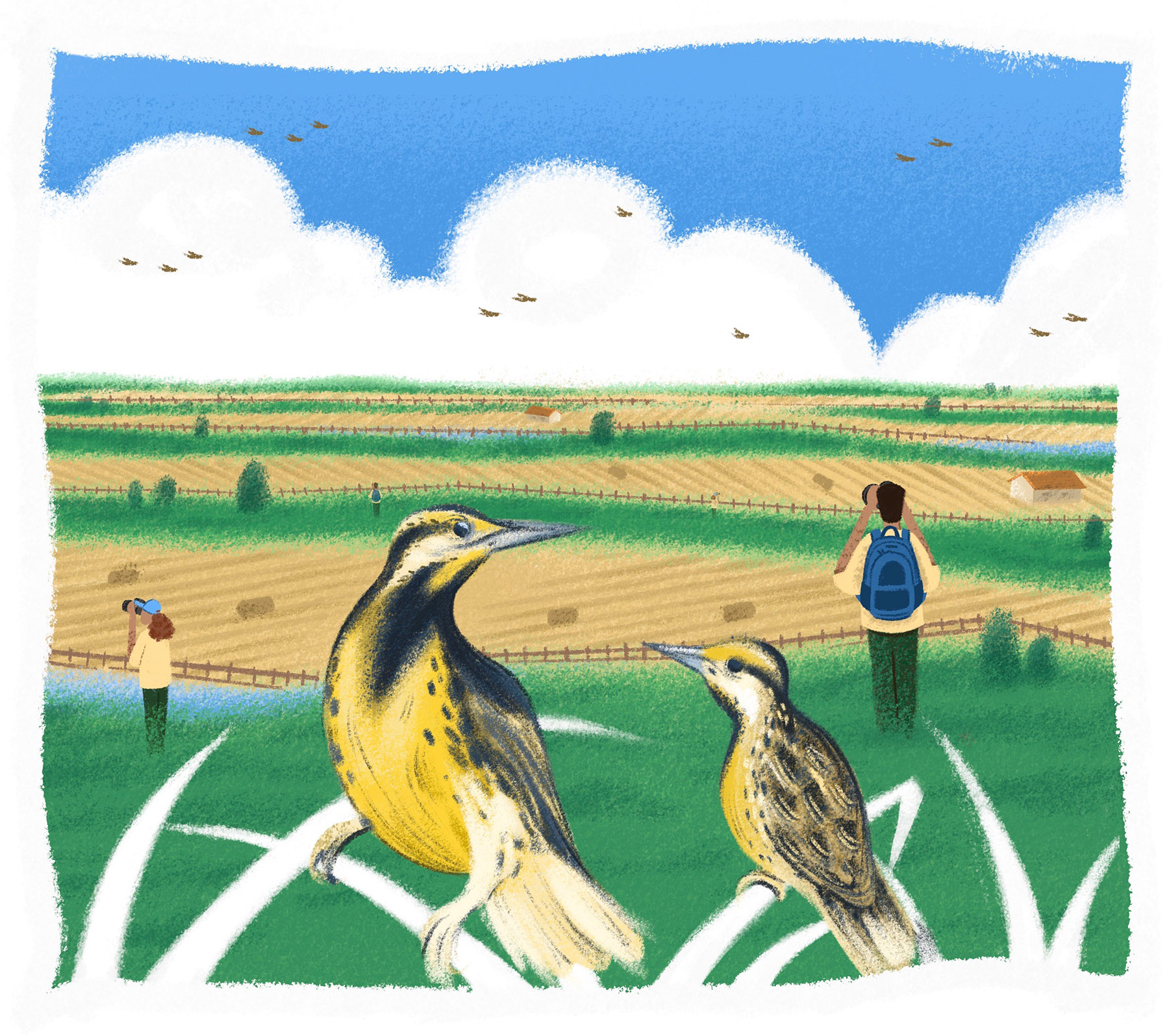
In the late spring, just before sunrise, Smithsonian scientists and community volunteers arrive at designated points spread across northwestern Virginia’s farmland. Working in pairs, they wait, watch, and listen. For 10 minutes, they record the species of each individual bird that they see or hear within a 100-metre radius. Most often, they spot common species, such as the red-winged blackbird or eastern bluebird. Less often, they record one of Virginia’s increasingly rare species of grassland obligate birds, such as the northern bobwhite or eastern meadowlark. Of all North American birds, grassland bird populations are declining the quickest. Where the scientists and volunteers are working, these grassland species are threatened by earlier and more frequent hay cutting that destroys ground nests, agricultural intensification, pesticides, and grassland conversion to other land uses.
Our understanding of biodiversity on US agricultural lands is limited because most of these are privately owned, with few restrictions on how they are managed. One conservation tool that is increasingly popular is conservation easements. By enrolling land in a conservation easement, landowners cede some or all of that land’s development rights—often in exchange for a tax benefit. Because conservation easements persist in perpetuity, even if the land is sold, some conservationists see them as contributing to conservation area targets, such as the target of protecting 30 percent of the world’s surface area by 2030 set under the Kunming-Montreal Global Biodiversity Framework. As of 2025, about 4.3 million acres of land in Virginia, or about 17 percent of its total area, is under conservation easement. However, assessing the effects of conservation easements on biodiversity is limited by the fact that species monitoring is not required, leaving little data to evaluate their effectiveness.
Using data collected by Smithsonian scientists and volunteers, we aimed to provide the best evidence yet for how species abundance (the number of species and number of individuals per species) differs between agricultural properties with and without conservation easements. For over 10 years, Virginia Working Landscapes (VWL)—a programme of the Smithsonian National Zoo and Conservation Biology Institute—has partnered with volunteers to conduct bird surveys in private working grasslands, recording the presence of more than 100 species. We analysed VWL bird survey data alongside records from the National Conservation Easement Database (NCED), which uses voluntary crowdsourced information to show locations of conservation easements and their dates of origin. According to the NCED, which is the best database on easements available, despite not being comprehensive, 54 percent of the properties that had been visited by VWL and the volunteers were under an easement.
To understand the effects of conservation easements, we developed four statistical models. With these models, we compared grassland obligate species to the wider bird community, and examined the influence of both simply having an easement and the length of time a property had been under one. Our study showed that bird species respond to conservation easements in different ways. Some species were significantly more abundant on eased properties, others were less common, and many showed little difference at all. This variability across species meant that there was no consistent overall effect on species abundance in three of the four models. Further, we found no evidence that overall bird species diversity differs between properties with and without easements. However, in one model, which assessed the full bird community and only accounted for presence of an easement (versus time under easement), we found some evidence that the average bird species abundance was higher on eased properties.
These results indicate that conservation easements alone do not fully explain patterns in bird diversity and abundance. While our analysis accounted for differing land cover surrounding surveyed sites, we could not assess whether or how landowners of eased properties managed their land differently from those without easements. Further, the limitations of the crowdsourced data in the NCED made measuring the effects of easements more difficult.
Thus, while conservation easements play an important role in protecting private agricultural lands from development pressures, our analysis revealed highly variable effects on bird abundance by species—some showing positive responses, others negative, and some neutral—resulting in no clear overall trend across all species. Greater transparency in easement contracts and requiring standardised reporting metrics, particularly on land management practices, would significantly enhance scientists’ ability to assess the role of easements in addressing multiple threats to biodiversity.
Further Reading
Van Sant, L., A. E. M. Johnson, D. J. Read, G. Connette and E. Shibley. 2025. Effects of conservation easements on bird populations in the Shenandoah and Piedmont Regions of Virginia. Conservation Science and Practice: e70019. https://doi.org/10.1111/csp2.70019.