What do we visualise when we think of cities? Noisy, dusty spaces made up of concrete and glass, where life moves at a breakneck pace? And what do we imagine when we think of nature-filled spaces? A trek to the mountains, or a trip to a wildlife sanctuary?
Yet, our cities are teeming with a quiet, industrious world of nature that we often overlook. Ask any urban biologist, and they will show you the thriving ecosystem that persists in the cracks of pavements to the canopies of roadside trees.
What we need is the curiosity to gaze, and the compassion to understand.
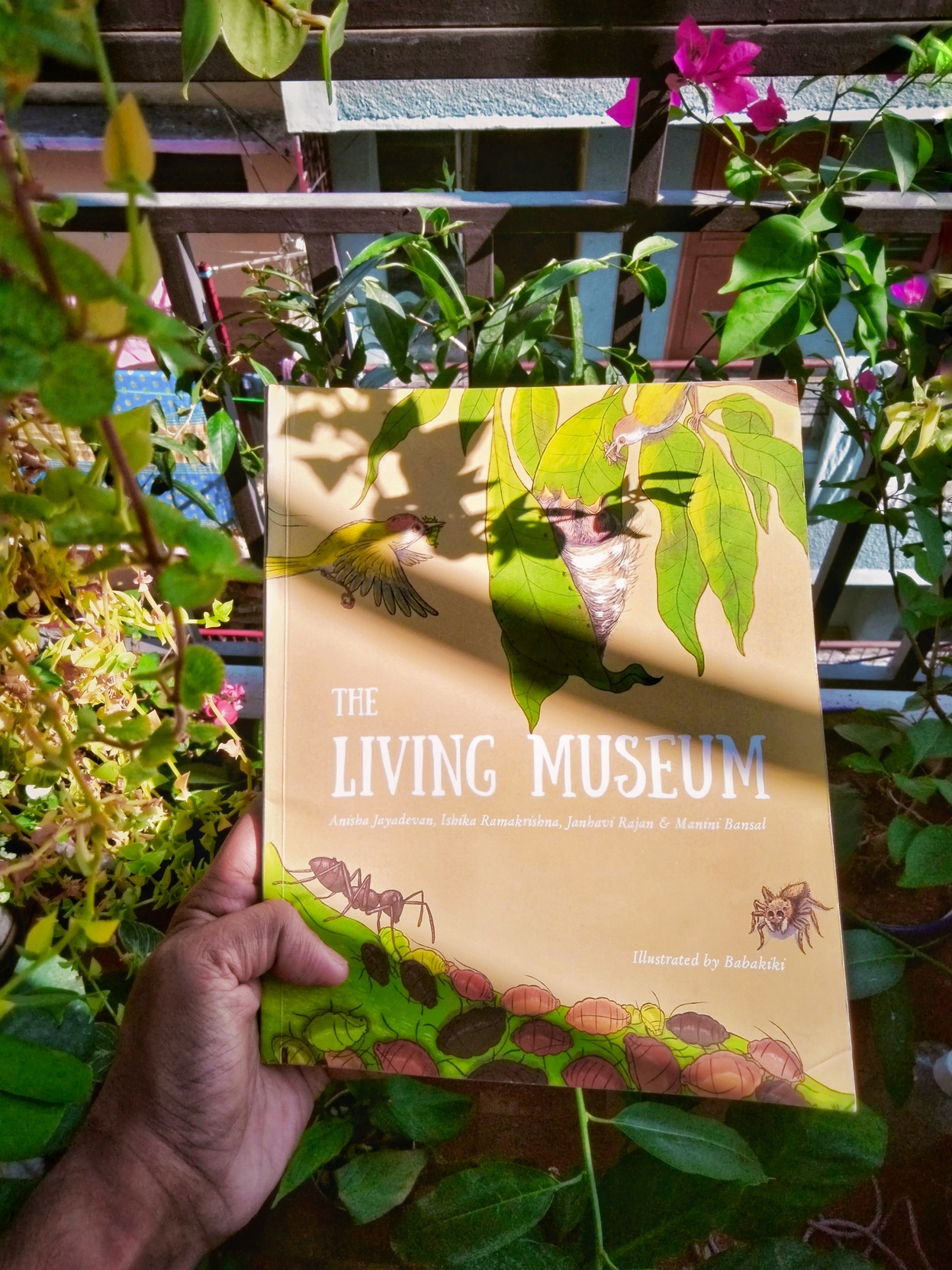
The Living Museum, an illustrated guide to urban biodiversity in India, breaks the myth that our city is barren and devoid of nature. Created by the collective Café Oikos (Anisha Jayadevan, Ishika Ramakrishna, Jahnavi Rajan, Shishir Rao, and Manini Bansal) and brought to life through the vibrant illustrations of Studio Babakiki (Fahad Faizal and Sunaina Coelho), the book acts as a guide to the living natural world that surrounds us.
Nature in our backyards
The leader of this journey into urban wilderness is an unlikely curator: a jumping spider. While we often overlook it as a nuisance, this ‘hairy hunter’ is a bridge between the domestic realms of our homes and the complex ecosystems that lie right beside it. The choice of protagonist builds on the central theme of the book: conservation is not limited to the megafauna of larger ecosystems, but begins with the architects of smaller ones in our own homes.
Like a traditional museum, the book takes the reader into ‘halls’. However, these galleries are anything but static; they are diverse and dynamic, ranging from indoor spaces to gardens to roadsides. Leafing through the pages, the reader is transformed from passive resident to active observer—exactly as the book intends.
One of the book’s greatest strengths lies in its ability to translate complex biological behaviours into engaging stories. Readers are drawn to the high-stakes survival mechanisms of their not-so-familiar neighbours.
We learn about the masterful deceptions of the common Mormon butterfly, which drapes distasteful costumes to ward off predators. And the toxic chemical warfare of the plain tiger caterpillar, which utilises the giant milkweed as a biological shield.
The authors also give us a peek into the avian world. We learn about the spectacular breeding displays of black kites and the seasonal transformations of cattle egrets, which sport orange feathers to signal their readiness for a mate.
The book reminds us that our cities are part of the natural world, not separate from it. It gives us ways we can aid the adaptation of species we coexist with in urban spaces.
Beyond aesthetics
While The Living Museum is undeniably beautiful, it does not shy away from the harder science of urban ecology. The aesthetics of a tree-lined street is also backed by functional value. As research by ATREE shows, tree canopies create a temperature difference of up to 5°C compared to bare stretches of the same street, while also acting as sinks for airborne pollution.
The book subtly weaves these nuggets of knowledge into its pages. It reminds us that urban biodiversity is not just a luxury, but a life-support system. It also addresses the internal clocks of city-dwelling species, and how climate change is beginning to destabilise the delicate seasonal cycles of flowering and fruiting.
Art for conservation
The pages of The Living Museum are brought to life with vivid imagery. The illustrations by Fahad Faizal and Sunaina Coelho are sweeping and exuberant. The colourful artwork complements the prose in capturing movement and the flurry of activity.
In a world full of digital fatigue, the tactile and visual appeal of the book serves as an entry point to citizen science. The visual vignettes feed our curiosity, offering ways to connect with our surroundings through sight, sound, smell, and touch. From the sound of a bird call to the smell of a rain-soaked garden and the texture of bark, each element is a conduit of experiential learning that goes beyond facts and lays bare a world of urban ecology and citizen science.
In doing so, the book addresses the ‘extinction of experience’—the loss of direct contact with nature among urban dwellers.
Call to action
Ultimately, The Living Museum moves beyond observation toward agency. It poses a question: How can we, as citizens, contribute to the conservation of this living system?
As co-author Anisha Jayadevan suggests, the first step is simply fostering curiosity. By asking where a bird builds its nest or which month a tree fruits, we begin to draw patterns. These patterns become the foundation of citizen science, enabling ordinary residents to contribute to the data needed to protect urban ecosystems.
The book ends with a ray of inspiration and hope for urban communities to come together to conserve the rich biodiversity of these living ecosystems that surround us.