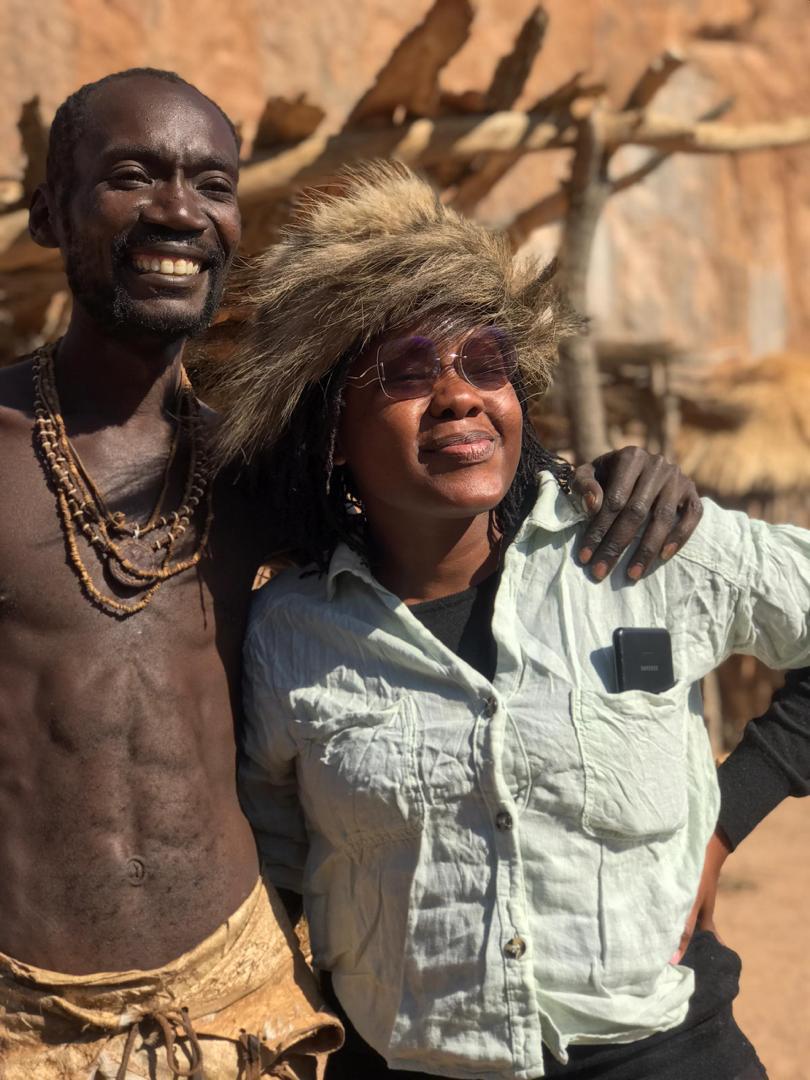
Feature image: The author in Damaraland, Namibia, interacting with the people of the land, and learning from them and their ways of knowing
In the wide, arid scenery of South West Africa, the ancient stones, paintings, and petrified wood hold millennia-old stories. Yet, they are not just relics of the past—they serve as tangible metaphors for the complexities of modern conservation debates. My PhD fieldwork helps bring together not just the physical world but also the digital world of wildlife conservation discourse.
Standing timeless in Namibia’s desert landscape, the first ‘thing’ to explore from my fieldwork is the Twyfelfontein engravings and the Bushmen paintings located nearby, both etched into the rocks of Damaraland. Though ancient and seemingly silent, they capture moments of human interaction with the environment that are still relevant today. They tell stories of a time long before—yet ironically so similar to—today’s conservation debates; stories of survival, respect for wildlife, and the balance between humans and nature—a balance that has been disrupted by modern, Western-based conservation models.
These markings, mute as they may seem, speak volumes about the human connection to the land and its creatures. They are not just art forms but expressions of relationships between humans and non-humans. The rocks themselves seem to participate in this relationship, though they are often treated as mute. The stone, despite being non-living, has a kind of agency. It draws humans to it, commands reverence, and tells a story that isn’t verbal but visual and felt. The Western-based conservation model, however, often reduces this relationship to scientific categorisations, sidelining the Indigenous knowledge systems that recognise the stone’s deeper meanings.
The other ‘thing’ is the petrified wood. Particularly unique to the Damaraland region, it embodies both endurance and silence. Yet, it too is a repository of knowledge, waiting for us to decipher its story. On the surface, this stone-like material is scientifically classified as fossilised remnants of ancient forests. Standing silent and unchanged in the desert, it is another symbol of disruption. It speaks of time and transformation, having once been living, breathing trees, now turned to stone by the slow, almost invisible hand of time.
Yet, this description seems to fall short. The petrified wood isn’t just an inert object; it holds layers of meaning, history, and relationships with the land and the people. It embodies a kind of muteness, a silence that mirrors the erasure of Indigenous voices and histories within conservation narratives; a muteness often imposed on rural communities in Namibia, whose livelihoods are deeply tied to the land and the wildlife. Just as the petrified wood is reduced to an object of scientific curiosity, the voices of these communities are often sidelined in policy debates.
In many ways, this petrified wood exists as a ‘thing’ but also as something beyond that—it holds an abstract veil of connection to the past. The Western conservation model, while focused on wildlife preservation, sometimes overlooks the intricate relationships that Indigenous people have with the environment—relationships that are as enduring and complex as the fossilised forest itself.
When the stone speaks
In my fieldwork, I not only engage with these physical elements but also with the digital realm, where conversations about wildlife conservation unfold. Social media platforms serve as the modern-day ‘rocks’ upon which stakeholders carve out their positions, often in ways that abstract and distance the reality on the ground. Like the rock engravings, these digital debates capture a moment in time, yet they too can feel silent—devoid of the deeper, lived experiences of the communities impacted by conservation policies.
The challenge lies in interpreting both these ancient and digital inscriptions, understanding what is being said, and what remains unsaid. Both the stones of Damaraland and the social media conversations hold power, not in their noise, but in their silence. They remind us that conservation is not just about protecting wildlife, but also about recognising the stories that are etched into the land and the voices, both human and non-human, that remain unheard.
Social media, as part of my fieldwork, echoes this tension between the living and non-living, the voiced and the silenced. In online spaces, conversations between wildlife stakeholders often treat the landscape and the wildlife as ‘things’ to be managed, commodified, and controlled. Policy debates on platforms like Twitter (now X) or Facebook tend to decontextualise these natural elements, transforming them into abstract numbers or conservation targets. This reflects a simulacrum—an imitation of reality—where what is discussed online may not align with the complex, lived experiences of the rural communities affected by these policies. The Western framework creates an intimacy with the idea of conservation but ignores the intimate relationships between rural people and their environment.
The violence done to these things—whether it’s through Western conservation efforts or the forced belonging imposed on local communities through policy—begins with naming. In naming the petrified wood, the rocks, and the wildlife, we risk objectifying them, freezing their identity in the lens of Western science. This mirrors the violence done to people when names, identities, and histories are imposed on them without consent. The lines between what is a ‘thing’ and what is living are thin, and the violence begins when we start treating living relationships as things to be categorised, controlled, or owned.
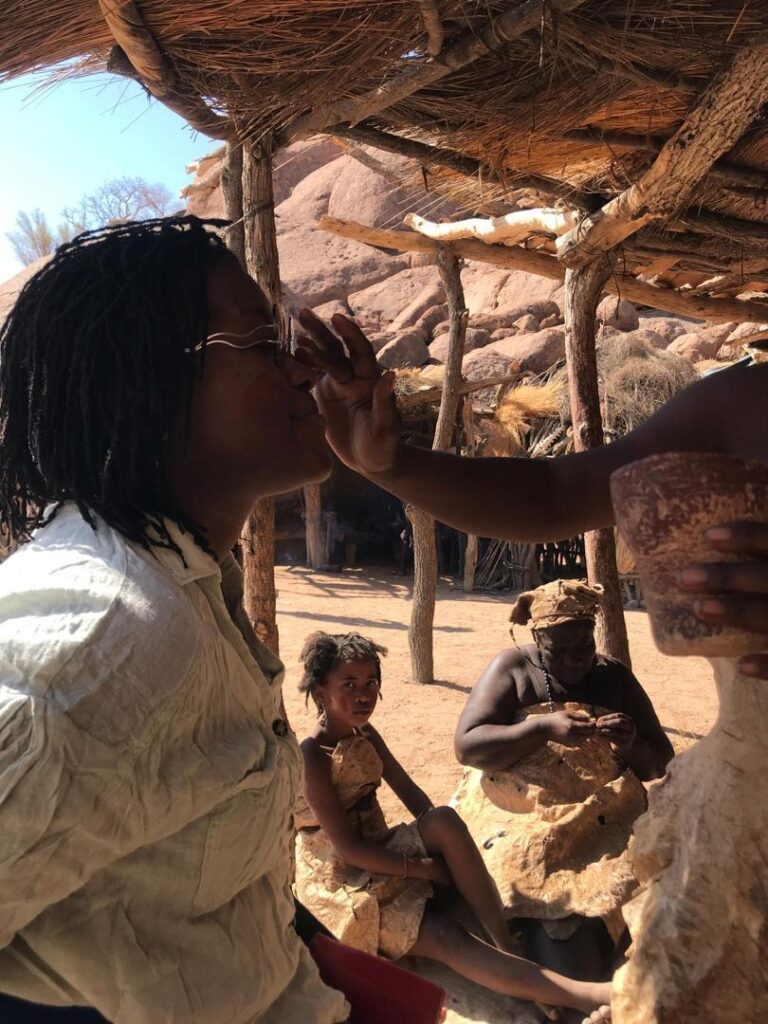
In the context of social media, research methods themselves become “fingerfied”—frozen into a single dimension of analysis. The act of capturing and interpreting online conversations can feel like reducing a living, fluid interaction into something static—a thing. Yet, the conversations around wildlife conservation are not neutral. They are shaped by cultural realities, power dynamics, and the legacies of colonialism, much like the petrified wood that remains as a silent witness to time.
Reclaiming African history—especially in the context of wildlife and land conservation—requires us to listen to the stones, to the silence of the more-than-human world, and to understand the relationships they hold with the people. The petrified wood, in its stillness, has agency. It shapes the way humans perceive and interact with the land, just as social media shapes the real-world consequences of policy. The violence of simplification—whether of a stone or a social relationship—reveals the tension between the objectified and the living, the thing and the human, both in Namibia’s desert and in the digital field of social media.
Ultimately, things matter because of the feelings they evoke and the relationships they shape, whether they are ancient fossils or modern digital avatars. Understanding the force of things helps us recognise their agency, and in turn, question our own biases in how we relate to them—both in writing and in the world. The petrified wood, though seemingly mute, holds power in its silence. It speaks to the history of the land, the violence of colonialism, and the need to return to Indigenous ways of knowing that understand the world as a complex web of relationships between humans and the more-than-human and metaphysical world.
One thus wonders, did they silence us? Or did we silence ourselves?
Further Reading
Foyet, M. 2025. Using digital and rights-based approaches to understand institutional linkages between social media, wildlife activism and the new conservation movement in southern Africa: Views from non-state rural actors. Doctoral dissertation, University of Florida.