Feature image: Underwater Ocean corridor. Photo credit: Damocean via iStock
The work of economists Daron Acemoglu and James Robinson has never been more relevant. In their landmark book The Narrow Corridor (2019), they argue that social progress is possible only within a delicate, contested space where the power of the state and the power of society are held in a productive balance.
Criticisms aside, the metaphor is potent. On one side of this corridor lies the “Absent Leviathan”: a state too weak to provide basic services or enforce rules. On the other lies the “Despotic Leviathan”: a state so powerful it crushes society and serves only a narrow elite. Liberty, progress, and prosperity, they contend, exist only in the middle, where an organised society can hold the state accountable, creating what they call a “Shackled Leviathan”—one that is strong and able to fulfill critical functions, but bound to serve the common good.
For those of us in marine resource governance, this framework is a powerful diagnostic tool. The reason is simple: many of the world’s fisheries are managed by institutions that fall far outside this corridor.
In practice, fisheries management institutions often embody the Absent Leviathan: chronically under-resourced agencies unable to perform fundamental governance functions such as science, regulatory development, or enforcement. In many other cases, these institutions operate as arms of the Despotic Leviathan—captured by powerful elites who impose extractive economic regimes benefitting a narrow minority at the expense of the resource. The root of both failures is the same: the absence of a strong, capable state that is simultaneously held in check by a strong, mobilised society.
But can this grand theory of political economy help us both understand and design concrete advances towards more sustainable and equitable oceans? Two recent reforms in South America suggest the answer is yes.
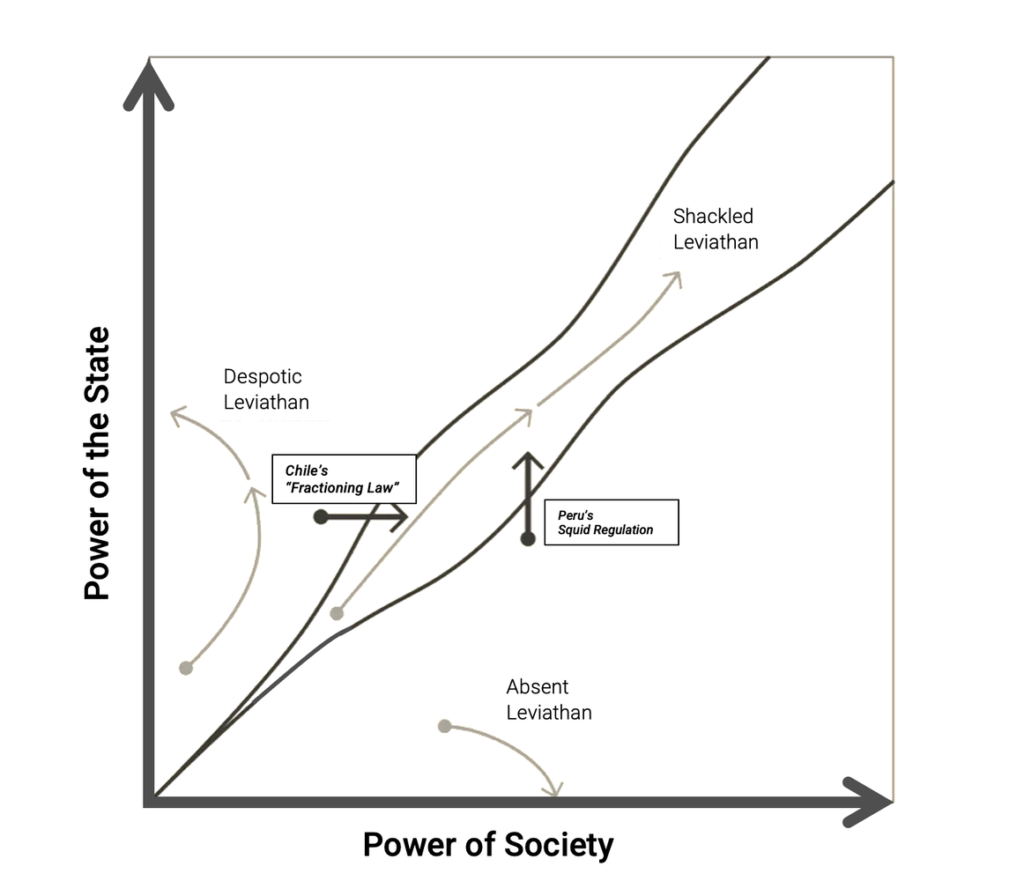
Graphic representing the two case studies reported within the Narrow Corridor framing (Source: Acemoglu and Robinson, 2019)
How Chilean fishers reclaimed their rights
The story of Chile’s Fisheries Fractioning Law (2025) is a textbook case of society mobilising to correct a captured state. The conflict was institutionalised in 2013 with the Longueira Law, a regulation born from a crisis of legitimacy. Proven cases of corruption led to unfair allocation of rights: nearly 78 percent of the nation’s fisheries wealth were handed to the industrial fishing sector. For more than a decade, Chile shouldered this injustice: a Despotic Leviathan where the state’s power was wielded to serve a narrow elite, leaving the artisanal sector fragmented and marginalised.
The turning point required decisive action from the state, but this could only happen with strong societal backing. In a pivotal 2024 meeting (for an inside perspective, check Martínez, 2025), artisanal leaders diagnosed the root of their political weakness: their own disunity. From this insight, the National Alliance for the Defense of Chilean Artisanal Fishing was born, uniting multiple federations into a single political force.
By engaging in a safe space for open dialogue, the Alliance forged a unified front—one capable of bold action. Their agenda was clear: first, an immediate and equitable reallocation of quotas; second, the establishment of a long-term platform to secure access to basic social rights. Armed with a shared purpose, they systematically engaged the political process. In the framing of Acemoglu and Robinson, a newly mobilised society began to shackle a state that had long served elite interests. The results are a testament to their success.
The new Fisheries Fractioning Law, enacted in June 2025, represents a material reallocation of power. The artisanal sector’s share of national quotas has soared from 22.2 percent to a landmark 49.5 percent. This was not a gift; it was a political achievement, as well as a vivid reminder that the corridor is not a static place, but a space that is won when society organises to pull the Leviathan towards serving the common good.
Building a state for Peru’s squid fishers
The challenge in Peru’s giant squid, or pota, fishery was not the same. Here, the country’s largest artisanal fishery operated in a dangerous power vacuum. It was governed by an obsolete 2011 regulation (for further details, see Rojas 2025) designed to manage activities—such as the operation of an industrial fleet—that had since disappeared. This was a classic Absent Leviathan: a state whose weakness left a vital resource—and their users—legally unrecognised and vulnerable to capture by industry elites and alien interests.
The solution, therefore, needed to be more foundational. It began with patient institution-building to bridge historical tensions between groups with disparate interests. Before a unified voice could emerge, the actors themselves had to be organised. Through a focused process of catalysis, these disparate groups of fishers and processors came together to form coherent, national bodies—principally the artisanal fishers’ association SONAPESCAL (Sociedad Nacional de Pesca Artesanal) and the processors’ association CAPECAL (Cámara Peruana del Calamar Gigante).
Once these institutions were in place, the two groups—demonstrating remarkable vision—forged a strategic alliance. The breakthrough came at a precise historical moment—when, for the first time, incentives truly aligned. For processors, the motivation had long been the need to address a cascade of uncertainties threatening their long-term viability: an unknown stock status, an ineffective management regime, and an unstable legal landscape. For artisanal producers, however, it was only with the recent completion of fleet formalisation—and the security of licenses for more than 90 percent of the fishing vessels, a process SONAPESCAL critically supported (see Fiestas, 2025)—that the incentive to act truly emerged. Suddenly, this overwhelming majority of fishers and processors shared an urgent reason to work collectively, overcoming historic distrust and inertia.
The Squid Management Regulation enacted in 2025 is the direct outcome of this pivotal marriage of incentive and agency. Over 90 percent of the coalition’s policy proposal was adopted, formally declaring the fishery exclusively artisanal and establishing a modern governance scheme to secure the health of the stock. The Peruvian case offers a profound insight: sometimes the corridor is reached not by shackling a despot, but by empowering a society to call a capable state into being, ensuring it arrives already bound to serve the public good.
Two paths into the corridor, one critical lesson
Viewed together, these recent advances in Chile and Peru are two sides of the same coin. They represent two distinct struggles to forge power into the narrow corridor. In Chile, a powerful society rose up to constrain a captured state, pulling it back towards the middle. In Peru, a newly organised society effectively built a state where one was absent, giving away resistance to regulation, enabling the state to fulfill its role and pushing it forward into the corridor from a place of weakness.
These are not just local stories; they are illustrations of universal principles. They show that securing the fair and sustainable use of ocean resources is not primarily a technical problem to be solved. It is, first and foremost, a governance challenge—one that requires moving beyond simplistic, top-down fixes to engage with the complex, messy, and essential work of building and balancing power.
The ocean is a fundamental public good, and it can only be defended by state institutions that are both capable and accountable. As these cases show, forging such a state is the real work. Whether it means shackling a Leviathan that serves the few or building one to serve the many, the goal is the same: shaping governance institutions that can truly protect our shared planet.
The future of the ocean lies in that narrow, contested, and vital corridor.
Further Reading:
Acemoglu, D. and J.A. Robinson. 2019. The Narrow Corridor: States, Societies, and the Fate of Liberty. Penguin Random House.
Fiestas Flores, J. M., M.E. Rosas Houghton, J.L. Jacinto Galán, S.H. Juárez Ruiz, J. Querevalú Puescas, E.G. Vega Pardo, C.W. Yenque Carrasco et al. 2025. La Pesca Artesanal Peruana y la OROP-PS. Un Camino Colectivo por Nuestros Derechos. https://doi.org/10.5281/zenodo.16741473.
Martínez, M. 2025. New allocation of fishing rights in Chile: Achievements by the artisanal fishing sector guided by a common agenda. https://www.linkedin.com/pulse/new-allocation-fishing-rights-chile-achievements-mart%C3%ADnez-gonz%C3%A1lez-rbpge/. Accessed on May 20, 2025.
Rojas, P. 2025. New fishery management regulation for the jumbo flying squid (dosidicus gigas): current status, progress, and challenge. https://www.linkedin.com/pulse/new-fishery-management-regulation-jumbo-flying-squid-rojas-v%C3%A1squez-p60re/. Accessed on March 11, 2025.