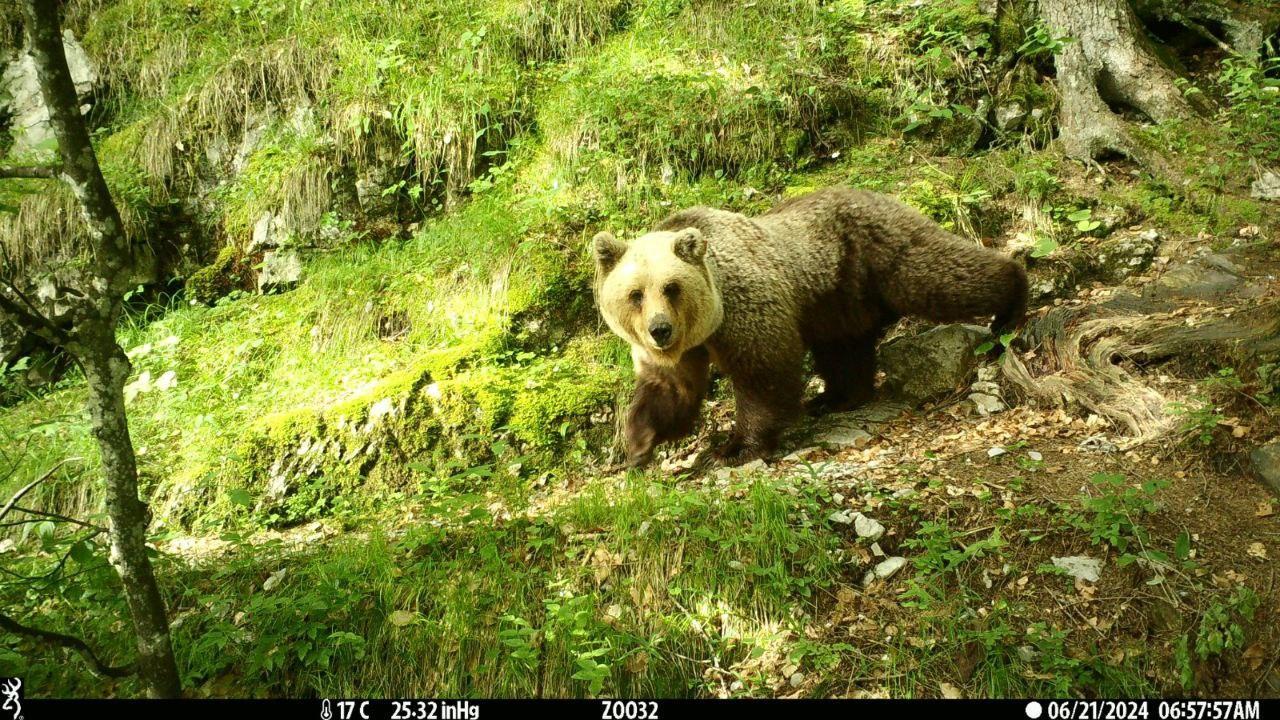
Feature image: Camera trap image of a brown bear captured during systematic monitoring in the central Italian Alps (Photo credit: MUSE–Science Museum, Trento, Italy)
Can large carnivore reintroductions succeed in the long term even within human-dominated landscapes? A recent study, published in Biological Conservation, on the reintroduced brown bear population of the Central Alps gives us a complex answer.
Centuries ago, brown bears were widespread in the forests of the Alps, but began declining in the 18th century due to deforestation, agriculture, and direct human persecution. When the reintroduction programme was launched in the late 1990s, the species was deemed functionally extinct in the Alps, with only a couple of bears estimated to remain. Through the EU-funded Life project Ursus, between 1999 and 2002, 10 bears from Slovenia—a genetically similar population—were translocated to the Adamello Brenta Nature Park in the Italian Dolomites, where bear presence was still documented.
Since then, bears have been carefully monitored through the collection of hair and faeces, in order to obtain the genetic identity of as many individuals as possible. Armed with more than 20 years of data, our research team, comprising ecologists, geneticists, and wildlife managers, could estimate trends in this bear population. Using statistical models, we focused on population density, spatial expansion, and responses to artificial barriers, such as highways, roads, and urban areas.
We found that brown bears increased in number and density, reaching 90–120 individuals in 2023, with higher densities in steeper areas and closer to the reintroduction site. While males were found to be more prone to dispersal, females tended to remain close to their natal area. The higher propensity of males to disperse, even over very long distances, resulted also in a lower survival probability compared to females. Dispersal is indeed a dangerous phase in bear life, compounded by the higher risk of being poached or falling victim to vehicular collisions. Despite their low propensity to move away from their natal area, females’ range steadily increased, nearly quadrupling over the past two decades.
Human-bear coexistence
These findings confirm the success of the reintroduction programme in bringing bears back to the heart of Europe, yet they also highlight human-related threats to its future persistence. The population remains small and vulnerable to inbreeding and is completely isolated from its closest population in the Dinaric Alps. A major, heavily urbanised valley lacks effective wildlife corridors and constitutes an almost insurmountable artificial barrier for bears. No female has ever crossed this barrier to settle in the east, nor has any bear been documented to move from Slovenia to the central Alps. More than half of the bears found dead during the study period died due to human-related causes, such as vehicle collisions, poaching, accidents during captures, and legal removal.
In addition, new threats are emerging as human-bear conflicts intensify. In 2023, a fatal attack on a mountain runner by a female bear with yearlings sparked a heated debate over bear management, the meaning of coexistence, and the compromises that come with the reintroduction of large carnivores in a human-dominated area. Periodic surveys conducted among local communities clearly highlight a shift in social perceptions over time, with decreasing tolerance towards bears. Fear for personal safety and overestimated perceptions of bear numbers were recorded even where bears are absent or only sporadically present.
Therefore, human-bear conflicts, both real and perceived, currently pose a major challenge for the bear population in the central Alps, putting conservation and social priorities at odds. Addressing conservation challenges and, at the same time, ensuring safety for the local communities living within bear range will be crucial to foster long-term coexistence. Hopefully, this study will help re-centre the public debate around scientific knowledge, favouring evidence-based management and improved connectivity measures.
Further Reading
Salvatori, M., N. Bragalanti, A. Corradini, L. Pedrotti, L. Corlatti, V. La Morgia, V. Gervasi et al. 2026. Reintroducing a large carnivore in a human dominated landscape: Dynamics of an isolated brown bear population over two decades post-reintroduction. Biological Conservation 313: 111598. https://doi.org/10.1016/j.biocon.2025.111598.