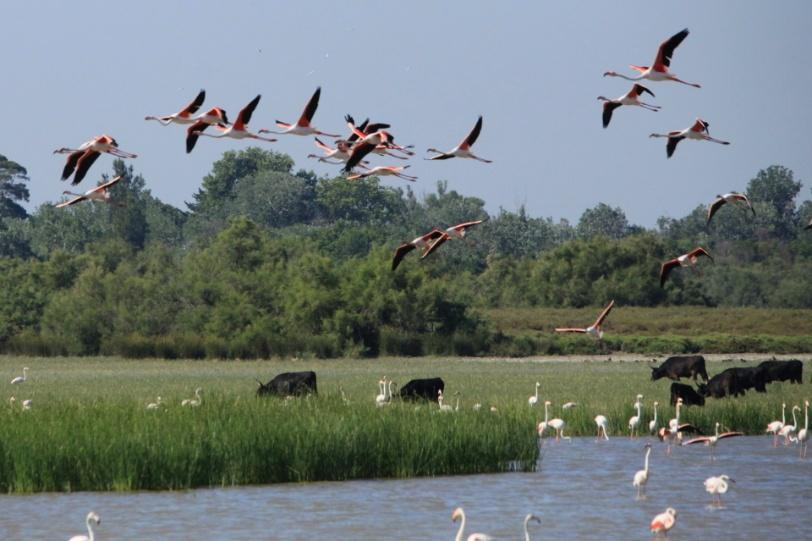
Feature image: Cattle grazing in a protected area in Camargue, France (Photo credit: J. Jalbert-Tour du Valat)
Protected areas are an important tool for biodiversity conservation. The largest network of protected areas in the world is the EU’s Natura 2000 network, covering 26 percent of Europe’s land and 12 percent of its seas. Despite this impressive coverage, the state of European nature remains far from healthy. Why is that?
Across the Natura 2000 network, human activities are not necessarily excluded from protected areas. Conservation objectives can align with economic ones, as with, for instance, food production. Sometimes this can work well, while in other cases it may prevent effective conservation.
In our study, we wanted to investigate the biggest threats to biodiversity in Natura 2000 areas and how management actions can address them. To answer these questions, we turned to the managers of protected areas. We asked hundreds of them across Europe about the threats to biodiversity inside the Natura 2000 areas they manage, what actions they take to mitigate these threats, and how they acquire funding.
The results were clear: the presence of intensive agricultural activities was by far the main concern for protected area managers. Intensive agriculture is a process characterised by large monocultures and the use of chemical products like fertilisers and pesticides. These were often highlighted as difficult threats to address. And despite these practices being harmful for many species and habitats, they still take place within protected areas and their surroundings.
Does this mean that protected area managers are fully against agriculture? Not necessarily. In fact, many of the management actions reported to benefit biodiversity consisted of low intensity mowing and grazing. These agricultural practices are used to maintain open habitats, such as grasslands. Grasslands are incredibly biodiversity-rich, but are becoming rarer across Europe, due to the rise of intensive agriculture and the loss of traditional farming activities, such as extensive mowing and grazing. Thus, the use of domesticated livestock species and reintroductions of wild ones to restore open habitats and their associated species has also been implemented in many rewilding initiatives.
Resolving the conflict between agriculture and biodiversity conservation involves economic considerations. In the study, we found that the management of Natura 2000 areas relies on public funding, both national and European. However, intensive agriculture taking place inside Natura 2000 areas is also subsidised by public money from the Common Agricultural Policy (CAP), which mostly focuses on optimising food production for European food security and international trading.
In 2020, the EU launched the Green Deal, which included some proposals that attempted to make agriculture more climate and biodiversity-friendly. However, the Green Deal was met with resistance by part of the farming community, and some of its proposals—including an attempt to reduce the use of pesticides—were cancelled or diluted. A further possible setback to protected areas’ effectiveness came in 2025 with a proposal to cancel LIFE+, the only European fund completely focused on biodiversity conservation inside the Natura 2000 network.
Our results show that if the EU is to meet its conservation goals, farming inside protected areas and their surroundings needs to be regulated accordingly. Instead of loosening up environmental regulations, one option would be for the EU to provide adequate subsidies for farmers that prioritise biodiversity conservation over intensive food production. Ultimately, preserving nature is a win-win situation for everyone, as agriculture itself depends on healthy ecosystems.
Further Reading
Zavattoni, G., E. Gaget, T. Hallman, I. Kačergytė, T. Pärt, D. Pavón-Jordán, T. Sattler et al. 2025. Threats to and management of Natura 2000 protected areas relative to agricultural practices. Conservation Biology 40(2): e70172. https://doi.org/10.1111/cobi.70172.