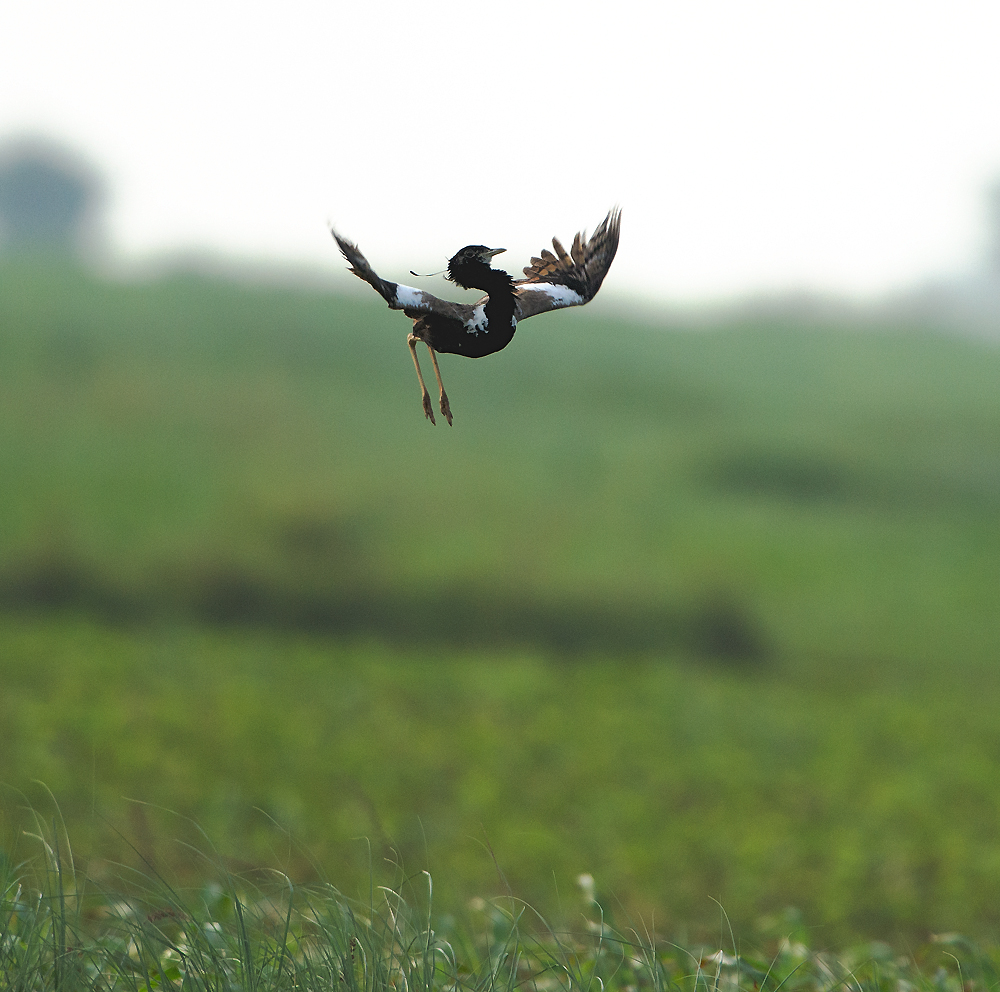
Feature image: Male Lesser Florican (Sypheotides indicus) in courtship display (Photo credit: Koshyk via Wikimedia Commons)
Imagine standing in a sea of tall grasses. The wind rustles softly. Then—out of nowhere BOING! —a small black-and-white bird launches nearly two metres into the air and vanishes just as quickly into the green. Meet the lesser florican (Sypheotides indicus), one of the most elusive and extraordinary birds of India. Every monsoon, these feathered dancers take centre stage in nature’s secret show.
Jump for love
Lesser floricans are famous for one thing: spectacular courtship jumps. The males launch themselves straight up, sometimes hundreds of times a day. Their goal? To impress females hiding and watching in the tall grass. Mid-air, they flutter their wings, showing off their black bodies, white plumes, and funky tufts that curl over their heads like a dancer’s costume.
Why jump so high? Because standing out in a thick, grassy meadow isn’t easy. Jumping helps the male show off his strength, energy, and visibility—like saying, “Hey, look how amazing I am!”
Where do they live?
These birds live in India’s seasonal grasslands, especially in Rajasthan, Madhya Pradesh, Gujarat, and parts of Maharashtra. During the monsoon (June to September), they appear like magic. But as the rains fade and the grass is cut or grazed, the floricans disappear.
No one knows exactly where they go—it’s one of nature’s great mysteries. Some scientists think they may spread out to drier, less-disturbed areas for the rest of the year, but tracking such secretive birds is tricky.
Life on the ground
Despite their love of heights, floricans don’t live in trees. They nest on the ground, laying eggs in little scrapes hidden in the tall grass. That makes them especially vulnerable to predators, farm machinery, and grazing animals. Females raise the chicks alone, keeping them hidden while teaching them to forage.
When it comes to food, they mostly eat insects—especially grasshoppers—and sometimes seeds. In this way, floricans help balance the grassland ecosystem, acting as natural pest controllers.
Disappearing grasslands, disappearing birds
Once found across much of India, lesser floricans are now critically endangered. Their biggest threat is the loss of native grasslands. These habitats are often dismissed as “wastelands” and converted into farmland or buildings. But for floricans and other grassland creatures, this is home.
Monsoon crops like soybean and cotton, planted where grasslands once thrived, leave no space for nesting birds. Tractors, pesticides, and fences make survival harder still. Climate change adds further pressure, with unpredictable rainfall patterns affecting breeding cycles.
In short, the lesser florican’s dance is vanishing.
Hope on the horizon
Conservationists, state Forest Departments, and local communities are joining forces to help. In places like Shokhaliya in Rajasthan, florican-friendly farming practices are being encouraged, with farmers supported for leaving patches of land undisturbed during the monsoon.
The Wildlife Institute of India and the Bombay Natural History Society (BNHS) have been tracking floricans using radio tags and drones to understand their movements better. One male, tagged in 2023, turned up at stopover sites in Gujarat where floricans hadn’t been seen in years!
A personal encounter
In August 2022, I visited Shokhaliya, a small village nestled in the undulating grasslands of Rajasthan. We arrived before sunrise, our guide leading us past sleepy homes and grazing cattle into the open fields. A gentle mist floated over the grasses, and every so often, the chirp of larks and the buzz of insects punctuated the silence. We waited.
Suddenly—there he was! A blur of black and white shot into the sky. A male florican leapt high above the grass, hovering in mid-air for the briefest moment, before dropping down like a feather. My heart skipped a beat. He jumped again. And again. We held our breath each time. His head-plumes twirled, his wings fluttered. It felt like we had stumbled into a hidden stage, this tiny bird performing a solo dance just for us.
In that moment, the grassland didn’t feel empty; it felt alive and important. I realised these birds don’t just need saving; they deserve to be celebrated.
The other dancers
Did you know India is home to three bustard species. The lesser florican is the smallest and the only one that leaps. Its cousins, the great Indian bustard and the Bengal florican, are also endangered, each occupying different grassland habitats across the subcontinent.
Together, they remind us of how rich and diverse our “empty” grasslands really are.
What you can do
You don’t need to be a scientist to help the lesser florican. Here’s how you can join the dance:
- Talk about grasslands: Tell friends and teachers why grasslands matter.
- Support native plants: Grow native grasses or flowers in your school or home garden.
- Follow the flight: Log sightings on citizen science platforms like eBird and also follow efforts tracking where floricans appear each monsoon.
Saving the lesser florican is about more than saving a bird. It’s about protecting a dance thousands of years old, hidden in the tall grasses of India.