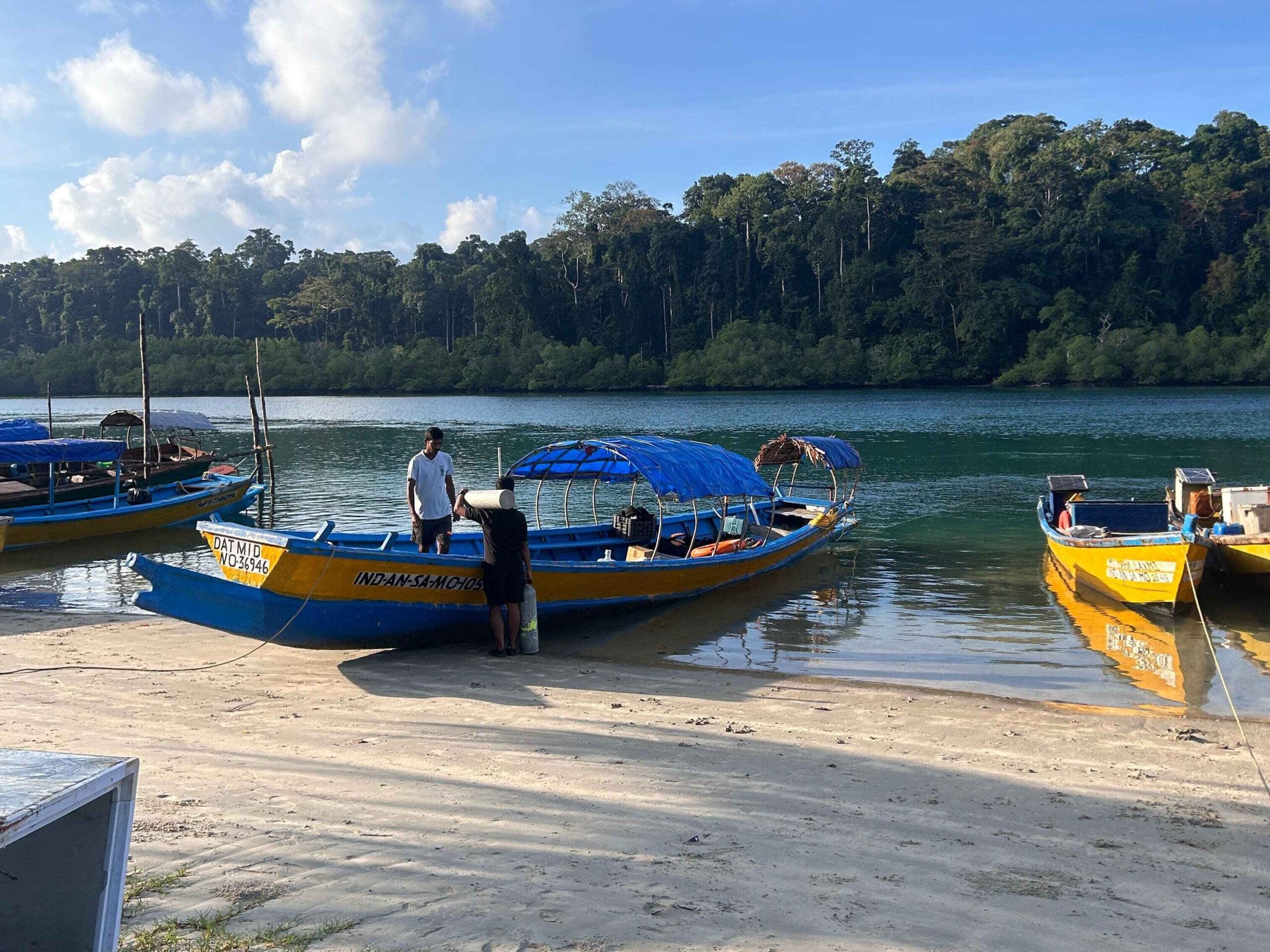
“I’m in the field”, I tell my high school best friend on the phone, gazing at the street from the terrace. We dived in the morning, and I’m a step closer to completing my Master’s thesis. A school bus has stopped, uniformed children tumbling out. Fresh parottas sizzle on the open stove. I think I spot my neighbour waiting in line for photocopies. It feels rude, somehow, to condense this lived-in tableau to the ‘field’, and my throat itches to describe the setting more adequately.
Rameswaram, a bustling town on Pamban Island, in the southeast Indian state of Tamil Nadu, isn’t some remote, isolated locale only ever visited to study coral reefs. It’s a home to my neighbours, friends, and the reefs I’m studying. Surveying the street from the terrace feels like a metaphor that’s too on the nose—I’m on the outside, looking in.
Out there
Since that conversation, I’ve struggled to accurately define what ‘fieldwork’ is, and I’m not the only one. Anthropologists, sociologists, and ecologists have all tried. In the barest terms, you could describe it as a place where you collect data. The problem is that it implies the inverse. What of the location where you don’t collect data? What of the movement, the here, the not-here, and the not-field? Is the field merely a physical location, neatly cordoned off and demarcated from the personal life of the researcher?
To view the field as a destination or locale also prevents us from truly engaging with it. By separating the home and field, we view the world as an exhibition for display. It is a place where an outsider may be granted leave to look in.
Like many other ecologists in India, I hail from a city. The city is home, and the field is not. This perceived dichotomy between home and field makes me view the urban home as devoid of life and, hence, unworthy of study. In fact, my home should be the default for my own study. It is the place I know best in the entire world. Some researchers even argue that this perception of the field as distant and exotic leads us to overwrite its nature as inhabited and peopled—because ‘real fieldwork’ happens in the remote and isolated; our writing and discussions make these landscapes so, even if that isn’t the case.
For researchers from the Global South, the problem is starker and easier to define. For instance, at a conference, you might come across someone challenging a white researcher working in Africa, Asia, or South America, asking how or whether they integrated into the local community or sought free, prior and informed consent. Here the lines of insider and outsider are drawn by nationality.
One study examined the countries of origin of researchers working on coral reefs. Coral reefs are predominantly tropical biomes, restricted to the Global South. They note that of the top 10 countries with the most publications in the field, only two were not high-income countries”—Mexico and Indonesia. Interestingly, Germany and Canada ranked on this list despite having no coral reefs.
But my home has no coral reefs either, and yet I study them.
The field is neither a separate, discrete space nor exotic. Rather, it is a network of power relations which may be specific to a community. Researchers of sociology examine the “processes, patterns and peopling of the world”, and are thus always in the field. Words such as ‘distant’ or ‘remote’ are no longer applicable, as our field sites are invariably people’s homes. How do we reconcile studying non-human organisms within the network of patterns and peopling of the world?
Anthropologists have had far more success defining the field, perhaps because the study of people appears inherently more political than the study of wildlife (though I’d argue this isn’t the case). In examining the field, anthropology has moved beyond dividing nature and people. Instead, it deeply interrogates who gets to produce knowledge and who is considered an authority. This element of reflection is, at present, limited in Indian conservation research.
At best, I convince myself that the term ‘field’ can be used to describe any place where we work, regardless of where our homes may be. Any site where we gather data from—separate or overlapping with analysis, writing, and publishing—becomes the field. Yet, I still wonder what word can encapsulate the concept more compassionately, making room for all the nebulous ideas of the field.
Give and take
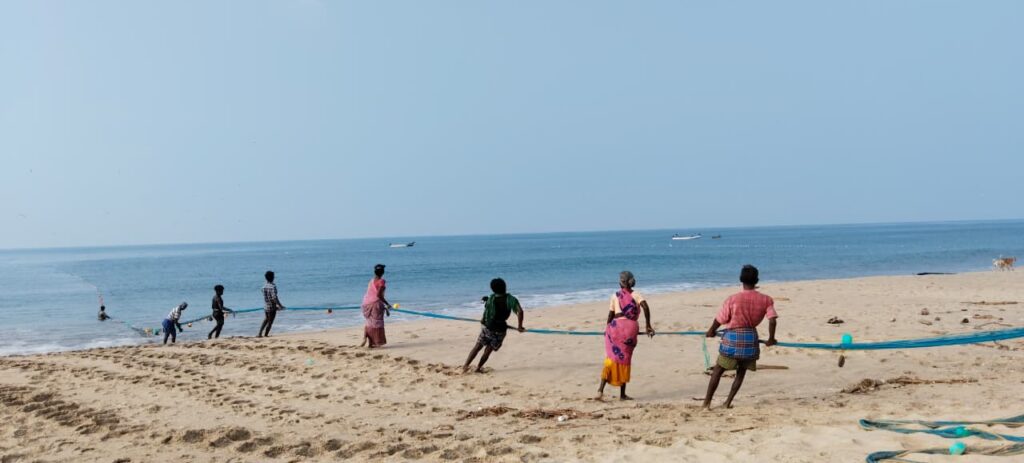
We are shaped by our experiences, and our experiences shape our perspectives. Although we know this innately, it matters for two reasons. First, we can only look at the world through our own lenses, which are shaped by our lived experiences. Second, fieldwork shapes us too. Have I ever returned home without changing? I have never been the same person at the start and end of a field season, and have changed in a hundred small ways during that period. This give and take and exchange of experiences underpins exactly why fieldwork can feel so uncomfortable and extractive.
The term ‘colonial field ecology’ has been used to challenge the extraction of intellectual gain without any return or exchange. It’s also linked to the ephemeral nature of fieldwork. A ‘field season’ means that researchers are not embedded within their landscapes. They may come and go, but the effects of the researchers are not so transient as the researchers themselves. Each researcher who comes and goes stands in the shadow of those that came before.
The idea of a ‘return’ or an end of a field season for comfort, to process or analyse data, or merely as a homecoming also underscores the economic disparity that typically lies between the home and the field. Field researchers often cite the lack of lab equipment, processing power, or even network and internet access as their reason for temporality. In other words, because the data cannot be processed in the field, the field season can only be temporary. By accepting a return to one’s ‘home’ or ‘institute’, we ensure resources as simple as WiFi never arrive at the field site. The disparity is maintained and further perpetuates itself. Should we perhaps demand more wherever we go so that other people benefit as well? What consequences might that have?
In 2019, a conference between research scholars and the Idu-Mishmi community of Dibang Valley in Arunachal Pradesh (see Aiyadurai 2021) highlighted this tension. Many members of the Idu-Mishmi community, while appreciative of the recognition of the region’s biodiversity, were understandably cautious. An influx of researchers hadn’t brought any real material gain, and a sudden spotlight on the conservation significance of the region could negatively affect development. This was the case with a proposed hydropower project, suddenly under greater scrutiny. Wildlife researchers naturally opposed the project, but was it really their place to do so?
Giving, taking, and extracting also has important implications for cultural sensitivity and understanding. Conservation and ecology have profound impacts on livelihoods, safety, and even survival. Working anywhere, even if it’s right at home, should be regarded as a privilege and not a right. It is important that we reflect upon how we regard our field sites, and the implications it might have on local communities.
Moving forward
Do we then insist that everyone should only work in their places of origin? It’s a proposition that is unlikely at best and immoral at worst. Resources and education are unequally distributed across space, and entire landscapes run the risk of being silenced altogether. In the absence of the ideal situation, a better solution is to research with communities. But the very first step must be recognition. Although the field may be distinct from the home, it is vital we never forget that landscapes are others’ homes first.
Then comes engagement and free, prior and informed consent. Local stakeholders across power equations, genders, and professions should be engaged from the problem-conceptualising and grant writing stage. Continuous data sharing, practices of co-authorship, and communication flow across groups need to be maintained. Engaging with local stakeholders and planning long-term engagements is also key. Lastly, there’s the possibility of exchange. Can academic research benefit those studied as much, if not more, as those doing the studying?
Ultimately, all these practices come down to working with people rather than working for ourselves. Regardless of the extent to which an ecologist might work with people, interpersonal relationships govern every dimension of our work. Reflecting on our praxis is key to bettering it. How do we relate to our field sites (and homes) on a personal, professional, and political level? Is information extraction sufficient, or can and should we do something in exchange for the data we collect?
Further Reading
Stefanoudis, P. V., W. Y. Licuanan, T. H. Morrison, S. Talma, J. Veitayaki and L. C. Woodall. 2021. Turning the tide of parachute science. Current Biology 31(4): R184–185. https://doi.org/10.1016/j.cub.2021.01.029.
Ramesh, M. 2020. A Call to redefine ‘the field’ in nature conservation studies in India. Ecology, Economy and Society–the INSEE Journal 3(2): 27–31. https://doi.org/10.37773/ees.v3i2.123.
Aiyadurai, A. 2021. Dilemmas of wildlife research in Arunachal. Seminar Special Issue: Future Enviornmentalisms) 744: 19–23. https://india-seminar.com/2021/744/744_ambika_aiyadurai.htm.