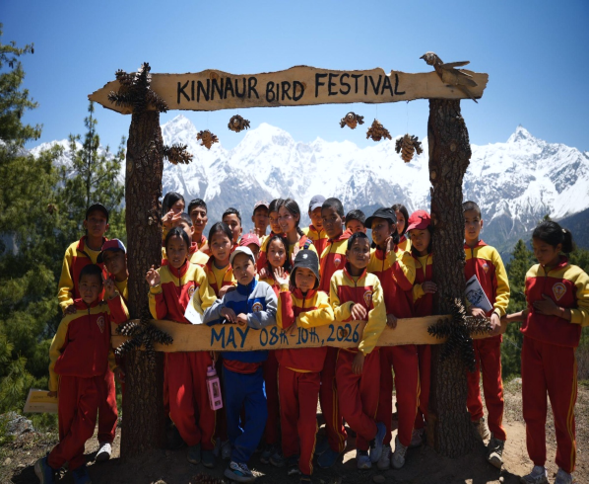
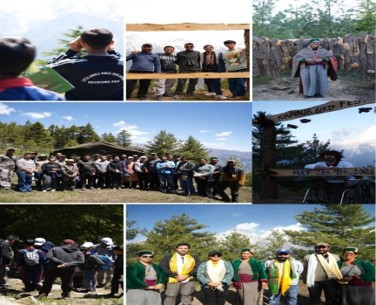
Featured image: Schoolchildren participate in the 2026 Kinnaur Bird Festival in Kalpa, Kinnaur (Photo credit: Varun Chauva)
Kinnaur’s first community-led bird festival did not just count species. It asked a community to slow down, remember its birds, and reckon with what losing them would mean. On World Environment Day this year, Himkatha, an initiative of the Nature Conservation Foundation (NCF), premiered a documentary. The film Kinnaur Bird Festival: Documentaries by Locals originated from a specific place and a specific person—Mahesh Negi Ronseru, a farmer, wildlife photographer, and earth educator from Brelingi village in the Kinnaur district of Himachal Pradesh, India. Mahesh founded Aum Kinnaur, an eco-literacy organisation, through which he runs programmes on sustainable living built around a principle he calls “conservation through appreciation”—communities protect most fiercely what they have first learned to see.
His own seeing began during childhood. In the documentary, Mahesh narrates how his aapi (grandmother) once told him that it was about to snow. He had noticed no changes and asked how she possibly knew. She told him that the pompya (plain mountain finch)—a snowbird—had arrived. And thus, the beginning of the snowy season. That a small bird could carry a whole season through its movements stayed with young Mahesh. He started paying attention to the chirps around him, to what the birds were doing and when. That habit of attention grew into a vision, and the vision grew into Aum Kinnaur, which took shape when he received the Youth Conservation Action Network fellowship and bought his first pair of binoculars.
And so, Mahesh brought Kinnaur’s first community-led bird festival to life, with support from NCF, the Kinnaur district administration, Himachal Pradesh Tourism, and the Forest Department. From 8 to 10 May 2026, at Goli Kande in Kalpa, the mountains filled with bird lovers, local schoolchildren, researchers, trainers, and the tribal people of Kinnaur, for whom the occasion was ultimately designed. The festival drew more than 250 visitors.
Kinnaur is home to 275 bird species across an altitudinal range of 1,500 m to over 6,000 m, and harbours more than 850 plant species, making it one of the most ecologically layered landscapes in the western Himalaya. The event organisers did not choose an endangered species as the festival mascot. Instead, they picked a common backyard bird that most Kinnauri families were intimately familiar with. That decision carried the festival’s entire argument: start with what people already love and build from there. Three threads ran through the festival, and each one deserves examination on its own terms.
Eco-literacy walks
At the bird festival, something occurred across all age groups that no classroom had produced. Children who had spent years reading bird names from textbooks stood at dawn in a forest and listened. Elders who had grown up knowing the calls around the house found a new language for what they had always known. A 12-year-old pointed out a species that a researcher had spent two days searching for.
This is what Mahesh means when he says that concrete walls are not the spaces where people truly learn to love nature. A child who memorises the scientific name of the Himalayan monal (Lophophorus impejanus) and fills the correct box in an exam has not necessarily understood anything about the bird. A child who stands on a ridge at Kalpa and watches that bird catch morning light has started thinking ecologically.
Researchers have documented this connection formally. A 2017 study published in BioScience by Cox and colleagues at the University of Exeter found that people living in neighbourhoods with higher afternoon bird abundance showed measurably lower prevalence of depression, anxiety, and stress. The connection is not abstract. Watching birds asks something simple of the watcher: slow down, pay attention, be present. Those three demands are also the beginning of ecological thinking.
The deeper argument here is institutional. Eco-literacy walks should not depend on a festival rolling through the district once a year, or on an unusually motivated teacher deciding to organise a trip. They need to be embedded in the school curriculum as a recurring, assessed, and valued activity. In a region like Kinnaur, where the landscape is the most important classroom a child will ever have access to, this is not an aspiration. It is a practical demand. The schools of Kalpa, Pooh and Nichar tehsils—local administrative sub-districts—sit inside forests, rivers, and migratory corridors that ornithologists travel great distances to study. Students who live there need structured time and pedagogical permission to regularly be in that landscape.
The festival showed one version of what this looks like. Schoolchildren joined bird walks led by experienced naturalists, maintained field notebooks, drew what they observed, and later shared their findings. It was the beginning of a practice, not a performance. The argument Mahesh makes through every programme and every school visit is that eco-literacy is not enrichment. For communities navigating climate change, hydropower expansion, and the slow erosion of traditional livelihoods, a generation that cannot read its own landscape cannot protect it.
Preserving oral histories
The festival’s mascot was not an eagle or a pheasant. It was the rufous-naped tit (Periparus rufonuchalis), a small, ordinary bird that lives in the backyards of Kinnauri homes. The choice was deliberate, and the story behind it is the most important thing the festival produced.
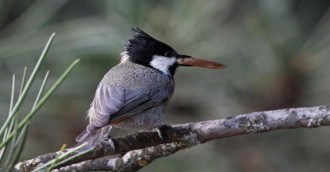
In the Kinnauri oral tradition, the rufous-naped tit has a reputation. The bird collects chilgoza pine nuts (Pinus gerardiana), known locally as neoza or ri, and hides them. It works methodically through the garden, carrying nuts one by one and tucking them into crevices in stone walls, under tree bark, and in corners that human eyes struggle to find. People watching the bird at work have tried to follow it and recover the stash, but it had already hidden the pine nuts elsewhere. Across generations, this species became a figure of quiet industry and cheerful cunning: a bird every Kinnauri household knew, and almost every family had a story about.
Mahesh chose this bird precisely because it is a living memory. Nobody in the audience needed an introduction. Every person there already had a relationship with it, usually without having labelled it as ecological knowledge. The festival made that knowledge visible.
A parallel story, recorded by Pramiti Negi for Voices of Rural India, follows a similar arc but with a different bird. Pramiti writes of watching—as a child in Rekong Peo—the coal tit collecting chilgoza nuts in their garden. She and her sister called it a thief. They followed it, tried to take back the nuts, watched it from a distance, and over time came to think of it as a pet of sorts, a creature sharing the garden on its own terms. Slowly, they understood that the garden was not only theirs.
Both stories carry an entire ecology inside them: the chilgoza tree, its economic and cultural weight, the mountain seasons, the shared fate of a bird and a household. These are not nostalgic fragments. Rather, they represent ecological knowledge that oral tradition preserves in the most durable form—something felt and remembered rather than written and filed. By centering the rufous-naped tit and inviting people to share their own bird stories, the festival turned personal memory into a collective archive.
The chilgoza tree connects both stories to something larger. Kinnaur’s pine nut forests are simultaneously a livelihood, a cultural emblem, and a habitat for the rufous-naped and coal tits. The birds and the tree need each other. So do the birds and the community that has spent centuries learning to read them. Oral history is not a supplement to conservation science. In landscapes like Kinnaur, it is often the baseline from which any serious conservation work has to begin.
Green festivals matter
The bird festival brought these threads into a single public space and opened them to everyone. When a child from Kalpa learns the Kinnauri names of local birds, what they eat, where they nest, and why their numbers shift, that child becomes a different kind of voice in the next environmental clearance hearing. That is not a metaphor. It is how conservation constituencies are actually formed.
Green festivals matter in the Himalayas because they turn environmental concern into a shared practice rather than a distant worry. In Kinnaur, people already live with landslides, shifting snowfall patterns, and water sources that vary annually. A festival offers a deliberate pause. It puts villagers, students, officials, and visitors into the same landscape, at the same time, and asks them all to look carefully. At the Kinnaur Bird Festival, this happened through bird walks, conversations about chilgoza forests, and films that tied ecological change to daily life. Environmental change became something people felt together, and not something they read about in a report.
Kinnaur is also India’s hydropower capital—nearly 22 projects are at various stages of planning or operation along the Sutlej. Hydropower accounts for close to 20 percent of Himachal Pradesh’s annual non-tax revenues, making the tension between ecological protection and infrastructure expansion structural, not incidental.
These festivals also function as a form of environmental activism that does not begin with confrontation. It begins with attention, naming, and documentation. Exhibitions, talks, songs, youth-led media, and school programmes build a constituency that can recognise specific birds, forests, and rivers, and can later speak clearly about what is being lost. That is activism growing from the ground up.
Read through the lens of biocultural rights, the festival also asserts something larger: that Indigenous peoples and local communities hold collective rights to maintain the relationships, knowledge, and practices that tie them to land, water, and biodiversity. When a Himalayan festival puts local languages, rituals, livelihood trees like the chilgoza, and traditional ecological knowledge at the centre, alongside scientific talks, it is not simply celebrating culture. It insists that communities are not beneficiaries of conservation but rights-bearing stewards of biocultural landscapes.
Mahesh’s aapi knew snow was coming because the snowbird had arrived. The rufous-naped tit’s hidden pine nut caches are both a child’s first mystery and an ecologist’s data point. Pramiti’s coal tit thief is a story about a garden, and also about sharing a landscape with creatures that were there long before us. All of this is knowledge. The mountains have always been listening. The festival asked whether we still know how to listen back.
Further Reading
Bird Count India. 2026. Kinnaur Bird Festival: A fledgling hope. https://birdcount.in/kinnaur-bird-festival-2026/. Accessed on 25 September 2026.
Cox, D. T. C., D. F. Shanahan, H. L. Hudson, K. E. Plummer, G. M. Siriwardena, R. A. Fuller, K. Anderson et al. 2017. Doses of neighborhood nature: The benefits for mental health of living with nature. BioScience 67(2): 147–155. https://doi.org/10.1093/biosci/biw173.
Negi, P. 2023. ‘Re- Nyoza- Chilgoza’- The wonder tree of Kinnaur that is also a cultural emblem. https://www.voicesofruralindia.org/re-nyoza-chilgoza-the-wonder-tree-of-kinnaur-that-is-also-a-cultural-emblem/. Accessed on 25 September 2026.