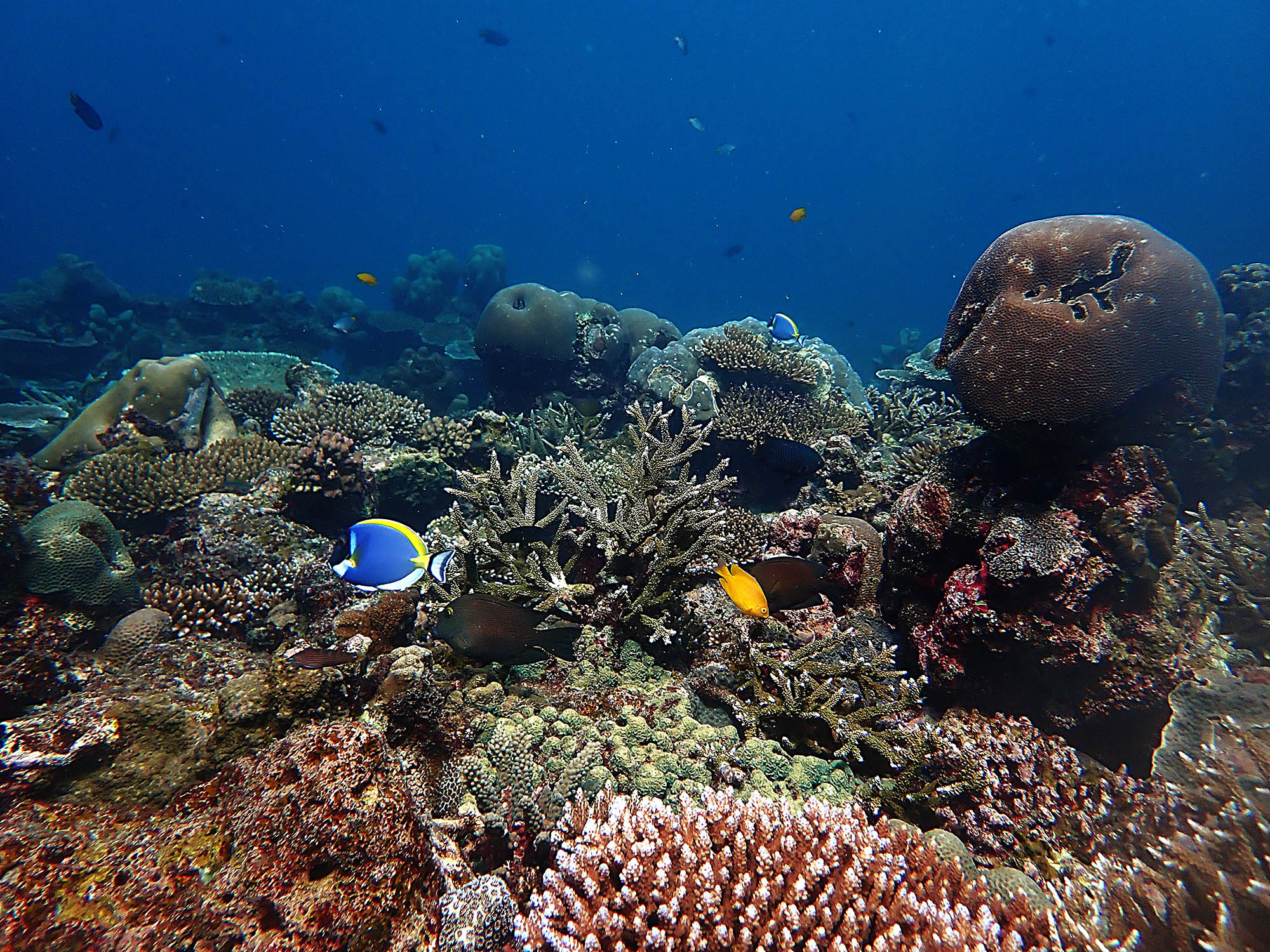
In the Andaman Islands, at the southern tip of the Mahatma Gandhi Marine National Park, lie the Twin Islands, or Kachua Tekri as they are locally referred to. Beneath the clear, blue waters, a coral reef fringes the islands. Sunlight illuminates the reef, revealing its extent—there is coral for as far as you can see. Branching Acropora corals dominate the reef, with cameos by tabular, corymbose, and encrusting corals, forming an intricate structure. Here, the reef is almost completely covered by corals.
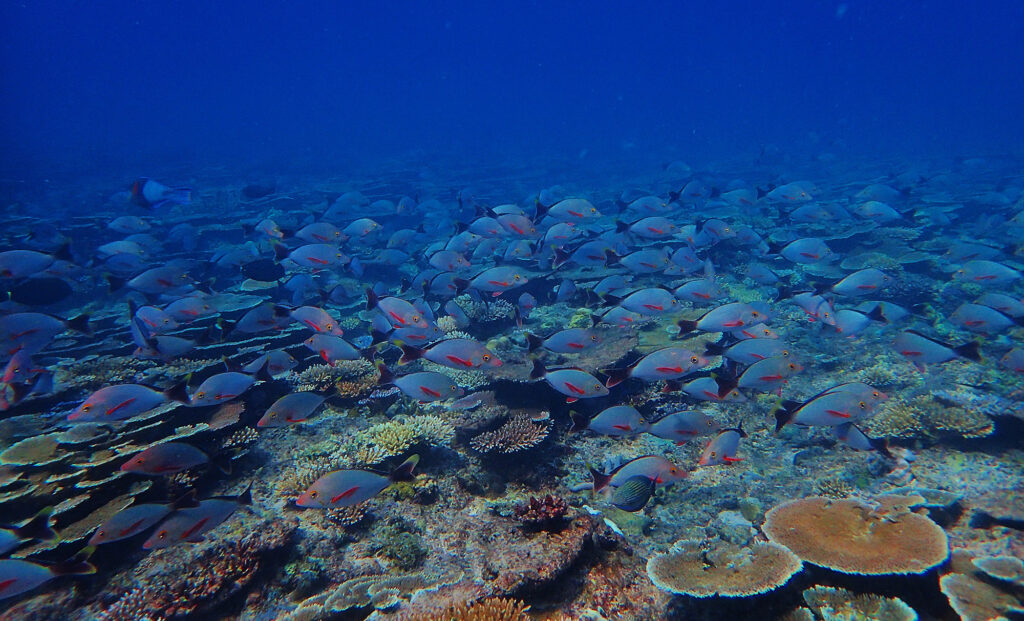
The Acropora branches are dotted by damselfish—some yellow, others blue or white with black stripes. Across the reef there are schools of parrotfish, surgeonfish, and rabbitfish, busy taking bites off the reef. In close pursuit are vividly coloured wrasses, opportunistically feeding on any invertebrates that are dislodged. Just above the reef, a large school of fusiliers dazzles with synchronised movement as it zooms past. Along the reef crest, bluefin trevallies stealthily prowl like a pack of wolves, while a school of yellow snappers with white stripes scans the reef slope. Further out, the silhouette of a reef manta glides by.
For a diver hovering above this reef, the scene feels entirely unreal.
Entering a new normal
But one might wonder—how long will this reef persist as I described? After all, coral reefs are at the forefront of ecosystems impacted by climate change. Rising ocean temperatures are rapidly transforming these hyperdiverse ecosystems into less complex configurations, often taken over by algae or fast-growing corals. Such has been the effect of global warming that mass coral bleaching is now recognised as the most pervasive threat to corals and coral reefs across the world.
Extreme spikes in ocean temperatures cause corals to expel the photosynthetic algae symbiont from their tissue. As a result, corals turn white and could die if high temperatures persist. Typically, coral bleaching occurs after short-term seawater temperature anomalies of 1–2oC above the usual summer maximum. However, scientists believe that we might be entering a new normal, where global average temperatures rise up to 1.5oC above pre-industrial levels. This increase in temperature is a critical threshold for coral reef ecosystems.
The Global Tipping Points Report 2025, published by the University of Exeter, states that coral reefs are fast approaching one of the first climate tipping points. Beyond this critical threshold, coral reefs will undergo severe and possibly irreversible change. Scientists largely agree that even if global warming is restricted to an increase of 1.5oC, reefs are projected to lose about 70–90 percent of corals. Overall, the consensus appears to be that coral reefs as we know them might be lost.
While the first tipping point looms large, coral reefs around the world have already faced four global mass bleaching events, including the most recent in April 2024, along with several regional events. Documenting the impacts of past bleaching events and subsequent recovery patterns have provided important insights into how coral reefs may look and function in the near future.
But most of our knowledge comes from well-studied systems like the Great Barrier Reef and coral reefs of the Red Sea and the Caribbean. There is a distinct lack of comparable understanding from remote, data-deficient reef systems like those in the Andaman Islands. As we approach the tipping point, we must ask—will the impact across corals and coral reefs around the world be homogeneous, or will it be more complex, with regional identity playing a big part?
The Andaman Islands
The Andaman archipelago is situated 1,200 km from mainland India, between the Bay of Bengal to the west and the Andaman Sea to the east. This group of about 300 islands is part of the Indo-Burma biodiversity hotspot and lies close to the highly biodiverse Coral Triangle. Coral reefs in the Andaman Islands are home to hundreds of coral species and thousands of reef-associated organisms.
Beyond ecological richness, these ecosystems are of great cultural and economic value for communities across the islands. They support small-scale reef fisheries and reef-based tourism, which play a big role in the local economy. The continuity of these ecosystem services in the Andaman Islands depends on a stable three-dimensional reef framework. However, coral reefs in this region have been affected by a series of major disturbances, including the Indian Ocean tsunami of 2004 and coral bleaching events of 1998, 2002, 2005, 2010, 2016, and 2024.
Studies following events from 1998 to 2016 documented consistently high sea surface temperatures and a loss of live hard coral ranging from 20 to 90 percent across sites. Impacts varied among locations within the archipelago, with some areas experiencing higher live coral loss during particular bleaching events, while the same locations remained relatively undisturbed during other events. Coral taxa most susceptible to bleaching also varied across the events. This indicates that just within the archipelago, spatial and taxonomic responses to bleaching events have been heterogeneous.
Indeed, the Andaman Islands present an intriguing case, both in terms of the impacts of bleaching and how reefs respond to them. Despite the repeated bleaching events, archipelago-wide live coral cover appears to be relatively stable (however, this understanding is based on reef assessments that have been spatially and temporally scattered across the islands and should therefore be interpreted with caution). There are two distinct factors that could limit coral susceptibility to bleaching in the Andaman Islands.
First, the presence of Large Amplitude Internal Waves (LAIWs), which are formed when layers of water are moved by tides and currents over uneven seafloor topography. As LAIWs pass over coral reefs in the islands, they bring cool water from the depths upward, reducing high temperatures responsible for bleaching. While LAIWs are present throughout the year, they are strongest between February and April—limiting the exposure of coral reefs to hot waters during peak summer months.
The second important factor that could reduce bleaching impact is the presence of turbid inshore waters across parts of the islands. Suspended particulates reduce the direct impact of solar radiation on corals by blocking light penetration, thereby diluting the combination of high seawater temperatures and direct sunlight on shallow, nearshore coral reefs.
Lessons in reef recovery
When it comes to recovery, live coral cover alone cannot capture all aspects of bleaching impacts and reef recovery, and is often only used as a symptom of changing reefs. As part of the multi-institutional Long Term Ecological Observatories programme, our team has been monitoring select coral reefs in the Andaman Islands for the last four years. We examine coral reef community structure across sites and years, and whether variation in composition also means variation in reef functioning, the impacts of disturbance, and reef recovery.
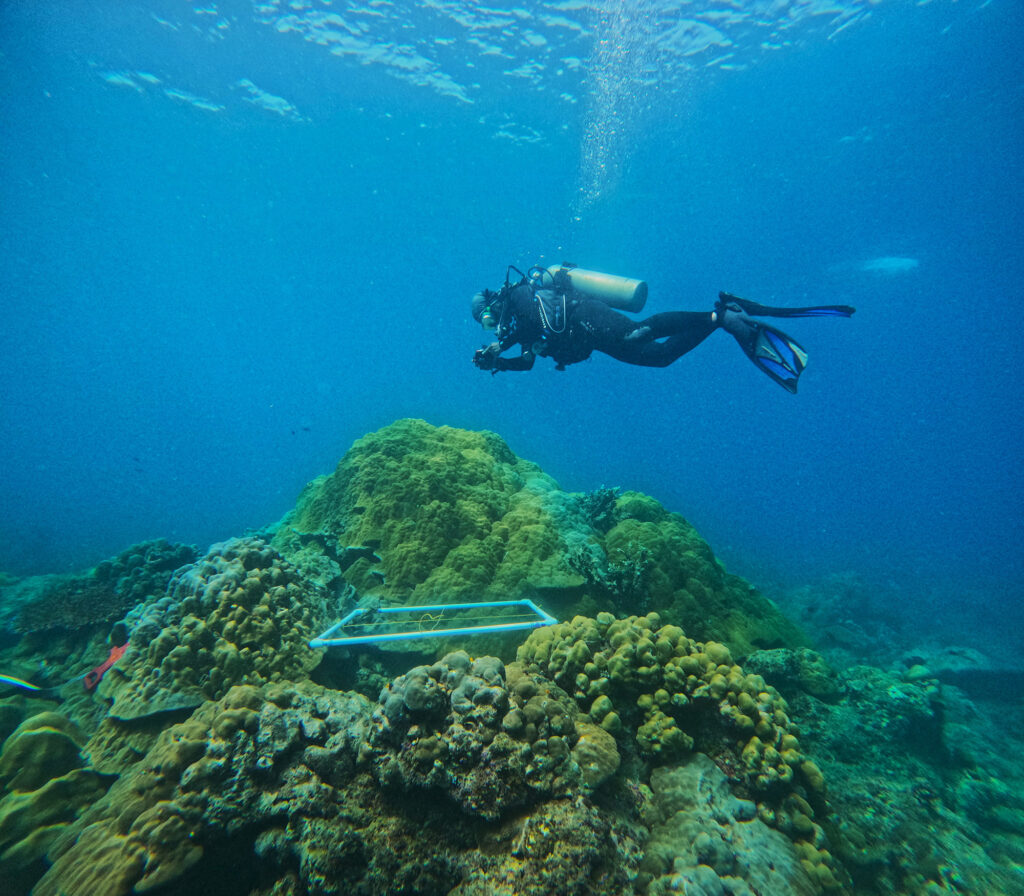
We monitor eight sites across Tarmugli and Boat Islands in the Mahatma Gandhi Marine National Park—four sites on the windward side and four on the leeward side of the islands. These islands predominantly experience winds and high-energy waves from the southwest, making the western sides more exposed to wave action, while the eastern sides remain relatively sheltered.
Our surveys revealed that coral reef community structure on the exposed side of the islands is indeed markedly different from that on the sheltered side. Exposed sites are structurally complex and dominated by fast-growing Acropora corals, especially branching and tabular forms. These reefs also have a high cover of the pink, encrusting coralline algae that facilitates the settlement of coral larvae. Turf algae are present in sparse patches across the reefs.
In contrast, the sheltered sites are turbid, flatter, and less complex. These sites have lower live coral cover, with boulder-like, reef-building Porites corals being the dominant forms. Sheltered reefs have a high number of dead and broken corals, overgrown with sediment-laden turf algae. Together, these differences suggest that exposure to wave action largely influences how coral reefs are shaped across our sites.
Following the announcement of the fourth global mass bleaching event in April 2024, we carried out surveys at these eight sites in early May 2024 and followed it up with surveys in January 2025. Like coral reef composition, the impact of coral bleaching and reef response markedly differed between exposed and sheltered sites. While the bleaching impact was minimal, fast-growing Acropora morphologies on exposed sites were the most affected. Post-bleaching, a decrease in live coral cover was followed by an increase in turf algae across exposed and sheltered sites. Interestingly, about a year after the event, exposed sites already had a significantly higher number of recruit (2–5 cm) and juvenile (5–10 cm) corals than the sheltered sites. Recovery of coral populations on exposed reefs had already started.
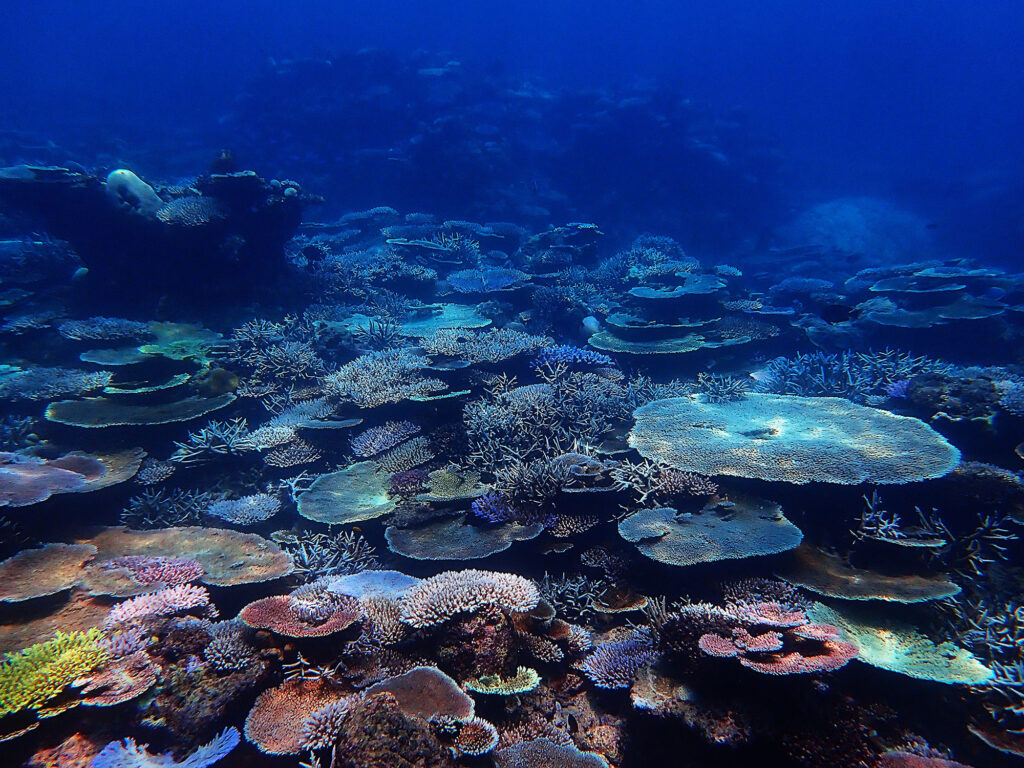
These findings offer interesting insights: exposed sites are likely to experience higher short-term vulnerability to bleaching events due to the presence of the highly vulnerable Acropora corals. Yet these sites are also capable of rapid recovery post-disturbance, given the fast growth and reproduction of these corals and the availability of space. However, a different pattern emerges on the sheltered sites. The boulder-like Porites corals are more stress-tolerant and are able to resist bleaching events. Nonetheless, coral recovery through coral recruitment may be slower due to competition with turf algae and higher sediment accumulation, both decreasing available space.
Overall, these findings suggest that the impact of climate change and responses to bleaching events are highly variable across time, distance, and taxonomic diversity in the Andaman Islands. It appears that the response of coral reefs to climate tipping points in the islands may ultimately depend on local environmental settings and existing reef structures.
But this is still only a part of the resilience story. As part of our research, we are looking at how reef fish aid reef recovery by removing competitive algae and the balance between carbonate production and bioerosion that maintains reef frameworks. We hope that improving our understanding of coral reef structure and function across space and time will provide deeper insights into reef resilience.
Coral reefs in a human-impacted world
The latest Global Tipping Points report raises legitimate alarm bells for coral reefs. However, impacts across coral reefs may not be homogeneous and coral reef change and reorganisation may be far more complex. Consider this, the Andaman Islands have faced six bleaching events since 1998. I was born in 1997, which means that these ecosystems have faced climate change impacts for as long as I have lived. Yet, in my decade of observing coral reefs, I have rarely encountered coral cover as high as that seen on some reefs in the Andaman Islands. As the tipping point looms large, I think there is still hope for the archipelago.
The report also acknowledges that despite the imminent tipping point, coral reef refugia may exist. The Andaman Islands have been deemed to be such a refugia for coral reefs in the face of climate change. However, I wonder how long that will hold true. While coral reefs are capable of self-organisation following bleaching events, their resilience could well be affected by chronic local pressures. For example, the islands have seen increasingly frequent and more intense cyclones, overfishing, unregulated tourism, heavy sediment loads, and large-scale coastal development. These pressures, in combination, have created a serious challenge for reef resilience by shrinking recovery windows. Coral reefs may not have enough time to self-organise after a mass bleaching event, given these existing stressors.
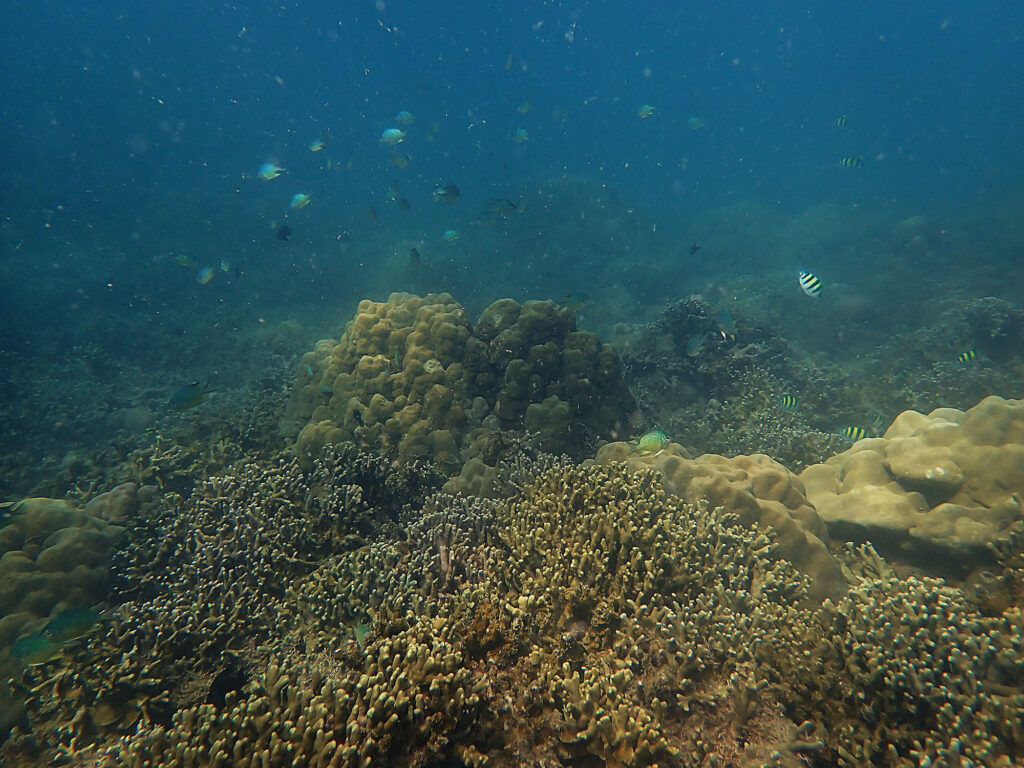
Globally, coral reefs face an uncertain future in the Anthropocene. We are heading towards widespread coral mortality and may encounter previously unseen reef configurations. It is not known how these novel configurations will continue to support not only biodiversity, but also hundreds of local communities worldwide. It is also unclear whether all coral reefs will follow similar trajectories under climate change. In fact, coral reefs already exist in a variety of configurations that span high coral cover, high turf algae cover, reefs dominated by encrusting forms, turbid reefs, and reefs with high macroalgae cover. Moreover, regional environmental and socio-ecological settings could strongly shape the trajectory that coral reef systems take in the near future. If we are to better understand changing reefs and what the future holds, it is imperative that we consider these local contexts.
Ultimately, it is perhaps time to accept that in the face of climate change, coral reefs are going to inevitably transform and many reefs will exist in low coral cover configurations. While reefs are capable of natural self-organisation following disturbances, they may not match our visual standards, which are biased by nostalgia. Yet, these transformed reefs may still be able to provide key ecosystem services and we need a more nuanced way of looking at what the future holds for coral reefs.
Robert Streit, Tiffany Morrison, and David Bellwood put it best in their 2025 paper: “We may not have the coral reefs we want, but we should perhaps learn to appreciate the coral reefs we will have (and perhaps deserve).”
Further Reading
Brown, B. E., R. P. Dunne, R. Arthur, A. H. Baird, E. D’Souza, S. Khokiattiwong, Z. Lunn et al. 2025. Revisiting the coral reefs of the Andaman Sea–factors affecting resilience, recovery and reef refugia. In: Oceanography and Marine Biology: An Annual Review, Volume 63. Pp 1–41. CRC Press.
Majumdar, S.D., S. Hazra, S. Giri, A. Chanda, K. Gupta, A. Mukhopadhyay and S. D. Roy. 2018. Threats to coral reef diversity of Andaman Islands, India: A review. Regional Studies in Marine Science 24: 237–250.
Pinto, W., K. Deshpande, A. S. Lobo, A. Jamalabad, A. Hussain, A. Paul, A. Dutta et al. 2026. Regional and genus-specific factors underpin bleaching variation across India’s coral reefs during the fourth global coral bleaching event. (in review)