Featured image: Source: NOAA Restore Science program
Under the surface lies a symphony of sounds through which marine species communicate with each other. Hundreds of years ago, we would never have known how these work. New technologies, however, make it possible for us not only to record these sounds, but also to interpret them and understand how animals communicate—helping us make major advancements in conserving biodiversity.
In the last few decades, bioacoustics has emerged as one of the most effective tools for conservation. It has come a long way since the 1920s, when Slovenian biologist Ivan Regen planted a recording device in a forest to study the sounds of different insects. Today, acoustic recorders carry far greater memory and battery capacity, and devices like hydrophones can even detect sounds that humans can’t hear.
These technologies can not only record the hidden sounds of a wide variety of ecosystems, but also assess invasive species, identify new animal species and behaviours, and map migration routes for animals on land and below water. In recent years, they have found their greatest applications in marine ecosystems, where varying conditions underwater allow for highly effective transmissions of acoustic signals. Using this technology, scientists now aim to explore the remaining 95 percent of the ocean.
Transmit, echo, and locate
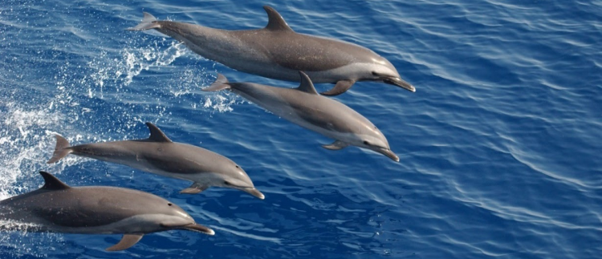
Since light barely penetrates underwater, many marine animals have evolved to sense their surroundings and communicate through sound. Cetaceans—a group of mammals that includes whales and dolphins—transmit sound to communicate underwater, relying on clicks and whistles for navigation and social functions such as mating and establishing territory. Some crustaceans, such as lobsters, exhibit this behaviour too.
Echolocation is one mechanism through which animals make sense of their surroundings using sound. When animals—notably toothed whales (or Odontocetes) such as orcas and dolphins—send out noises such as clicks or whistles, their sound waves reflect from receptor surfaces such as the ocean floor or corals. By sensing these echoes, animals figure out where objects around them are, their size, and even what they are made of. The accuracy is remarkable: some animals can even identify whether a surface contains bones! Using acoustic technologies, these frequencies of these sounds can be plotted and interpreted to understand marine animals and their environments.
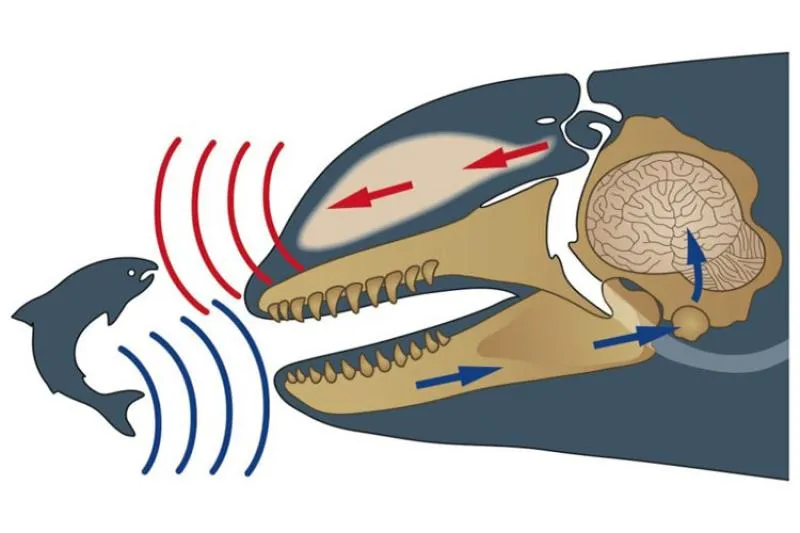
By placing a spatial audio recorder in the environment, sound is captured and stored to detect nearby activity without disturbing the ecosystem. Different recorders are designed for varying environments—Arctic or deep sea systems, for instance—to account for how sound waves travel differently in each. These devices work like regular audio recorders, but the captured sound is then processed through signal processing software to filter noise and identify different species through pattern recognition. This allows researchers to detect outliers in the environment, unidentified species, or signs of human activity.
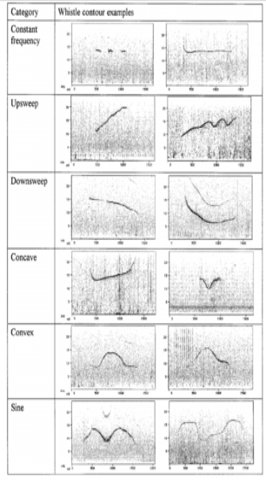
Scientists have been able to distinguish between mammal groups and species by analysing frequencies recorded by these devices. This is done by identifying each species’ unique vocalisations, known as ‘acoustic signatures’. These acoustic signatures vary between species and between individuals, and can be organised into audio recordings and analysed computationally to identify known species or detect possible new ‘cryptic’ species that may resemble known ones.
Underwater microphones called hydrophones are deployed to pick up these sounds and track behaviour, migration, biodiversity, and the presence of animals in specific areas. The recorded frequencies are then plotted on a line graph to visually identify patterns or outliers in the ecosystem.
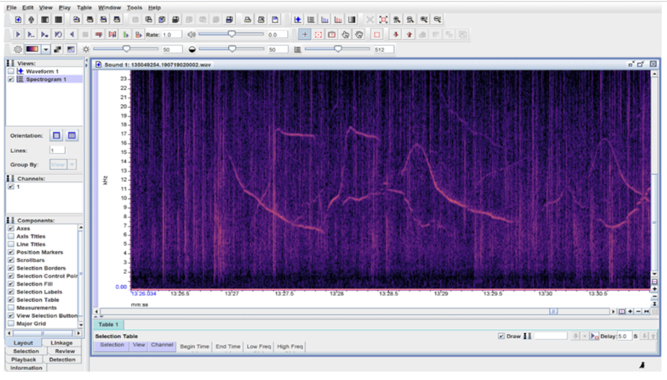
Today, countless types of acoustic recorders capture frequency data without disturbing the surrounding ecosystem. One example is passive acoustic monitoring, used to differentiate whale species by their distinct vocalisations—such as humpback whale songs, which can be tracked across vast distances and matched to migratory patterns. This technology is now used in over 70 percent of marine bioacoustics fieldwork, and can be seafloor-mounted or attached to a buoy or platform.
Using sound-based data for conservation
Over the decades, bioacoustics has made significant strides in marine conservation through underwater recording, informing protection measures and deepening our understanding of marine animal behaviour. For example, researchers from the National Oceanic and Atmospheric Administration (NOAA) deployed underwater hydrophones and marine autonomous recording gliders across the eastern tropical and southern Pacific Ocean to record blue whale calls over several months. They found that different whale populations have distinct regional dialects, allowing researchers to separate these populations and map their seasonal migration patterns. Migration was found to be most active between February and July, following inconsistent routes.
Projects on the Atlantic cod have also utilised passive acoustic monitoring. Researchers from the Massachusetts Division of Marine Fisheries recorded low-frequency grunting and drumming noises by Atlantic cod at 300 Hertz. Since lower frequencies indicate higher satisfaction levels in cod, the study concluded that human activity was minimal during the time of recording. These results were used to inform local fisheries and boaters about the impact of their activity, leading to the stronger strategic planning around marine protected areas and sustainable fishing in the Atlantic.
The vaquita (Phocoena sinus) is one of the world’s most endangered marine mammals, with fewer than 50 estimated to remain. Scientists were able to locate some individuals in their known habitat, where echolocation clicks were recorded, and acoustic detections confirmed an 80 percent population decline between 2011 and 2015. Despite these rapidly declining numbers, the acoustic signals confirmed their continued presence in core habitat areas, prompting the Mexican government to enforce gill-net bans in the Gulf of California.
The future of bioacoustics
Marine bioacoustics is advancing on several fronts. Real-time acoustic sensors—some connected to satellites—can send immediate alerts about unusual sound patterns, such as illegal dynamite fishing. These devices are sensitive to disturbances even above the ocean floor, making them effective for detecting large-scale environmental damage from human activity.
Underwater gliders, a new upcoming technology, have increased acoustic data collection by around 300 percent in the last decade, due to their durability and longer operation time. A glider is latched onto a hydrophone, and minimises interference. It even uses its natural buoyancy to glide up and down through the water in an energy-efficient column.
That said, the field has room to grow. Deeper studies tend to focus on only a few applications and the fine-tuning of existing models, rather than expanding coverage to as many species as possible. There is also the persistent challenge of interference from nearby human activity—boat noise and soundwaves from above are routinely caught in hydrophone recordings. Better tools for distinguishing animal sounds from human ones, based on depth, distance, and frequency patterns, would help researchers not only interpret the data more accurately but also detect the ratio of animal to human activity in sensitive areas.
In the future, bioacoustic technology may even develop to show simultaneous visual representations alongside real-time recordings, helping researchers draw more precise conclusions. Tools that can also detect the effects of nearby echolocation on organisms such as plankton, coral, and krill could open new pathways for coral restoration.
Until then, we will continue to develop and refine these technologies—bridging the gap between humanity and the hidden underwater world, and working towards a more complete picture of marine life.
Further Reading
Barber, E. 2024. Making Waves. The Royal Society Blog, November 2024. https://royalsociety.org/blog/2024/11/making-waves/. Accessed on March 12, 2026.
Berta, A., J. L. Sumich and K. M. Kovacs. 2015. Sound Production for Communication, Echolocation, and Prey Capture. In: Marine Mammals: Evolutionary Biology. 3rd ed. Pp 345-395. San Diego: Academic Press.
Woods Hole Oceanographic Institution. 2023. Annual Report. https://www.whoi.edu/wp-content/uploads/2024/11/WHOI-Annual-Report-2023.pdf. Accessed on April 5, 2026.