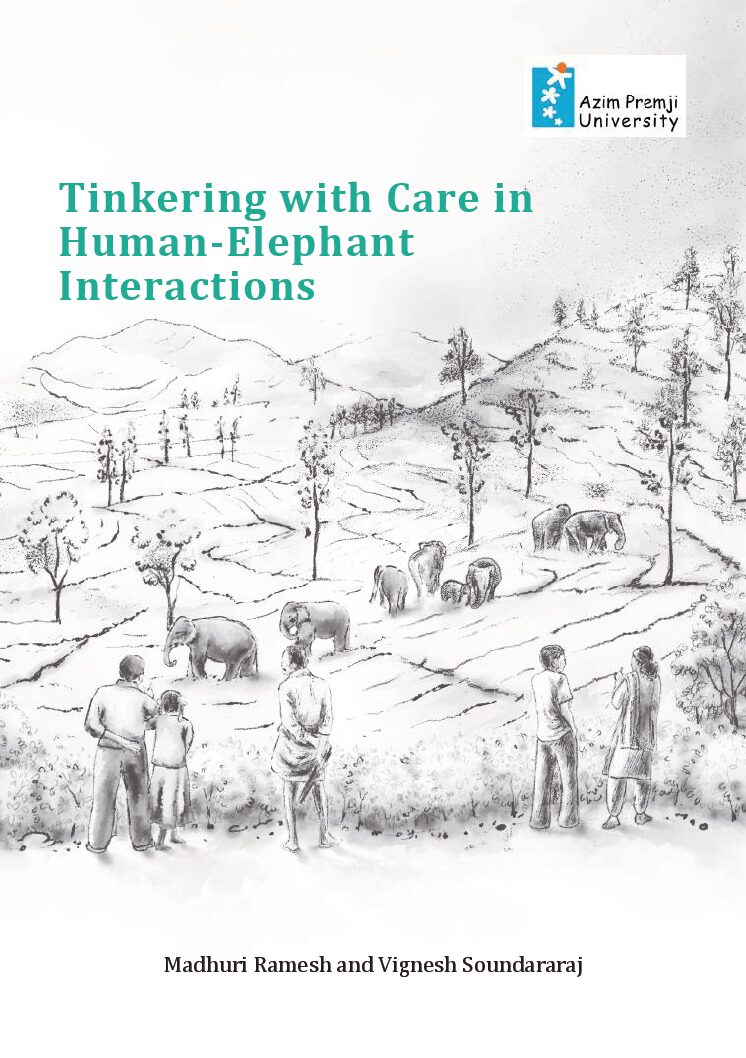
In their recently published book Tinkering with Care in Human-Elephant Interactions, Madhuri Ramesh and Vignesh Soundararaj tell the compelling story of an ongoing conservation practice that evolved around the empathetic relationship between Asian elephants and the human inhabitants of Valparai. Located in the Anamalai Hills in India’s Western Ghats, Valparai plateau has a unique mosaic of habitats, with forest fragments scattered throughout colonial-era tea plantations. Such a setting fosters a shared culture of coexistence between humans and wildlife, including elephants—but not without its fair share of challenges.
Situated inside the Anamalai and Parambikulam Tiger Reserves, Eravikulam National Park, and Vazhachal Reserved Forest, Valparai serves as a ‘frontier zone’ or a corridor for seasonal elephant migrations. The 120 Asian Elephants and roughly 70,000 humans on this plateau are the protagonists of the coexistence story that Ramesh and Soundararaj narrate. And in this public anthropology book, they argue that ‘care work’ and ‘affective labour’ can help cultivate an elephant-human coexistence.
Care work and affective labour have been used to describe the work done to evoke or manage emotions and to build, repair, or maintain relations between humans and elephants. Here, ‘affect’ refers to the feelings or emotions experienced in the presence of another being. Both affective labour and care work, in the context of Valparai, go beyond a human-centric approach, engaging both humans and nonhumans, to create ‘interspecies sociality’.
Quintessential question
The authors set the context with historical descriptions of Valparai’s elephants from documented records, ranging from the colonial period to contemporary novels, as well as from different perspectives. For instance, descriptions from the likes of P. H. Daniel (a doctor and unioniser) and Aara (a plantation worker’s son), give accounts of the lives of immigrant estate workers through the decades of 1920–40 and 1970–90.
On the other hand, descriptions by C. R. T. Congreve and General Douglas Hamilton critically detail the movements of elephants across an annual calendar and track their routes. They state that Valparai came into being as a human settlement and became an economic zone following the elephants’ trails through the jungle, and with immigrant workers pouring in from different parts of India as tea plantation workers.
The authors’ examination of these documents raises a simple question that serves as a point of departure for their ethnographic work: “Are elephants in our way or are we in theirs?” The ethnographic accounts that follow (in Chapters 3, 4, and 5) seek to answer this critical and foundational conservation question.
Stories of empathy
Ramesh and Soundararaj’s anthropological study aims to understand how ‘concerned allies’, such as conservationists, tea estate workers, and residents of Valparai, make sense of the world they share with their sagacious neighbours. Engagement with the community for over a decade and being part of their everyday lives were key to carving out thick accounts from lived experiences, emotions, and individual encounters with elephants.
The authors engaged in actively listening to the mundane details and casual thoughts of daily life among Valparai residents, drawing on an ‘ethnographic sensibility’. Listening is a method here. These ordinary accounts from a diverse group of people, including tea estate workers, bus drivers, and state Forest Department staff, about what they saw, how they work, and what animates them, enabled Ramesh and Soundararaj to do two things. First, to go beyond scripted narratives that reflect conservationist rhetoric. And once they became particularly attentive to these lived experiences, the authors came to see conservation as attempts to manage emotions and to repair relationships between species that is ‘affective labour’.
The quotidian narratives inform that a certain level of mutual fear (bayam) exists between elephants and humans. It helps both parties to maintain a ‘decorum’ and prevent any conflict. Residents see conflicts as disruptions to their daily lives, such as commuting or arranging social events such as weddings after dark. But the main concern is about the loss of life, which might put a family under long-term economic stress.
However, this does not affect the deep empathy that the people of Valparai have for the elephants. So much so that they could relate to the elephants’ struggle for food, much like how people migrate for work. The care is also seen when drivers refrain from honking while crossing herds or when residents use specific LED lights or fairy lights to deter elephants from buildings. Often, an elephant would be a very familiar neighbour, like the matriarch Monica. These micro-practices are part of the essential Valparai vazhakkam or the Valparai way of life, where care is central.
Tinkering with care
Together, the Tamil Nadu Forest Department’s Anti-Depredation Squad (ADS) and the Nature Conservation Foundation (NCF)—an NGO headquartered in Mysore and with a permanent field station in Valparai—capitalise on this care work to move towards human-elephant coexistence in the plateau.
The ADS sits between both species to prevent potential negative encounters and therefore profiles both the specific temperaments of elephant herds and the habits of likely vulnerable people. Their work is heavily dependent on mobile phones, especially the Thadam WhatsApp group. These cell phone-based technologies are central to real-time alerts and enable mitigators to provide calibrated care by offering specific instructions during encounters. Additionally, the squad appears on the scene quickly by jeep and bikes. So important is their contribution that these vehicles are regarded as a marker of competence and sincerity. They build rapport within the community to advise the residents on safety. The authors find them constantly bridging gaps among spaces, seasons, and species—for the ADS, negative encounter mitigation is a present continuous action.
On the other hand, NCF’s intervention is built around attunement and accountability based on tracking herds (information), sending alerts (communication), and liaising with stakeholders (coordination). Veteran scientists like Dr. M. Anand Kumar advocate for community-engaged living to gain a careful understanding of the daily-life effects of wildlife disruption. Insights like these are pivotal to ensuring that mitigation measures are socially accepted and feasible. However, the authors highlighted that a moral residue remains among these caregivers when accidents occur despite their best efforts.
Future outlook
There are additional factors that could have been better addressed to provide a fuller picture of the Valparai vazhakkam. Interestingly, the authors openly reflected on the limitations and methodological challenges they encountered during fieldwork.
A major gap was the perspective of migrant workers who encounter elephants daily. The authors mention that neither NCF nor the Forest Department were fluent in Hindi, Assamese, Sadri, and other languages commonly spoken by migrant estate workers, which limited their ability to understand and address the challenges these groups face. The authors could also only conduct limited participant observation due to the NCF members’ unfamiliarity with the qualitative, interpretivist approach adopted by the authors, leaving them to only rely on cultivating an ‘ethnographic sensibility’. The lack of methodical study of conservation practitioner stress among frontline mitigators and NCF staff was another limitation of the book—these frontliners suffer from severe physical and mental health issues due to their intense affective labour.
The question, however, remains whether the same conservation method is applicable in other Indian contexts, such as human-tiger interactions in the Sundarbans in West Bengal or in Ranthambore in Rajasthan. The authors note that the success of the NCF model is highly specific to Valparai. They point out that these strategies might not easily be generalised. It requires substantial tinkering in other contexts such as floodplains or resource-strapped landscapes. The authors’ engagement with this question remained unattended. However, the answer can be found well within the book’s chapters—a common theme that binds everything together: ancestral knowledge. This is the core aspect that can guide how care is employed in conservation efforts in different socio-cultural and geographical spaces.
Tinkering with Care in Human-Elephant Interactions reframes human-wildlife coexistence as a continuous, repetitive process of care work. It moves beyond normative practices and focuses on ‘affective labour’ as its core, building and repairing inter-species relationships through specialised skills and emotional work. It suggests that persistent tinkering would allow the mitigators to adjust and address human and wildlife vulnerabilities in different situations. Additionally, the authors count mixed-community residents as active partners in the conservation and mitigation process. They highlight the importance of technology but also acknowledge that the care work is most effective when rooted in situated knowledge and mutual social trust. The book shows that Valparai vazhakkam is possible through empathy, accountability, and a commitment towards different species in society.
Editor’s note: The book is licensed under Creative Commons and can be downloaded for free here.
Further Reading
Despret, Vinciane. 2016 What Would Animals Say if We Asked the Right Question? Minnesota: University of Minnesota Press.
Tsing, A. L. 2015. The Mushroom at the End of the World: On the Possibility of Life in Capitalist Ruins. Princeton: Princeton University Press.
van Dooren, T. 2014. Flight Ways: Life and Loss at the Edge of Extinction. New York: Columbia University Press.