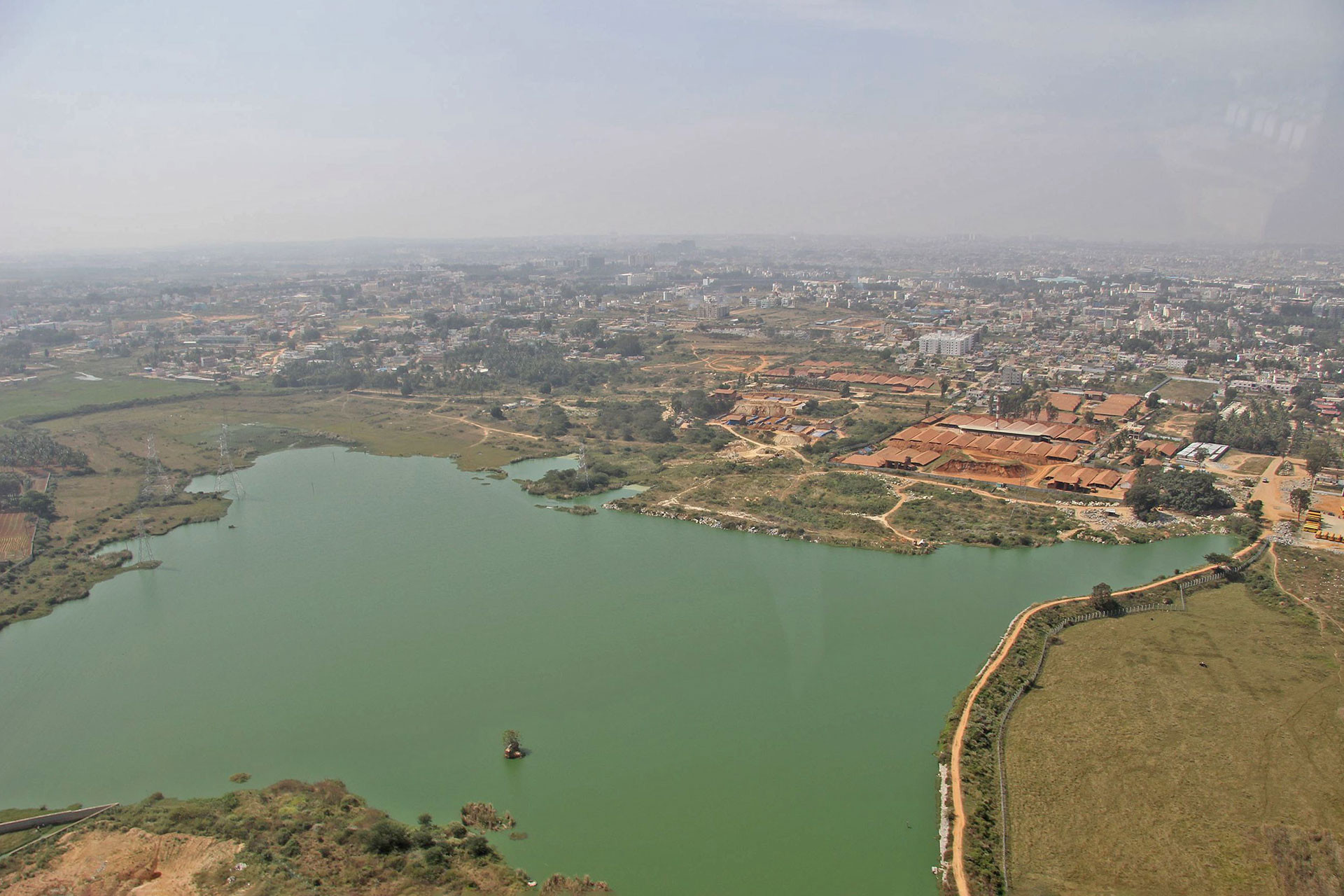
Featured image: An aerial view of a lake in Bengaluru in 2011, illustrating the city’s urban lake landscape. Source: Vinu Thomas via Wikimedia Commons under the CC BY-SA 2.0 license.
One of India’s largest cities, Bengaluru has a population of around 13 million people. Its massive urban sprawl, spanning over 740 square kilometres, was once home to more than a thousand lakes. They formed a cascading, interconnected system that naturally filtered sewage, buffered monsoons, and helped recharge groundwater. Today, of the remaining 830 or so lakes, many remain isolated, polluted, and encroached, leaving the city’s traditional lake systems in shambles.
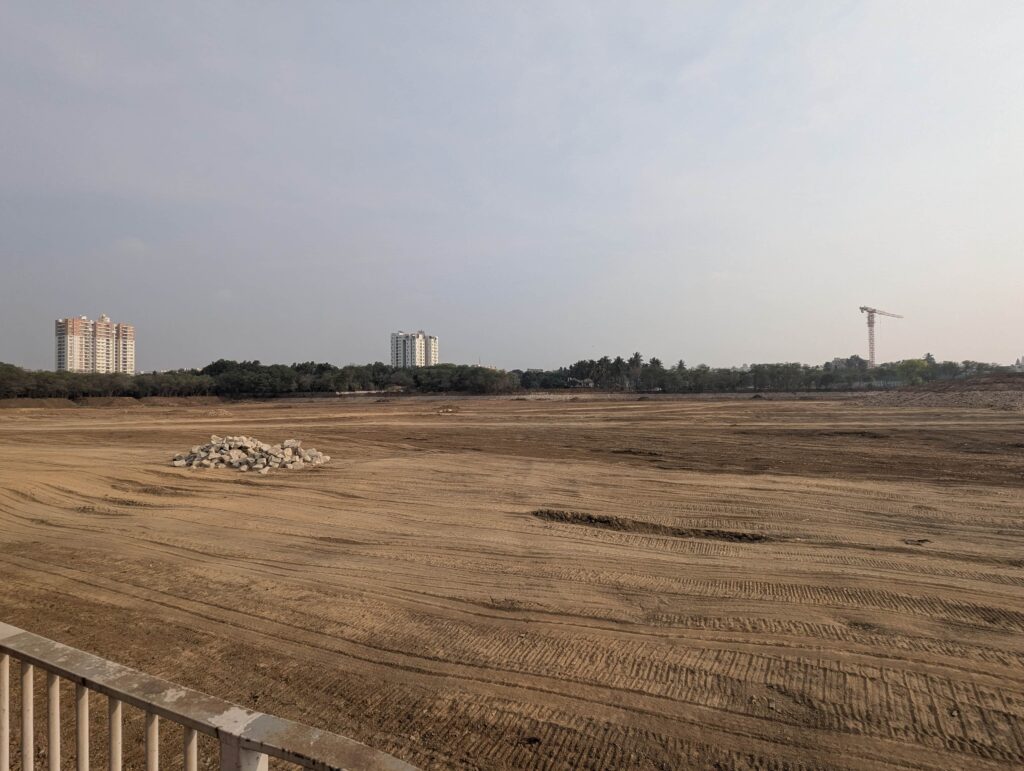
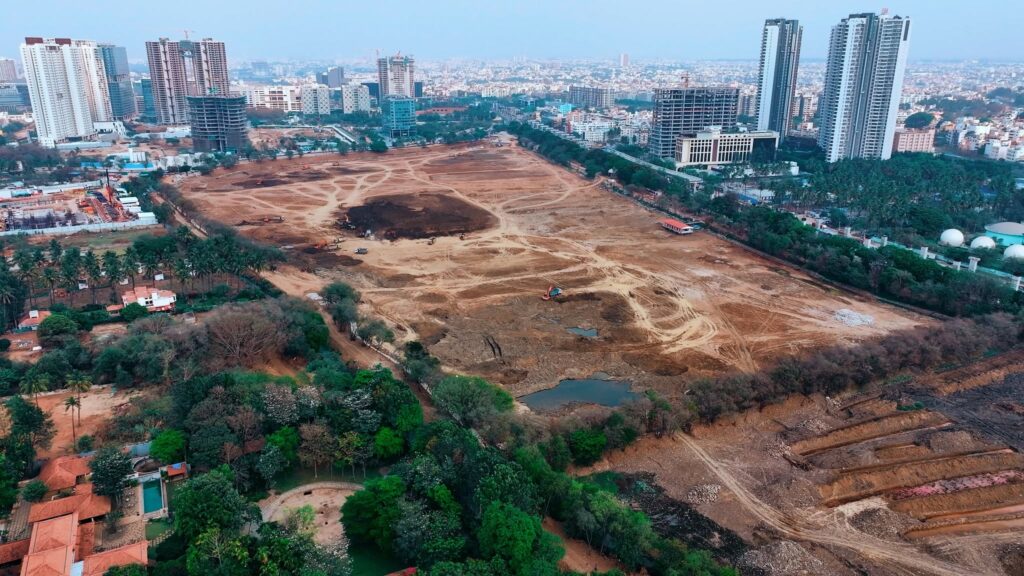
While returning home from the Bengaluru airport the other day, I saw a completely dry Nagavara lake. Something is absolutely unsettling about observing a lake that should have been full in February, bustling with waders, pelicans, and warblers, but instead was empty and drained out, with heavy machinery digging up the lakebed. Mud was exposed. A few birds, largely egrets, were restricted to a small remaining puddle. Past eBird bar charts and checklists show Nagavara kere (meaning ‘lake’ in Kannada) as a reliably bird-rich wetland, abruptly thinning out in 2025–26—exactly when desilting and structural work began—suggesting that the birds simply aren’t using the lake under its current state.
Urban ecology
This is what urban lake restoration often looks like at first glance. A few reports exist on the need for a large-scale restoration project that began in early 2026, as part of a planned rejuvenation project by the Greater Bengaluru Authority (GBA) and related agencies. It involves desilting, improving inflows and outflows, and basic structural upgrades—work that is expected to leave the lake drained temporarily before refilling. Recent local reporting noted the lake was deliberately drained for this effort and said the works were to improve the lake’s function, though the severe ecosystem disruption has been clearly visible on the ground.
Many lakes in Bengaluru adopt a ‘soup bowl’ design, so they are in need of desilting from time to time. However, this structural design is inherently not biodiversity-friendly. In addition, large-scale restoration and beautification further dismiss local ecologies and histories. A hard pill to swallow, but public understanding of local ecologies is often shallow. As urban residents, many of us do not recognise what constitutes native biodiversity, what ecosystem services a functioning lake quietly provides, or why muddy shallows, grassy patches, and seasonal fluctuations are signs of health rather than neglect.
In that vacuum of ecological literacy, “restoration” becomes aesthetic—cleaner edges, deeper basins, ornamental landscaping—a version of green that looks pleasing but may actually erode habitat complexity, weaken climate resilience, and simplify ecosystems that were once layered, connected, and alive. But local ecological knowledge on urban lakes isn’t missing. Experts already know what urban lakes need in order for them to support local ecology and hydrology, birds, aquatic life, and seasonal migrants. There is enough data about lake system hydrology, Bengaluru’s lost lakes, shoreline vegetation, and how shallow waters form crucial bird nesting habitat.
Studies also show the impact of human-induced disturbance on species presence, the impact of non-native trees and invasive species such as Lantana camara or Pontederia crassipes (water hyacinth), and how long stable ecosystems take to recover once disrupted completely. This is not obscure science buried in journals anymore; it is fleetingly present in several school textbooks, within citizen science portals, GIS systems, in songs and movies, and within several books written on urban greenery, water, and biodiversity. The bottom line is that the science is well-established, repeatedly demonstrated, and often publicly available.
And yet, in many cities in India, several lakes continue to degrade. For example, a study comprising 44 interconnected lakes in the Hebbal-Nagavara valley showed that lakes that were once dry in the summer are now filled with sewage, with downstream lakes filled only with domestic wastewater. Along with untreated sewage and nutrient pollution that fuel invasive water hyacinth and algal blooms, many urban lakes also face problems of: unmanaged solid waste and debris that block inlets and trap silt; encroachments and altered hydrology that disconnect catchments and reduce water-holding capacity; and the absence of shallow littoral zones that are critical for birds, fish, and aquatic plants. These issues are not arising because ecologists have failed to understand lakes, biodiversity, or ecosystem services. These are happening because governance systems are not designed to incorporate ecological knowledge into decision-making.
Fragmented responsibility and broken systems
Urban ecosystems rarely have a single custodian. One department manages stormwater. Another handles sewage. Another controls land use. Another funds “restoration”. None is accountable for ecological outcomes in their entirety, and each agency optimises for its own mandate.
Engineering goals prevail because they are visible and measurable. Earlier, there were no lights or footpaths around lakes; now there are lights as well as concrete walkways. Cubic metres of silt removed can be calculated. Rebuilt embankments can be photographed. Kilometres of pathways can be reported.
But ecological recovery does not present itself so neatly. The absence of birds is not immediately tabulated. The decline of reptiles or tortoises does not appear in progress reports. The slow spread of invasive species often goes unnoticed until the lake is suddenly covered in an algal bloom and declared a crisis. Most biodiversity does not respond to administrative timelines. Ecological processes unfold slowly, often invisibly—and precisely because they are slow, they are misunderstood. Yet when disrupted, these same processes can unravel quickly and become deeply destructive to the health of the people, far harder to manage than if they had been conserved in their natural state.
Here is the irony: There is no shortage of biodiversity data. Birdwatchers log sightings. Students conduct surveys. Researchers publish papers. Citizen science platforms hold years of observations. Many urban lakes have richer biological records than the institutions that manage them. And yet, almost none of this information is structurally required in governmental decision-making. There is rarely a mandate to present baseline biodiversity data before altering a habitat; rarely a requirement to monitor ecological outcomes after intervention and make them public.
So, the data exists—but they are invisible. They inform conversations, not decisions. And when evidence is not embedded in governance, it cannot shape outcomes.
Restoration is not always ecological
Many urban restoration projects prioritise visible transformation that pleases people from an urban convenience lens over ecological functioning or climate resilience. Stone embankments with heavy-duty lights replace natural edges and biological darkness. Ornamental plants replace native vegetation. Open, deep water in a soup bowl structure replaces a layered, shallow, grassy habitat. Visually, it appears improved. Ecologically, it often simplifies systems that depend on complexity and that support biodiversity and functioning. When success is measured by what can be photographed, counted, and inaugurated, interventions favour aesthetics and engineering over ecology and nature.
We often talk about degraded lakes in surprise. A wetland collapses. A forest becomes fragmented. A species vanishes. Each case is treated as a local tragedy. But the patterns are obvious across geographies; ecosystems decline most where governance is fragmented, reactive, or short-term. Ecosystems degrade and biodiversity declines because institutions are not designed to maintain the ecological conditions that science has long identified as necessary.
It is comforting to believe environmental problems exist because we don’t yet understand nature well enough or that there isn’t enough data available. That belief implies that more research will fix things. But many conservation failures, including degraded lake systems today, persist despite decades of ecological knowledge and citizen science data. The limiting factor is not understanding. It is the implementation and regulations that govern nature around us. Our urban lakes remain degraded and continue to be soup bowls by design, with the need for timely, often destructive desilting, because institutions that govern these lakes are not built to act on what science has already told us.
From an ecological and conservation perspective, maintaining a mosaic of water depths throughout the year is important. Ideally, an urban lake must have shallow water and exposed muddy margins with emergent and littoral vegetation, rather than maximising paved, deep open waters. Citizen science data like bird checklists can help track changes and build ecological baselines. Instead of paved pathways and lights, restoration must focus on native biodiversity retention and recovery that will enhance the ecological functioning of a lake. In lakes where timely desilting is necessary, it must be carried out in phases. Some water and lakebed must be kept undisturbed while avoiding important breeding, nesting, and migratory periods for wildlife. Biodiversity assessments carried out before and after any lake interventions, alongside citizens, would allow people to meaningfully engage with the existing lake network.
Further Reading
Grimm, N. B., F. S. Chapin III, B. Bierwagen, P. Gonzalez, P. M. Groffman, Y. Luo et al. 2008. Global change and the ecology of cities. Science 319: 756–760.
Kulranjan, R. and V. Srinivasan. 2026. Cascading urban lakes: How spatial, temporal, and anthropogenic characteristics control lake behavior. Frontiers in Water 8: 1778071. https://doi.org/10.3389/frwa.2026.1778071.
Murty, S. R. The Times of India. 2026. Bengaluru’s Nagawara lake to stay dry for 15 days as restoration work begins. https://timesofindia.indiatimes.com/city/bengaluru/bengalurus-nagawara-lake-to-stay-dry-for-15-days-as-restoration-work-begins/articleshow/127782452.cms. Accessed on February 25, 2026.