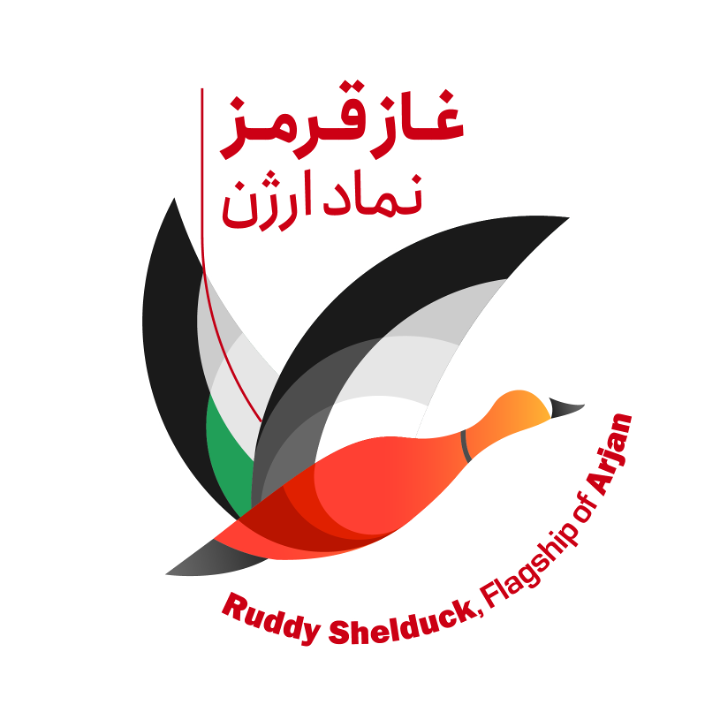
Featured image: The ruddy shelduck flagship logo created for Arjan International Wetland
Long before I first visited Arjan Wetland in Iran, its most powerful animal had already disappeared.
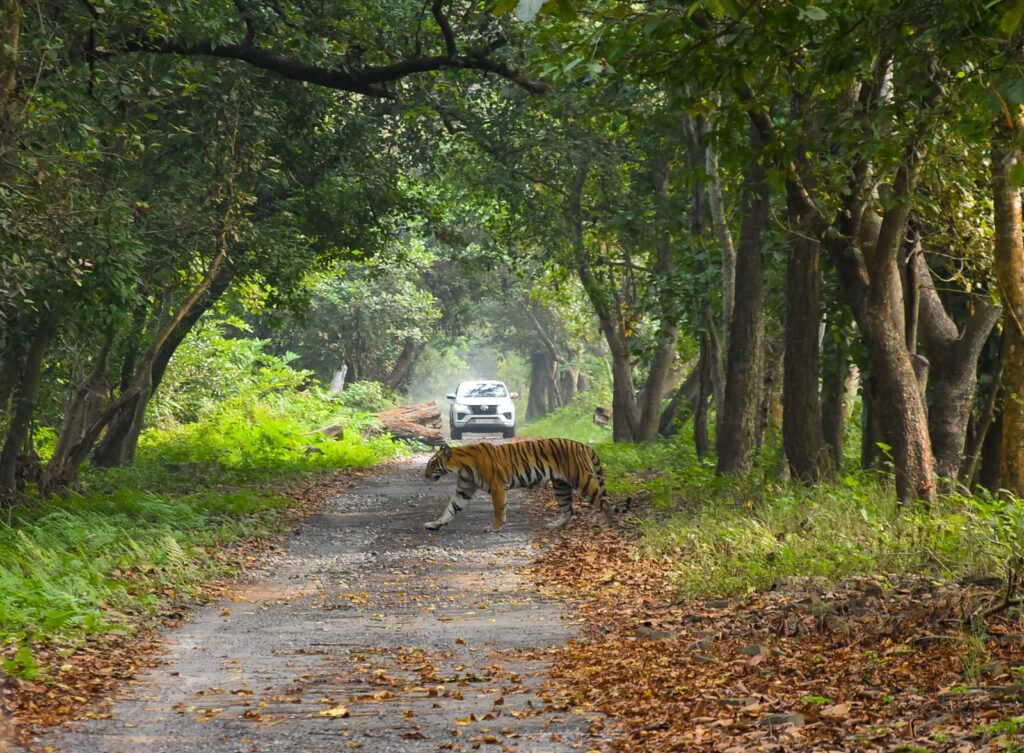
The Persian lion once lived in this landscape. Here, the lion is not only an animal from the past. It’s part of how the place is remembered, part of the weight of the wetland, the mountains, and the stories around them. But the lion has not been seen since the 1940s, remaining an absence with a name.
When I visited in 2020, I was invited by the local office of the Department of Environment to advise on bird conservation. I expected to think about species, habitats, threats, and monitoring. And I did think about all of these, but the first thing that struck me was something else.
People in Arjan were not disconnected from the wetland. They had a historical relationship with the ecosystem around them. They knew the place and had grown up beside it. The wetland was part of their memory, even when it was damaged, but something in that relationship was missing.
It was as if the connection had become thin. The place was still there, and the people were still there, but one of the living threads between them had weakened. I began to feel that Arjan didn’t need only protection—but to become meaningful once again.
A wounded wetland
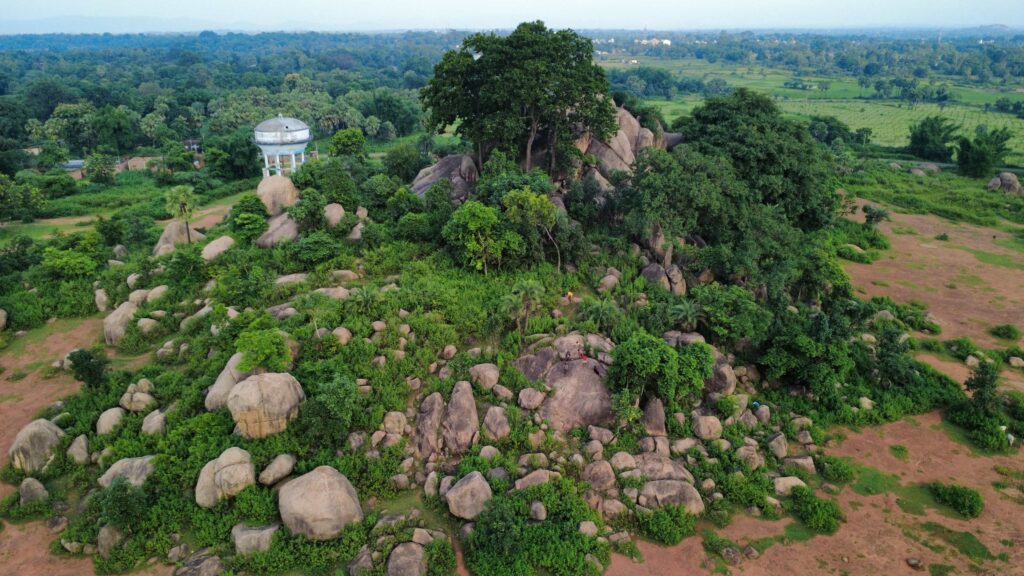
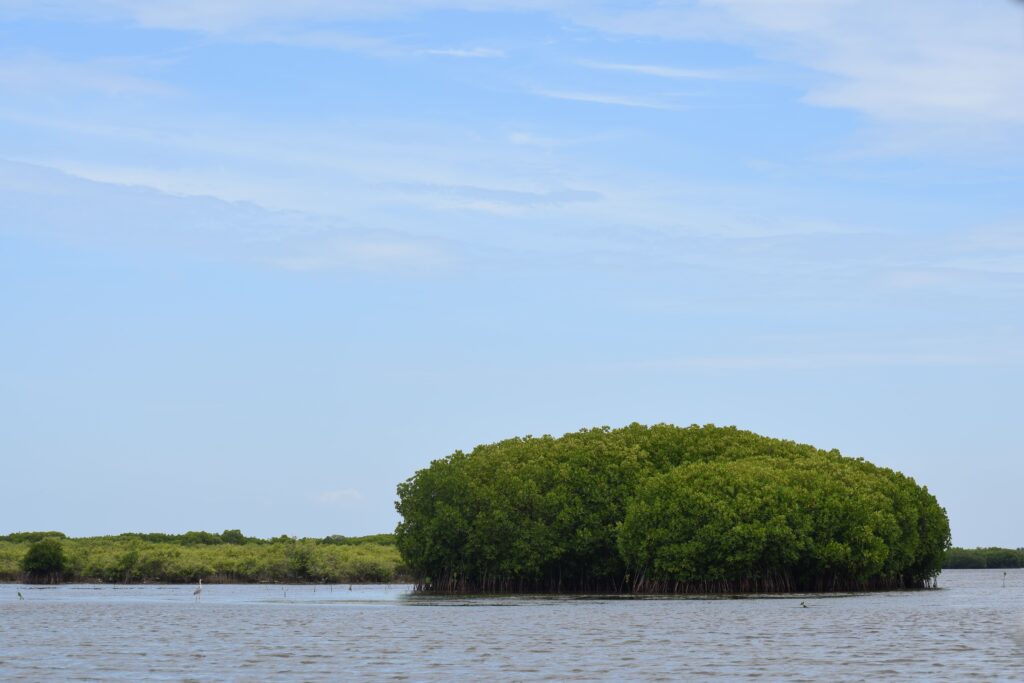
Arjan International Wetland lies in Fars Province in southern Iran, near Dasht-e Arjan village. It was recognised as a Ramsar site in 1975 and is part of the Arjan-Parishan Protected Area and Arjan Biosphere Reserve. The wider area has recorded more than 263 bird species, and the wetland itself is home to over 70 waterbird species.
But Arjan has also faced many pressures. Water extraction, well drilling, agricultural expansion, poaching, roads, power lines, wetland drying, and limited enforcement have all changed the landscape. In a few years, the wetland has shrunk dramatically, and in some seasons, what should have been water became land for cultivation. Birds that flew across the sky in larger numbers became rarer.
Attempts were made in the 1970s to reintroduce Persian lions and treat them as a regional symbol, but those efforts did not succeed. Habitat destruction and fragmentation were part of the problem, but there was also another absence—the decision had not grown from local participation, and people had not seen the lion in decades. A symbol that no longer walks, flies, calls, or appears in daily life cannot easily carry a new conservation relationship. The lion remained powerful, but it belonged to the past. We needed to ask whether another species, one still present, still visible, and still known by people, could help the Arjan community reconnect with the wetland.
Point of return
In conservation, we often speak about flagship species. The term can sound technical, and sometimes too close to branding. In Arjan, I did not think of it that way. We were not looking for a mascot—we were looking for a living point of return.
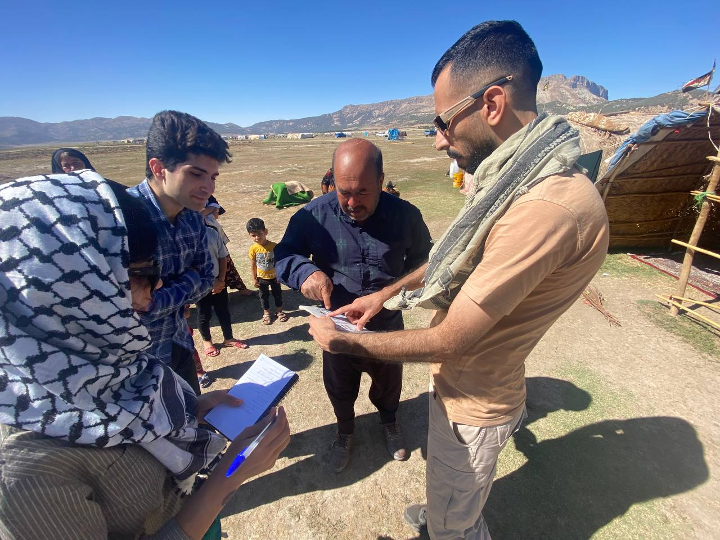
My colleagues at AvayeBoom Bird Conservation Society and I began to ask which bird could do this for Arjan. We considered three waterbird species: ruddy shelduck, common crane, and Eurasian coot. But we did not want to choose a bird for the village from outside. We wanted to understand which species already lived in people’s memory, language, and everyday knowledge.
In April 2022, local people gathered in the community hall of the village mosque. The meeting did not happen in a distant office or an academic room, but rather in the place where people already gathered. We used 10 criteria to compare the candidate species. Some were ecological or conservation-related, such as conservation status, distribution, and ecological role. Others were social: recognition, positive association, local ecological knowledge, common name, charisma, cultural significance, and whether the species had already been used as a flagship elsewhere. In the end, responses from 65 local participants were included.
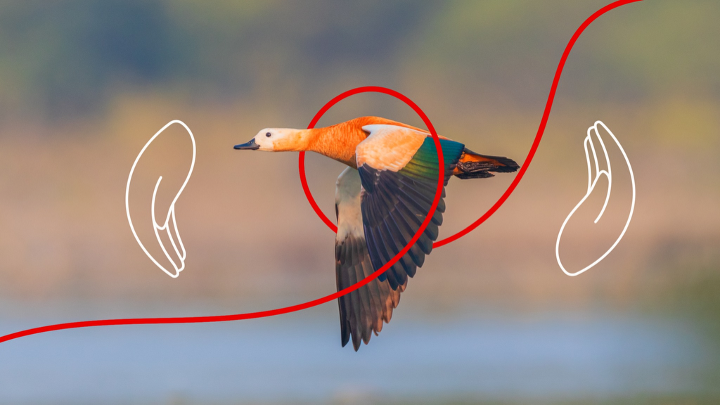
The ruddy shelduck received the highest overall score. Its local name, ghaze ghermez, was simple and vivid. Ruddy shelduck is a medium-sized waterbird, bright orange-brown on the body, pale on the head, and strikingly white-winged in flight. The distribution of this striking goose-like migratory duck extends across northwest Africa, southeastern Europe, West Asia and Central Asia.
Around Arjan, it feeds and rests in the wetland and the open areas around it. This visibility mattered to us. It was not a bird hidden deep inside the habitat, but one that people could still observe, follow with their eyes, and bring back into conversation. People recognised the species, had positive feelings towards it, and many knew where it could be found. It was not globally threatened like many species that attract urgent conservation campaigns. But for Arjan, it had another kind of importance because it could still be seen, named, and expected to return.
During our work in Arjan, many villagers told us that it had been a long time since the ruddy shelduck with its white wings had passed over the village. This stayed with me because it did not fully match what we had seen in the field. Our observations showed that the bird had not disappeared from the wetland, but it had become less visible in people’s everyday lives.
A species can remain in a landscape and still disappear from human attention. It can be present in counts, reports, and field notes, but absent from the daily experience of people who once noticed it. If fewer birds pass over the village, if they appear less often, if children no longer learn their name, if adults stop expecting them in the sky, the species begins to disappear socially before it disappears ecologically.
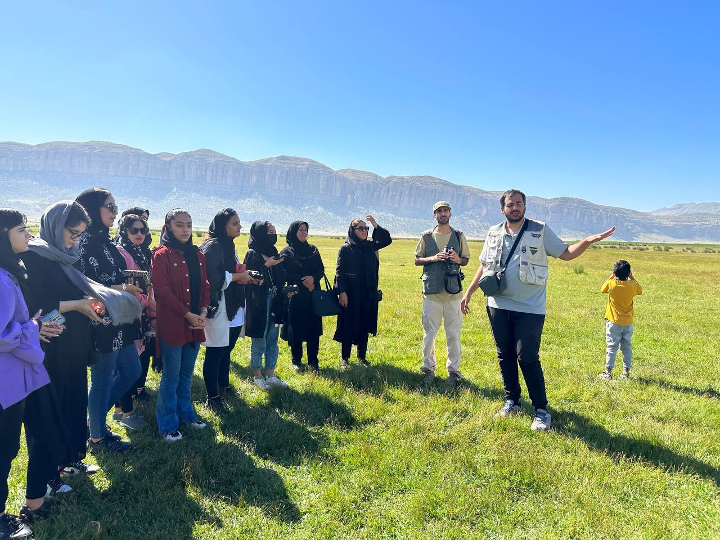
When we took people to the wetland and showed them the birds, many were surprised, and some were openly happy. I remember this not as a dramatic conservation moment, but as something quieter and more important. They were not only seeing a bird, but recognising something they thought had gone.
From species to symbol
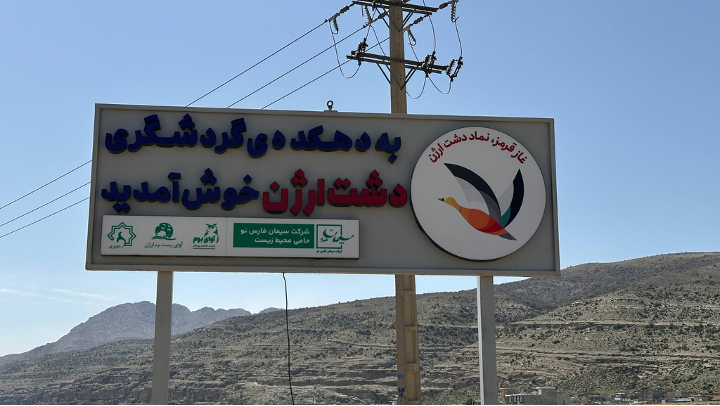
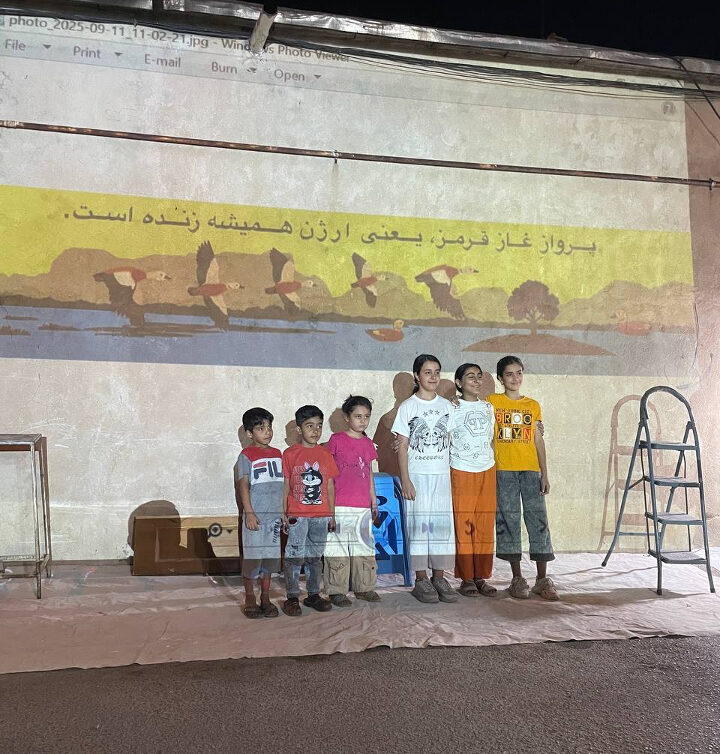
After the ruddy shelduck was selected, it began to move through the social life of the village in new ways. A logo was created, and the entrance sign of Dasht-e Arjan village was redesigned with the bird as a visible symbol of the wetland. Children saw the bird projected on walls during community activities, and families joined educational events. Birdwatching visits and local activities helped people encounter the wetland not only as a threatened area, but as a place where something living still asked for attention.
For me, the most important change was not that the ruddy shelduck became a brand. It was that the bird became a shared language. People could point to it, name it, speak about it, and connect it to the wetland. It did not replace the Persian lion, which belonged to another historical and ecological reality. But the ruddy shelduck did something different by giving Arjan a living symbol.
Relational restoration
Looking back, I think what happened in Arjan was not only the selection of a flagship species. It was the beginning of a different kind of restoration. Restoration is often understood as habitat work: bringing back water, vegetation, ecological function, or species populations. All of this is necessary, but in places where human relationships with nature have become thin, another form of restoration is also needed.
The relationship itself must be repaired. This does not mean asking people to love nature in a vague or sentimental way, but rebuilding the pathways through which people recognise a place as part of their own lives. Names, childhood memories, and local pride matter. Other things matter too: signs at the village entrance; the moment a villager spots a bird they thought had disappeared; and a child learning that the orange bird on the wall is not just an image, but a living part of the wetland beside their home. These are not decorations around conservation, but how it can be sustained in the long term.
The lion remains in Arjan’s past, while the ruddy shelduck flies in its present. The future of the wetland will still depend on water, law, restoration, and protection. But for me, Arjan has also shown the beginning of relational restoration: not restoring nature only as habitat, but restoring the relationships through which people and places are intertwined once more.
Further Reading
Bowen-Jones, E. and A. Entwistle. 2002. Identifying appropriate flagship species: the importance of culture and local contexts. Oryx 36(2): 189–195.
Ebrahimi, I., R. Dai, F. Kazemi and A. Seifii. 2024. Selecting a flagship species for Arjan International Wetland in Iran. Journal of Wildlife and Biodiversity 8(4): 364–383.