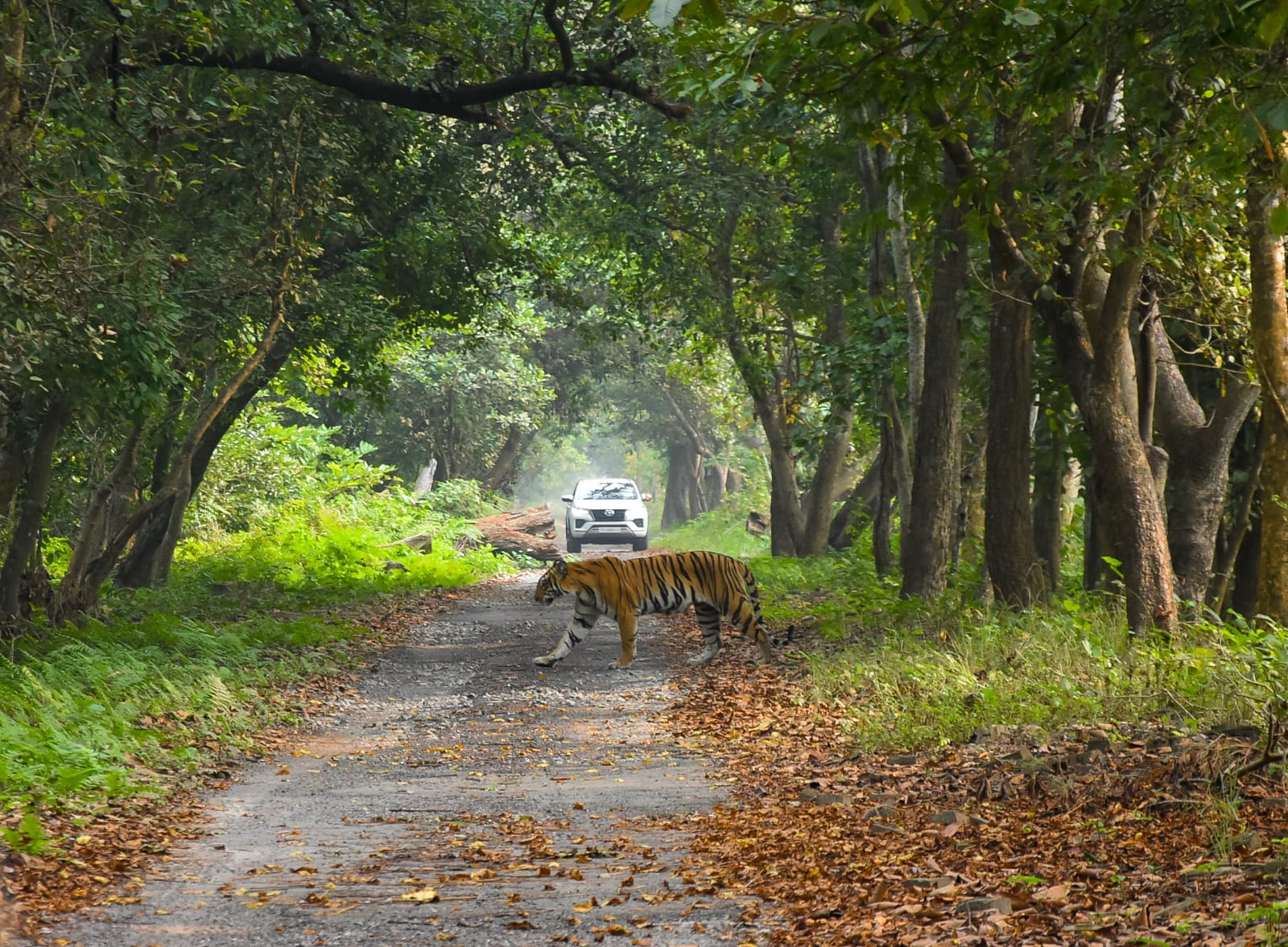
Feature image: A tiger crossing a forest trail in the Pilibhit Tiger Reserve in Uttar Pradesh, India (Photo credit: Mohammad Kasim)
Around 10 o’clock at night, I returned to our field station in Palia, Lakhimpur Kheri, in the Indian state of Uttar Pradesh. I was exhausted after a full day of fieldwork, which involved documenting the traditional knowledge of the Tharu community residing in the Dudhwa National Park, bordering Nepal.
That night, instead of returning home, our field associate Udasa di stayed at the field station—as she often does when we have to leave early the next morning for fieldwork.
Udasa di is often talkative. She loves sharing stories and enjoys using her mobile phone. After a full day in the field, she usually watches a couple of YouTube videos—setting the phone volume low so as not to disturb us—before falling asleep. Since I sleep beside her whenever she stays with us, I’m familiar with her small routines.
That night, when we went to bed, she was still watching short videos. After a while, she asked, “Didi, are you awake?”
When I said yes, she showed me a video on her phone. It was about tigers. In the clip, a tiger approaches from the front, grabs a man’s hand, and attacks him. “Didi, does a tiger behave like this?” Udasa di asked.
I said, “No, it should not be like this.”
“That’s what I also thought,” she replied.

Udasa di is around 35–40 years old and has received much of her knowledge from her father and elders, who had also explained to her how a tiger hunts. According to them, a tiger usually attacks from behind, catching the neck, instead of grabbing a limb from the front. She also mentioned how older people used to say that you could sense a tiger’s presence by its smell.
But after watching the video, she began to question her intergenerational knowledge, feeling that perhaps the video was right, and what she and her elders had known for years might not be correct.
Her face revealed her inner conflict. She seemed uneasy and unsettled at the thought that the knowledge she had grown up with could be wrong. It wasn’t just a doubt—it seemed to shake her confidence in the knowledge she had inherited.
Fake videos, real harm
Her question and confusion reminded me of my own confusion after seeing another AI-generated video a few months ago. My experience with that video was similar, and even the species was the same. It also featured a tiger; a drunk man was shown petting a tiger. The video appeared to be recorded on CCTV footage. It was only a few seconds long, but it looked extremely real.
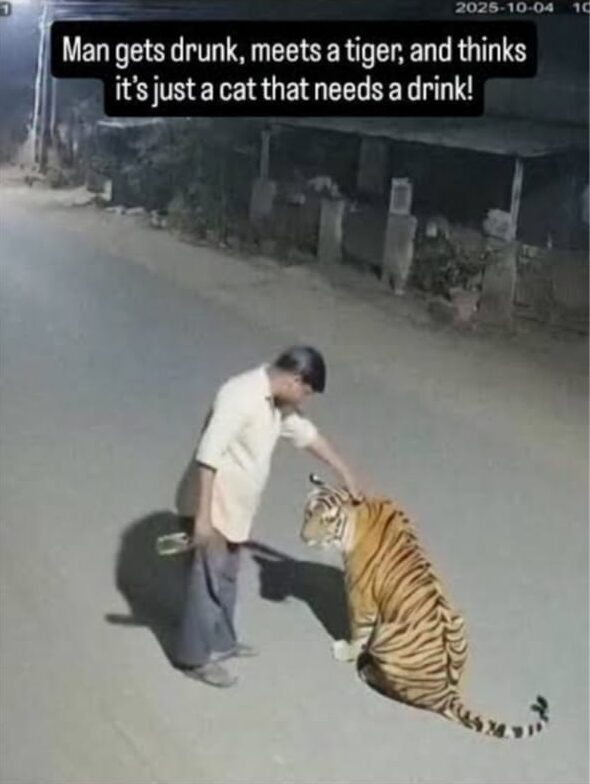
I was confused and called my friend D. P. Shrivastava, who has worked extensively on urban tigers in Bhopal for many years, in hopes of clearing my doubt. He had already seen the video and reassured me that it was, sadly, generated using artificial intelligence.
The realism of the video had nearly convinced me. That is how powerful and potentially dangerous such AI-generated content can be.
Udasa di’s question also reminded me of a similar conversation with Kaiser bhai in Pilibhit, also in Uttar Pradesh, during my project on elephant crop-raiding. Kaiser bhai was a driver from the area. He helped us interact with people in villages, as his presence as a local was an advantage. During our travels, he narrated many stories about wild animal behaviour and other adventurous experiences.
One day, I asked how he knew all these stories and behaviours. He said that he had learned them from videos he watched, showing me a few.
I was surprised and responded, “I thought you got all this information from the elders in your family? Since your village is located within the Pilibhit Tiger Reserve, I assumed that was why you know so much about the forest and wild animals.”
He replied, “I know that too, but I believe the information in these videos is accurate. Wait, I will share the page with you.”
Many of the clips were not completely fake, but not entirely real either. The animals looked accurate. The tiger or Asian elephant appeared morphologically correct, but the behaviour or context was misleading.
I tried to explain this to Kaiser bhai, but he refused to believe it.
“I have been watching these videos for months,” he said. “How can they be wrong?”
In a way, it felt similar to how Udasa di was feeling that night. This experience with AI-generated videos led me to a question: what is the influence of AI-generated wildlife videos on community perception and traditional knowledge?
Uncertain future
If communities begin relying on such information, will traditional knowledge still be passed down from one generation to the next? Forest-dependent communities understand the forest through their own knowledge systems, rules, and coping mechanisms—whether about tigers or other animals.

Udasa di herself has lived within this forest landscape for years. If such intergenerational knowledge becomes diluted or replaced by misleading digital information, could it affect people’s safety and survival?
These videos, often created mainly for entertainment, are now quietly shaping how wildlife is understood. While I’m not claiming that traditional beliefs are always perfect, they are part of people’s resilience and ways of developing tolerance that allow coexistence.
But if AI content is not monitored, will this misleading information slowly erase lived experience?
Another question came to mind while documenting traditional knowledge. If people are already influenced by AI-generated information, how accurate will our documentation be? Do we, as researchers, need to rethink our field methods?
There seemed to be something beyond simple uncertainty about the video. It was a quiet moment in which intergenerational wisdom and lived experience suddenly felt fragile.
In that small pause, it seemed as though a few seconds of digital content were powerful enough to disturb years of trust in what communities had always known to be true.