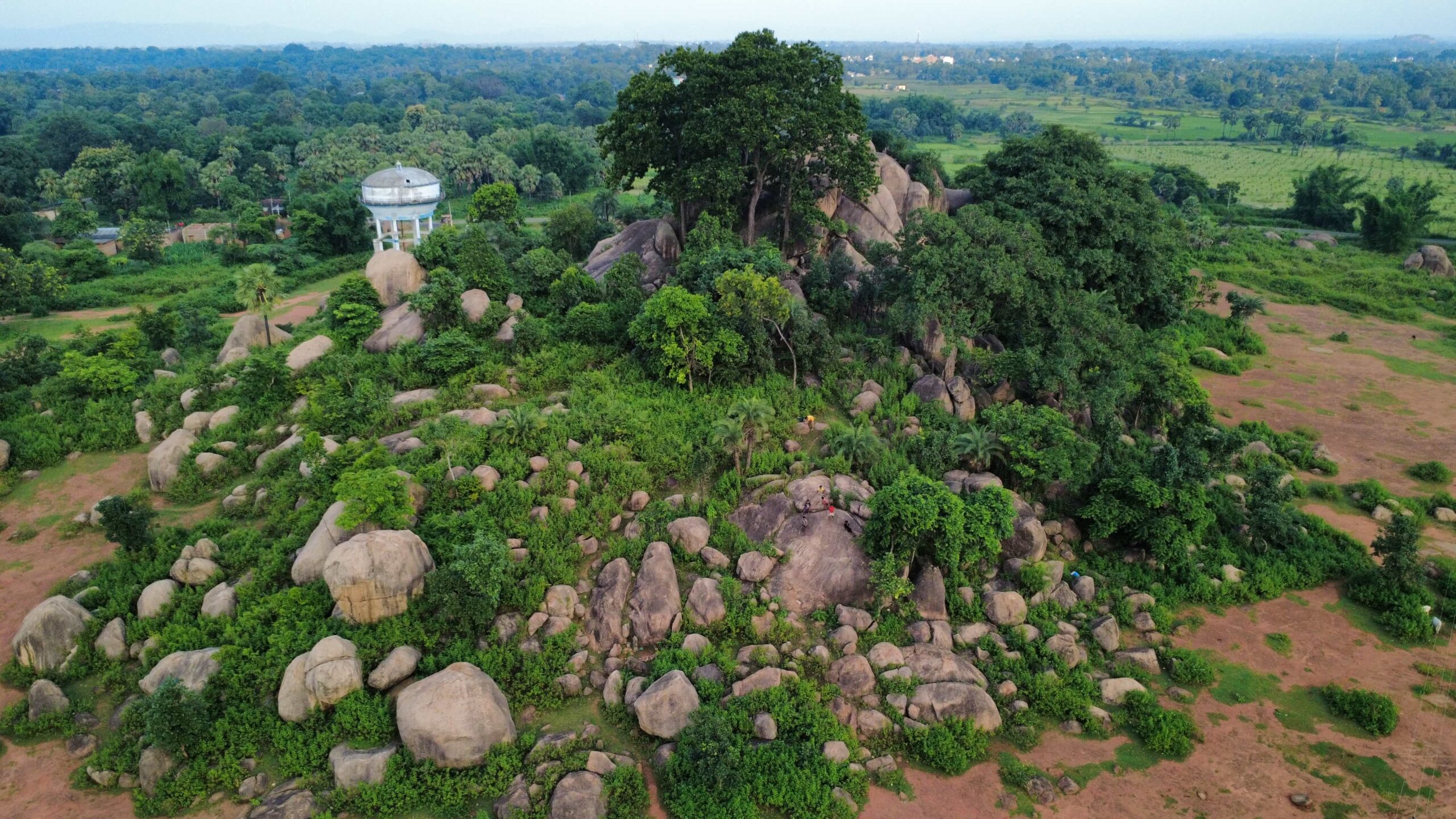
Featured image: Granite outcrop forest on Badra Pahad, Dumka District, Jharkhand, India, with village settlement and cultivation at its base
The first time I heard about the animal the villagers called Tayu, the conversation happened quietly near a small settlement at the edge of the hills. The elders of Kenduatikar village in the Dumka district of Jharkhand, India, spoke of the striped hyena that sometimes walked along the village road after sunset. Livestock had not yet suffered serious losses, but the stories were enough to draw my attention. A few weeks later, during a return from the slopes of Badra Pahad, I too saw a shadow move across the road before disappearing into the forest. In that moment, the granite hills of Santhal Pargana revealed themselves not just as geological formations, but as living ecological landscapes shared by people and wildlife.
These hills—Badra Pahad, Rajapathar, and Simani—rise quietly above the surrounding plains of Dumka district at elevations between 220 and 240 metres. Though modest in height, they form part of a broader granite inselberg landscape, where rocky outcrops interrupt stretches of forest and scrub woodland. To many observers, these hills appear rugged and empty. But walking among them reveals a different world: hidden water sources, resilient plants anchored in rock crevices, and animals navigating a mosaic of forests and villages.
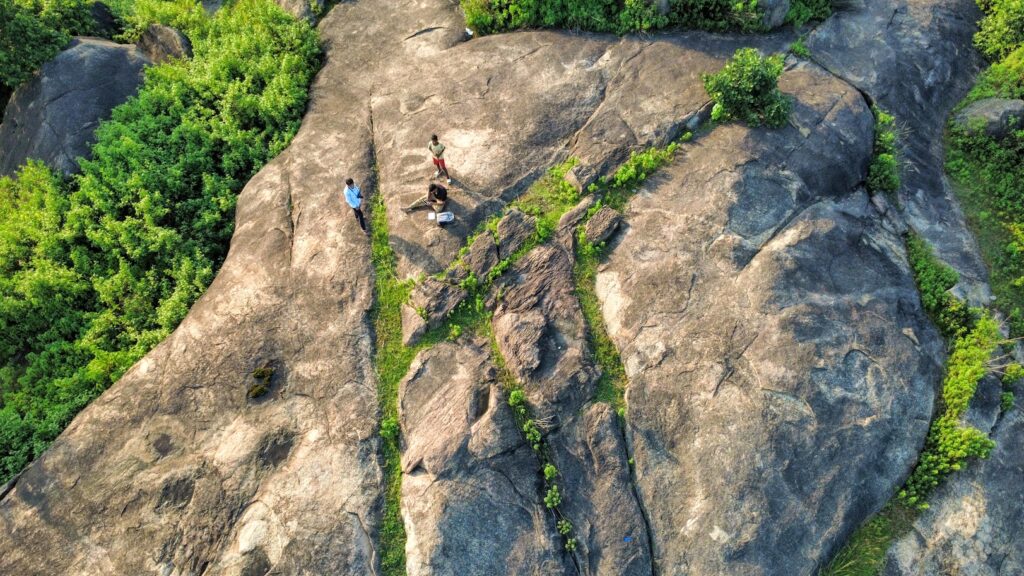
Between October 2025 and January 2026, I made repeated visits to these landscapes: Badra Pahad and Rajapathar in Dumka district, the forest near Kenduatikar village, and a granite formation near Khandokata in Pakur district. Each location offered ecological details that often remain overlooked in larger conservation discussions.
Hidden water and resilient flora
One of the most remarkable features of the Rajapathar hills is the water. Four small perennial streams emerge from the rocky slopes, feeding nearly 10 square kilometres of surrounding habitat. Even during dry months, water continues to flow through narrow channels carved into the granite. Moss, ferns, and other moisture-dependent plants cling on here, surviving where most vegetation gives up.
Elsewhere, the hills are dominated by sal (Shorea robusta) forests, mixed woodland, and scrub vegetation. Some trees appear to grow straight out of rock, their roots twist through narrow fissures in the granite, anchoring the plant firmly in shallow soil. These adaptations allow vegetation to survive in an environment where soil is thin and exposed rock dominates the terrain.
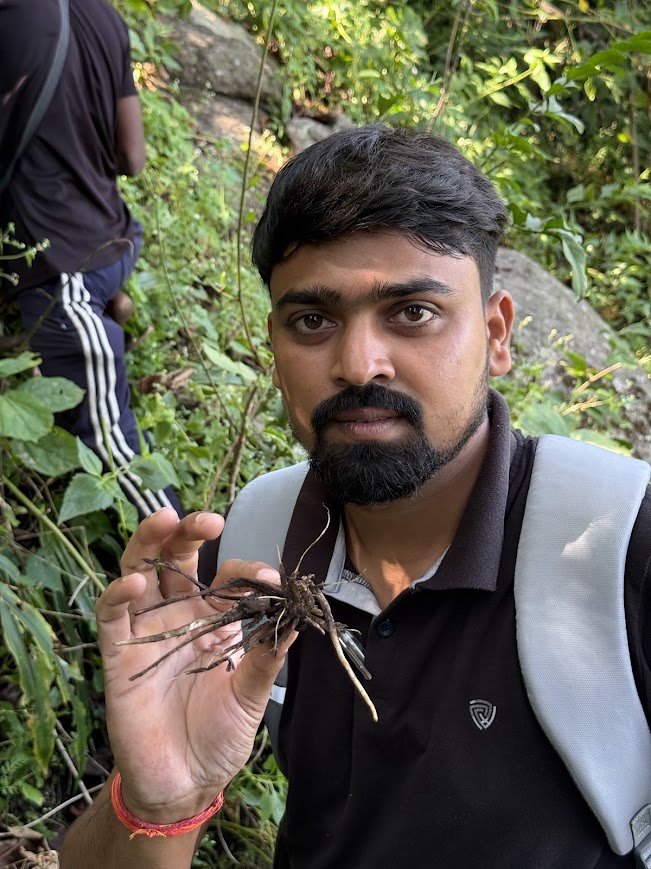
The slopes of Simani Pahad in particular support small pockets of moss and ferns that cling to damp rock faces, as well as insects and other organisms. Such habitats illustrate how even small variations in terrain can support specialised ecological communities.Moving through this terrain is another matter. Thorny thickets and invasive shrubs choke parts of the slopes, some sharp enough to cause real pain on contact. Climbing these rocky hills, therefore, requires patience and caution. But the difficulty is also proof of something: this landscape holds onto its biodiversity even as human activity around it grows.
Shared territories
These granite hills are not untouched wilderness. They are working landscapes, shaped daily by the communities beside them. For villagers, Badra Pahad and Rajapathar are familiar landmarks within their everyday environment. They are places connected to grazing routes, seasonal farming, and daily forest use. Villagers frequently visit these hills to collect firewood, graze livestock, or rest during long walks through the forest. The ecological and the cultural are not separate here; they shape each other.
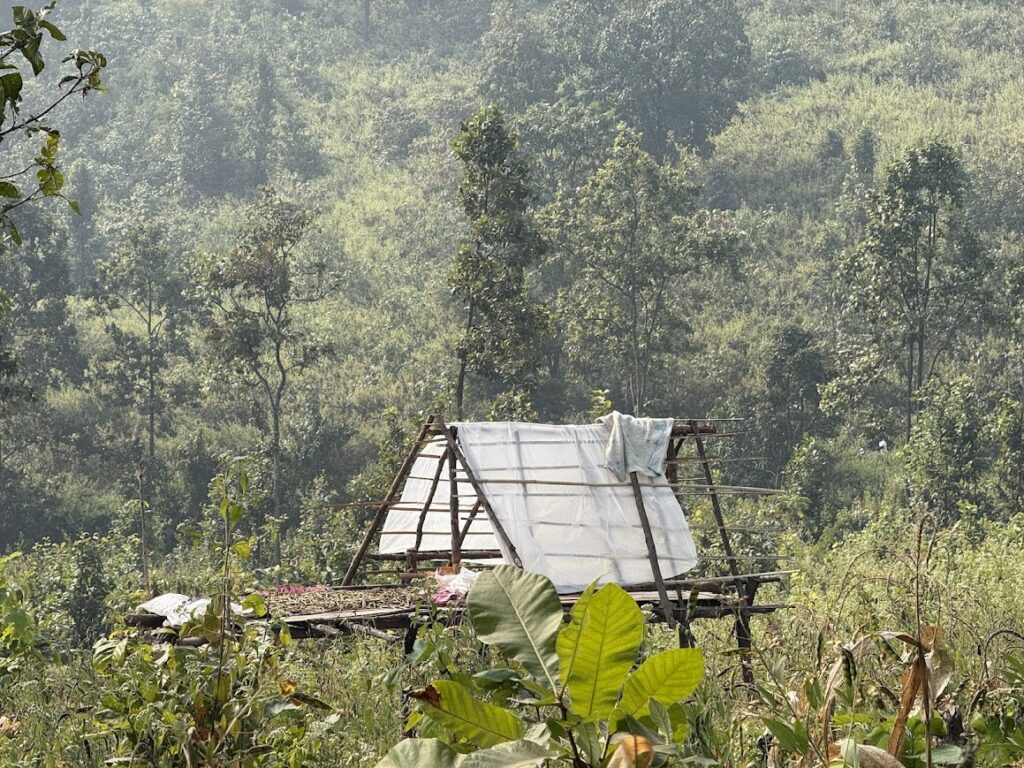
Near Kenduatikar village, temporary shelters constructed from wood and plastic sheets stand at the edges of forest patches. Villagers use these spaces while grazing livestock, collecting firewood, or tending small agricultural plots. In many ways, the hills represent shared territory where ecological and human processes overlap.
Wildlife still moves through this landscape, often in plain sight. Langur troops cross the canopy regularly. Wild boars leave their mark in disturbed soil. Golden jackals slip along forest edges. But it is the aforementioned striped hyena, or Tayu in the local Santhali language, that has drawn increasing attention from villagers recently.
During conversations in Kenduatikar village, several residents described the hyena with a mixture of caution and familiarity. Some consider it a quiet scavenger that keeps to the forest edge, while others recall occasional incidents when goats or poultry were taken during the night. Despite these concerns, the animal is rarely hunted or actively chased away. Instead, most people see its presence as part of the forest landscape that surrounds their villages.
Direct photographic documentation of hyenas in these hills remains limited, but repeated field sightings and local reports suggest that the species continues to move through these forest mosaics. Several residents reported night sightings of hyenas near roads and village boundaries. During my own field visits, I repeatedly observed hyenas and jackals crossing quiet rural roads that pass through these hills. After dusk, these roads fall almost completely silent, and in that silence, even the smallest movement stands out. One such sighting, a hyena crossing near Badra Pahad, lasted only seconds. But it spoke of something larger: these roads serve as both barrier and corridor, depending on the hour and the traffic.
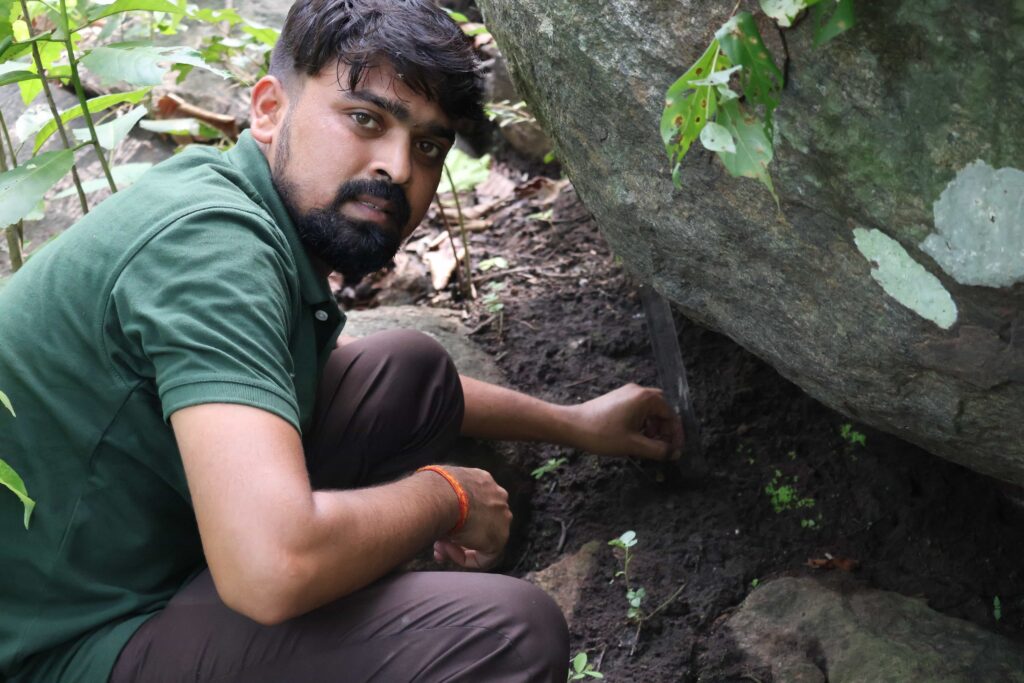
The granite hill forests of Santhal Pargana remain important wildlife landscapes, even outside formally protected areas. So far, these encounters have caused only limited concern. Livestock losses are rare, and conflicts remain minimal. However, the pattern suggests that wildlife movement is gradually adapting to landscapes increasingly shaped by human presence. As grazing areas expand and people travel more frequently through forest edges, animals must navigate a more complex environment.
Overlooked ecosystems
From the upper slopes of Badra Pahad, the surrounding terrain unfolds in a patchwork of sal forests, rocky ridges, agricultural fields, and scattered settlements. These hills form part of a wider granite hill network extending across the Dumka and Pakur districts of the Santhal Pargana region. In late afternoon light, the granite domes glow orange above the canopy, a landscape where geology, ecology, and livelihood all meet.
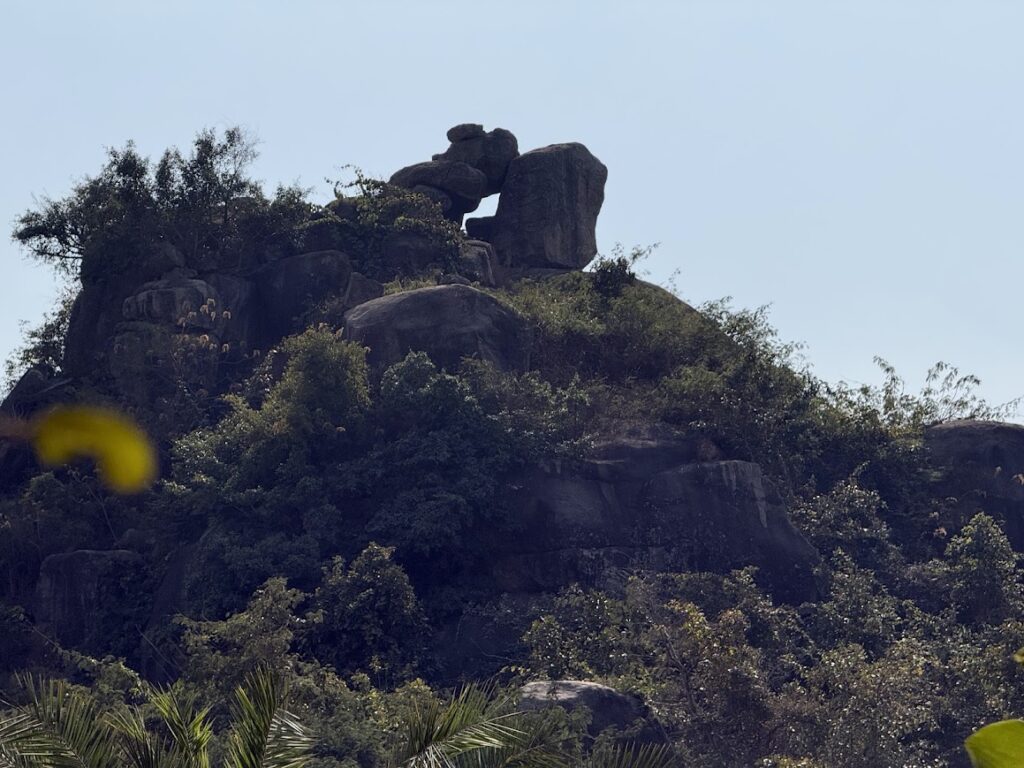
Despite their ecological significance, these granite hill systems remain largely absent from conservation discussions. Research and protection efforts in India often focus on dense forests or large protected areas, while smaller rocky landscapes like those of Santhal Pargana receive comparatively little attention, despite what they quietly do: sustain streams, shelter wildlife, and support plants built for rock rather than soil. They also sustain cultural and livelihood landscapes for the communities that live beside them.
Standing on Badra Pahad’s crest at sunset, this becomes hard to miss. Beneath the granite: hidden water, stubborn vegetation, and animals still moving unseen through the dark. Documenting these overlooked ecosystems may prove essential if we are to fully appreciate the ecological diversity of eastern India’s upland forests. From a distance, these hills look silent. Up close, they hold a living mosaic that continues to define what Santhal Pargana is.
Further Reading
Arya, S. L., J. S. Samra and S. P. Mittal. 1998. Rural women and conservation of natural resources: traps and opportunities. Gender, Technology and Development 2(2): 167–185.
Plumwood, V. 2003. Decolonising relationships with nature. In: Decolonising Nature: Strategies for Conservation in a Post-Colonial Era (eds. Adams, W. M. and M. Mulligan). London: Earthscan.
Watve, A. 2013. Status review of rocky plateau ecosystems in the northern Western Ghats and Konkan region of Maharashtra, India. Journal of Threatened Taxa 5(5).