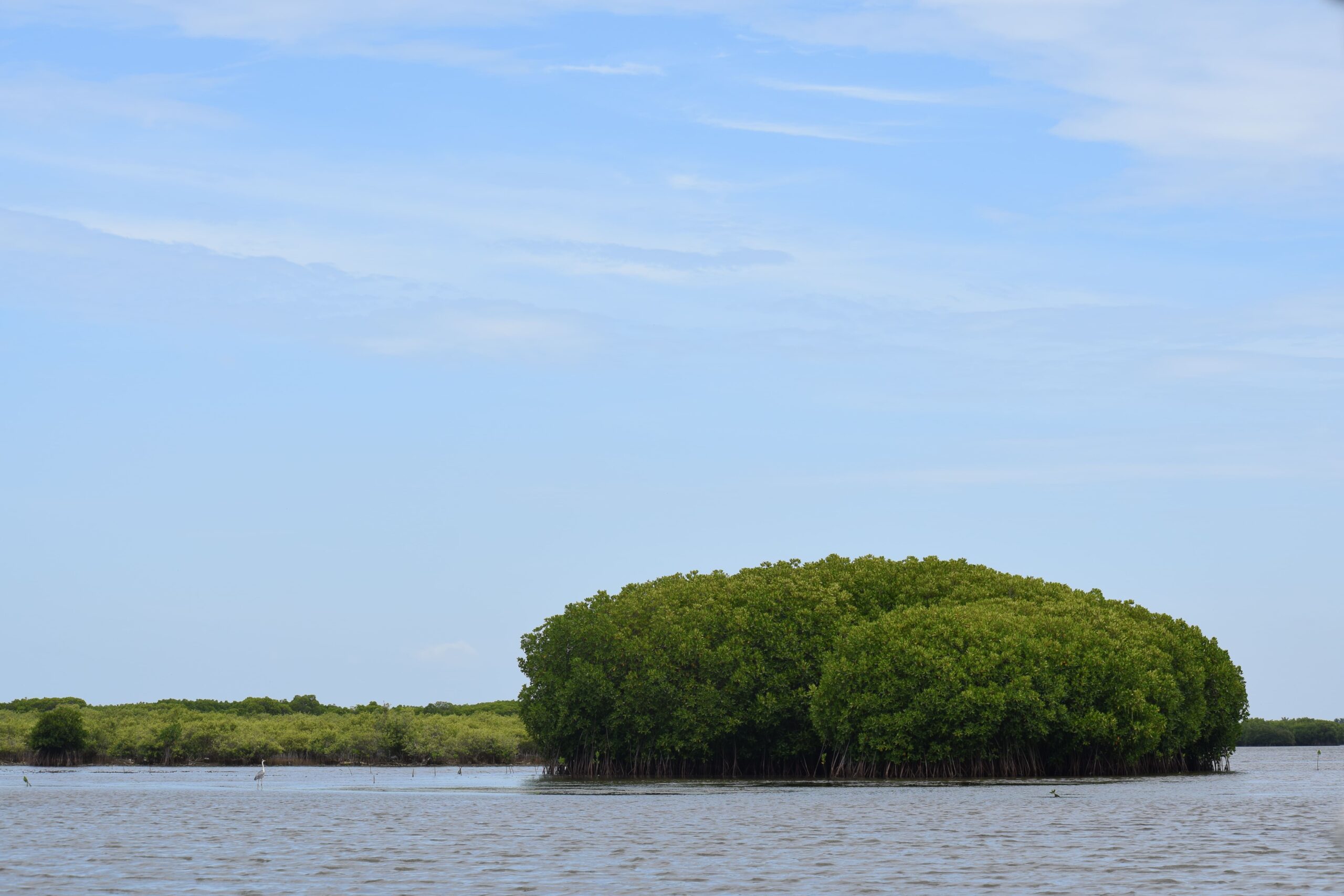
Featured image: A dense patch of mangroves in the backwaters of Pichavaram
On a sunny day in 2025, I visited Pichavaram, a mangrove forest recognised as a Ramsar Site, underscoring its importance as a wetland of global significance. I was working with a team tasked with preparing a conservation management plan for it. As part of our visit, we were taken deep into the mangrove ecosystem to record its biodiversity and understand its setting. That’s when I met the boatman who was steering us through the tangled roots and the receding water with ease.
Several studies have documented Pichavaram’s role in buffering the coast during the 2004 Boxing Day Tsunami, which naturally made me curious about the boatman’s experience as a survivor. People who live alongside these ecosystems often hold insights that science alone cannot capture. This made me even more eager to hear his story. When I asked him about that day, he didn’t respond immediately.
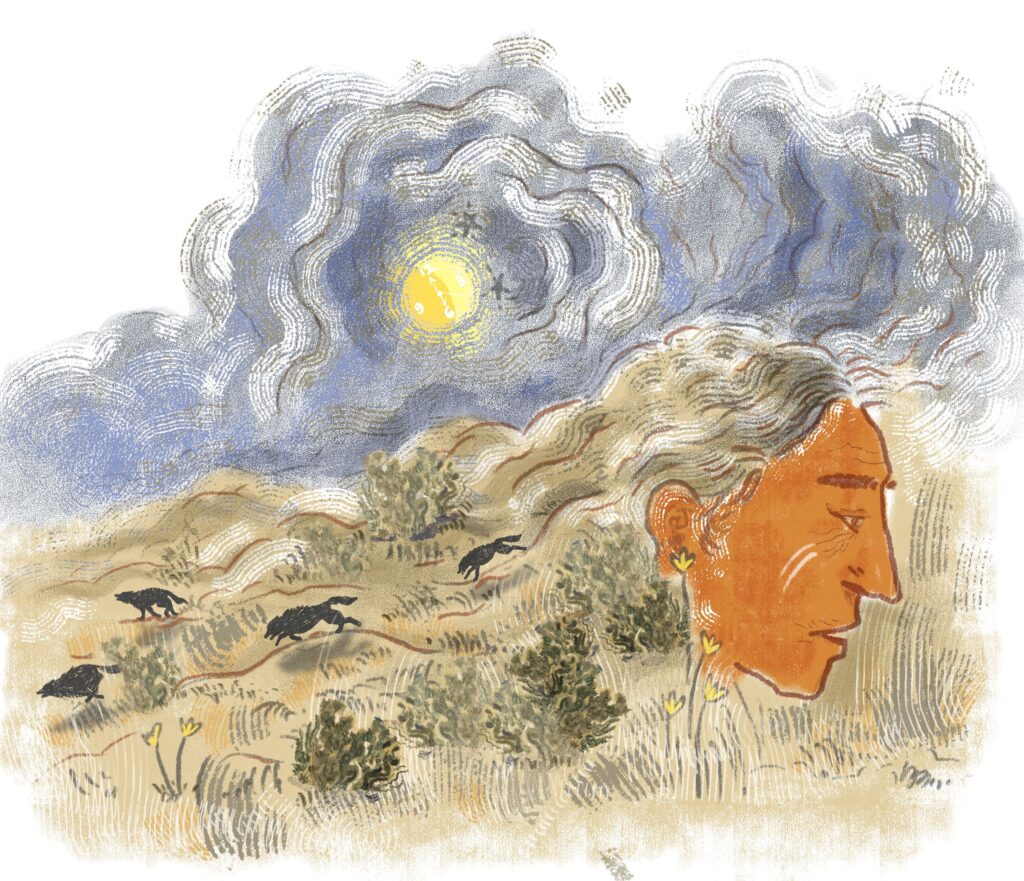
“The sky had lost its stars, swallowed by an ink-black void,” he began, eyes far off, as though still seeing it all before him. “It was the kind of darkness I had never seen before. Even the sea held its breath that night.”
There was a pause, nothing moved for a moment—not him, not the water. Then, he spoke again, his voice even lower now. “The ooranis (traditional village pond for freshwater), they started to bubble and overflow. At first, we thought it was just the heat playing tricks, but the elders knew better. They exchanged looks.” He stopped, then added, “The dogs whined; the birds were gone. The Fishermen don’t fear the sea; they understand her moods. But that night…” His voice trailed off.
“That night, the sea was trying to tell us something, but we didn’t understand. On the day of the tsunami, everything went still. It was as if the world had paused, waiting for something. Then, without warning, a huge mass of water hit our village.”
It was only later he knew from the fishermen how big the wave was and what actually had happened. He described the wave from everything he heard. “It was a dark, towering wall of water that approached with terrifying speed. It wasn’t the soft blue of the usual tides, but an ominous, black mass.”
He continued, “That wave struck hard, toppling everything in its path. It was complete chaos in our village. But as the water poured in, it carried an unnatural chill.”
I asked how cold it had been. “The coldest thing I had ever felt… like hugging a big ice cube.” He emphasised, “Those days we didn’t have refrigerators at home, growing up without fridges, the coldest thing we knew was the ice used to keep fish fresh or the inside of the ice cream vendor’s box.”
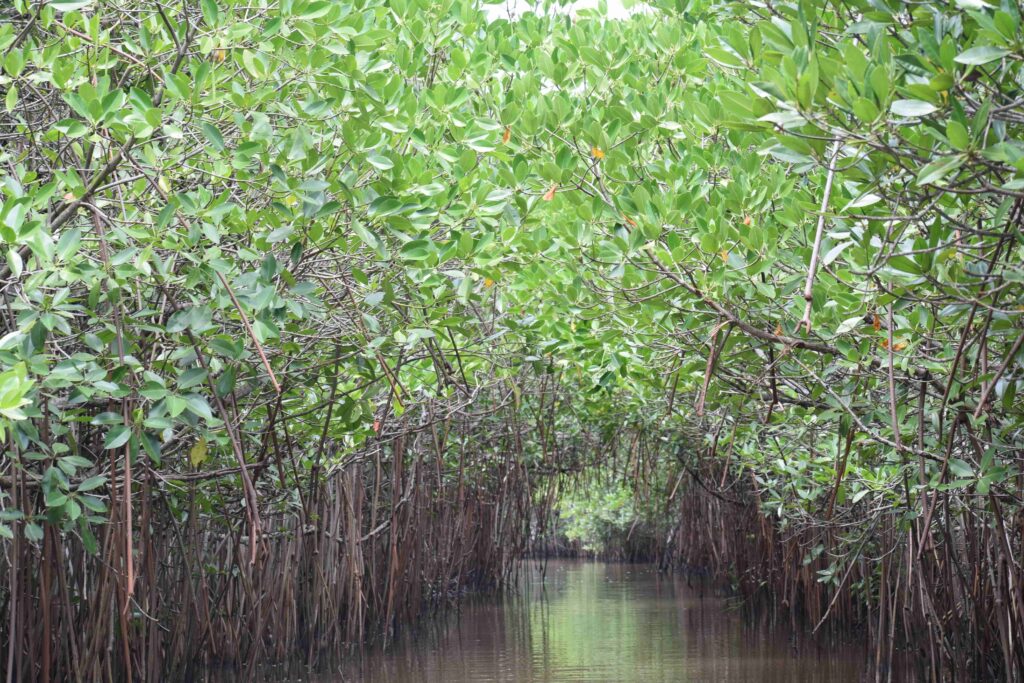
No one could have described it more vividly. He spoke of leaving their villages in catamarans, uncertainty pressing on their hearts. “We didn’t think much of these trees back then, nobody ever prayed to a mangrove,” he muttered. “But they did more for us that day than all the temples put together.” As the wave surged toward them, the mangroves acted as a shield. Their dense roots and intertwined branches broke the force of the water, slowing down the gigantic wave and lessening its impact on the village. The mangroves not only buffered the village but also trapped debris and sediment, preventing further erosion. What he described wasn’t just memory; scientific studies have since confirmed their protective role that day.
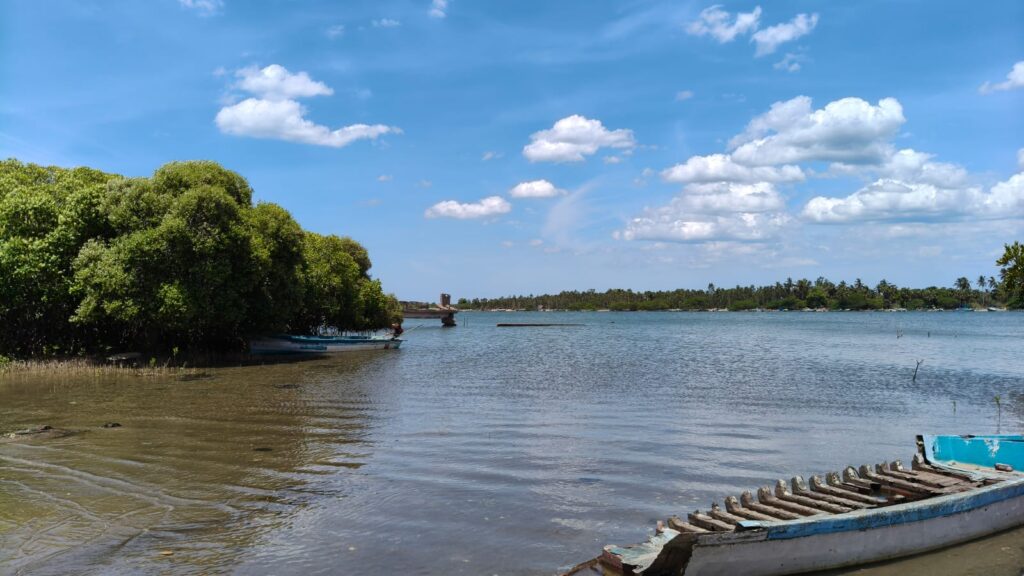
Mangroves aren’t just clusters of trees standing knee-deep in water. They are nature’s frontline defenders. When storms rage and waves come crashing in, they act like living barricades, breaking the force of wind and water. They are one of nature’s best feats of engineering, preventing erosion and helping the land build up over time. Their ability to trap sediments and slow water flow contributes to healthier coastal ecosystems, making them even more essential as sea levels rise with climate change.
In the aftermath
The tsunami caused devastation across India’s east coast; it turned island nations upside down. Lives were lost, and many survivors found themselves searching for remnants of their past amid the rubble. But while the rest of the coast was left in pieces, Pichavaram’s mangroves stood tall, their roots gripping the earth like a well-trained wrestler. They didn’t just slow the tsunami, they practically gave the coastal villages a free pass, buffering them from the worst of the destruction.
The tsunami did more than reshape the coastline—it reshaped destinies. For the Irulas, an Indigenous community from southern India who had long lived in the shadows, it became a turning point. Traditionally, the Irulas earned a living by handling snakes and protecting crops, often combining this with temporary farm labour. But after the tsunami, their knowledge of the land and its rhythms found new meaning.
Recognised as a Scheduled Tribe in the aftermath of the disaster, the Irulas took on a new and crucial role in environmental conservation. They became active participants in the restoration of Pichavaram’s mangrove forests, their hands carefully planting the very trees that had once shielded them from destruction.
Recognition brought them empowerment and opportunity, proving that conservation starts with the people who know the land best. These mangroves, once again planted with the care and expertise of the Irulas, serve as both a shield for coastal villages and a symbol of the tribe’s growing importance in preserving the region’s fragile environment.
Life among the roots
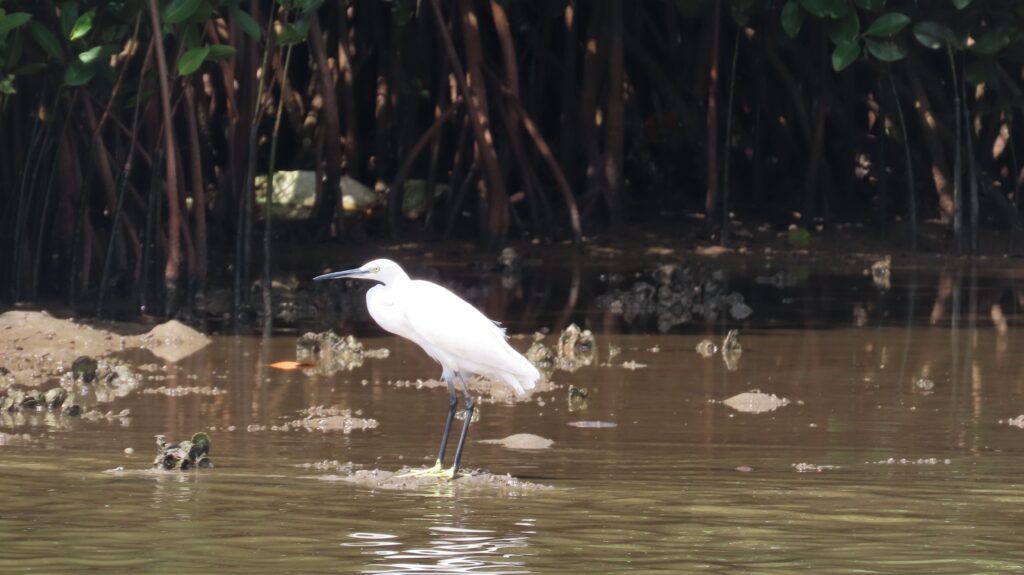
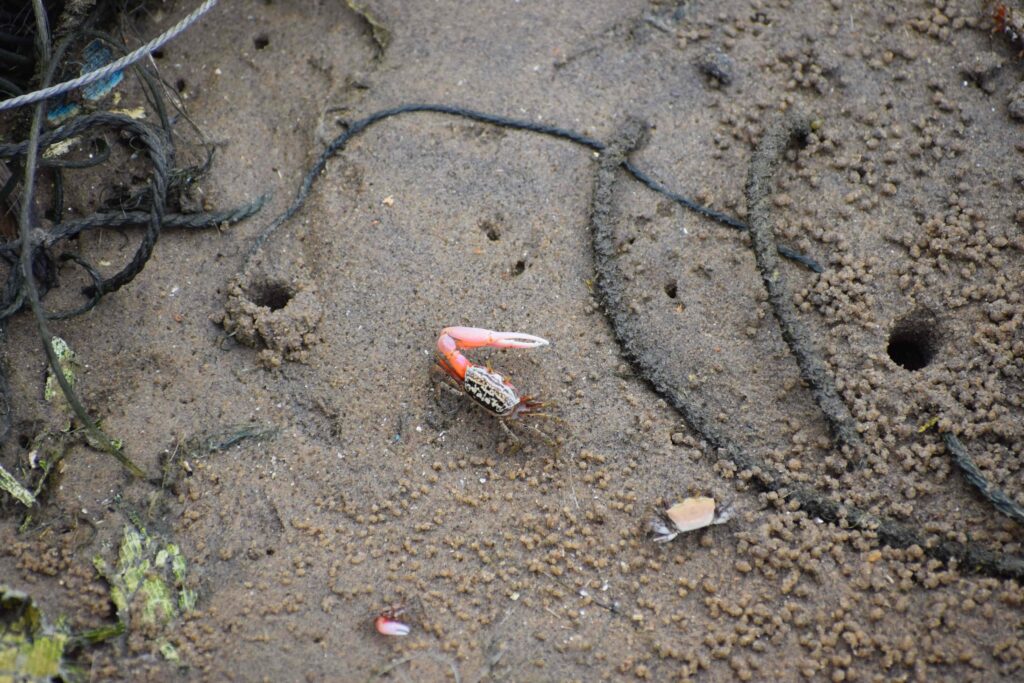
Among Pichavaram’s tangled roots, life operates on fine margins. Mudskippers haul themselves across wet banks, blinking with raised eyes. Despite being fish, they spend much of their time out of water, using their fins to walk across mudflats and even climb mangrove roots. Fiddler crabs wave asymmetrical claws in territorial dances. Underwater, the brackish mix supports juvenile stages of species like milkfish, mullets and tiger prawns, all of which depend on the mangroves as nursery grounds before moving out to sea.
Mangrove tree species such as Avicennia marina, Rhizophora apiculata, and Bruguiera cylindrica dominate here, each with unique strategies—including salt excretion, prop roots (which grow downward from the branches to provide extra mechanical support), and pneumatophores (specialised aerial roots that grow vertically upward from the soil)—that make survival in saline, oxygen-poor soils possible.
Among the more intriguing species found in Pichavaram is Rhizophora annamalaiyana, a mangrove endemic to this region of Tamil Nadu. It displays a mix of traits seen in Rhizophora mucronata and Rhizophora apiculata. These adaptations not only support the plant but create microhabitats for molluscs such as the obtuse horn shell (Cerithidea obtusa) and telescope snail (Telescopium telescopium), and even the mud crab (Scylla serrata), a key species for local livelihoods.
Local wisdom
As we neared the shore, the women were bent knee-deep in the soft mangrove mud, their hands expertly moving through the slush. They were collecting prawns and even the occasional mud crab, in a small basket-pouch held by the teeth. They completely rely on an age-old instinct, a knowledge passed from mother to daughter, a ritual that reflects an unspoken pact with the mangroves: take only what you need, and leave the roots undisturbed. In a time of automated everything, it felt like the most human thing I had seen in a long time.
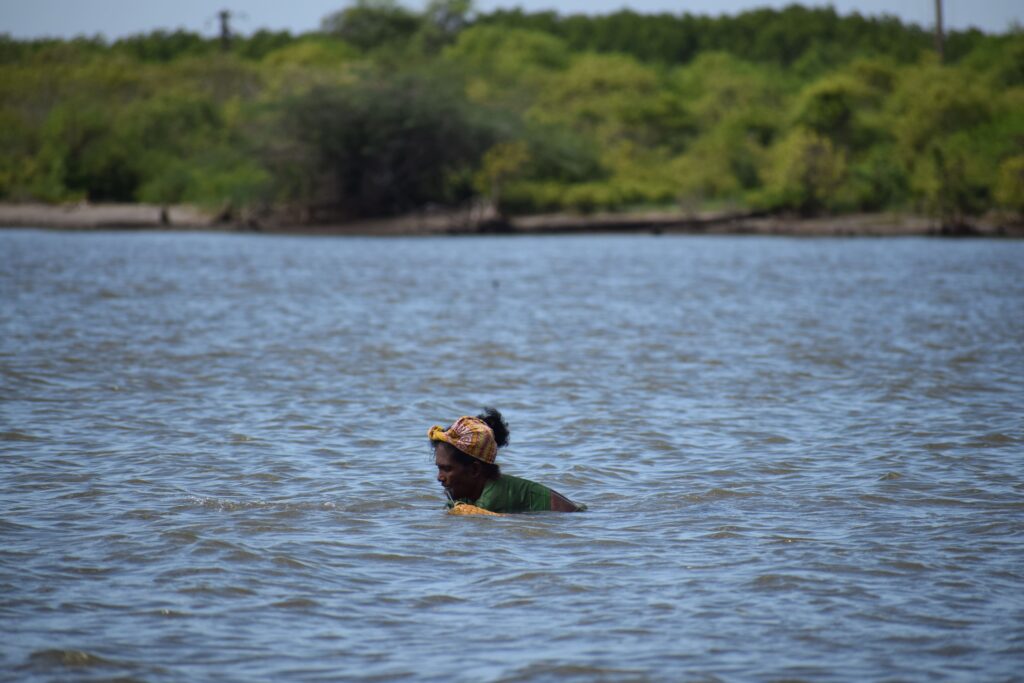
In the past, Irulas collected fruits from Bruguiera cylindrica, Dalbergia spinosa, and Sonneratia apetala, as well as tender stems of Sesuvium portulacastrum (Sea purslane), for food. They fish during particular tide cycles, and also assist in mangrove restoration propagating species by hand, especially in degraded patches. Once, they fished without proper gear; today, they use cast and drag nets. Their knowledge is seasonal, intuitive, and often not captured in scientific reports, but it shapes how the forest survives.
Pichavaram’s connection with people extends beyond livelihoods and conservation. Local lore tells of the mangrove tree species locally known as Tillai (Excoecaria agallocha) being revered since the 18th century at the Lord Nataraja Temple in Chidambaram. The region was once called Tillai Vanam, and these mangroves have long held cultural and spiritual significance for local communities.
On the boat, we heard the occasional calls of herons and terns flocking throughout. Sunlight filtered through the dense canopy, casting shifting patterns on the water, like nature’s own kaleidoscope. Seeing all this, it struck me: everything here survives by adaptation. The mangroves never shouted for attention and yet, when the sea came roaring, they were the ones who held the line. Maybe the future isn’t about building higher walls, but learning from what has already stood its ground for centuries.
Before pushing us ashore, our boatman patted a mangrove root and said, “If the mangroves hadn’t held that day, the sea would have taken us all.”
Further Reading
A win-win: Irula community prospers with the mangrove forests of Pichavaram. 2021. 101Reporters. https://101reporters.com/article/The_Promise_Of_Commons/A_winwin_Irula_community_prospers_with_the_mangrove_forests_of_Pichavaram. Accessed on August 1, 2025.
Kathiresan, K. 2000. A review of studies on Pichavaram mangrove, southeast India. Hydrobiologia 430: 185–205.
Keeping head above water: Irulars in Pichavaram. 2022. Economic & Political Weekly. https://www.epw.in/engage/article/keeping-head-above-water-irular-pichavaram. Accessed on August 13, 2025.