Urban coyotes: How these clever canids made cities their home

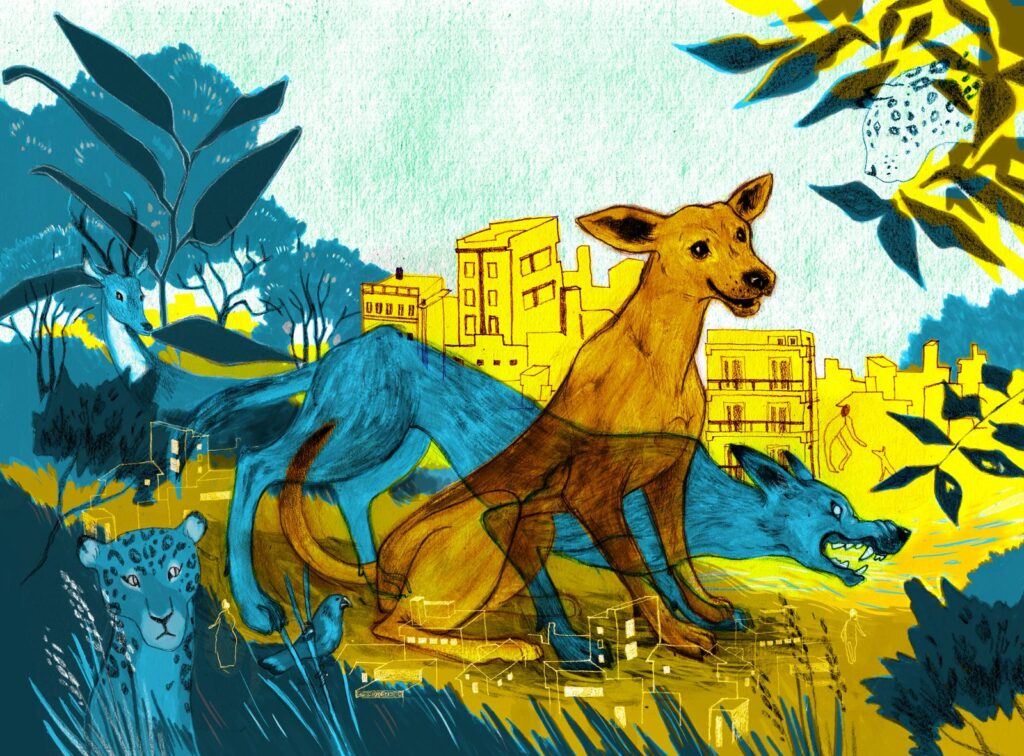
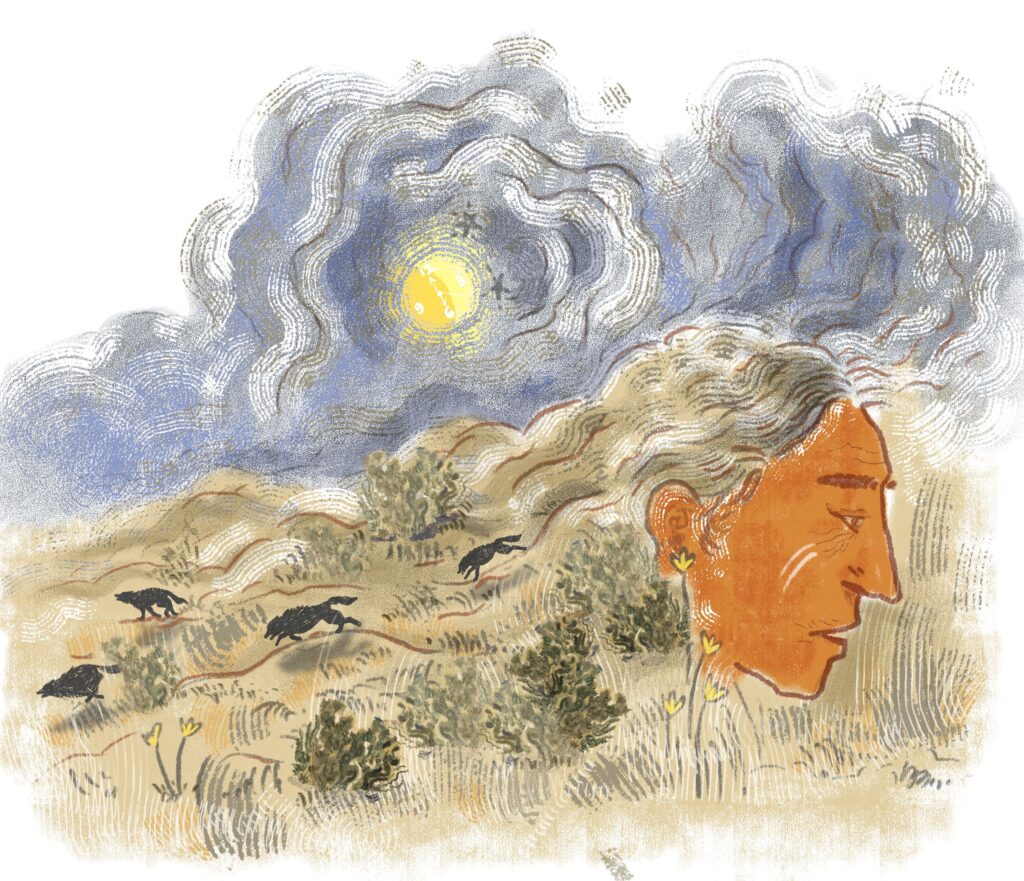
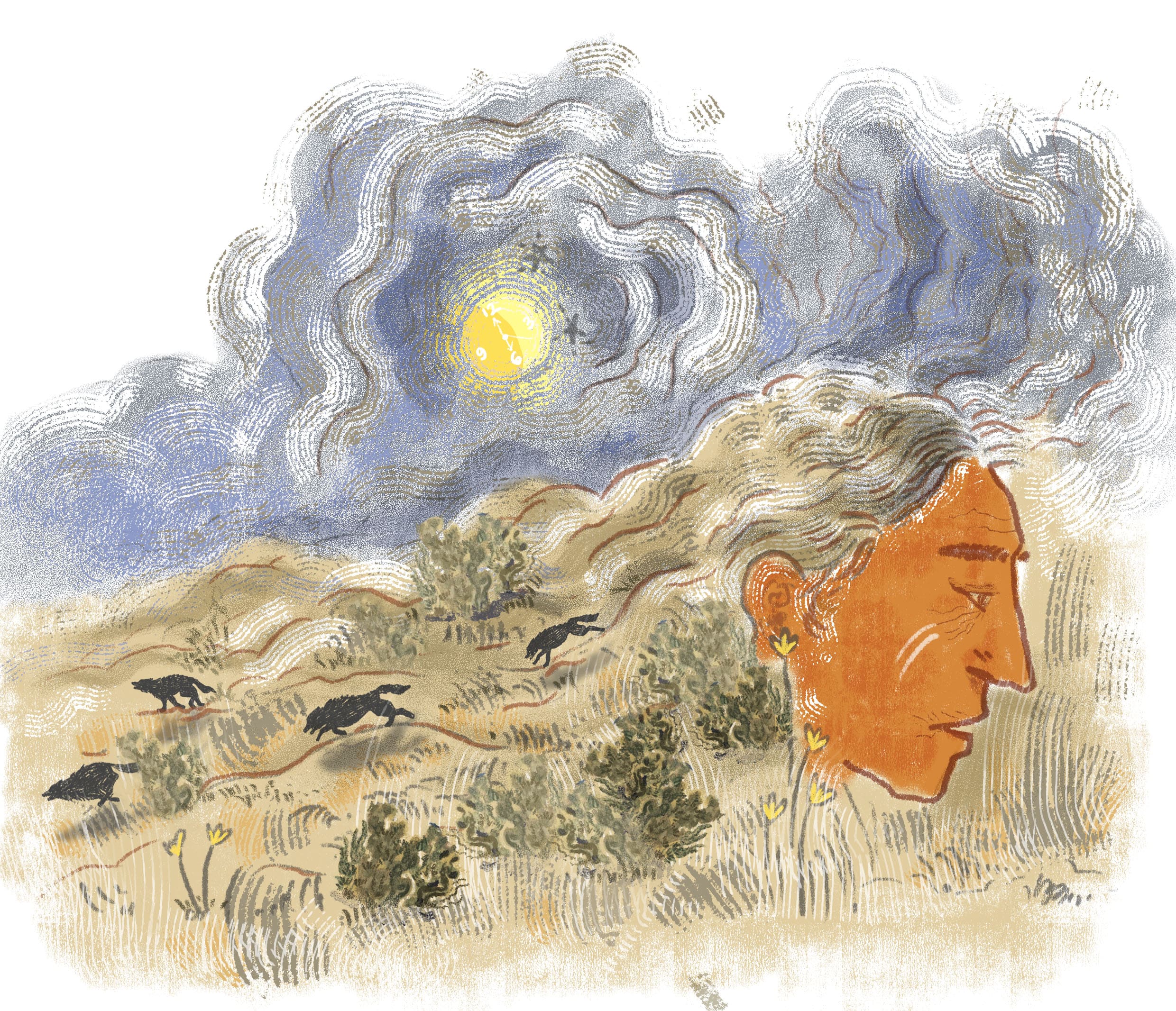
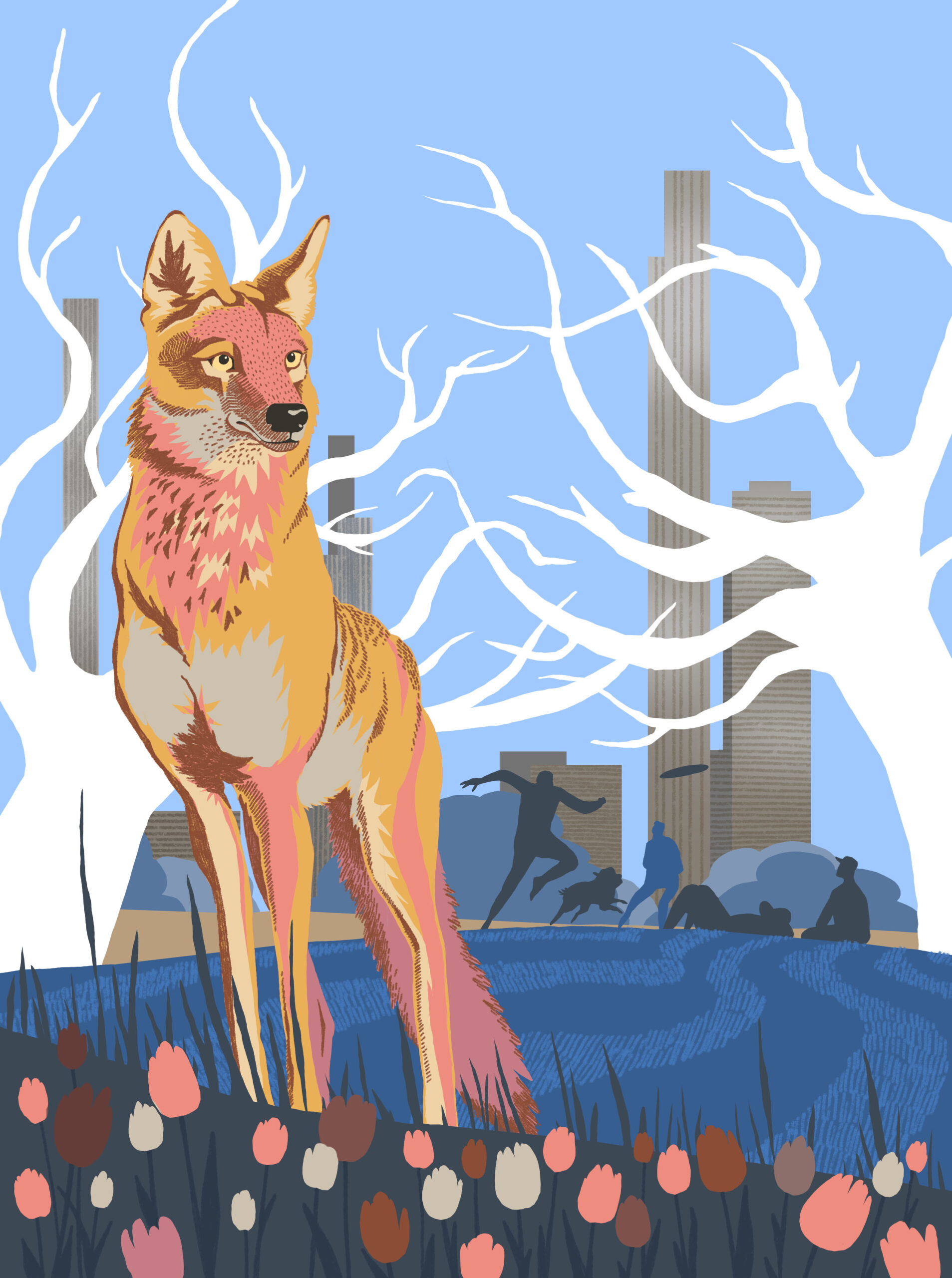
Over the past few decades, coyotes—animals most people associate with deserts or rural areas—have been popping up in places you’d never expect: big cities. From San Francisco and Denver to Chicago and even New York City, these wild canids are learning to live side-by-side with humans. It’s a major shift, and it brings up some interesting questions. How are they surviving in these concrete jungles? What does that mean for us?

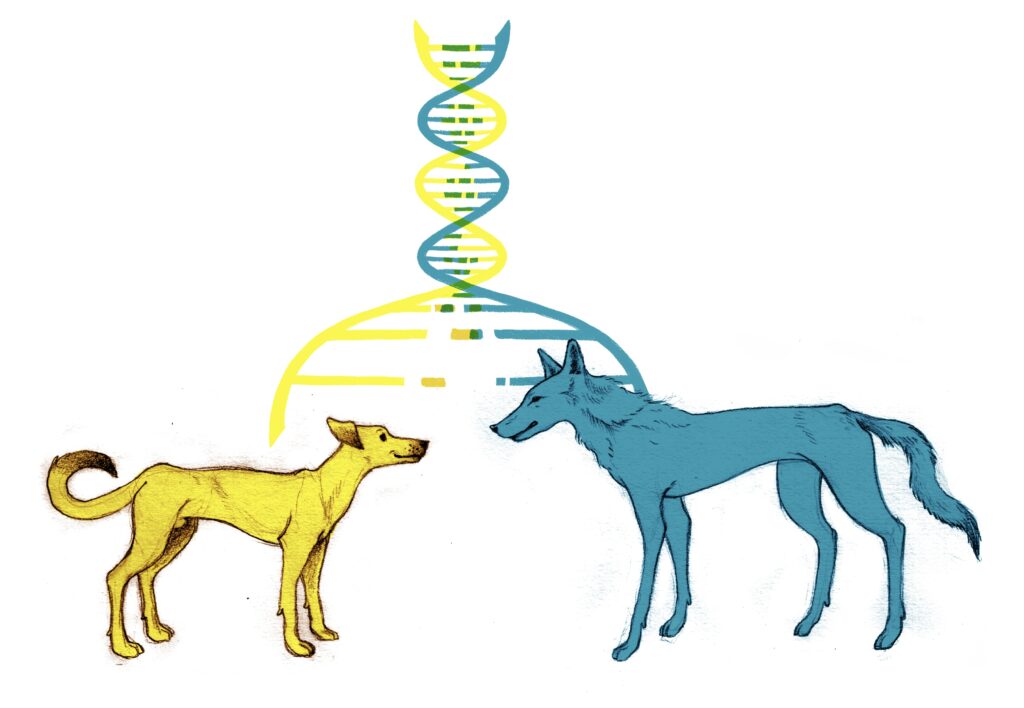
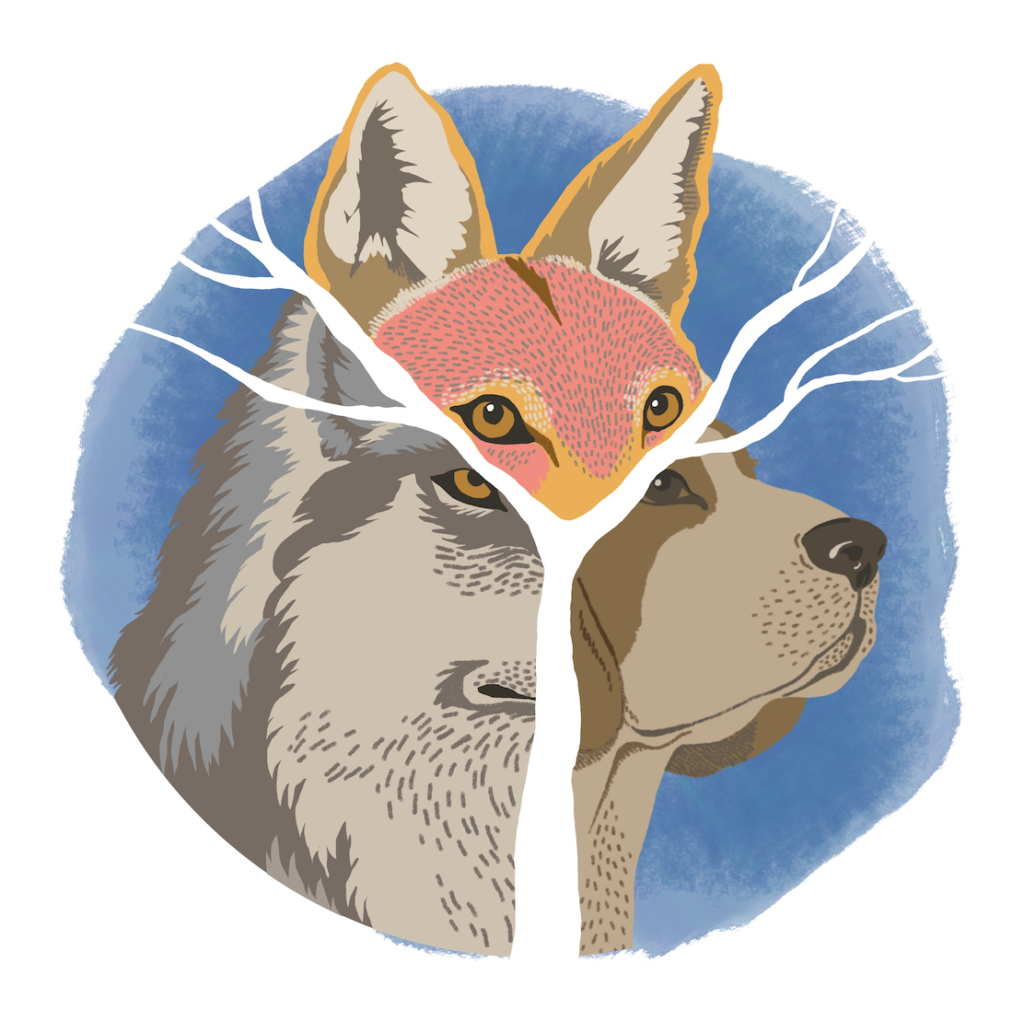
Coyotes have always been survivors. For thousands of years, they mostly stuck to the western and southern US. But things began to change in the 20th century. As bigger predators like wolves and cougars began to disappear due to habitat loss and extermination campaigns, coyotes moved into new areas—including the East Coast. In the middle of the century, coyotes from the west crossbred with grey wolves from Canada around the Great Lakes region. They continued to expand their range into the northeastern US at the end of the century, where they also crossbred with domestic dogs. The hybridisation with wolves made them bigger and stronger, allowing them to hunt larger prey such as deer that lived in large numbers on the East Coast. Combined with their adaptability, this unique hybridisation enhanced their predatory skills and allowed them to thrive in their new range.

Thus, the coyotes we see in the eastern part of the country today are hybrids, with genes from wolves and dogs. They each served a purpose for the coyotes. Wolf genes made the species larger, while genes from domestic dogs gave them a higher tolerance for anthropogenic conditions, such as loud sounds, lights, and human presence. These genetic shifts meant coyotes were adaptable; a crucial trait for an urban life that demands flexibility. Today, they’ve learned to make the most of what urban environments offer—even if it means dodging cars, scavenging from trash bins, and dealing with a lot of humans.

Making city life work

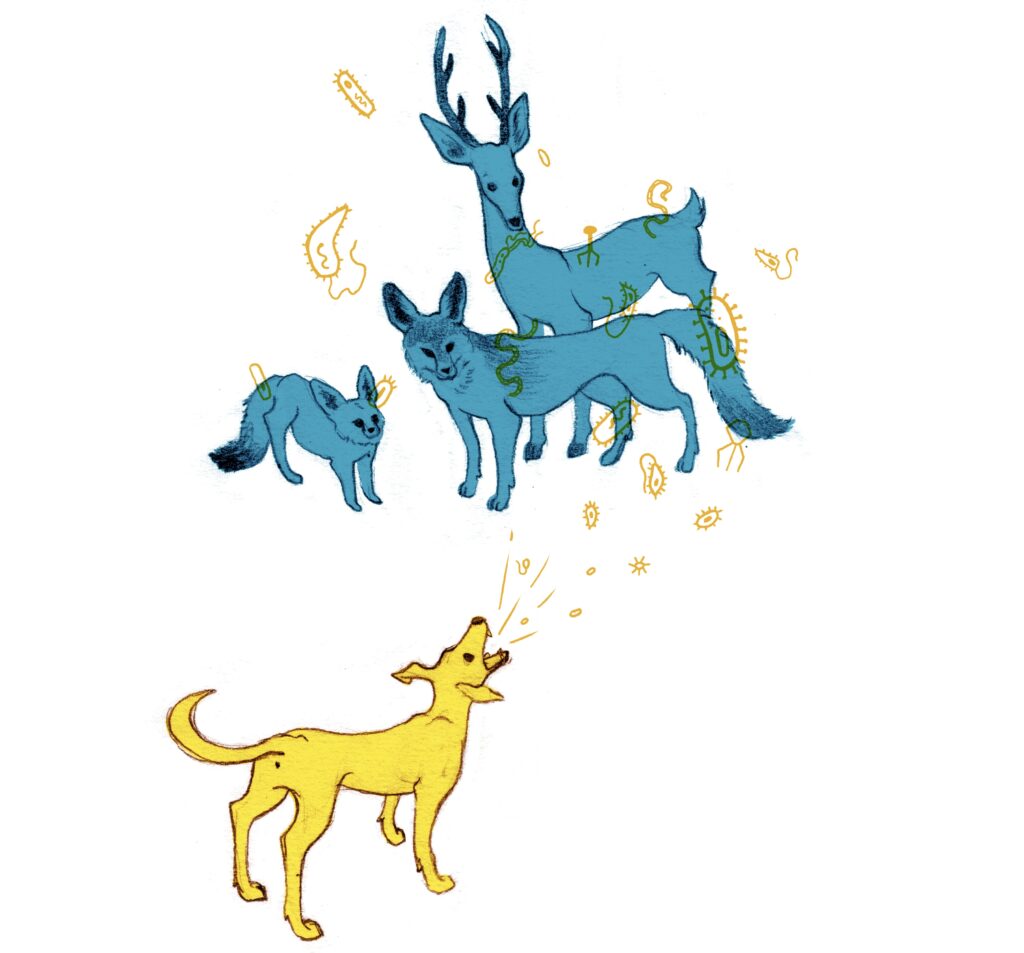
For coyotes, one of the biggest shifts to city life has been their food sources. In the wild, their diet mostly consists of small mammals and sometimes deer, alongside some supplementation with wild fruits. Urban life, though, asks for more flexibility. Coyotes will still hunt for small mammals that inhabit cities (such as rats and squirrels), but they’re also scavenging from garbage cans, eating fruit from backyard trees, and even helping to control stray cat populations. 

It’s not just their eating habits that have changed. City coyotes are also getting creative with where they live. Their small family groups are finding dens in city parks, under thick brush, and in spots that give them a little privacy. They tend to like areas with a bit of slope, some good hiding spots, and places facing east—researchers aren’t sure why, but it might help with morning sun exposure during pup-rearing season. 

In New York City, learning how to utilise the limited green space the city has to offer gives urban coyotes an edge. Several years ago, wild coyotes were found in Central Park in the middle of Manhattan and were later relocated to the Queens Zoo in Flushing, where they live today. More recently, a new pair has moved into Central Park and become locally famous, showing that coyotes are making use of one of the most iconic parks in the world. 

Researchers also tracked coyotes across various boroughs in New York City and found them in parks where there is enough cover and food to support them. Genetically, they appear to have descended from a relatively small founding group, but movement between green spaces such as parks allows different groups to intermix, keeping populations from becoming inbred. In the same place, they have also learned to use the local train tracks, such as the Long Island Railroad, which runs from the heart of New York City east for more than two hours, to reach the end of Long Island. They have realised that the trains run less frequently at night and travel on the tracks under the cover of darkness. 

Despite being in the middle of one of the world’s busiest cities, these coyotes seem to prefer a quiet life. They avoid people as much as possible, stick to night hours, and raise their pups in relatively secluded spots. However, coyotes born in urban areas seem to be getting more used to us. Their parents live near humans, so over time, their pups are becoming less afraid of people. This doesn’t mean coyotes are soon going to come up and ask for a treat, but it does mean they might act more boldly than their country coun – terparts. For example, these urban coyotes are more active during the day and are frequently seen around houses as well as in densely populated areas. 

But urban life might also be changing coyotes on a genetic level. Since living in a city comes with a whole new set of challenges—busy roads, less space, new food sources, and constant human activity— animals are pushed to evolve in different ways. Some coyotes in New York City carry significant amounts of DNA from domestic dogs. One coyote in Queens had nearly half of his genome from dogs, and his pups showed behaviours you’d expect more from pets than wild animals—such as being a little too comfortable around humans. This raises interesting questions on how urban coyotes might evolve in the future.

Friends, foes, or somewhere in between? 

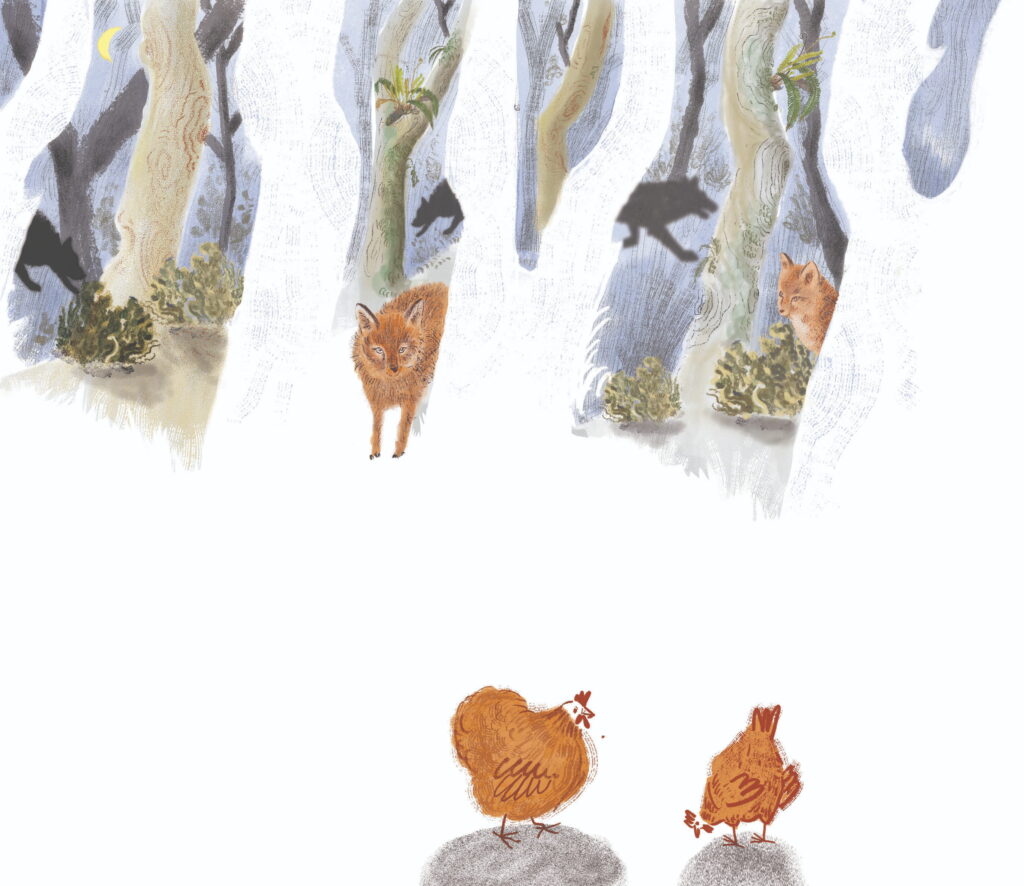
For the most part, coyotes want nothing to do with us humans. In cities like Denver and Chicago, the majority of coyote-related incidents are just sightings—no attacks, no real conflict. When problems do arise, they are usually related to domestic pets. A small number of coyotes go after dogs or cats, especially if they are left outside unattended or venture too close to a den. But incidents are rare, and most coyotes avoid direct confrontation. 

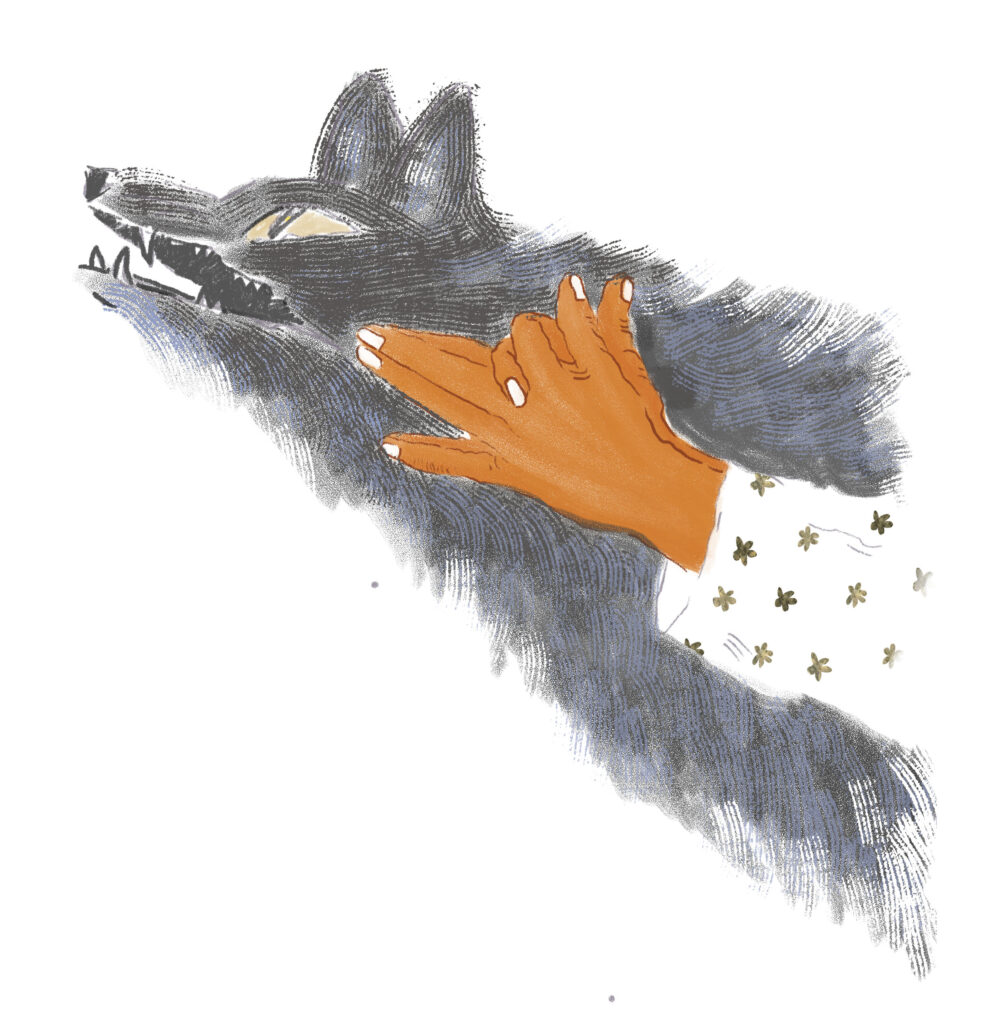
Still, it’s understandable that some folks get nervous when they spot one in their neighbourhood—and that’s fair! In response to this, many cities are starting outreach programmes to teach people how to handle coyote encounters. One effective method they teach is called ‘hazing’—scaring coyotes away by yelling, clapping, or waving your arms—so they don’t get too comfortable around people. Such approaches help keep both humans and coyotes safe in the long run. 

Coyotes are showing us that nature doesn’t stop at the edge of the city. Urban species adapt to our environments, evolve in surprising ways, and challenge the idea that cities are only for humans. They are not simply learning how to survive, they are learning how to thrive. Of course, with closer cohabitation comes responsibility. As more wildlife starts to share our urban spaces, we need to think about how to coexist peacefully. That means educating ourselves, protecting our pets, and finding ways to let these amazing animals be part of our urban ecosystems without putting anyone at risk. 

Coyotes might not be everyone’s favourite neighbour—but they’re here to stay. If we pay attention, they have a thing or two to teach us about resilience, adaptability, and what it means to share space in an ever-changing world.

Further Reading 

Bonnell, T. J. and S. W. Breck. 2017. Urban coyote management: Evaluation of hazing and non-lethal methods. Journal of Wildlife Management 81(5): 813–820. https://doi. org/10.1002/jwmg.21254

Caragiulo, A. A., M. T. Wyman and P. R. Sievert. 2022. Coyote hybridisation and sociability in urban environments: Insights from New York City. Urban Wildlife Conservation 11(3): 215–232. https://doi.org/10.1016/j.urbanwild.2022.03.005

Henger, D., S. R. Ibarra and M. Brown. 2020. Urban coyotes in New York City: Genetic analysis and behavioral trends. Journal of Urban Ecology 14(2): 54–65. https://doi. org/10.1111/jue.12438.

This article is from issue

19.4

2025 Dec

paradise lost: road verges in a changing world

Read story in

In 1970, singer-songwriter Joni Mitchell wrote Big Yellow Taxi on her first trip to Hawaii. The morning after arriving at her hotel, Mitchell “threw back the curtains and saw these beautiful green mountains in the distance”— she said in an interview—but looked down to see a huge parking lot, which broke her heart. And so she wrote: 

They paved paradise
And put up a parking lot 

It was a small moment, but it’s since become a universal lament—a line that captures the blunt sorrow of watching something beautiful disappear beneath concrete. That same sorrow hums under the surface of many of our landscapes today. Meadows flattened. Hedgerows lost. Wildflower fields traded for sterile lawns. Paradise, again and again, casually paved. But sometimes—on the edge of a field, by the curve of a lane—it survives in the margins, tended by those who understand what we stand to lose. 

My father-in-law Paul is one of those caretakers. A trained ecologist who studied at the University of Leicester before working for the railroad and eventually becoming a self-employed conservationist, he has spent over 30 years in Longparish, Hampshire, England, watching over the landscape with the kind of quiet dedication that runs in families. His father, Peter—a lawyer by profession but a naturalist by passion—kept meticulous nature diaries and wrote for local magazines, recording the rhythms of the seasons with the eye of someone who truly saw. Peter once asked his future wife, Doreen, to be his girlfriend under the sound of blackbirds on a picnic, and noted throughout his life how blackbirds had been present at every milestone, even toward the end. 

This love of the natural world wasn’t unique to Paul’s family. Growing up, I declared at age three that I wanted to be a lepidopterist. My father, a former scout, built me a large bug house where I raised butterflies. After his unexpected death, my mother transformed our inground pool into a garden. I kept pet squirrels that had fallen from our loft, and my grandfather brought home turtles from his fishing trips. My brother and I spent family camping trips catching salamanders, our hands muddy with creek water and wonder. Paul’s brother Anthony raised atlas moths in his home, just as I later did in my university accommodation closet. Nature wasn’t just around us—it was in us, passed down like an inheritance we couldn’t imagine living without. 

Now that inheritance is slipping away at an alarming rate, which makes what Paul tends all the more precious.

A legacy in the grass

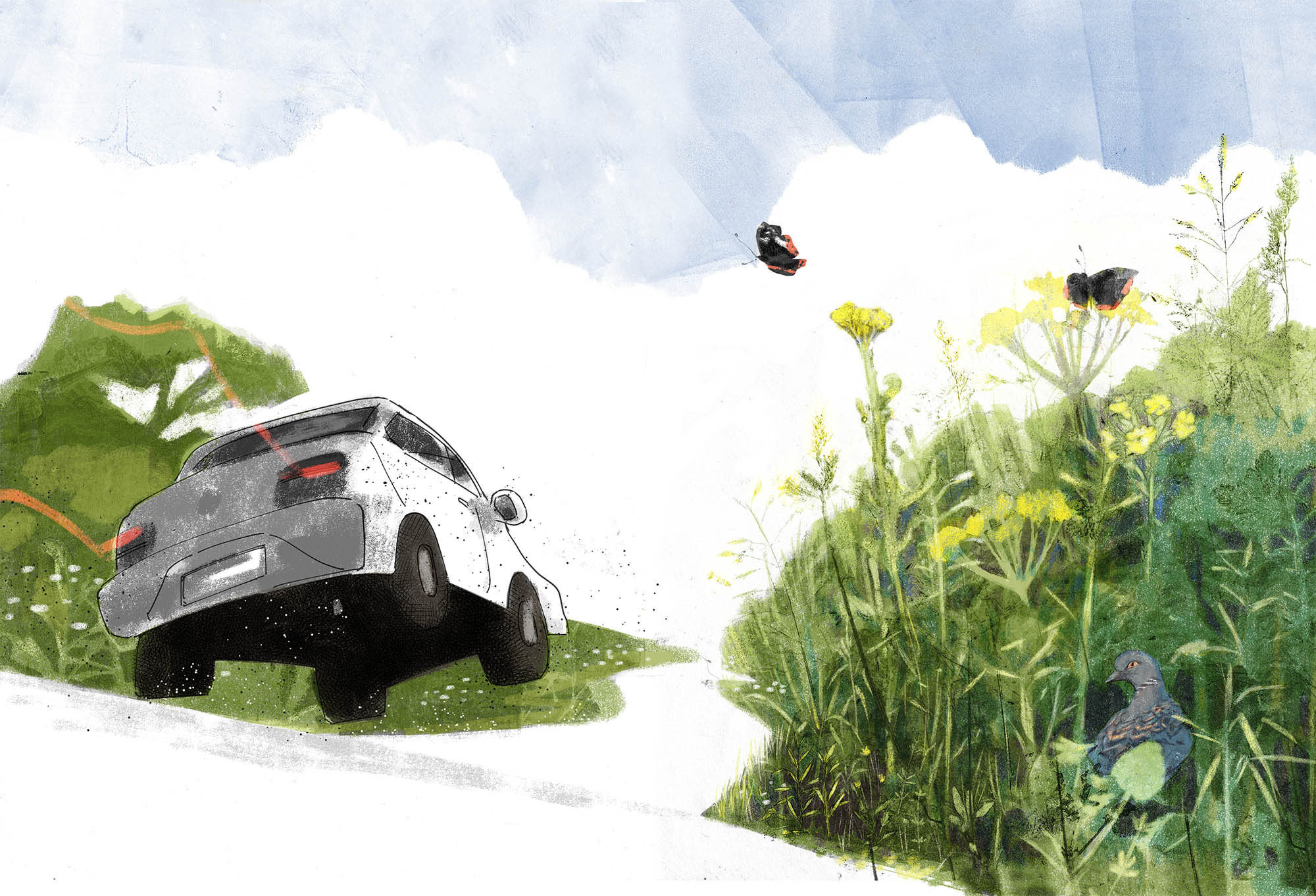
In Hampshire, a narrow verge along a village road in Longparish is quietly defying that disappearance. What might seem like an unremarkable strip of grass to passing drivers is, in fact, a blaze of yellow each spring—thick with cowslips, nodding in the wind like something out of an older, gentler world.

This verge has been cared for, not neglected. It’s been watched, protected, allowed to change with the seasons. Paul understands that these small scraps of land can carry deep meaning—ecologically, yes, but personally too. His work is part conservation, part memory. The verge is a living tribute to his father’s ideals, to the belief that our relationship with the land matters. That what we take, we owe. And that what we ruin, we must answer for. 

Through a local countryside club, Paul is quietly passing on those ideals to a new generation. Children from the village come to the fields to learn the names of the flowers, to spot butterflies rising in bursts of colour, to notice the slow, seasonal magic of the land. Paul doesn’t teach with speeches—he teaches by doing. And the children, naturally, follow, just as I once followed my father to check the bug house, just as Paul once followed Peter through Buckinghamshire fields.

Verges as vessels of life 

Road verges are often treated like non-places—mowed flat, littered, dismissed as nothing more than the ragged edge of somewhere else. But they’re not nothing. They are everything to wildflowers that have lost their meadows, to bees in search of nectar, to butterflies drifting on the wind hoping for a patch to land on.

When managed well, verges support hundreds of native species—nearly half of the UK’s total wildflower diversity can be found in them. They serve as corridors, connecting fragmented habitats. They feed pollinators and shelter small mammals. And they remind us, if we’re paying attention, that even the smallest effort to care for the land can ripple outward.

Good management mimics the rhythms of traditional hay meadows: allowing growth in spring and early summer, then cutting in late summer and removing the clippings to keep nutrient levels low. This encourages a broader variety of perennial herbs and flowers, curbing the dominance of aggressive species such as thistles, nettles, and docks. It’s slow work. It’s deliberate. But it works—something Paul learned through his years as a professional conservationist, knowledge now applied with the patience of someone who has found his calling.

A misunderstood dove 

The European turtle-dove—so often romanticised, so rarely understood—is one of the many species whose survival may hinge on these slivers of wildness. It is not the snow-white bird from sentimental songs, but a slender, warm-chested summer visitor, patterned in russet and charcoal, soft in sound and rare in sight. Its numbers have plummeted by 98 percent since 1994.
The turtle-dove needs seed-rich ground—exactly the kind a thriving verge can provide. But its dry diet also means it must drink frequently, and with the decline of traditional livestock ponds, clean water is becoming scarce. Add to that the grim fate awaiting many turtle-doves on their migration routes—mercilessly shot and trapped across parts of Europe—and you begin to wonder if this shy, symbolic bird will go the way of its cousin, the passenger pigeon: once the most abundant bird in North America, now extinct. What is a world without its doves?
As someone who has spent a lifetime watching species—from the moths in my university closet to the butterflies in my childhood bug house—I know the quiet devastation of watching something beautiful become rare, then rarer still.

From despair to doing something 

Some councils are beginning to see the value of places like verges. Cutting less, letting things grow, letting things live. Hampshire is trialing wildlife-friendly regimes, following in the footsteps of counties like Dorset, which has managed to both boost biodiversity and save money by reducing mowing schedules. 

But change is slow. Many verges are still shaved down to the roots before they can bloom. Others are trampled, parked on, sprayed. Too often, we treat the world as if beauty and usefulness must be separate, as if wildness is untidy and order is king. But wildness is the order—we’ve simply forgotten how to read it.

The climate crisis looms large. Species vanish. Young people feel it most sharply: the guilt of inheritance, the anxiety of inaction. But in the face of global despair, there’s something incredibly grounding about tending to a single stretch of land. About making space for cowslips and butterflies. About defending a little pocket of life not because it’s convenient or profitable, but because of its intrinsic value. 

When I watch Paul tend his verge, I see my grandfather returning from fishing trips with rescued turtles. I see my mother transforming our pool into a garden. I see the continuation of something essential—the belief that we are not separate from nature but part of it, responsible for it, diminished by its loss. 

The verge in Longparish isn’t just about conservation. It’s about inheritance—the kind that passes not through wills but through example, not through money but through mud on your boots and the names of flowers on your tongue. It’s about understanding that paradise isn’t something we visit but something we tend, not something we had but something we choose to keep. 

You don’t know what you got, till it’s gone. But sometimes, if you’re very careful and very patient, you can keep it from going at all.

This article is from issue

19.4

2025 Dec

Mysteries of the deep sea captured by a sponge

Read story in

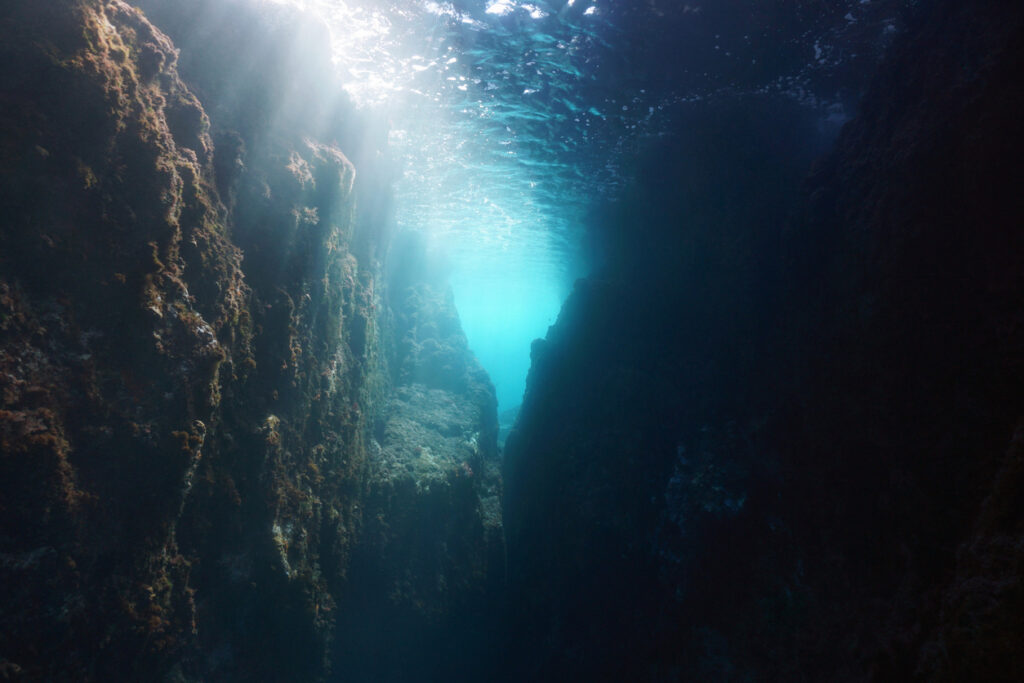
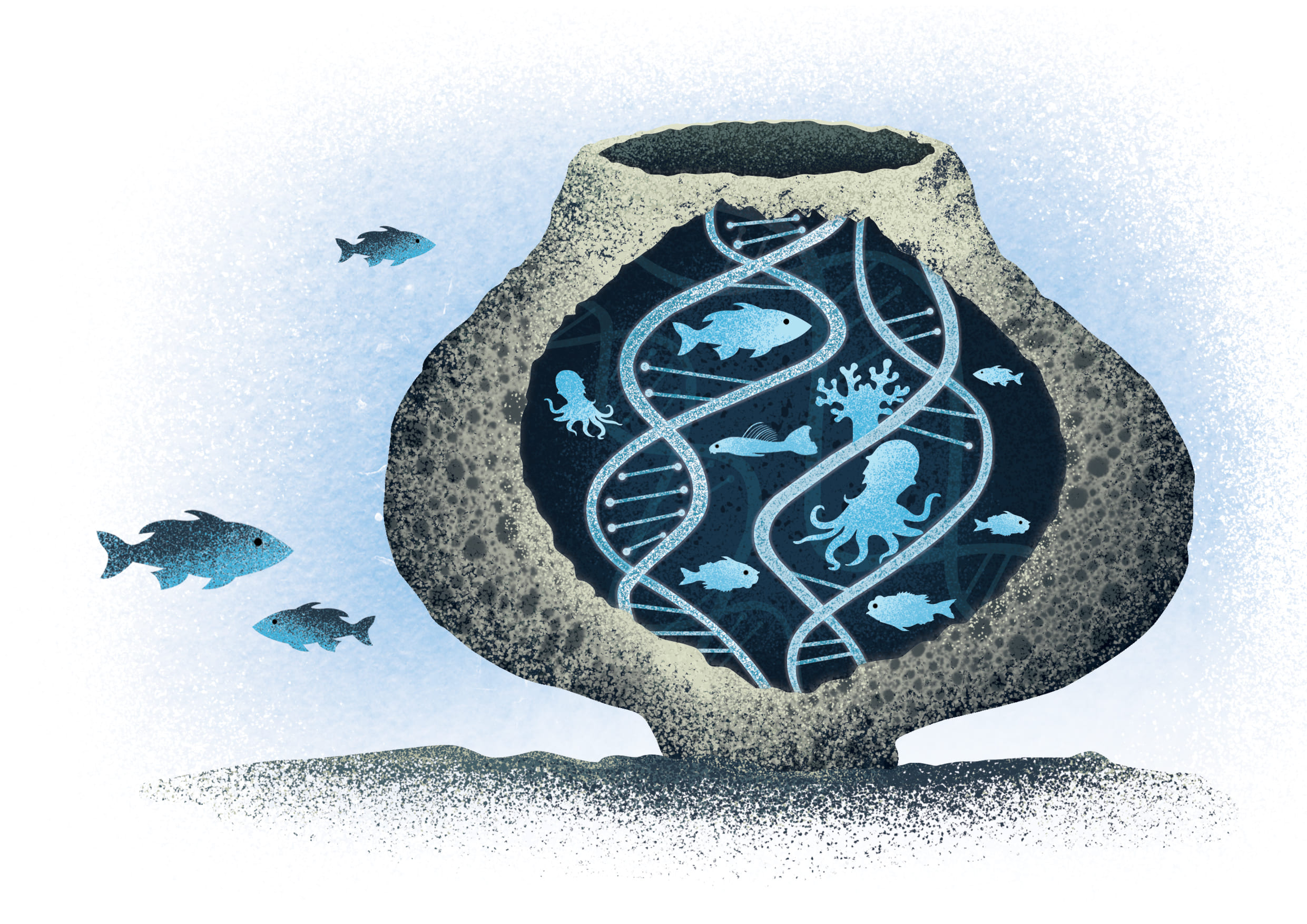
Like an obscure alien underworld, the deep sea beholds unique habitats and wonderfully weird creatures, from walking fish to spiky cucumbers and Casper the Octopod—a ghostly white octopus discovered in waters off Hawaii in 2016. Covering 65 percent of the planet’s surface, the deep sea is the world’s largest ecosystem, yet one of the least explored. However, a recent study by Ramón Gallego and colleagues, published in Communications Biology found that sea sponges can hold a genetic catalogue of deep, salty secrets. 

With an average depth of more than 3,500 metres (11,000 feet), the deep sea is a costly ecological frontier. Immense pressures, near-freezing temperatures and pitch-black darkness make studying life in the deep sea one of biodiversity’s greatest tests. Conventional methods to collect basic data near the ocean surface are prohibitively expensive and technically challenging in deeper waters. 

Despite these difficulties, it is crucial to know which species live on the seafloor and where. Without this knowledge, rare and fragile habitats—including cold-water coral and sponge gardens—are threatened by overexploitation, bottom trawling, oil site prospecting, and deep-sea mining of rare metals. 

In recent years, a relatively low-budget approach to collecting genetic data from seawater has revolutionised biodiversity monitoring and management in remote areas such as the deep sea. Every living thing sheds DNA into its surroundings— whether in the air, soil, or water. This genetic material, known as ‘environmental DNA’ or ‘eDNA’, can be used to determine the presence of different species. A mere 500 ml sample of seawater can contain thousands of shed animal cells, from which DNA can be extracted to identify which species recently passed through. 

However, such samples are often inundated with single-celled microbes and capture relatively little information on corals, fish, and other large marine animals. Studies have also revealed that this method is restricted to capturing DNA within a relatively short temporal window—since eDNA degrades over time, this is the period during which it remains detectable and usable. 

Fortunately, researchers from the National Museum of Madrid recently revealed a new ‘high resolution’ method for sampling eDNA by harnessing the natural filtering power of sea sponges. Their approach yields an unprecedented treasure trove of genetic data. Sea sponges are stationary creatures that continually filter large volumes of water, naturally accumulating and consuming microscopic particles such as cells shed by other animals. 

Compared to seawater samples, sea sponges can harbour genetic material from far larger areas. This is likely because of their enormous filtering capacity, with a 1-kg sponge pumping up to 24,000 litres of water per day. A study from 2022 also found that certain sponges capture eDNA across a longer time period than seawater samples, making them an incredibly valuable inventory of eDNA. 

Gallego and colleagues sampled 1 cm-sized pieces of tissue from 97 deep-sea sponges across four species from the Arctic and North Atlantic. The remarkable accuracy of eDNA obtained from sponges allowed the researchers to identify over 400 animal species, including several ‘indicator species’ such as corals, that are used to help identify vulnerable marine ecosystems (VMEs). 

VMEs are ecosystems designated as ‘highly threatened’ by human pressures and protected through the United Nations’ policy against destructive fishing practices. However, mapping the presence of VME indicator species in the deep sea currently faces significant financial, technical, and logistical hurdles. Recent advancements in ‘sponge DNA’ biomonitoring provide a transformative, cost-effective tool to inform deep-sea management and protection. 

Unexpectedly, non-native species such as the North American horseshoe crab were also documented by the study. The team suggests that ‘sponge DNA’ can reliably detect species undergoing a shift in their distribution due to rapid climate change. For instance, the authors found evidence of a phenomenon called ‘atlantification’, whereby typically Atlantic-dwelling species are gradually colonising warming Arctic waters. 

Looking ahead, the team aims to identify which species of sponge capture and store the most eDNA. They hope this will enable even more detailed data collection and further improve cost efficiency for deep-sea biodiversity monitoring.

Further Reading 

Cai, W., L. R. Harper, E. F. Neave, P. Shum, J. Craggs, M. B. Arias, A. Riesgo et al. 2022. Environmental DNA persistence and fish detection in captive sponges.Molecular Ecology Resources 22(8): 2956–66. https://doi. org/10.1111/1755-0998.13677

Collins, R. A., O. S. Wangensteen, E. J. O’Gorman, S. Mariani, D. W. Sims and M. J. Genner. 2018. Persistence of environmental DNA in marine systems. Communications Biology 1: 185. https://doi.org/10.1038/ s42003-018-0192-6

Gallego, R., M. B. Arias, A. Corral-Lou, C. Díez-Vives, E. F. Neave, C. Wang, P. Cárdenas, et al. 2024. North Atlantic deep-sea benthic biodiversity unveiled through sponge natural sampler DNA. Communications Biology 7: 1015. https://doi.org/10.1038/s42003-024- 06695-4
This article is from issue

19.4

2025 Dec

Saving Land, saving birds: A look at US conservation easements

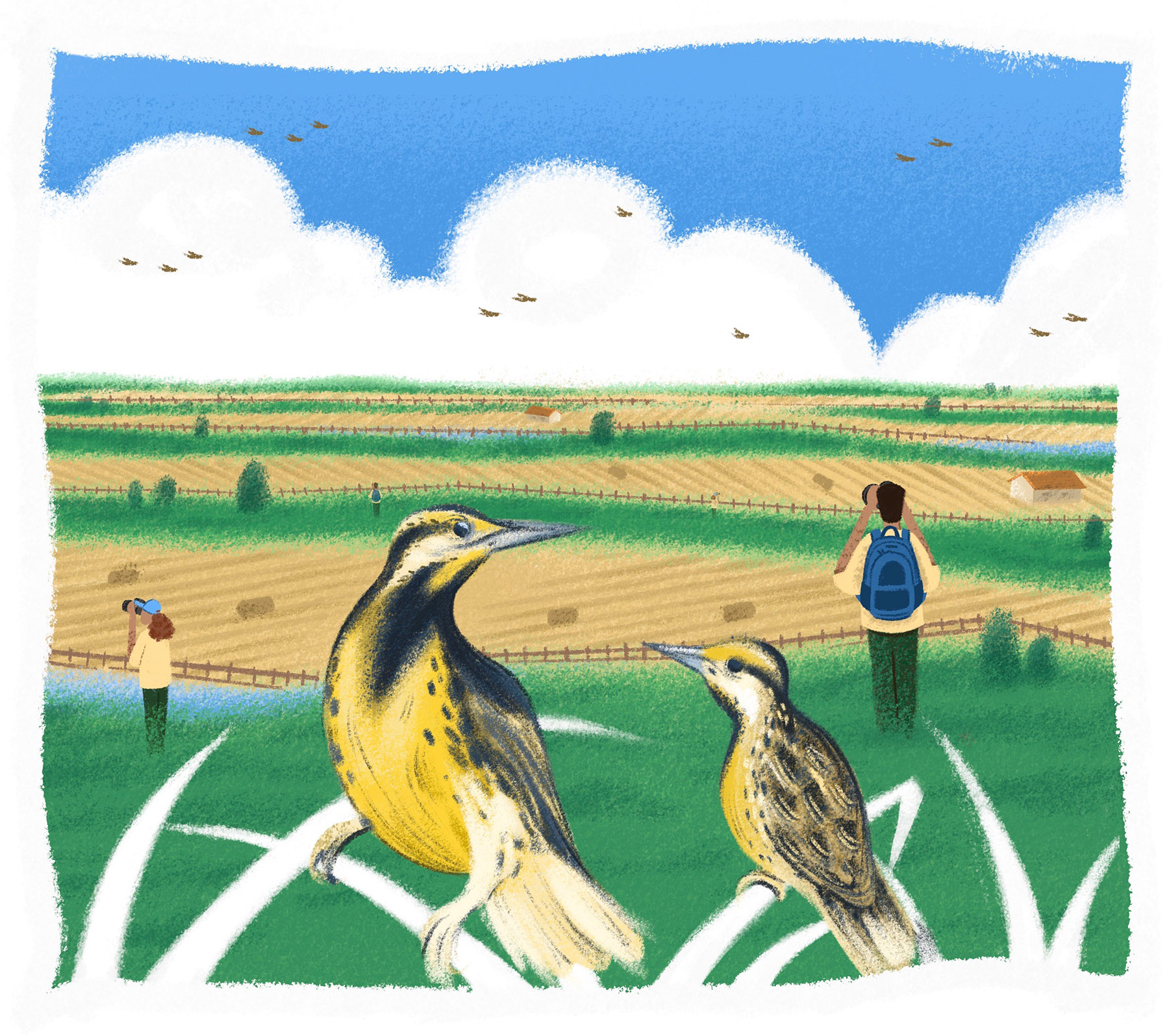
In the late spring, just before sunrise, Smithsonian scientists and community volunteers arrive at designated points spread across northwestern Virginia’s farmland. Working in pairs, they wait, watch, and listen. For 10 minutes, they record the species of each individual bird that they see or hear within a 100-metre radius. Most often, they spot common species, such as the red-winged blackbird or eastern bluebird. Less often, they record one of Virginia’s increasingly rare species of grassland obligate birds, such as the northern bobwhite or eastern meadowlark. Of all North American birds, grassland bird populations are declining the quickest. Where the scientists and volunteers are working, these grassland species are threatened by earlier and more frequent hay cutting that destroys ground nests, agricultural intensification, pesticides, and grassland conversion to other land uses.

Our understanding of biodiversity on US agricultural lands is limited because most of these are privately owned, with few restrictions on how they are managed. One conservation tool that is increasingly popular is conservation easements. By enrolling land in a conservation easement, landowners cede some or all of that land’s development rights—often in exchange for a tax benefit. Because conservation easements persist in perpetuity, even if the land is sold, some conservationists see them as contributing to conservation area targets, such as the target of protecting 30 percent of the world’s surface area by 2030 set under the Kunming-Montreal Global Biodiversity Framework. As of 2025, about 4.3 million acres of land in Virginia, or about 17 percent of its total area, is under conservation easement. However, assessing the effects of conservation easements on biodiversity is limited by the fact that species monitoring is not required, leaving little data to evaluate their effectiveness.

Using data collected by Smithsonian scientists and volunteers, we aimed to provide the best evidence yet for how species abundance (the number of species and number of individuals per species) differs between agricultural properties with and without conservation easements. For over 10 years, Virginia Working Landscapes (VWL)—a programme of the Smithsonian National Zoo and Conservation Biology Institute—has partnered with volunteers to conduct bird surveys in private working grasslands, recording the presence of more than 100 species. We analysed VWL bird survey data alongside records from the National Conservation Easement Database (NCED), which uses voluntary crowdsourced information to show locations of conservation easements and their dates of origin. According to the NCED, which is the best database on easements available, despite not being comprehensive, 54 percent of the properties that had been visited by VWL and the volunteers were under an easement. 

To understand the effects of conservation easements, we developed four statistical models. With these models, we compared grassland obligate species to the wider bird community, and examined the influence of both simply having an easement and the length of time a property had been under one. Our study showed that bird species respond to conservation easements in different ways. Some species were significantly more abundant on eased properties, others were less common, and many showed little difference at all. This variability across species meant that there was no consistent overall effect on species abundance in three of the four models. Further, we found no evidence that overall bird species diversity differs between properties with and without easements. However, in one model, which assessed the full bird community and only accounted for presence of an easement (versus time under easement), we found some evidence that the average bird species abundance was higher on eased properties.

These results indicate that conservation easements alone do not fully explain patterns in bird diversity and abundance. While our analysis accounted for differing land cover surrounding surveyed sites, we could not assess whether or how landowners of eased properties managed their land differently from those without easements. Further, the limitations of the crowdsourced data in the NCED made measuring the effects of easements more difficult.

Thus, while conservation easements play an important role in protecting private agricultural lands from development pressures, our analysis revealed highly variable effects on bird abundance by species—some showing positive responses, others negative, and some neutral—resulting in no clear overall trend across all species. Greater transparency in easement contracts and requiring standardised reporting metrics, particularly on land management practices, would significantly enhance scientists’ ability to assess the role of easements in addressing multiple threats to biodiversity. 

Further Reading 

Van Sant, L., A. E. M. Johnson, D. J. Read, G. Connette and E. Shibley. 2025. Effects of conservation easements on bird populations in the Shenandoah and Piedmont Regions of Virginia. Conservation Science and Practice: e70019. https://doi.org/10.1111/csp2.70019

This article is from issue

19.4

2025 Dec

No forest, no rest: Capuchin monkeys in pine plantations

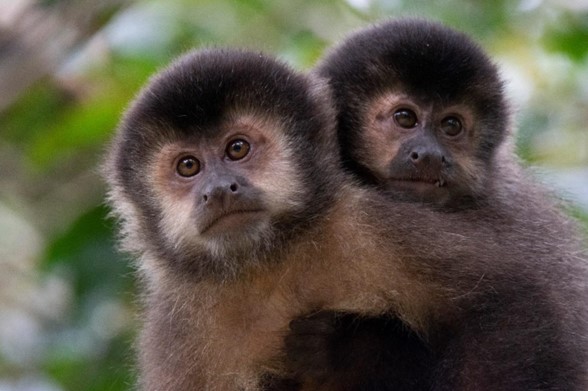
Feature image: Juvenile black capuchin monkeys in Iguazú National Park, Argentina (Photo credit: Stephanie Meredith)

What happens to wild primates when their native forests turn into commercial plantations? In northeastern Argentina, black capuchin monkeys (Sapajus nigritus) face that question every day. Their lush Atlantic Forest has been largely replaced by vast pine monocultures—orderly, quiet, and lacking much of the rich life that once filled the forest canopy.

Using GPS collars and field observations, we followed capuchin groups living either in native, continuous protected forests or in plantation-dominated landscapes. We studied how individuals move, where they rest, and how they find food across these contrasting environments. 

What we discovered was both surprising and concerning. 

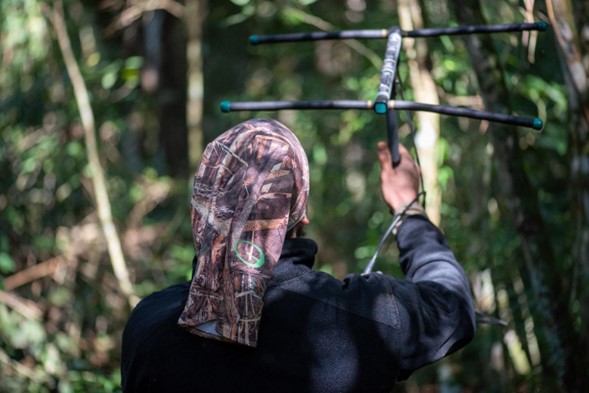
Tracking GPS-collared capuchins through pine plantations (Photo credit: Hernando Rivera)

Capuchins living in pine plantations traverse much more ground each day than those in protected forests. They need to travel far and wide to find enough food and shelter, moving through territories nearly three times larger than their counterparts. Yet most of their vital activities, such as eating, sleeping, and resting, still depend on the small remnants of native forest scattered throughout the sea of planted pines. 

Just imagine the extra energy it takes to climb, jump, and hang while moving through the canopy across such vast distances, day after day! In fact, researchers have estimated that it takes up to twice as much energy to travel through the trees as it does to cover the same distance on the forest floor. But capuchins usually avoid travelling through the forest floor because it increases their vulnerability to predators such as wild cats and dogs, as well as to human presence in plantation areas. Staying in the canopy, though energetically costly, keeps them safer. 

So although native forest fragments make up only a fifth of the plantation-dominated landscape, these scattered regions mean everything for the monkeys. In fact, 95 percent of all capuchin sleeping sites were found in these green islands.

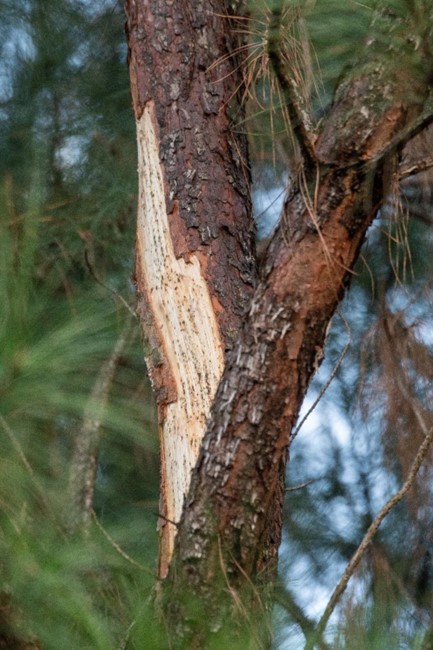
But the story doesn’t end there. Our findings show that these resilient capuchins have learned to exploit the planted pine trees for food. They peel back the pine bark to eat the sugary tissues underneath, particularly during late winter and early spring, when the bark is softer and easier to remove, and the layer underneath is thicker. This allows them to gain more energy with less effort. This behaviour, known as ‘bark stripping’, can cause significant damage to the pine and leads to conflict with forestry companies.

Pine tree stripped of its bark by a black capuchin monkey (Photo credit: Hernando Rivera)

During the bark stripping season, we observed a shift in the monkeys’ movements: they began spending more time in pine stands—large expanses of pine trees—frequently using them as feeding grounds, and thus reducing their reliance on native forest fragments and corridors. This highlights just how adaptable capuchins can be, and how their survival strategies can lead to conflict with humans. 

What’s happening in Argentina is part of a global story. Across the world, forestry plantations and other production landscapes are occupying increasing amounts of land, fragmenting habitats for many species. Nearly 60 primate species are known to occupy tree plantations, though many of them rely on nearby remnant forests to survive. The patterns we observed in capuchins mirror challenges faced by primates across the world—from Argentina to Borneo. 

The message is clear: if we want wildlife to be able to persist in human-altered landscapes, we need to plan and design at the landscape level. Native forest fragments must be preserved, and connected by corridors, allowing wildlife to move between these protected areas. In order to support biodiversity and species conservation, the forestry industry and conservation scientists need to collaborate to create connected habitats, thereby reducing conflict and allowing for the survival of wildlife.

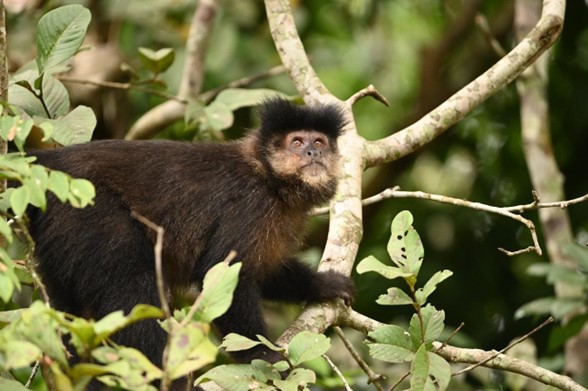
Adult female black capuchin monkey in Iguazú National Park (Photo credit: Agostina S. Juncosa-Polzella)

Further Reading 

Zárate, V., I. Torge, M. P. Tujague, M. C. Baldovino, J. P. Arrabal, E. A. Vanderhoeven, I. Agostini and M. S. Di Bitetti. 2025. Movement ecology and conservation of capuchin monkeys in pine plantation landscapes. Biological Conservation 309: 111304. https://doi. org/10.1016/j.biocon.2025.111304.

This article is from issue

19.4

2025 Dec

Amphibian conservation in a changing world

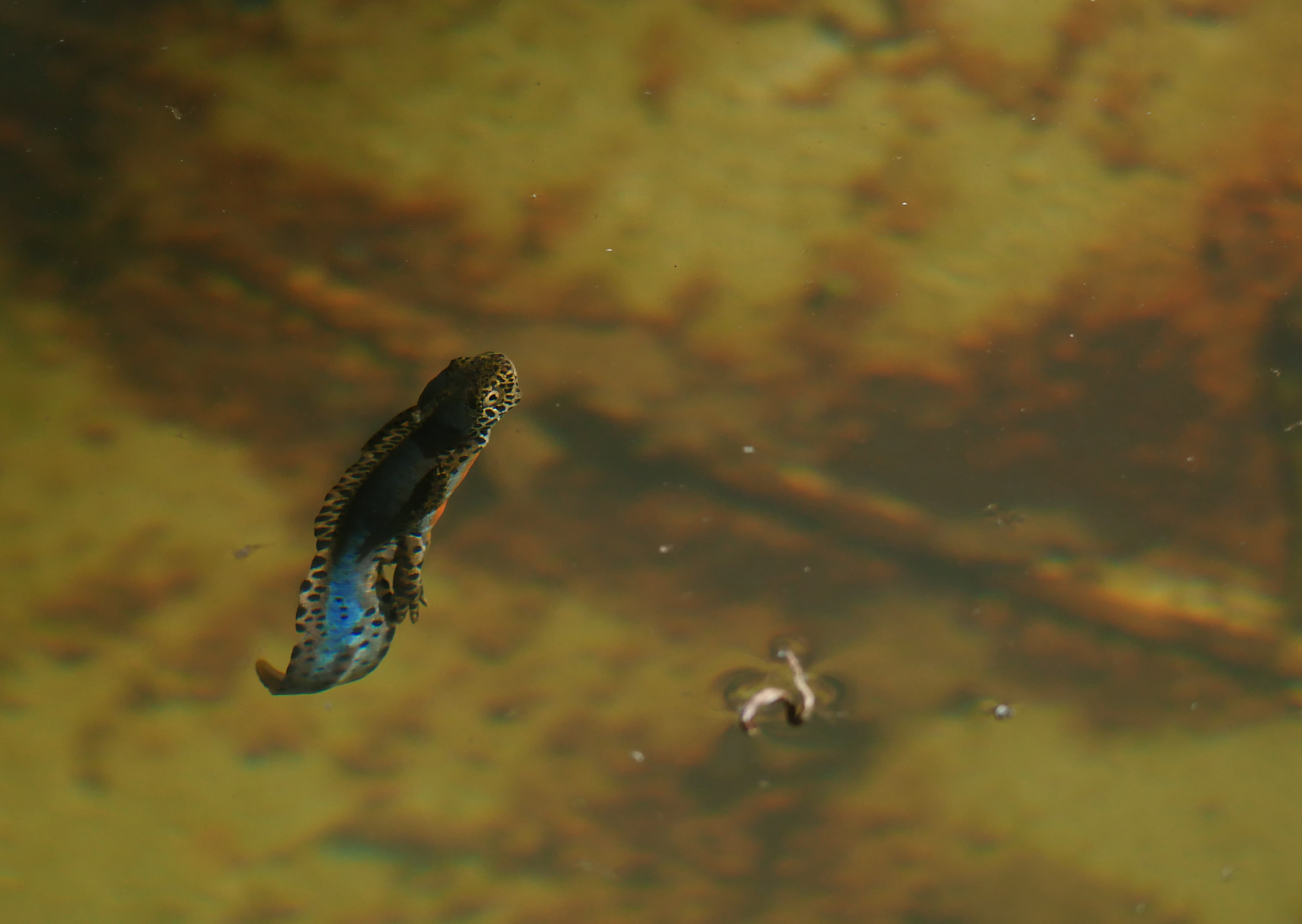
Feature image: The Italian alpine newt (Ichthyosaura alpestris apuana) is endemic to the country’s Apennine region (Photo credit: Martino Flego)

Amphibians are among the most vulnerable creatures on Earth, with many species facing increasing threats from human-induced climate and habitat change. These threats are particularly concerning for amphibians with limited mobility and small ranges, such as endemic species that thrive in specific, often isolated habitats. Emphasising their dependence on stable environments, in a recently published study in Biological Conservation, researchers investigated the vulnerability of two endemic Italian amphibian species to climate change and habitat loss.

Climate and land use changes have dramatically reduced habitats with stable water sources and suitable land where amphibians once thrived. Rising temperatures and reduced rainfall have diminished the suitability of many regions, while urbanisation and agricultural expansion have fragmented habitats and isolated populations, limiting amphibians’ ability to move to better areas. This isolation disrupts genetic diversity and reduces population resilience to further environmental stresses, including temperature-humidity imbalance and drought.

Italy’s unique amphibians 

The Italian peninsula’s climate and geography make it home to unique amphibians. Two notable species are the Italian alpine newt (Ichthyosaura alpestris apuana) and the Apennine yellow-bellied toad (Bombina variegata pachypus), both endemic to Italy’s Apennine region. These once thriving cold-adapted species now face threats from climate and land use change.

Rising temperatures and decreasing water availability have led to steady declines in the alpine newt’s habitat. While this species has adapted to certain human-modified environments like artificial water bodies, habitat fragmentation has severely impacted its ability to move and reproduce effectively. Therefore, preserving or restoring habitat connectivity will be crucial for this species’ survival.

On the other hand, the habitat of the Apennine yellow-bellied toad has remained relatively stable over the past decades, but is predicted to suffer a dramatic 49 percent decline by 2069. Unlike the alpine newt, the yellow-bellied toad already inhabits highly fragmented and isolated landscapes, making it even more susceptible to habitat loss. Therefore, preserving current habitat while establishing new populations in areas that will be suitable in the future are particularly important.

A strategic approach to conservation 

The authors used innovative methods to model the impacts of climate and land use changes on these species. By combining habitat suitability models with landscape connectivity assessments, they identified critical, species-specific areas where conservation efforts could have the most impact. 

For the alpine newt, they recommend restoring habitat cover and connectivity through the creation and maintenance of water bodies. For the yellow-bellied toad, they identify crucial habitat areas to protect immediately, and suggest exploring assisted migration. Their method of identifying species-specific recommendations can be adapted for other species and regions. For example, habitat corridors can help species move between suitable areas, while targeted land management practices can mitigate the effects of habitat loss. Traditional practices such as maintaining ponds or wetlands could support amphibian reproduction, even in altered landscapes.

This research highlights the intertwined effects of human-induced climate and land cover change on biodiversity using two endemic amphibian species as model organisms. It underscores the need for an integrated approach to conservation, combining historical data with future projections to prioritise actions. While the study focused on two Italian species, its methods and findings are broadly applicable to vulnerable species worldwide.

Apennine yellow-bellied toad, Bombina variegata pachypus
(Photo credit: Martino Flego
)

In summary, amphibians are critical indicators of environmental health. Their struggles reflect the broader challenges of preserving biodiversity in the face of rapid environmental change. Proactive conservation measures can help safeguard these fascinating creatures, ensuring they continue to enrich our ecosystems for generations to come.

Further Reading 

Mangiacotti, M., M. Flego, F. Oneto, D. Ottonello, R. Cottalasso, G. Ferraro and R. Sacchi. 2025. Climate and land use change through the eyes of two endemic amphibians: Temporal trajectories of suitability and connectivity reveal differential responses. Biological Conservation 302: 110971. https://doi.org/10.1016/j.biocon.2025.110971.

This article is from issue

19.4

2025 Dec

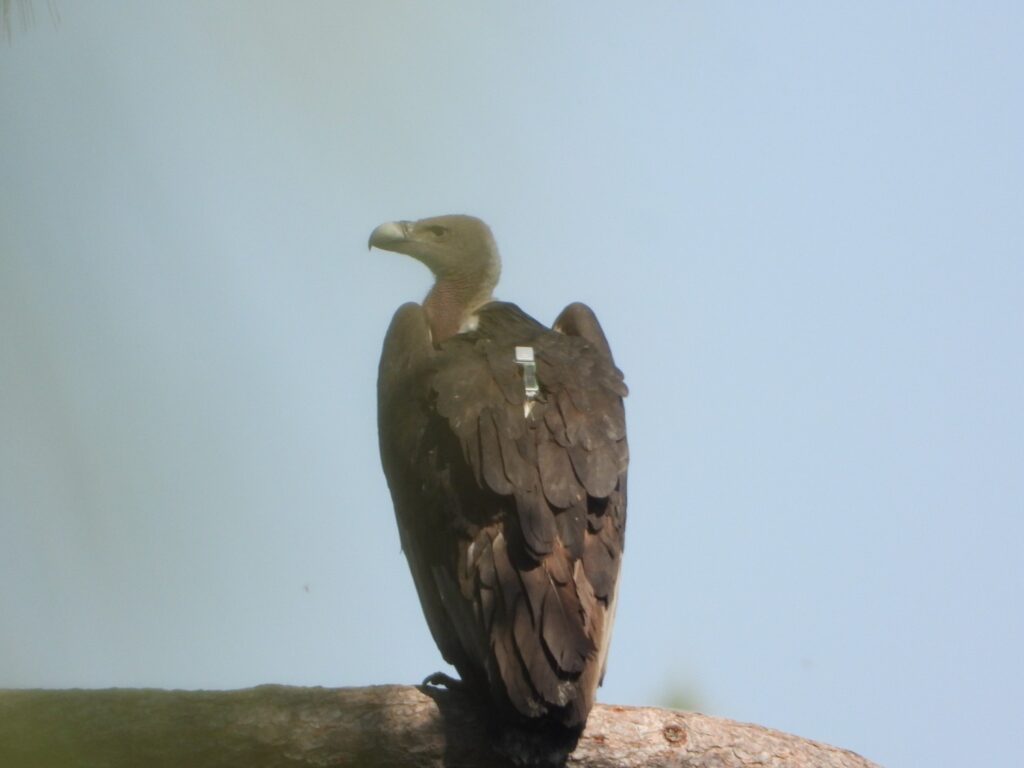
An emerging crisis for Indian vultures

Often seen as nature’s scavengers, vultures have long been misjudged as unsightly creatures with little appreciation beyond their role in cleaning up the environment. Their bald heads and habit of feasting on dead carcasses may not inspire admiration, but these birds are far more remarkable than their appearance suggests. In ancient Egypt, they were symbols of protection, motherhood, and royalty—so revered that female pharaohs, high-ranking priestesses, and royal wives adorned themselves with vulture crowns (a headdress in the shape of a vulture draped over the head, wings hanging down the sides).

Even today, vultures remain culturally important. In India’s Parsi communities, the deceased are placed in the Tower of Silence, where vultures consume the flesh—a practice that dates back millennia. Yet, despite their historical, cultural, and ecological importance, 61 percent of vulture populations globally are threatened with extinction, including those in Asia.

Emerging threats 

To better understand the challenges to vulture survival, we carried out a study in the Deccan Plateau of Telangana state, India. Our findings reveal both concerning trends and emerging threats to these critically endangered birds. We found that toxic wastewater discharge from the paper industry is a key factor negatively influencing the breeding success of long-billed vultures (Gyps indicus). 

Our study highlights urgent conservation needs and why protecting these birds matters beyond their intrinsic value. We recommend strict measures to filter hazardous substances from toxic waste discharged by the Sirpur Paper Industry in Telangana state. We also need detailed toxicological studies on vulture carcasses to better understand how industrial discharge and continued diclofenac use in cattle—despite the drug being banned due to its severe toxicity to vultures and other scavenging birds—are affecting local vulture populations. 

The broader implications of vulture decline extend to human health and safety. The loss of vultures has led to a rise in feral dog populations, which are also carriers of rabies. Livestock carcasses, once a key food source for vultures, are now increasingly consumed by dogs, whose populations have grown dramatically. Studies in India have observed a strong relationship between vulture declines and increasing numbers of feral dogs, underscoring vultures’ crucial role not only in maintaining ecological balance but also in reducing the risk of rabies transmission to humans. 

Our study reveals a new emerging threat in the form of hazardous industrial substances greatly affecting these critically endangered birds. The Indian government has classified the pulp and paper industry as one of the “notoriously polluting industries”, highlighting its devastating impact on human health and environmental integrity. The toxic industrial wastewater creates a cascade of consequences throughout the entire food web, affecting everything from river ecosystems to cliff-nesting species such as vultures. Immediate action is essential to prevent further environmental decline and protect these culturally and ecologically vital birds and their habitats for future generations.

Further Reading 

Ogada, D.L., F. Keesing and M. Z. Virani. 2012. Dropping dead: Causes and consequences of vulture population declines worldwide. Annals of the New York Academy of Sciences 1249(1): 57–71. 

Markandya, A., T. Taylor, A. Longo, M. N. Murty, S. Murty and K. Dhavala. 2008. Counting the cost of vulture decline— An appraisal of the human health and other benefits of vultures in India. Ecological Economics 67(2): 194–204. https://doi. org/10.1016/j.ecolecon.2008.04.020

Ravikanth, M., A. S. Khan, S. Sathishkumar, N. Baskaran, R. M. Medishetti and A. E. J. Ferdin. 2025. Breeding success of long-billed vulture (Gyps indicus) and its drivers in Deccan Plateau, India. European Journal of Wildlife Research 71: 35. https://doi.org/10.1007/s10344-025-01909-4. (The open access version of the paper can be accessed here: https://rdcu.be/edbIu). 

Ravikanth, M. and N. Baskaran. 2024. Abundance and age structure of critically endangered long-billed (Gyps indicus) and white-rumped (G. bengalensis) vultures at the breeding colonies of Kaghaznagar Forest Division and its adjoining areas in the Deccan Plateau, India. Journal of Biosciences 49: 58. https://doi.org/10.1007/s12038-024-00438-7.

This article is from issue

19.4

2025 Dec

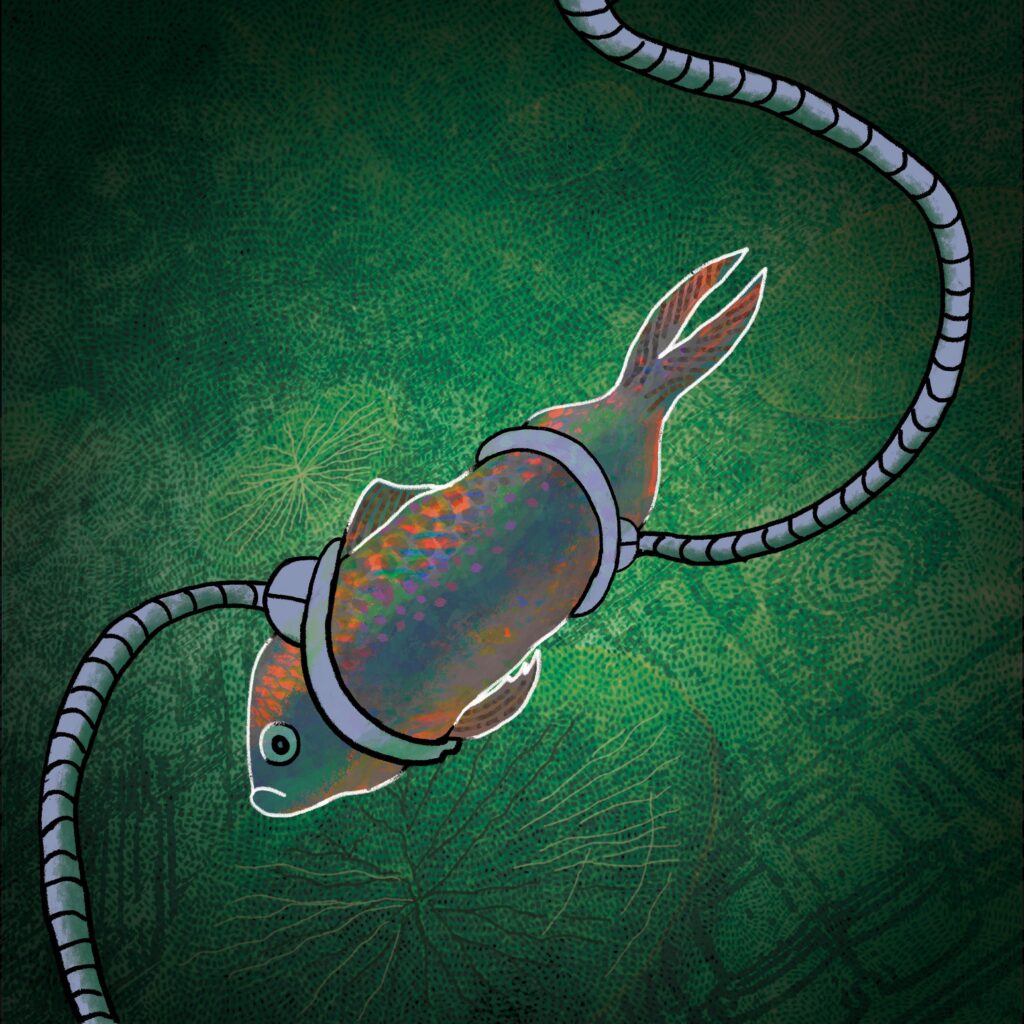
There’s something fishy about the Indian aquaculture industry

It was a very chilly winter morning in the Indian state of Haryana in January 2023, when we visited a catfish aquaculture pond for the first time. A bit rattled as our car swayed to one side, the narrow kaccha dirt road was barely wide enough for a single vehicle. The driver of our car pulled to the side to let a bike pass, which was leaving from the pond.

Though it was already nearing noon, the cold cut through us to the bone as we alighted from the taxi and made our way to the farmer who had been expecting us. He greeted us warmly and offered us chairs with the characteristic hospitality of the region. One of the species of fish he was farming in his multiple ponds, he shared candidly, was a catfish species that had been banned from cultivation.

The pond appeared calm on the surface—a deceptive serenity that made us wonder about the fish crowded in heavy densities below. As the farmer spoke, he painted a grim picture of the challenges they faced: low dissolved oxygen levels, frequent outbreaks of disease, and the routine application of antibiotics to keep the fish from dying.

Fish from the genus Pangasius—a group of freshwater catfish native to South and Southeast Asia—are resilient, surviving even in conditions with low oxygen, tolerating high stocking densities, and exhibiting greater resistance to diseases compared to other farmed aquatic species. These traits made Pangasius farming more profitable, even under lower welfare conditions, compared to species needing a more careful consideration of animal welfare for promoting their wellbeing to prevent suffocation, disease, and death.

Our visit to the aquaculture pond was a detour from our original itinerary, which involved conducting fieldwork at poultry units to understand the environmental footprint of the egg industry. A startling statement from the egg production facility owners, about how they disposed of “chicken waste” caught our attention during our interviews.

Awful reality

What they called ‘chicken waste’ is termed ‘chicken offal’, and refers to the internal organs of slaughtered birds and meat from birds deemed unfit for human consumption and discarded by the poultry industry. Poultry offal and other slaughterhouse wastes are routinely sold to the aquaculture industry as animal feed for omnivorous fish such as Pangasius and Roopchand (Chinese pomfret and Indian butterfish). This kind of untreated feed is found to contain unsafe levels of heavy metals such as mercury, arsenic, lead, and cadmium, as well as E. coli bacterial contamination.

The unsettling implications of this practice on public and environmental health lingered in our minds as we continued our fieldwork at poultry farms. With India as the world’s second largest aquaculture producer after China, the practices here carry far-reaching impacts—not just for food safety but also for broader global issues such as climate change and antimicrobial resistance. This visit reinforced the need to do scoping and speak to more aquaculture farmers, heeding the urgent call to understand these challenges with a legal or policy solution approach.

As we made our way back to the pond, we saw a farm worker return with a bag of hot samosas (a fried snack) on a bike, recognising him as the rider we had seen leaving just as we arrived. The duality we observed at the pond, tranquil on the surface and contaminated and choking under the surface, reflected how we felt—peaceful in our beautiful surroundings and the company of our friendly hosts, yet shaken and concerned for the environment and the farmers.

Our colleagues at the Fish Welfare Initiative observed a surprising trend during their work with farmers in Andhra Pradesh. While engaging with farmers rearing Indian major carp species such as Rohu and Catla (which are the dominantly farmed species), they discovered that in the last five years, a lot of farmers transitioned to farming catfish, particularly Pangasius (commonly known as Pangas or Basa). 

Economic and other practical reasons drove this shift. One such farmer expressed concerns that Pangasius aquaculture might soon be banned by the government, owing to the illegal feeding practices that the farmers were following. Their fears stemmed from some other non-native species of catfish that had already been banned from being farmed in India. Yet, the farmers are constrained in means and are left with little choice but to cut corners, if they want to cut their losses. This dichotomy highlights the tension between the biological strengths of the Pangasius species and the economic vulnerabilities faced by the farmers.

Worrying trends

Our next visit to a catfish aquaculture pond took place in the sweltering heat of April, as we made our way to Kolleru Lake in Andhra Pradesh. The Animal Law Centre from NALSAR University of Law was carrying out a scoping study in collaboration with Ethical Seafood Research at this ecologically important wetland. This region, situated between the Krishna and Godavari river basins, is vital for ecosystem health. It is protected under the Ramsar Convention—an international treaty dedicated to the conservation and sustainable use of these critical ecosystems. There is also a designated Kolleru Wildlife Sanctuary which is protected under the Wildlife (Protection) Act, 1972.

Driving from the city of Eluru to the biodiverse wetlands of Kolleru, we witnessed a scale of production beyond our imagination. The road was lined with aquaculture ponds on either side, stretching into the horizon, a stark transformation of the landscape. Not only is the encroachment expanding, but also the scale of production. Rented heavy construction machinery is being used for harvesting fish at the pond site—a worrying trend for the water quality, animal welfare, and food safety standards for the consumers, causing the fish to suffer from injuries and high stress levels. It also indicates the level of intensification of these farming systems, at the cost of lives of animals and human health at large. 

In addition to being a refuge for local wildlife, Kolleru Lake is a crucial stopover for migratory birds. We observed the regular use of biosecurity nets (also known as bird lines) to protect the fish in aquaculture ponds from being predated upon by the birds visiting the Kolleru wetland region. 

With the support of a scientist from the Andhra Pradesh Fisheries Department and experts from the Fish Welfare Initiative, we identified six major clusters of villages in and around the Kolleru Ramsar site, where Pangasius farming has a higher footprint. We then interviewed 30 farmers who have been farming a species called Pangasius pangasius to better understand their practices and challenges. 

Ripple effects

During our time in the field, we observed that the relationships among fish feed, disease, water treatment, and pond bottom soil conditions are influenced by many variables—even if they have weak correlations as individual factors. The cumulative effect of multiple small influences could lead to significant environmental stress. For example, even a 2–5 percent correlation between inferior feed such as poultry offal and other slaughterhouse wastes and the increased use of antibiotics can become significant when considered alongside other contributing factors.

More importantly, we observed the socio-economic factors that contributed to the prevalence of this harmful practice, which has been attracting policy attention for over a decade now, with several attempts to enforce the ban on using poultry offal as feed. That this practice continues to persist signals a deeper systemic issue.

The aquaculture production chain has little to no traceability in the mostly informal economy. The strings are often controlled by the traders and powerful middle men. In Pangasius aquaculture, it is possible to reduce costs by compromising fish welfare significantly without a corresponding increase in mortality rates. This makes Pangasius an appealing choice for aquaculture farmers, as compared to the dominantly farmed carp species, particularly Rohu and Catla. However, profitability and the likelihood of farmers shifting to this aquaculture is also incumbent on the market price of the species, set by the traders associations.

Economic losses during the COVID-19 period were said to be lower in Pangasius culture compared to carp culture in two of India’s largest aquaculture-producing states. However, when corners are cut, the costs are externalised on the fish, and the other human and non-human animals who depend on the wetlands.

Bioethics and policy

It may seem like an ethical dilemma between prioritising the interests of farmers’ livelihoods and protecting the welfare of animals and the environment, but in the long term, it is to the detriment of not just the farmers and the fish but all human and non-human individuals in the ecosystem (with the exception of market intermediaries).

Farmers care deeply about the welfare of their fish and the health of their ponds. With institutional support for better feeding practices, farmers will be eager to comply with the regulations. Moreover, there is a need for regulating and creating stringent protocols for certifying the drugs that the pharmaceutical industry supplies to Pangasius farmers. Currently, there are no quality control tests or any checks in place to ensure that the medicines are appropriate for the condition they are prescribed for. 

Regulatory challenges in monitoring and enforcement exist due to the scale of the industry. However, unless the root cause is addressed and as long as farmers struggle to make their margins, the cross-border shadow supply chain of poultry offal across Telangana, Odisha, Tamil Nadu, and other coastal states will persist.

A shift from a siloed to an integrated approach such as One Health will go a long way. Parallely, increasing local institutional capacity and incentivising coordination between agencies—including Municipal Administration, Fisheries, Animal Husbandry, and Transport—is critical. Poultry, as a key industry stakeholder, must not be left out of the implementation roadmap. Public authorities checking compliance, including waste treatment and management at poultry facilities, can also be looped in. 

During our fieldwork, we realised that the intensification of aquaculture and the resultant use of chicken offal as feed would become the focal point of our study. This harmful practice is at the heart of a broader biodiversity and food security crisis. What started as a study into aquaculture practices in a nationally and internationally protected wetland quickly demanded a closer look to unpack its downstream implications.

The influence of industry and political vested interests, along with the implementation challenges across a vast and unorganised sector, could be countered with satellite monitoring. Artificial intelligence and machine learning tools can help overcome barriers by enabling real-time, large-scale data collection. These technologies offer a cost effective and accurate way to monitor water quality and fish welfare parameters, thereby strengthening government oversight and supporting holistic and evidence-based policy implementation.

Further Reading:

Rao, K. M. 2015. Down to Earth. Kolleru Wildlife Sanctuary faces threats. https://www.downtoearth.org.in/environment/kolleru-wildlife-sanctuary-faces-threats-52211. Accessed March 28, 2025.

Srinivas, V. 2024. Deccan Herald. Police drive against dumping of chicken waste in Kolleru Lake.  https://www.deccanchronicle.com/southern-states/andhra-pradesh/police-drive-against-dumping-of-chicken-waste-in-kolleru-lake-1832219. Accessed on March 28, 2025.

JORBEER CONSERVATION RESERVE, A DEATHLY PARADISE

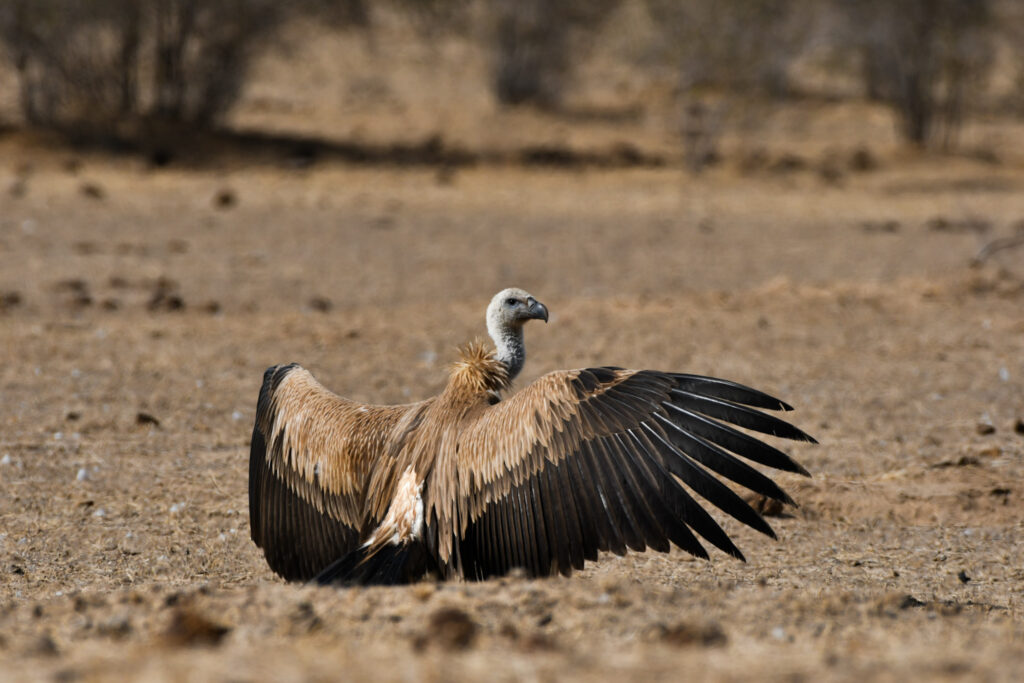
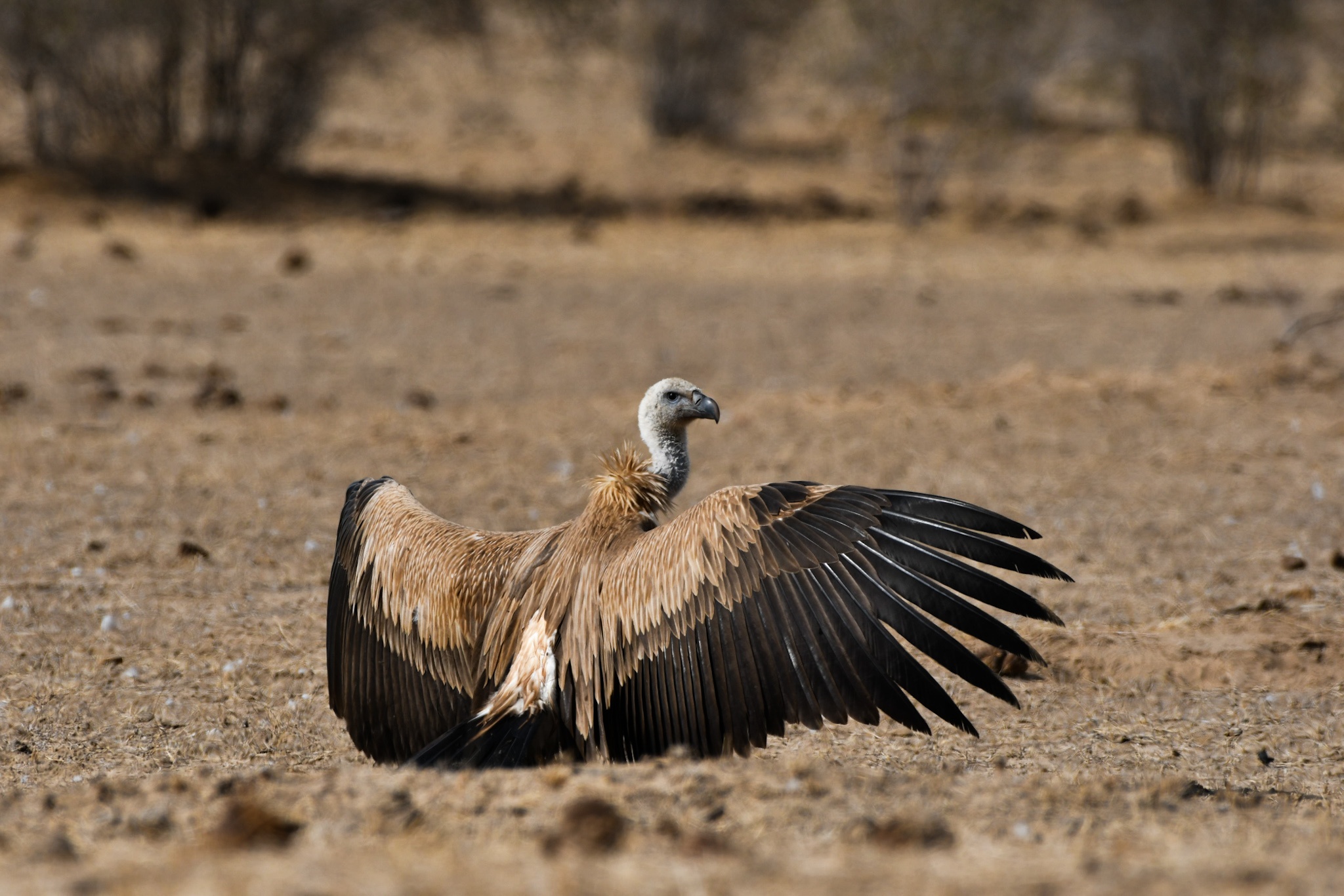
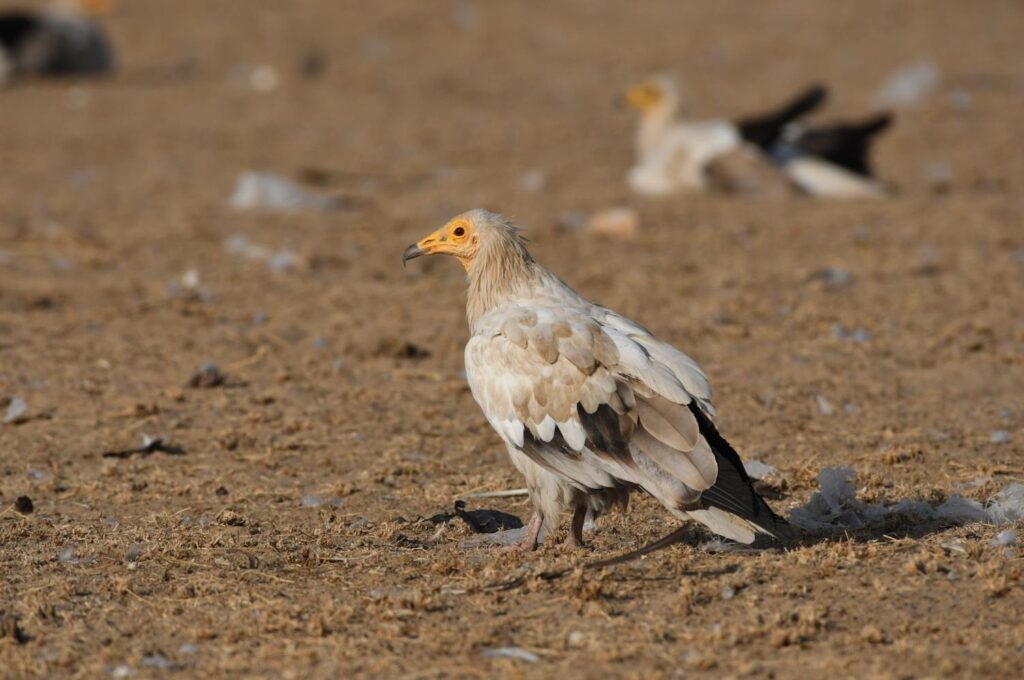
Feature image: Eurasian Griffon (Gyps fulvus)

While travelling to Jaipur, India, by road between 1990–95, one would see a number of vultures along the way, cleaning the carrion of dead animals killed by the cars and trucks. With approximately 300 million cattle in the country, the vultures played a major role in removing the carcasses of dead livestock. But unfortunately, by the start of the 20th century, the populations of these scavengers had plummeted alarmingly.

Studies finally narrowed down the cause of the decline to the veterinary drug diclofenac. Used as an anti-inflammatory drug for the cattle, it was found that it caused kidney failure in the vultures. While diclofenac was eventually banned in India, the damage had been done. 

As the scavengers disappeared, many carcasses were left to rot, becoming a serious threat to human health. The government started to review the remaining population of vultures and started a captive breeding programme. The Jorbeer Conservation Reserve was set up in Bikaner, Rajasthan. An area of about 25 square kilometres, it was selected as a location where animal carcasses could be dropped off.

Cattle, including cows, buffaloes, and even camels are collected from city areas, the innards removed to prevent any risk to the vultures, and then dumped in the reserve area. Contractors take the skin and the bones for commercial use, thus covering the cost of animal collection and disposal. The rest is left for the scavengers. 

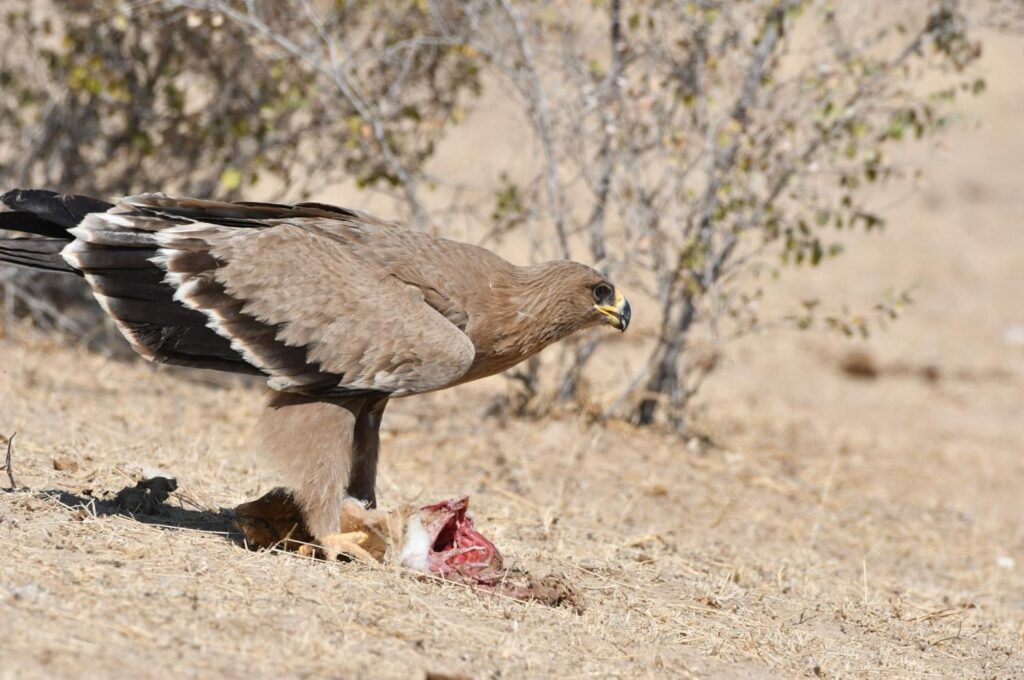
Steppe Eagle (Aquila nipalensis) with piece of meat in its claws

The park is home to vast open areas, dry desert sand dotted with trees that are bare or have sparse foliage. Driving on the main dirt road, one has to be careful to avoid going off the path, so as not to get trapped in burrows dug by dogs. It is a bleak landscape that reeks of death, and as you get closer to the carcasses, bears a strong odour. But for those who can overcome it, the sight is one unlike anything else. 

Thousands of vultures cover the ground and sky. Some are perched on trees, not 10 feet away from you, while some circle in the thermals above or sit feeding on piles of flesh and bones. Everywhere you look, there are species that are rarely spotted elsewhere in the country. Some of the species I have observed on site include the Eurasian and Himalayan griffons, Egyptian and cinereous vultures, steppe, tawny, imperial, and white-tailed eagles, and black kites. I was also lucky enough to see the rare yellow-eyed pigeon!

Egyptian Vulture (Neophron percnopterus)

Developed as a feeding ground, the Jorbeer Conservation Reserve has become a sanctuary for endangered raptors. The consistent supply of food attracts scavengers from all over the world, some migrating from Mongolia, Kyrgyzstan, and other parts of Central Asia. With the animal carcasses safely consumed, the spread of zoonotic diseases to other wildlife and humans is prevented. 

A haven for birds and for birdwatchers like myself, it’s paradise!

The quiet signals of ecological stress

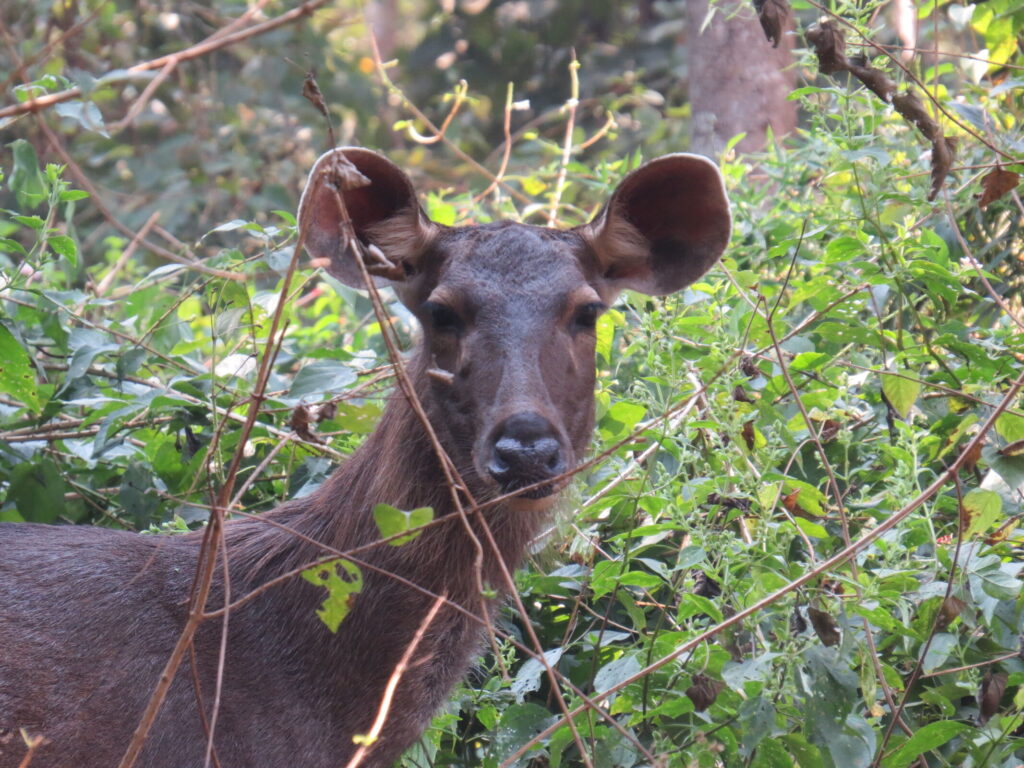
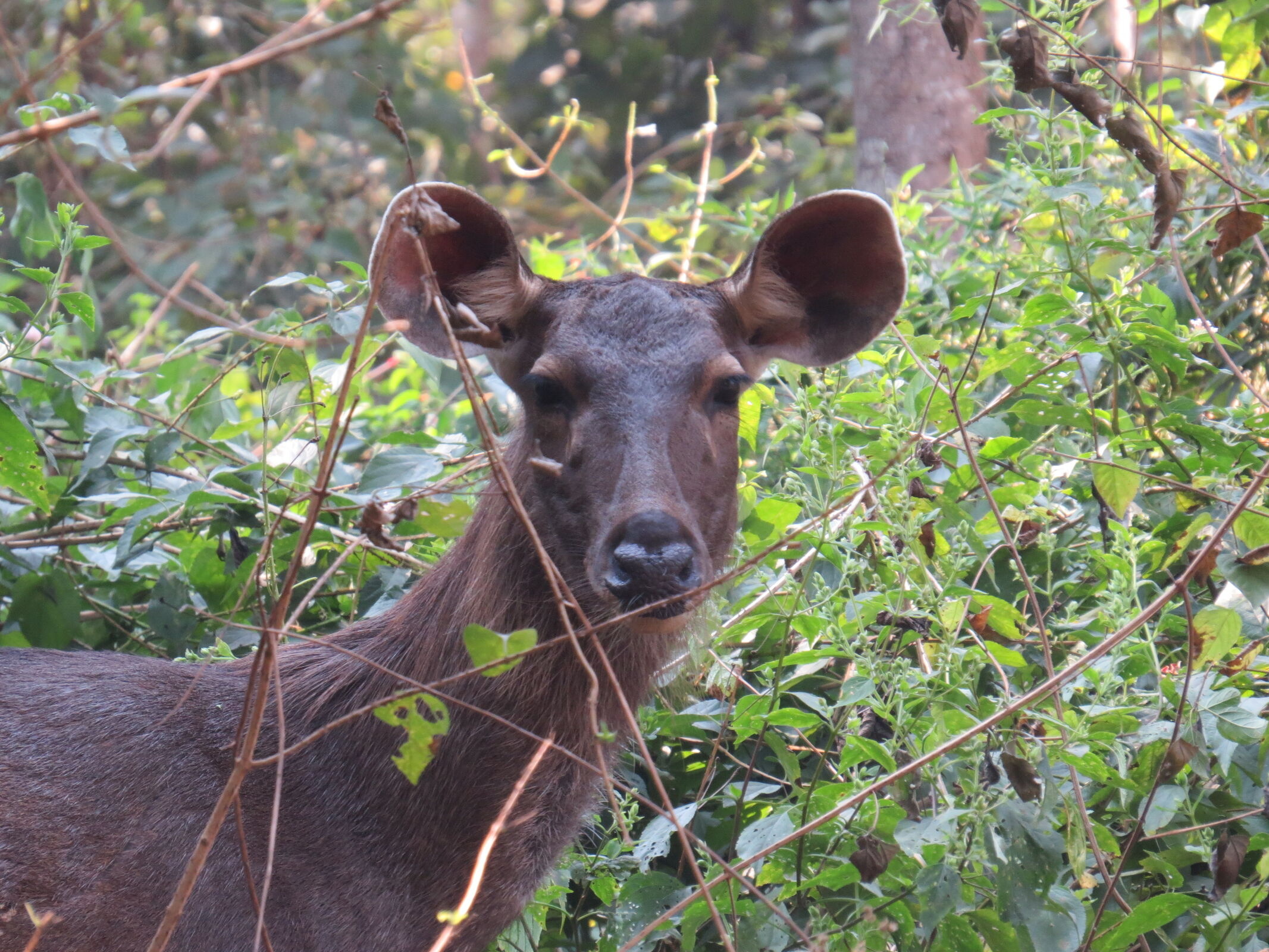
Feature image: A sambar deer peers through a dense Lantana thicket in Kanha. (Photo credit: Neha Awasthi)

It was early morning in the Kanha Tiger Reserve in Central India. The quiet made my own footsteps sound too loud. There was a slight chill in the air, so I kept my hands in my pockets as I walked through the sal trees to the same spot where I always sat—within a small opening behind a bamboo clump. Here, I knew that I could keep out of sight. With binoculars around my neck and a notebook tucked under my arm, I waited. Months in the field had taught me not to chase, but to simply sit and wait for the deer to come to me. 

A sambar stag emerged from the treeline. He stood there for a brief second, backlit by the morning light. His antlers caught the sun and made him look almost golden around the edges. He walked in slow, deliberate steps towards the undergrowth looking for breakfast. I thought he had started eating something familiar. Probably one of the native shrubs or a patch of grass. But I was mistaken. His choice of food caught me completely off guard. He bent his head and started feeding on Lantana camara, a thorny, toxic invasive plant, native to the American tropics and known more for its aggressive spread in non-native regions than its nutritional value. The stag didn’t take a bite and move on. He continued feeding on the woody shrub, leaf after leaf, as though it was a regular part of his diet. The scene lasted only a few minutes, but it stayed on my mind for months, forever changing the way I view the forest.

Tracking diets

I had come to Kanha to carry out my PhD study on the foraging behaviour of sambar (Rusa unicolor)—a large deer species native to the Indian subcontinent, South China, and Southeast Asia. I applied a standard bite count method, watching them eat through various seasons and across different forest types, such as sal, bamboo-dominated, and mixed growth. A fieldwork session meant carefully recording every plant they consumed (including how many mouthfuls of each) during fixed observation periods, along with details such as the habitat type, time of day, and whether the deer were alone or in a group. It required patience. Some days, I barely caught sight of a deer. On others, I’d be lucky enough to observe undisturbed feeding for more than an hour.

Before long, an unusual pattern started to emerge. Lantana kept appearing in my notes as the species’ choice of food, even when plenty of native plants were available. After a few weeks, the pattern was hard to ignore. In several patches, Lantana made up more than 15 percent of the sambar diet. In terms of dry weight, the invasive plant’s contribution was even higher. What struck me most was that even in areas where native shrubs were present, the deer seemed to prefer Lantana. They were actively choosing it. But why were the deer consuming so much of a plant known to be chemically toxic? 

I began to ask myself questions I hadn’t expected. Was this a matter of limited choice? In sites heavily invaded by Lantana, were the deer simply making do? Were they still feeding on this weed in healthier forest patches? Were the deer immune to the adverse effects of Lantana consumption, such as liver damage, recorded in studies on livestock? 

Toxic properties

Lantana camara is not native to Indian forests. Over 200 years ago, the species was brought here from Central or South America as an ornamental plant. It grows thick and fast, thereby outcompeting native plants and making it harder for forests to recover from disturbance. Today, it has overwhelmed millions of hectares across the country. The result is that native ruminants, such as sambar or spotted deer, are encountering this plant for the first time. 

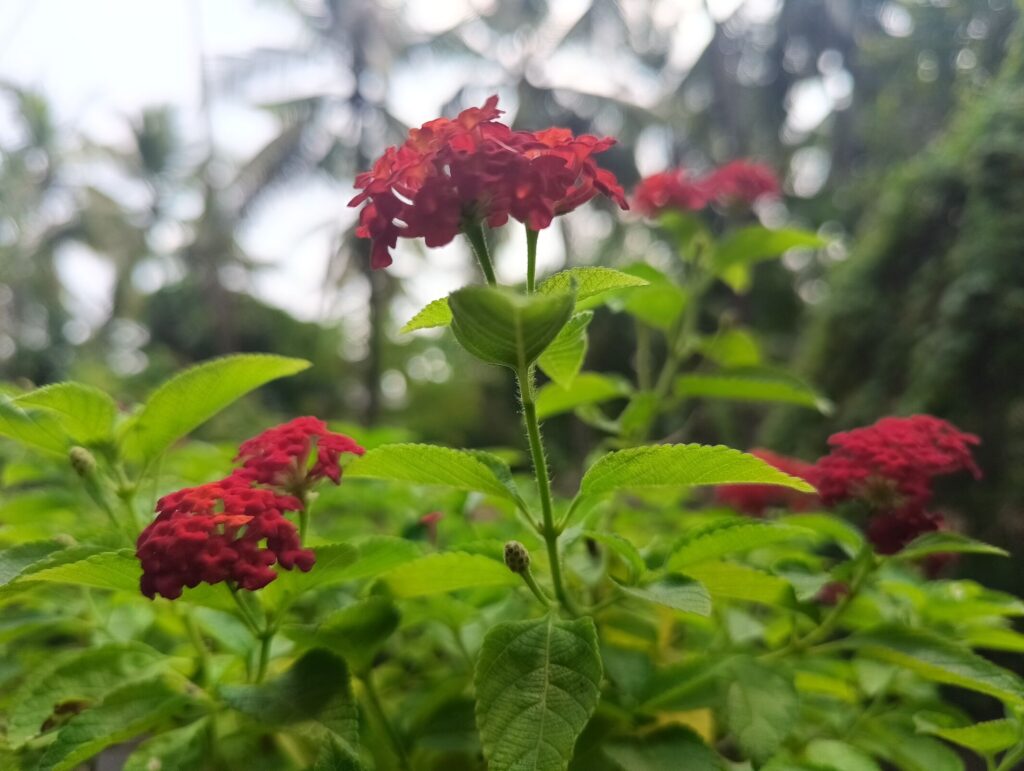
Lanatana camara is not native to Indian forests (Photo credit: Rasitha Nellickal)

Forests rarely shout. Most of the time, they whisper. And you only notice if you are quiet—a small shift in diet, a subtle change in behaviour, a pattern that repeats itself until it can no longer be ignored. Watching a sambar feed on Lantana was not dramatic. It was quiet, almost easy to miss. Yet, the moment stayed with me. It got me thinking about how animals cope when things around them start to change—when forests lose their biodiversity, when good forage becomes harder to find, they don’t always get to choose. They adapt. Sometimes that adaptability looks like compromise. Other times, it might look like a risk. Maybe the sambar did not prefer Lantana. Maybe it just didn’t have any better options.

To imagine that Lantana could become a key food source is surprising—it contains a chemical known as lantadene, which is toxic to animals. This has been documented by veterinarians for years, with consumption of this species found to cause photosensitivity and liver damage in cattle, proving fatal in some cases. So seeing a wild herbivore feed extensively on the plant was both puzzling and worrying. Was it a sign of desperation? An adaptation? A mistake? There were no easy answers. And that, perhaps, is what made this finding so important to me.

Ecological implications

These deer are not silent grazers in the forest. They are an essential part of the ecosystem. As large-bodied herbivores, their foraging shapes plant communities. They influence seed dispersal and, perhaps most importantly, they are a primary prey species for big cats such as tigers and leopards. If their health starts to suffer, the effects ripple throughout the food chain as well as the ecosystem. 

A steady diet of Lantana, low in nutrients and known to be toxic, could lead to weakened body conditions, reduced reproduction rates, higher chances of disease or being easily killed by predators. Thus the question of why deer are feeding on Lantana is not just about the deer, but also about the predators that rely on them and the ecological balance of the entire forest.

When we talk about invasive plants, we usually think about overcrowding, toxicity, and pushing out other plants. But the full story may only become visible by considering the behaviour of the animals that live among them. What are wild herbivores eating and why? 

Some of my strongest field memories are not dramatic sightings, but quiet moments: a line of sambar easing through a Lantana thicket, stopping and starting as they feed, or a hind with her fawn holding still in the half-light, taking careful bites from the edge of a bush. These memories are marked by hours spent with a notebook, recording each bite, then staring at the page and wondering what the data mean.

Looking back, those days taught me more than I expected. I went to Kanha to study foraging behaviour, but came away thinking about the silent negotiations between species every day. I found no clear evidence that sambar are immune to the toxic effects of Lantana camara. Whether their continued consumption reflects physiological tolerance or simple persistence under constrained forage conditions remains an open question. What the sambar eat, where they step, what they pass by—these are not just behaviours, but signals.

Over time, I began noticing other small shifts: denser Lantana thickets replacing diverse understory plants, deer spending more time along forest edges, and longer feeding bouts with fewer plant species. The story of a forest is not always about what is lost outright. Often it is about what changes slowly, almost unnoticed. Sometimes it begins with a deer pulling leaves from a thorny Lantana bush.

Further Reading: 

Rastogi, R., Q. Qureshi, A. Shrivastava and Y. V. Jhala. 2023. Multiple invasions exert combined magnified effects on native plants, soil nutrients and alters the plant-herbivore interaction in dry tropical forest. Forest Ecology and Management 531: 120781. https://doi.org/10.1016/j.foreco.2023.120781

Roy, H. E., A. Pauchard, P. J. Stoett, T. R. Truong, L. A. Meyerson, S. Bacher, B. S. Galil et al. 2024 Curbing the major and growing threats from invasive alien species is urgent and achievable. Nature Ecology & Evolution 8: 1216–1223. https://doi.org/10.1038/s41559-024-02412-w

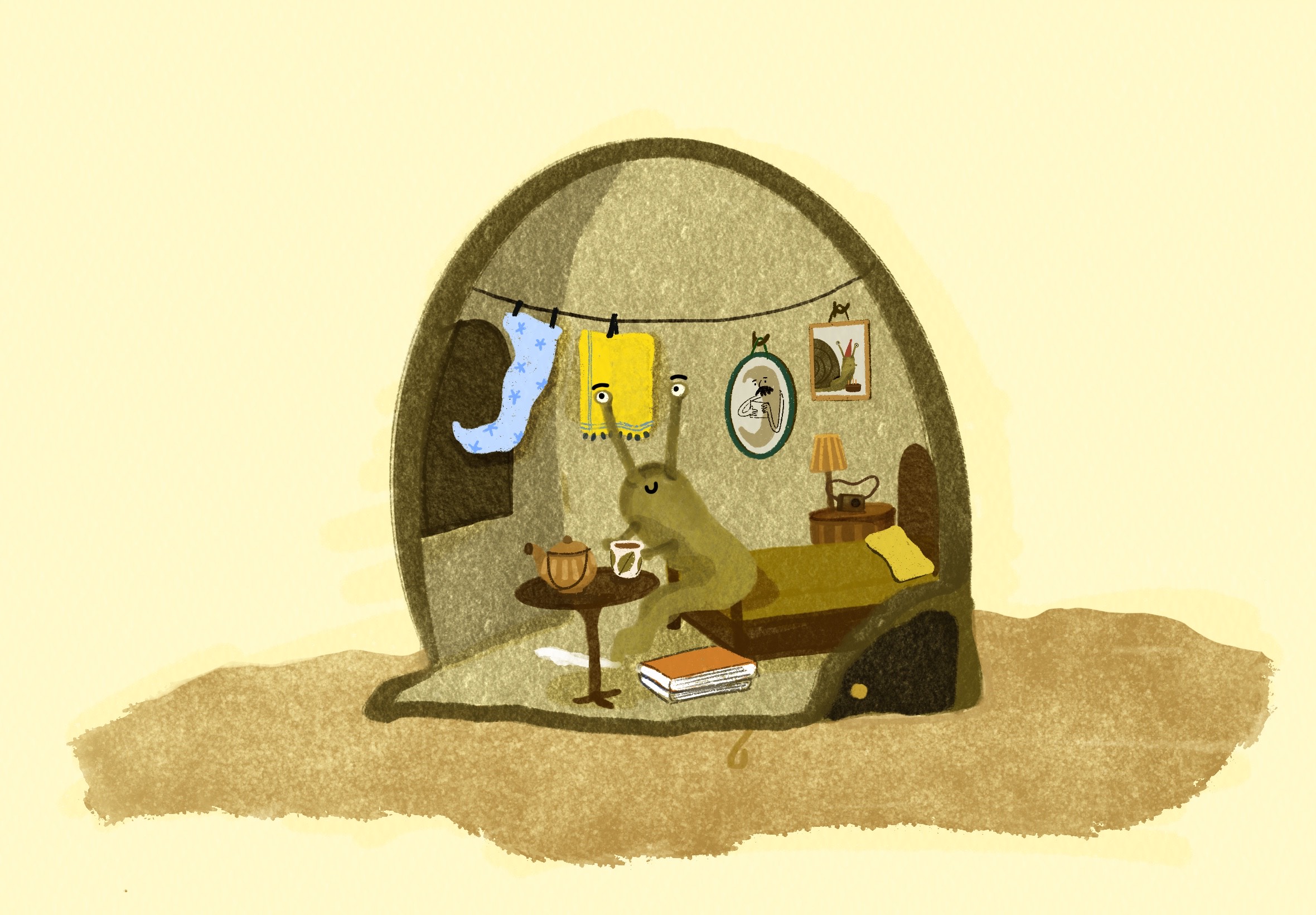
The Little Trail of Gary the Snail

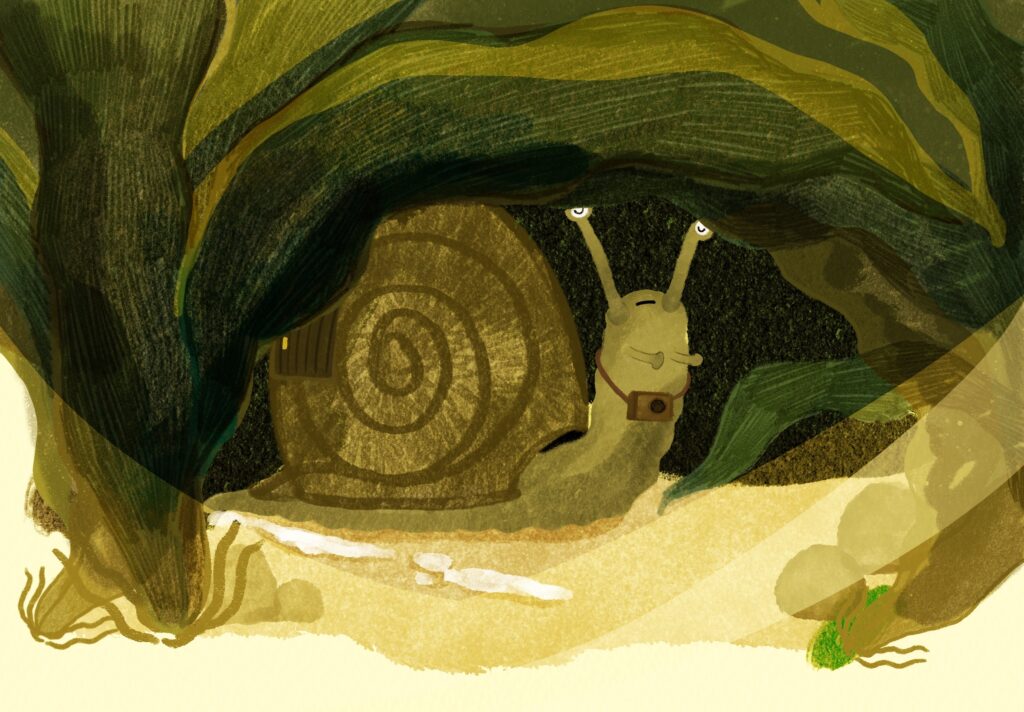
There once was a snail called Gary, 
who carried a shell—big and heavy. 
The shell was coiled, hard, and neat, 
where he used to rest and eat. 

Like all snails, 
he looked shy at first, 
but deep inside, he had a curious thirst. 

Like all snails, 
he was slowest in the race, 
but he never failed to explore any place. 

Gary the snail loved 
living in darkness indeed. 
Why? Because 
daylight made his soft skin dry. 
So, he would hide nearby—
under rocks, and soil, and leaves. 

For him, night was a friend—
a world of wonder. 
Gary the snail would slowly roam, 
finding food and stories to bring back home. 

Excited to make his own fairytale, 
like all snails, 
he learnt to leave his slimy trails. 

Be it food, prey, or the moist air, 
with his two sets of tentacles—
long and clear—
he would look, smell, 
and feel what was near. 

On his way, 
he crawled, crawled, crawled—so slow, 
munching on fallen leaves, 
helping the soil stay rich and grow.

Gary the snail helped nature 
in all the ways he could. 
After all, 
he too was a member 
of the environmental clean-up crew. 

One night, during his usual tour, 
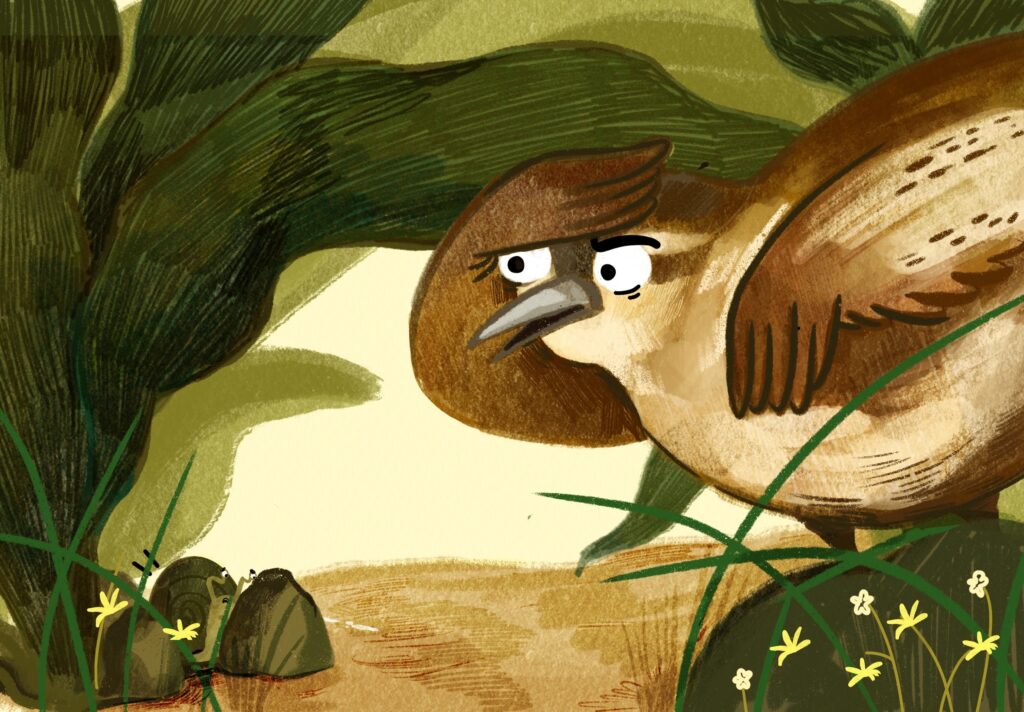
he met a huge birdy, searching for food. 
To the birdy,
Gary was perfect prey. 

But Gary knew 
just what to do. 
He stayed still, 
pretending to have no clue. 

Slowly, he crept into his hard shell,
where he would be hidden well. 
The shell made him look like a rock,
leaving the bird confused and in
shock. 

Disappointed—
with a flap and a flip—
the bird flew away. 
Gary the snail 
stood brave that day. 

Later, he met his friends—
ants, earthworms, and beetles—and
told them the tale 
of his bold adventure. 

After a while, 
he returned to his warm shell, 
wishing all a very good night, 
full of sweet dreams and delight. 

Be it an exciting day or a smooth, slow tour,
Gary the snail crawled—without any fear.

The Adventures of Sahibi the Dragonfly

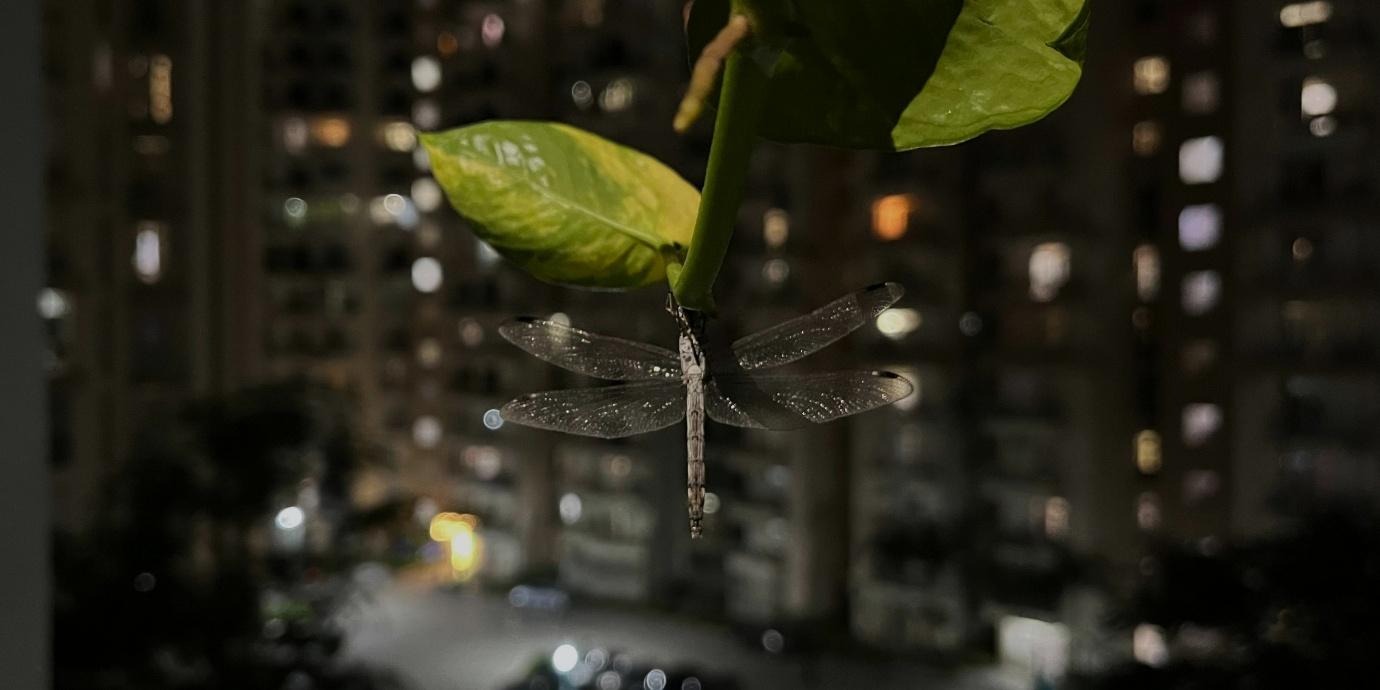
Feature image: A dragonfly resting on my balcony in a high-rise apartment building, highlighting nature’s presence in urban spaces. (Photo credit: Nirjesh Gautam)

Sahibi sat still on a branch one hot afternoon. Soaking in the sunshine to warm up her tiny body—a natural behaviour among cold-blooded creatures.
But above her, danger circled quietly.

A mighty bird swooped down, silent as a shadow—ready to snatch her.
But Sahibi wasn’t just any insect.
She wasn’t slow like a snail or bouncy like a grasshopper.
She could zip, zoom, dive, and dart!

That’s right—Sahibi was a dragonfly. A flying super-insect.

“Look at me go!” she buzzed, spinning through the air like a tiny helicopter.

But Sahibi didn’t always have wings.

Life in the pond

Before she could fly, Sahibi lived underwater.
And guess what? She had gills near her bottom that helped her breathe!

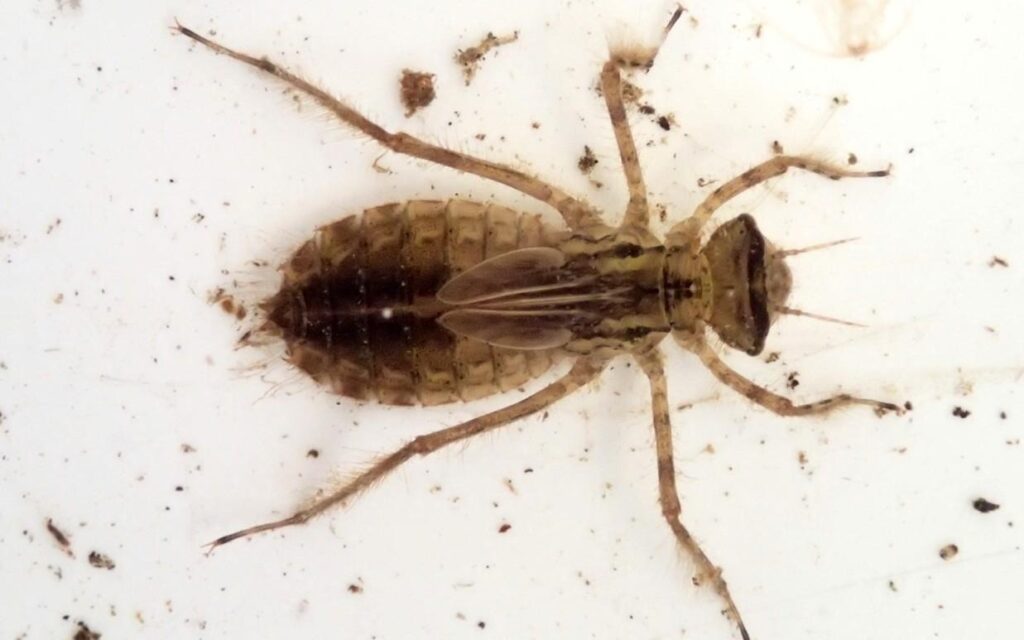
This is one of the three stages in the life of a dragonfly. Inside the pond, Sahibi was in larval stage. She had a brown bulky body, big eyes, small antenna, and six legs—perfectly adapted to live underwater.  

She was a naiad—that’s what a baby dragonfly is called in scientific terms. But she wasn’t just any pond creature.

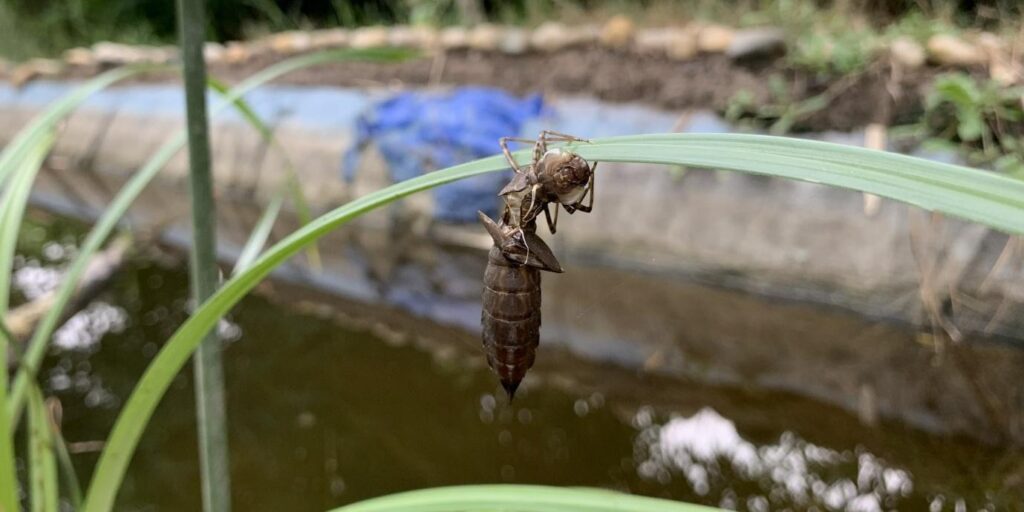
A dragonfly nymph, the lesser-seen aquatic stage before it emerges as a dragonfly. (Photo credit: D. Sikes/Wikimedia Commons)

While most bugs tried not to get eaten, Sahibi was busy being a fierce little predator, snapping up mosquito babies, tadpoles, and even tiny fish! She launched surprise attacks by shooting out her jaw and grabbing her prey in a flash. 

And she was always hungry—so much so that she sometimes mistook one of her own kind for a snack!

“Catch me if you can,” she’d gurgle underwater before lunging at a tadpole.

The big change

One night, Sahibi looked up through the pond water.
The moonlight sparkled at the surface.
Something stirred inside her.

After living nearly a year underwater, it was time to change.

She crawled out of the pond and climbed up a reed.
High above the water, she waited, still as a statue.

Pop!—her back split open under the dim moonlight.
She wiggled and pushed. First came her head.
Then her thorax—the part of her body like our chest.
Finally, her long abdomen and delicate wings slid free from her old skin, called the exuviae.

The sun peeked over the horizon just as she finished.
But Sahibi couldn’t fly yet.

She had to dry her wings in the morning sun. If she didn’t, she might never fly.

She waited. She flapped.
And then—ZOOOOOOOOOOOOOOOOOOOOOOM! 

She was flying. 

Her second life had begun.

Dragonfly exuviae attached to a blade of grass at Dheerpur Wetland Park, New Delhi. (Photo credit: Nirjesh Gautam)

Expert flier

Sahibi could fly forward, backward, sideways, and even hover and dart—movements which helicopters try to replicate.
She could twist and turn midair in ways even jets could not.

And her eyes?

Two giant compound eyes helped her see nearly all around.
And three tiny ones helped her detect light and motion.

It’s like having super vision!

Just as she was in the pond, Sahibi was a fierce hunter in the sky.
She snatched tiny flies and mosquitoes right out of the air, using her legs like a net!

She could eat hundreds of mosquitoes in a day, helping control their populations as well as those of other insects that humans consider as pests.

Love in the air

One sunny afternoon, Sahibi met another dragonfly with shiny wings and dazzling blue eyes.
He zoomed beside her and said, “Will you fly with me?”
Sahibi zipped around in circles and giggled, “Only if you can keep up!”

They chased and danced through the sky, like little stunt helicopters.

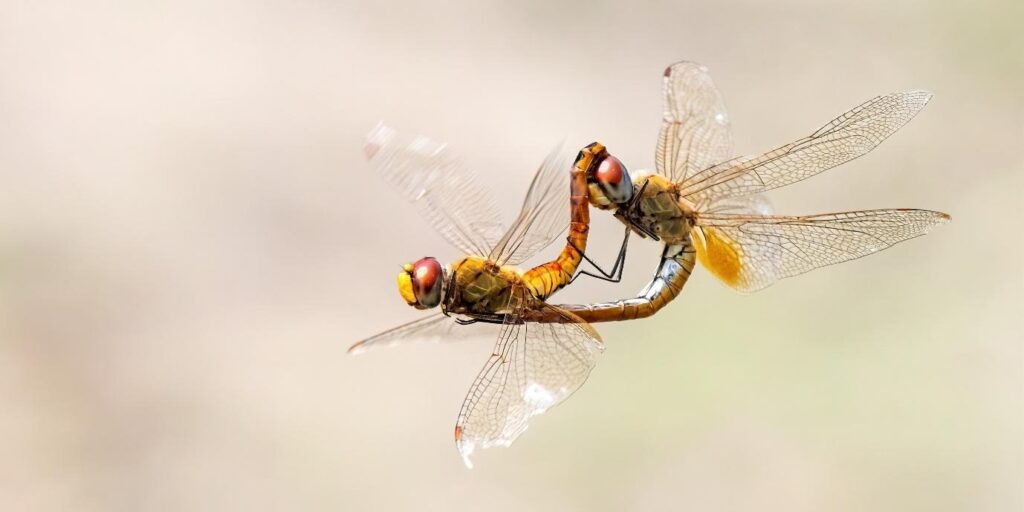
Then came the dragonfly hug. He gently held her by the neck in what’s called a tandem hold.
Together, they formed the shape of a heart in the air. This is a special dance called a mating wheel

A pair of dragonflies mating in flight, forming the characteristic “wheel” position. (Photo Credit: Prasan Shrestha/Wikimedia Commons)

After their sky ballet, they returned to the pond.
Sahibi laid her eggs gently on the water’s surface. Her partner hovered above, guarding her and their future young.

“Go on, little ones,” she whispered. “The pond is full of adventures.”  

Urban surprise

You might think dragonflies, like Sahibi, live only near jungles or big rivers. But Sahibi lived in the middle of a noisy city buzzing with cars, buildings, and people.

Still, she found a quiet waterbody amid all the noise. This waterbody was sheltered from wind by aquatic and semi-aquatic plants, and was full of food and sunlight.

It is difficult to imagine. Yet, even in a busy city, there was space for someone as magical as Sahibi. 

Don’t believe me? Go check for yourself!
Look around ponds, lakes or stagnant water. From July to November is the best time to spot dragonflies dancing in the sunshine.

So, the next time you see one gliding by, remember Sahibi—the insect who flew better than a helicopter, hunted with precision and reigned the city’s sky.

FUN FACTS

  • Dragonflies have been around on the Earth since before dinosaurs. And one dragonfly fossil had a wingspan of 70 cm!
  • A female can lay up to 400 eggs in one go.
  • Dragonflies catch their prey 97 percent of the time—making them one of the best hunters in the animal kingdom!
  • They can fly at speeds between 34–56 kilometres per hour (as fast as a car in a city).
  • Some species migrate over thousands of kilometres.
  • Dragonflies eat hundreds of mosquitoes each day.
  • Both pairs of their wings can move independently, giving them incredible control.
  • Dragonflies use motion camouflage—a sneaky trick that makes them look like they’re not moving, even when they are!
  • Dragonfly naiads help scientists monitor pollution, especially mercury contamination in wetlands.

QUIZ

Answer these questions and see what you remember from Sahibi’s story!

  1. What is a baby dragonfly called?
  2. Where do dragonflies begin their life?
  3. What helps a young dragonfly breathe underwater?
  4. What amazing flying skills does a dragonfly have?
  5. What is motion camouflage?
  6. Where did Sahibi the dragonfly live?
  7. How are dragonflies helpful to humans?

Suggested answers:

1. Naiad 2. In freshwater / in a pond or wetland 3. Gills near their bottom 4. Flying forward, backward, sideways, hovering, and making quick turns 5. A sneaky trick where the dragonfly looks still while flying toward its prey 6. In the middle of a noisy city, near a quiet waterbody 7. They eat mosquitoes and help control pests and diseases

The surprising responses of reptiles to extreme megafires

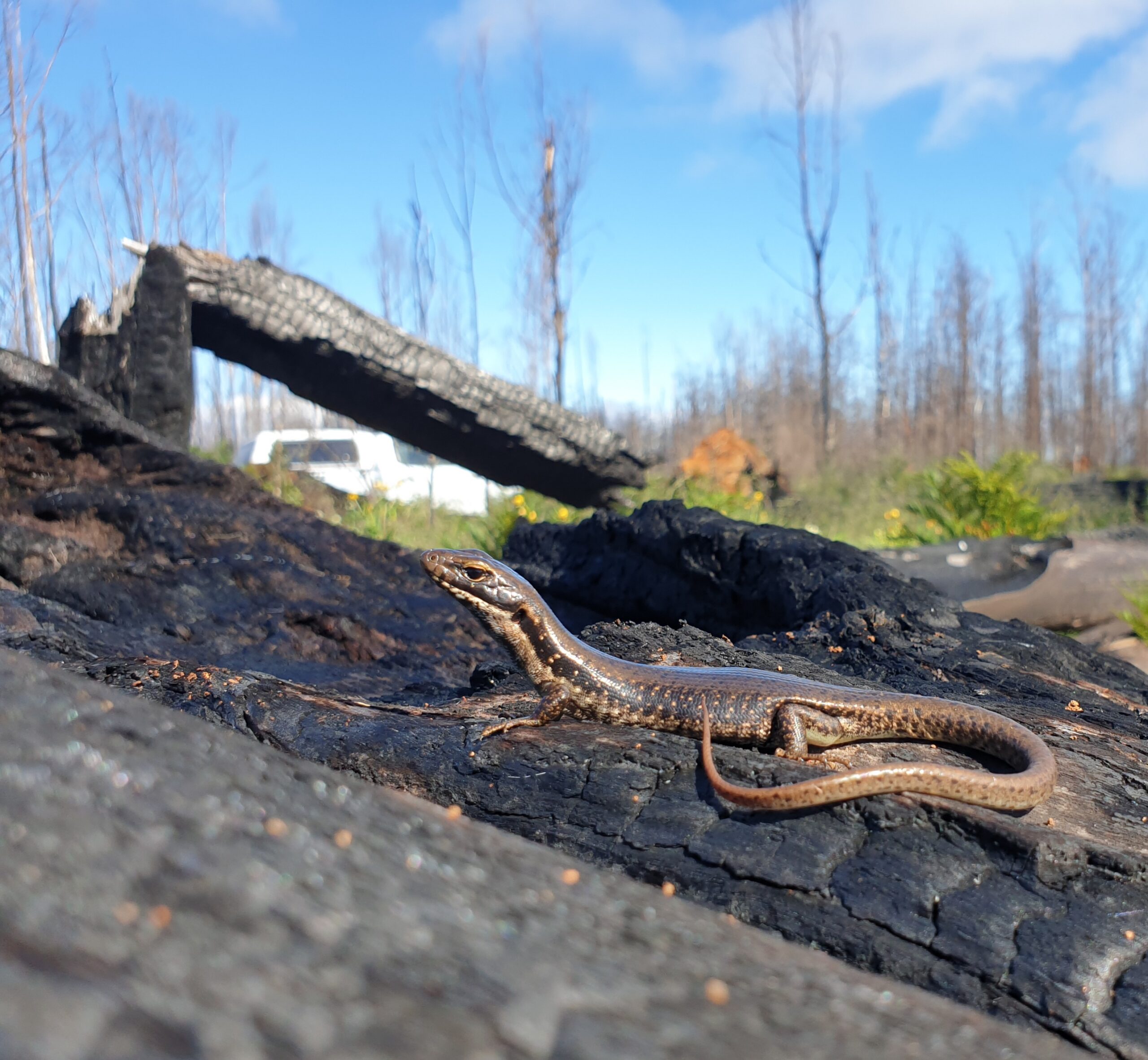
Feature image: A southern water skink (Eulamprus tympanum) basking on a charred log after the 2019–20 Australian megafires (Photo credit: Kristina Macdonald)

Wildfires often leave mineral earth with skeletal blackened stems, making it hard to imagine that wildlife might survive. But surprisingly, often what matters more than the shocking fire event is the history of past fires, which can influence, among other things, vegetation structure, logs, and tree hollows.     

Our new study analysed field data we collected after the 2019–20 Australian megafires. The megafires swept through 10.3 million hectares of forest, the largest area burnt in a single fire season until then. We aimed to discover whether the chances that small animals persist after a megafire are based only on the fire itself, or the landscape’s habitat and fire history. To do so, we selected 162 sites divided among unburnt sites and those burnt at different fire severities. 

We measured habitat features including moss, logs, and weed cover, and used online data to find out how many times each site had been burnt in the past. We then surveyed the sites to count the number of skinks across four species—glossy grass skink (Pseudemoia rawlinsoni), alpine water skink (Eulamprus kosciuskoi), southern water skink (Eulamprus tympanum), alpine grass skink (Pseudemoia cryodroma)—and to find signs of the threatened broad-toothed rat (Mastacomys fuscus). We surveyed each site three times, allowing us to account for the risk of not detecting a species during a survey, even though they are present.

Some of the results were straightforward. There was almost no chance of finding the glossy grass skink (P. rawlinsoni) and broad-toothed rat in sites that experienced high fire severity in the 2019–20 megafires. These species live in the vegetation and if fire obliterates that, they die out.

But surprisingly the other three skinks that live in the same habitat were unaffected by fire severity. Two are water skinks, the threatened alpine water skink (E. kosciuskoi) and southern water skink (E. tympanum), which is a common species. These species can use water and crustacean burrows as refuges, potentially explaining their ability to survive through extreme fire. However, as shown by another study, when those refuges dry out before a fire, such as during extreme drought, the southern water skinks have nowhere to hide and do decline with fire severity.

We suggest that the alpine grass skink (P. cryodroma) also uses burrows and water to avoid fire and to shelter afterwards, while its congener P. rawlinsoni does not—thus making the latter vulnerable to decline when fire is severe. But we were unable to explain why congeneric species using similar habitat would not all use burrows to escape fire.

We also found that the broad-toothed rat and southern water skink (E. tympanum) declined as the number of past fires increased. But if a site had many logs, these two species actually increased with more frequent fire; the opposite pattern to when there are no logs. Logs can provide important protection from fires. Frequent fires may also promote more shrubs, in which the broad-toothed rats shelter, and more exposed logs, which benefits the southern water skink.

A critical insight was that the alpine water skink (E. kosciuskoi) only achieved high numbers in sites that had high moss cover and were rarely or not burnt in the past 80 years. They also declined as the number of logs and weed cover increased, making rarely burnt, mossy sites with few logs and low weed cover important refuges. Moreover, both the threatened alpine skinks, E. kosciuskoi and P. cryodroma, declined with increasing weed cover. This could be because invasive weeds reduce habitat quality by altering the structure and distribution of vegetation. 

To protect these threatened skink species, managers could map rarely burnt mossy areas then exclude them from planned burns, target them for active defence during bushfires, and aim to exclude infrastructure development and feral herbivores from their habitat to limit the risk of increasing weed cover. This further highlights how studying the interactions between fire and habitat attributes helps to characterise wildfire refuges.

By incorporating the needs of native species into management, we can increase their resilience to extreme fires driven by climate change. However, this will only be a stopgap solution as extreme fires become increasingly frequent. Governments, businesses, and communities around the world need to urgently act to mitigate the impacts of climate change.

Further Reading

Letnic, M., B. Roberts, M. Hodgson, A. K. Ross, S. Cuartas, Y. Lapwong, O. Price et al. 2023. Fire severity influences the post-fire habitat structure and abundance of a cool climate lizard. Austral Ecology 48 (7): 1440–1453. https://doi.org/10.1111/aec.13410

Driscoll, D. A., K. J. Macdonald, R. K. Gibson, T. S. Doherty, D. G. Nimmo, R. H. Nolan, E. G. Ritchie et al. 2024. Biodiversity impacts of the 2019–2020 Australian megafires. Nature 635: 898–905. https://doi.org/10.1038/s41586-024-08174-6.   

Driscoll, D. A., Z. Walker, D. A. Whisson, E. G. Ritchie, C. Sato and K. J. Macdonald. 2025. Megafire severity, fire frequency and their interactions with habitat affect post-fire responses of small mammal and reptile species. Biological Conservation 307: 111206. https://doi.org/10.1016/j.biocon.2025.111206

For the Sake of Nature and Its People: Arguing for Humans and Non-Humans in an Unequal World

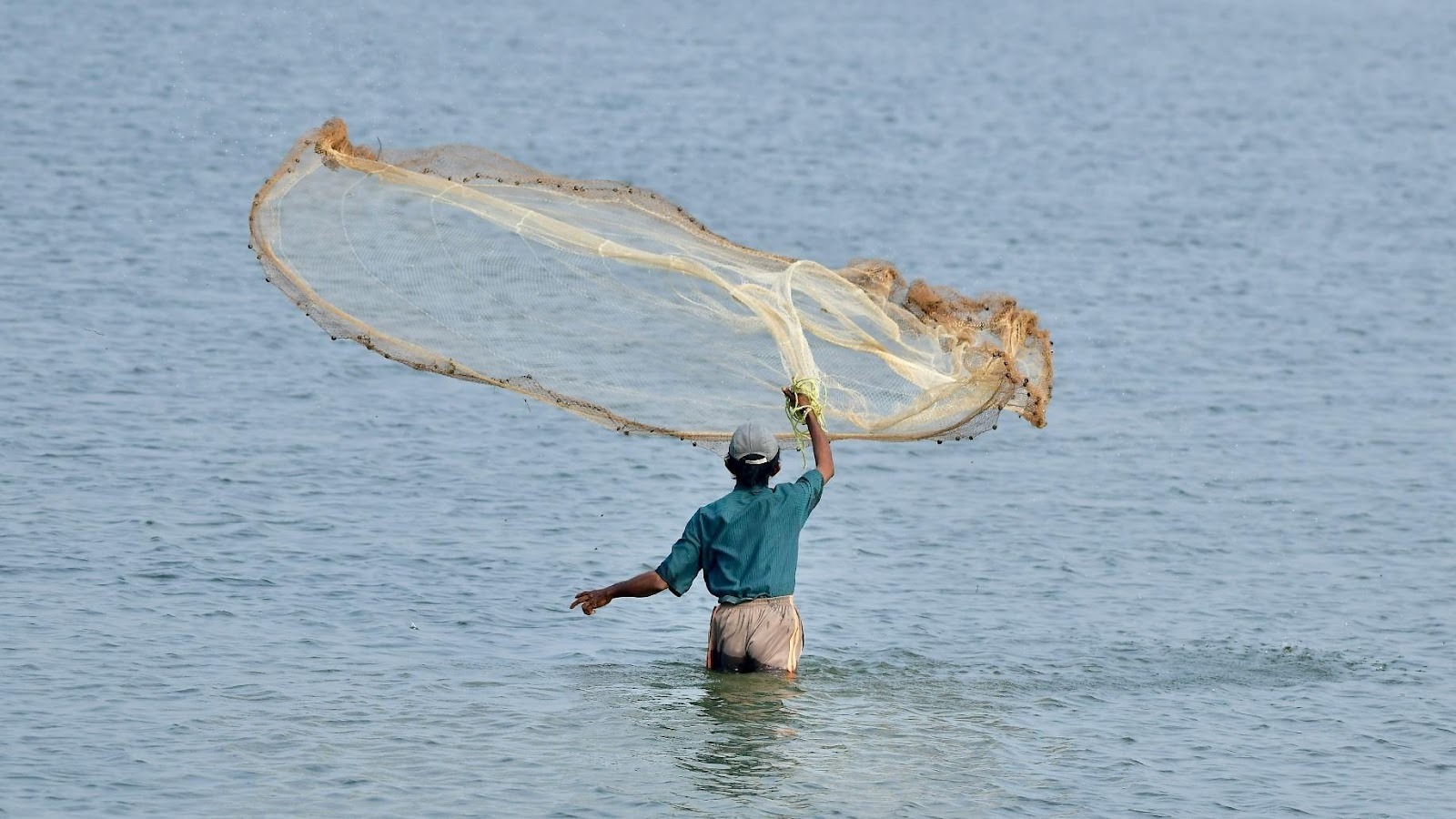
Feature image: For coastal fishing communities, nature is not an object of observation but a site of daily labour, livelihood, and survival, shaped by conservation and development decisions. (Image source: Rohan Solankurkar/Unsplash)

In a recent article titled ‘Nature for nature’s sake: Arguing for non-humans in the Anthropocene’ the author, Dr. Harish Prakash, makes a thoughtful case for expanding our ethical concern beyond humans to the vast range of non-human species with whom we share evolutionary history. The piece argues that we must value nature not only for its instrumental or relational importance, but for its intrinsic worth, independent of human benefit. It calls for cultivating awe, curiosity, and direct engagement with biodiversity, through observation, citizen science, and an ecocentric worldview that places humans on equal footing with all other species.

It is a compelling argument, and one that is essential in a time of accelerating extinctions, climate instability, and large-scale ecological loss. Arguments of this kind draw from long-standing debates within environmental philosophy and ethics, particularly those between anthropocentric and biocentric or ecocentric approaches that emerged strongly in the 1970s. These traditions were crucial in challenging extractive worldviews and foregrounding the moral standing of non-human life. At the same time, they have been widely critiqued for the ethical and political consequences that follow when universal moral claims are applied across deeply unequal social landscapes. Yet the ethical expansion the article calls for raises an unresolved question: whose humanity is being invoked, and whose relationship to nature is being assumed?

While reading the article, I found myself feeling uneasy, not because I disagreed with the call to value non-human life, but because the framing rests on a familiar but problematic assumption: that ‘humans’ form a single, homogeneous entity equally responsible for environmental destruction and equitably positioned to respond.

In reality, the category of ‘human’ is not flat. Nor is it neutral.

The Anthropocene is unevenly produced and unevenly experienced.

To speak of ‘humanity’ as the driver of environmental decline risks blurring the profound inequalities that structure who extracts, who benefits, who pollutes, and who suffers. As the historian Ramachandra Guha pointed out in his early critique of Deep Ecology, such universalising ethical claims often travel poorly in postcolonial contexts, where conservation has historically intersected with questions of land, livelihood and displacement.

This is not an abstract point. Consider India alone. The same Delhi air pollution index that registers as a health concern for the middle class becomes a crisis of breath for construction workers who inhale the dust 12 hours a day. The same rising temperatures that prompt an urban office worker to adjust their AC force migrant workers on agricultural fields to labour through heatwaves that are deadly. The same urban water scarcity projected for 2050 is already the lived reality in informal settlements, where tankers arrive unpredictably and women spend hours queuing for basic supply. 

Environmental degradation does not land on everyone equally. It lands where caste, class, landlessness, and precarious labour already exist.

Environmental degradation is unevenly experienced, with marginalised communities often living alongside polluted water bodies and ecological risk they did not create. (Image source: vinay manda/Unsplash)

This is why a universal ‘we’ in ecological writing can be misleading. It unintentionally reproduces a middle class, urban, protectionist standpoint, one in which humans stand outside nature and must learn to reconnect with it, often through leisure, observation, or personal curiosity. This framing echoes a broader conservation discourse in which nature is imagined as something “out there” to be preserved, rather than as a lived and worked-in landscape. Citizen science platforms such as eBird and iNaturalist are wonderful, but they reflect a particular subject who has time, access, mobility, and distance from nature as labour. For many rural and working class communities, being visible to conservation often means surveillance rather than participation.

Many communities in India do not connect to nature by going outdoors to observe biodiversity, they live in biodiversity. For Adivasi communities, forest dwellers, pastoralists, fishing communities, and Dalit agricultural labourers, nature is not an aesthetic object of awe but a site of livelihood, heritage, and survival. When the article uses the example of gathering wild berries to illustrate “relational value”, it overlooks that for many, foraging is not a recreational act; it is culture, subsistence, and autonomy. Such practices are often criminalised or restricted under conservation regimes, even though these communities have long histories of coexisting with and sustaining local ecologies.

Similarly, the call to appreciate the evolutionary kinship between humans and other species is powerful, but the erasure of unequal human suffering sits uneasily beside it. In the same decades that we mourn the decline of sparrows or ghost crabs, Dalit sanitation workers are dying in manholes, Adivasi families are displaced for mining projects, and coastal fishing communities are witnessing the ocean they depend on being swallowed by port expansions and industrial fisheries. These developments are not incidental to environmental decline; they are central to how ecological harm is produced and distributed.

These losses are ecological and social.

To speak of non-humans without acknowledging the socio-political structures harming marginalised humans risks narrowing environmental ethics to a form of conservation elitism, one where species matter, but people on the peripheries remain invisible. Yet this critique is not a rejection of ecocentric thinking. Rather, it echoes a long-standing argument within environmental ethics that moral concern for non-human life must be grounded in social context. Philosophers such as Bryan Norton have described this position as “weak anthropocentrism”, an approach that recognises the intrinsic value of non-human life while insisting that conservation ethics remain attentive to human values, cultural relationships with ecosystems, and especially the needs of the most vulnerable. This integrated approach also informed the Millennium Ecosystem Assessment published in 2005, which framed ecosystem health and human well-being as inseparable rather than competing goals.

Yet the original article by Dr. Harish Prakash is not wrong. It is incomplete.

Intrinsic value is essential. Awe is essential. Understanding evolutionary interconnectedness is essential. But none of these can afford to exist in an abstract conceptual world where all humans stand equally alongside all other species. Environmental responsibility is stratified. Ecological harm is stratified. And therefore, ecological care must also be stratified.

The challenge before us, then, is not to choose between non-human protection and human justice, but to insist that they are indivisible. Fighting to conserve the ghost crabs must not mean overlooking the fisher families whose huts are razed for “beach cleaning”. Saving a wetland must not mean evicting the very communities who have protected and cultivated it for generations. 

Conservation that ignores inequality risks reproducing the very hierarchies it seeks to dismantle. As scholars of environmental justice remind us: ecology without society is incomplete, and conservation without justice becomes elitist.

If we are to argue for non-humans in the Anthropocene, we must also argue for the humans pushed to its margins. Paying attention to species is critical, but so is paying attention to who is allowed to live near them, who is removed to protect them, and who is blamed for their decline.

The article invites us to widen our moral circle. My hope is to widen it further: not only to include non-human life, but also to recognise the unequal human worlds in which that life is embedded. Only then can we truly speak of care, responsibility, and the future we hope to preserve.

Further Reading

Guha, R. 1989. Radical American environmentalism and wilderness preservation: A third world critique. Environmental Ethics 11(1): 71–83.

Norton, B. G. 1989. The cultural approach to conservation biology. In: Conservation for the Twenty-First Century. (eds. Western, D. and M. Pearl). Oxford University Press.

Shanker, K. and Oommen, M. A. 2021. The authoritarian biologist reloaded and deep ecology redux: conservation imperialism and the battle over knowledge, money and space. In: A Functioning Anarchy. (eds. Sundar, N. and S. Raghavan). Penguin Random House India.

Lessons on community-led marine management from Fiji

Feature image: Women cleaning their fish catch in Fiji (Photo credit: Sangeeta Mangubhai)

Healthy seas and oceans are fundamental to our survival—providing food and livelihoods, absorbing carbon, and regulating the water cycle. Working to protect them is therefore essential, as is understanding the impacts of different resource management initiatives on these marine ecosystems and the local people who rely on them. 

Locally Managed Marine Areas (LMMAs) are Indigenous-led marine management initiatives that have spread rapidly over the past two decades and are now present in almost 1,000 communities across 15 countries. Local communities create plans and set fishing rules to support their fishing needs, alongside recovery of the ecosystem. 

In Fiji, support and guidance for these areas is coordinated under the Fiji Locally Managed Marine Areas (FLMMA) network. Participation in the network is voluntary and decided by the community. This raises the question—why do some villages join the network while others don’t? And what are the effects of participation on communities and ecosystems?

This is what our research set out to uncover. We wanted to understand what motivates villages to engage and what impacts participating in the network has on them. This understanding is important for designing future initiatives that are both positive for the community and the environment, and likely to have widespread adoption and wide-ranging impact. And so, we spoke with people in 146 coastal villages in Fiji who were or weren’t engaged in the FLMMA network. 

Common denominator

Villages that participated in the network shared certain characteristics. For example, nearly three-quarters of engaged villages had a neighbouring village that had also engaged, highlighting that word of mouth and learning from each other may be an important factor in helping initiatives to spread. Villages who had support from organisations such as NGOs or had a resource management committee at the district level (yaubula) were also more likely to engage. These structures may help sustain initiatives through facilitating local stewardship and formalising management. 

Interestingly, villages that engaged with the FLMMA network were also further away from tourist resorts and were more likely to be associated with Indigenous groups of greater influence. This could reflect the way in which NGOs select villages to partner with, alongside other livelihood opportunities available to villages in tourist hotspots.

Some of the characteristics of villages that engage with the Fiji Locally Managed Marine Area Network, which provides support to those adopting the LMMA initiative (Image credit: Jagadish et al., 2024)

Local benefits

We found that villages who engaged with the FLMMA network participated in making decisions about fishing rules more frequently and took greater ownership over management of resources. For example, they were more likely to have fishing rules in place and enforce penalties for breaking them. FLMMA villages also reported increased financial support, for instance, through investment in infrastructure, and an increase in perceived knowledge about marine resources, particularly among women and youth. 

However, we found no effect of participation on perceived ecological health of the reefs, on fish catch, food security, or on village or household wealth. So, while resource governance is improving, these aren’t necessarily being translated into desired long-term outcomes. 

Interestingly, participation of women has multiple benefits yet is generally low. Villages where women participated in decision-making about fishing areas reported catching more fish, greater satisfaction with food from the sea, and greater household wealth compared to villages with lower numbers of participating women. Although women often felt excluded from management committees, the value of their input was recognised within the community. 

Conservation initiatives must respond to the needs of communities, while collaboratively protecting and restoring natural resources. The FLMMA network shows us that communities are willing to engage when the right support is in place. However, there is still room for improvement—programmes can work better if they are more inclusive, and more robust data are needed to effectively assess long-term effects on people and nature. 

Further Reading:

Ferguson Irlanda, C. E., S. Mangubhai, E. Waqa,  H. Govan, A. Jagadish, S. E. Lester, M. Mills et al. 2025. Insights on the roles of women in effective and procedurally just environmental governance from coastal fisheries management in Fiji. Conservation Biology: e70121. https://doi.org/10.1111/cobi.70121.  

Jagadish, A., A. Freni-Sterrantino, Y. He, T. O’ Garra, L. Gecchele, S. Mangubhai, H. Govan et al. 2024. Scaling Indigenous-led natural resource management. Global Environmental Change 84: 102799. https://doi.org/10.1016/j.gloenvcha.2024.102799

O’Garra, T., S. Mangubhai, A. Jagadish, M. Tabunakawai-Vakalalabure, A. Tawake, H. Govan and M. Mills. 2023. National-level evaluation of a community-based marine management initiative. Nature Sustainability 6: 908–918. https://doi.org/10.1038/s41893-023-01123-7

And the Award Goes to …

Welcome to all creatures,
All you animals, great and small
Gary, please move down the back
Giraffes are rather tall

Mikey, Moxie, all you mice
Could you move up the front
Lions, away from the zebras!
This is not a hunt!

In fact we’re here to celebrate
The hard work done this year
Not a single one of you 
Should be sitting there in fear

So, once again, welcome 
to this special event
It’s so good to see you all
Not sure where the year went

As we’re all aware
around our great animal nation
We’ve been busy holding
A conservation conversation

And tonight, we’ve arrived
At our great culmination
With our prestigious award
In creature conservation

‘Conservationist of the Year’ 
For 2025 is up for grabs 
Who has won this impressive prize
The worms, the crows, the crabs?

Il settore del gioco online in Italia ha conosciuto una crescita costante, spingendo molti utenti a cercare piattaforme affidabili e ben strutturate. Con un’offerta sempre più ampia, diventa fondamentale sapere come orientarsi e quali criteri considerare per una scelta consapevole. In questo scenario, informarsi sui casino online italiani migliori aiuta a individuare ambienti sicuri, trasparenti e pensati per offrire un’esperienza di gioco equilibrata.


Uno degli aspetti principali da valutare è l’affidabilità del sito. Licenze valide, sistemi di sicurezza avanzati e una gestione chiara dei dati personali sono elementi indispensabili per giocare con tranquillità. Le piattaforme più apprezzate comunicano in modo diretto, rendendo facilmente accessibili termini, condizioni e informazioni sui servizi offerti.


Anche la qualità dell’offerta di gioco incide in modo significativo sulla scelta. I casinò online migliori propongono un catalogo vario che include slot moderne, giochi da tavolo classici e sezioni live curate. Collaborare con provider riconosciuti garantisce standard tecnici elevati, risultati affidabili e un’esperienza complessiva più fluida per l’utente.


I servizi aggiuntivi rappresentano un ulteriore fattore distintivo. Metodi di pagamento sicuri, tempi di prelievo chiari e un’assistenza clienti facilmente raggiungibile sono segnali di un progetto solido e orientato al lungo periodo. Un supporto efficiente contribuisce a rafforzare la fiducia e a migliorare l’esperienza complessiva.


Infine, il gioco responsabile assume un ruolo sempre più centrale. Le piattaforme di qualità mettono a disposizione strumenti per il controllo del budget e del tempo di gioco, promuovendo un approccio consapevole. Scegliere con attenzione e informarsi adeguatamente permette di vivere il gioco online come una forma di intrattenimento sicura e controllata.

Well, first let’s name third place
It goes to—Bertie Bee
For most prolific pollinator
Our judges all agree

That without you, Bertie
Many plants would die
You’re always busy pollinating 
You’re really a great guy!

The second place goes to
The fabulous Freddy Frog
A lifelong eco warrior
He works just like a dog

As a tiny tadpole
He munched on pond algae
Keeping oxygen levels right
And waterways clean, you see

Now, as an older fella, he
Controls insect populations
He also croaks to scientists
About water contaminations

Just before we announce 
Our winner for ‘25
Let’s call out some other
Commendations helping us thrive

Ellie Elephant for helping out
Smaller animals in a drought
Using your tusks to dig for water
You helped Belle and her daughter

Belle and Bindi are two boars
Who disperse seeds on grassy floors
Now, if only they could also try
To tread more lightly as they go by

Fin the Fish poops in the sea
helping lower acidity
Speaking of poop, it’s rather super
Our winner is a pooper trooper

So without any more ado
Let’s name our winner now for you
Our champion is a kind of bug
In fact, you all know him as Doug

Yes, Doug, The Dung Beetle
Is this year’s winner
In conservation, 
he’s no beginner

He cleans up after all of you
He shuffles by rolling up poo
Once it’s in a nice round ball
He even buries it and all

No matter, how stinky you are
He cleans it up. He’s such a star!
So, come on down, you’ve earned this. True!
Uh, no need to roll that ball with you!

This article is from issue

CC Kids 19

2025 Dec

Gibbons: The Singing, Swinging Apes

The first rays of the sun feel warm on my fur. The early morning light starts to filter through the leaves at the tops of the trees in the forest canopy. The night before, I had fallen asleep with my legs curled up to my chest and my arms crossed over my knees. My bed was the fork between two big branches in a very tall tree. I reach my long arms above my head to stretch and grasp the branch extending above me. Where is my family? Every day, my mother, father, younger brother, and I travel through the forest together. When the sun starts to set, we find our own beds for the night.

Ooooooooooooo-aahk…wak….wak….wak….wak…wick-u…wick-u…wick-u…

That’s my dad! He’s letting us know where he is.

Ooooooooooooooo…wup…..wup…..wup……wy..wy..wy..wy.”

There’s mom! Mom and dad like to sing together in the morning. When a mom and dad gibbon sing together, it’s called a duet. I try my best to imitate my mom’s voice.

Oooooooooooooooo…wup…wup…

She taught me how to sing. When we sing together, all the other gibbons in the forest know where our family is. I hear the sound of leaves rustling and branches creaking. I catch a glimpse of shiny black fur overhead as my dad makes his way over to me.

On the branch below, my mom sits with my brother clinging to her belly with his dark eyes looking up at me. His fur is a creamy tan colour and blends in perfectly with my mom’s. Their colours match, so predators can’t see him while my mom carries him around. In about a year, his fur will turn black like my dad’s and mine. Once I grow up, my fur will turn back to a creamy tan colour to match my mom and the other adult girls. My brother’s fur will stay black.

Wick-u…wick-u…wick-u…” My brother is just learning how to sing, but he likes to practice!

My brother is just learning how to sing, but he likes to practice! The song of another gibbon family echoes ours as they announce their territory and greet the day. Singing takes a lot of energy, and my empty stomach tells me it’s time for breakfast. My hand grips the branch above me a little tighter. I stretch my curled up legs and push off the branch to start my swing. I move through the trees the same way you climb across monkey bars, even though I am not really a monkey. I’m part of the ape family. My ape cousins, the orangutans, live in the trees with me here in Southeast Asia.

With my right hand, I grab one branch while my left reaches for the next one. Apes like me do not have tails to help balance on branches, but my strong arms help me dangle from the trees. I stretch my long arms as far as I can to swing from branch to branch and tree to tree. The way we move is called brachiation.

I spend most of my life up in the trees, so I have learned to move very fast and travel very far without ever having to touch the ground.

My favourite foods

With one final swing, I fly through the air grabbing the branch of a new tree where I will find my breakfast. I am lucky to live in a place where so many yummy fruits grow on trees, but these figs are one of my favourites. I slowly swing through the branches, looking carefully at the colours of the fruits until I find a bunch of sweet, ripe, purplish black figs. Dangling from a branch with one arm, I use my other hand to pick the sweet figs and start eating.

My brother also picks a ripe fig and sits balanced on a branch to eat his food. My dad sits down next to him and starts using his long fingers to inspect my brother’s fur while he eats. We call this grooming. My dad is removing bugs and parasites from my brother’s fur. Grooming is a way that we take care of each other.

Now that I’m full from snacking on a variety of fruits in nearby trees, I’m ready to play! I tag my brother with my hand and then nudge him with my foot, daring him to chase me. I take off, flying and swinging through the trees. I can hear him crashing through the leaves behind me. He is still young, but has already learned to brachiate very fast!

Daily log

My parents join in as they chase us through the trees. My mom catches up to my brother and grabs his foot as he swings by. She pulls him down to a bundle of branches where they wrestle. My whole family likes to play! We spend most of our days in the trees in our territory. We eat, we play, we groom each other, and we rest.

We also have to watch out for danger and predators. Being high up in the trees keeps us safe from big cats like tigers that stay closer to the ground. But eagles and hawks may be prowling from the sky looking for smaller gibbons like my brother, so we stay under the top layer of the forest canopy. The leaves make it hard for birds of prey to see us.

As we travel, we see our primate relatives in the trees. Some, like the slow loris, are nocturnal, which means they are awake at night. Our orangutan cousins are active during the day, like us. We sometimes fight with our relatives over the best food since we like a lot of the same things. But most of the time, we stay away from each other and continue on our way, swinging through the trees.

We travel all around our territory every day and, as we travel, we have an important job to do in the forest. Just like every other animal, sometimes we have to poop. The seeds from all the fruits we eat drop to the forest floor in our poop and find a place to start growing a brand new tree. Since we are always on the move, we are also spreading these seeds all around the forest so new trees can continue growing.

Tree troubles

One day, we were travelling towards the sun rising in the sky. The branches opened up to a place where there were no more tall trees. On this end of our territory we had seen another kind of primate, but they did not live in the trees like us. They stayed on the ground and only had fur on their heads. When they first arrived, they cut down some of our favourite fruit trees and started growing new ones called oil palm trees.

These oil palm trees grow fruit, but not the kind that we like. They are also shorter than the trees where we feel safe, and they are planted too far apart for us to swing from one to another. We could walk on the ground to get to the next tree, but there are a lot more predators down there. And we’re not as fast at walking as we are at swinging. This new kind of planted oil palm forest makes it hard to find fruits to eat or safe places to rest. The first time we got to this part of our territory, we realised we would have to go in a different direction to find food and safety.

Today, we are chasing each other through our territory, but this time we are moving in the direction of the setting sun. My father is winning the race, but I see him starting to slow down. The branches once again open up and the primates without fur are here, too. I think they are called ‘humans’. In this part of our territory, the humans have also planted new oil palm trees. But here, by the setting sun, these humans left a lot of our favourite fruit trees growing nearby. We can still find food and move safely through the branches without having to walk on the ground. I feel safe here.

As the sun continues to set, I look for the branch that will be my bed for the night. I settle in and look around at the oil palm trees nearby. There are two humans moving by the trees. They are hiding and chasing each other around the trees and playing. I start to fall asleep as I watch them play and realise maybe we are not so different from one another.

The singing, swinging apes in this story are northern white-cheeked gibbon (Hylobates leucogenys), a species that lives in parts of Southeast Asia.

This article is from issue

CC Kids 19

2025 Dec

Chronicles of the Cotton Stainer

By D. Cingulatus
Insect narrator, Misunderstood icon

6:45 AM: Rise and stain

The sun is up and the rays are warm on my wings. This means it’s time to stretch my six little legs and scurry up the cotton plant. You might be wondering what I do for breakfast. Well, I dig my needle-mouth into the soft cotton seed and succkkk. Yum!

Before you question my dining choices, no I do NOT eat the cotton. That all-white fluffy ball? Not my cup of tea. It’s the seeds I’m interested in. Fibrous, nutty, and full of plant power that will keep me energised for the adventures that await my day.

But they call me the ‘cotton stainer’. Dysdercus cingulatus to be precise. Dramatic, right? Sounds like I’ve spoiled someone’s fresh laundry.

Ugh, how do I explain this? What really happens is quite different from what you’ve been told about me. Here’s what I actually do: after I sip all the goodness from the cotton seed, I leave some of my—how shall I put it—bug business behind. If you don’t clean the cotton properly during processing, that gooey yellow liquid will stain the cotton. I don’t do it on purpose. This is survival.

9:01 AM: Bright red family

No, I’m not alone out here. 

There are also the nymphs, our little ones that scurry all over leaves in bright red packs. Big energy balls, but wingless as of now. Soon they’ll grow up, sprout their wings and it’ll finally be their turn to get their pilot licence.

We always stick together. Do you think it’s easy being at the bottom of the food chain? Birds, ants, wasps, you name it—they all want a taste of the stainer. Imagine being preyed on and still getting blamed for staining your food. You’d want to pick a different struggle. And yet, we’re here. Playing our own little role in maintaining the food chain.

12:30 PM: Pest control

Pest control? More like a fancy term for mass assasination. Giant, poison rains sprayed from cans and planes. You might think they’re protection for cotton plants. But here’s the deal: when you blast the field with chemicals, you don’t just get us. The leaves curl up into scared fists, the soil grows sour and the wildflowers vanish. Even the farmers suffer from the toxins. Did you know that cotton occupies third place for the most pesticide use in India?

They think “No bugs, no stains!” But ever wondered why that cotton looks a little extra clean? So unnaturally perfect? Maybe the stains we leave behind are signs. They tell you stories of where your cotton really comes from. That they were grown with care, not chemically treated.

Want better protection? Plant some flowers. Mix the crops. Let the good bugs do their job! We understand nature’s balance better than you think.

5:00 PM: A history lesson

You think I’m modern trouble? 

Haha! Our ancestors have been around since before cotton became a crop. We’ve been around for so long that even scientists relied on our poop stains to study insect coloration and natural dyes! Not so useless are we?

Yes, we snack and we stain. But we’re also small traces of what is forgotten, in a world full of chemicals and pesticides. 

This article is from issue

CC Kids 19

2025 Dec

Lalian and The Memory Keeper

In the mist-wrapped hills of Mizoram, in northeastern India, where clouds rolled down into forests like tired travellers, people spoke in hushed voices of a strange creature. A spirit with the face of a child and eyes that contained oceans. They called it the Forest Spirit Munla.

Most had never seen him, and those who had had only caught a glimpse of those eyes. They said the eyes were shiny black, circled with a white outline—as if drawn by a child with chalk. Munla’s eyes had an expression of eternal astonishment, as if seeing the world for the first time, or of having seen far more and holding it all inside.

The spirit walked around at night, in such hushed steps that no one would know even if it was right behind them. They said it didn’t jump—it glided between treetops, as if floating. Those who saw it either fell to the ground and mumbled a soft prayer, or ran as fast as they possibly could. No one dared to say Munla’s name aloud, except for one.

Her name was Lalian, a nine-year-old Mizo girl with unmissable eyes, shaped like perfect almonds and hidden behind thick glasses. She was always covered in dirt from climbing anything even remotely climbable. Her dark hair, tangled like the vines on trees, often carried bits of the forest. With bubbling excitement, she listened closely to every story the villagers told about Munla. Then she would run home and tell her grandmother everything, who smiled as she pumped air into the earthen chula (stove).

“I will see it one day, Amma. I will ask him where all the animals went,” Lalian would say every day. It was no secret that the animals who once roamed the periphery of the village had slowly started to disappear. Lalian had heard over the radio about people, called poachers, taking them away. The only logical solution according to her was to speak to the forest spirit directly.

Lalian would try to stay awake each night, waiting for Munla, so she could ask for the whereabouts of the poachers and talk to them. They would obviously release the animals. It must be a misunderstanding that they had taken them, she thought. Slowly, her eyes would grow heavy with sleep, and she would wonder when the forest spirit would come to meet her.

And finally, it happened—on a full moon night.

Nocturnal spirit

Lalian stood on her grandmother’s porch, looking into the forest as she often did. The night was still. No frogs. No crickets. Nothing. Just silence.

That’s when she saw it. The Forest Spirit.

Its slender body moved slowly from one treetop to another. It looked like it was flying, its fur brushing the leaves like feathers. Lalian didn’t think twice—she quietly followed.

She walked through the moss-covered trees, going deeper and deeper into the forest. The moonlight faded as the canopy thickened.

She slipped once. Maybe twice. She couldn’t remember. Her eyes were fixed on the forest spirit gliding above. At times, as the forest grew denser around her, she thought she had lost Munla—but then, soundlessly, it peered out from behind leaves. As if guiding her, as if saying, “You aren’t alone.”

The secret grove

After walking for what felt like an eternity, her rush of excitement began to fade. Tired, confused, and a little afraid, she crossed a creaking natural bridge fashioned from the living roots of trees and entered a clearing. A grove.

She was sure the spirit was gone. “Hello? Anyone here?” she called out. As if on cue, there was a movement in the shadows. The spirit slowly lowered itself from a tree in front of her. Lalian stared in amazement.

Munla stepped into the moonlight. Its body was covered in deep bluish-brown fur. It was on all fours, a long tail swishing slowly behind it. Then she saw its face. A round, haggard face covered in ashy fur. And the eyes. The same eyes from the stories. They looked sad, almost filled to the brim with something. What were they filled with? she wondered.

“Memories,” came the answer.

Lalian gasped. The spirit hadn’t spoken—but she had heard it. How? she thought. “You and I are connected, Lalian. Through this,” it said, gently touching the soil and raising its hand toward the trees. “And so are they.”

Suddenly, as if a fog had lifted, Lalian saw what she had only dreamed of.

In the clearing behind the forest spirit lay a red panda, perched on a root, its eyes bright with thought. A hornbill, its beak glowing golden. A pangolin curled up and humming softly. Even a clouded leopard, shy but watching closely, its eyes reflecting stars. They weren’t afraid. They were waiting. Lalian pinched herself. But this wasn’t a dream.

“What is this place?” she asked. “This is the Grove of the Forgotten. Where the endangered dream, and the hunted find peace. Where stars listen,” said Munla. His lips didn’t move but his eyes spoke somehow. Lalian looked at all the faces of the creatures—the ones who were lost, the ones they were still losing. And she sobbed.

It felt like a sudden sadness had engulfed her—a sadness not of this life. The sadness of her ancestors, of these creatures. As if the forest itself was calling to her. “Why me?” she whispered. What could she do?

She looked at her small hands and clenched her tiny fists. She thought about fighting off poachers. She would protect these creatures. She had to. But the spirit smiled gently. “You don’t have to fight for us, Lalian,” its eyes said.

She looked deep into them. “Why me?” she asked again.

And the eyes answered: “You are the first human to witness this. Because you followed, not to take, but to know. You carry the seed of our story. You carry these memories, so we are never forgotten.”

As if on cue, the animals began to leave. One by one, they walked deeper into the forest. The spirit stepped into the shadows. They vanished, like mist at dawn. The last to leave was the pangolin. It paused by Lalian’s feet, tapped them gently. And disappeared.

The return

Lalian walked out of the forest as the first rays of sun lit the hills. No one believed her, of course.

Not the schoolmaster.
Not the forest officer.
Not even her mother.

But her grandmother smiled. “Ah. So you met him,” she said.

“You know him? He’s a forest spirit! Everyone was right!” Lalian couldn’t stop mumbling.

Still smiling, her grandmother opened an old, illustrated book The Mammals of the Northeast. She flipped the pages slowly. Then stopped. As if knowing exactly which page to stop at, a habit developed over years.

A pair of white outlined eyes stared back at Lalian from the page.

The page read, “Phayre’s leaf monkey: Known for its expressive, wide-rimmed eyes and elusive nature, this endangered monkey is most active at night and glides silently through the upper canopy.”

She read it again. And again. And again. And then she understood. Why her grandmother always smiled at the name Munla. She always knew.

It wasn’t a spirit after all. Just an endangered creature. Carrying the memories and sorrows of its forest friends in its eyes. Lalian never tried to find the grove again. Instead, she drew it. Painted it. Wrote about it.

In school. In books. In competitions.

She wrote about animals with starlight in their eyes and a forest that remembered. And slowly, people began to listen.

A wetland was protected.
A poacher’s trap was removed.
A girl in another village started a rescue centre for hornbills.

Lalian’s stories spread like seeds in the wind.

Years later

When Lalian was grown and her name was known, a small child once asked her, “Did the Phayre’s leaf monkey give you magic?” She smiled.

“No,” she replied. “The monkey didn’t give me magic. It gave me something much more important—a memory to hold onto.”

And far away, in the forest where trees whispered together in fog, a pale figure leapt between the branches—its eyes shining like two orbs containing oceans.

This article is from issue

CC Kids 19

2025 Dec

Eyes in the Cornfield

This story was the winning entry to our 2025 Wordless Story Contest. Set in a village near Shruti’s hometown Sangamner in Maharashtra, India, it reflects the reality of farmers living in close proximity to wildlife. It offers a look at their shared struggle for survival when pushed to the very edge.

This article is from issue

CC Kids 19

2025 Dec

The guardian of the lagoon

On a typical Monday in May, the Vaporetto of the Imagination is charting the Venice lagoon. The morning air is cool and peaceful and the surrounding environment appears pristine: it is difficult to encounter anyone at this hour. The Vaporetto, however, is on a mission. Equipped with state-of-the art sensors, underwater microphones, probes, and cameras, the large vessel monitors and records the richness of the Venetian landscape, today threatened by pollution and changes in water, air, and soil conditions.

Located in northeastern Italy, the lagoon is an enclosed bay of the Adriatic Sea. This fragile ecosystem, in which the city of Venice is situated, is constantly shaped and influenced by natural and artificial elements. Water and land meet here, creating a rich habitat spanning 550 square kilometres—that’s larger than some countries, including Andorra, Palau, Barbados, and the Maldives. But by its very nature, the lagoon is at risk because of two dangers that are related to one another: subsidence and eustatism. What terrifying names, what complicated words!

Subsidence is the gradual sinking of an area of land or the seabed. Eustatism, on the other hand, relates to worldwide changes in sea level (which is currently increasing due to the melting of glaciers, for example). These two ‘cousins’ interact with one another at an incredibly slow pace. Thankfully so! It takes geological eras—a very long time—for them to achieve their aim and erase the lagoon from the map.

However, human activity—with its industries, buildings, and heavy carbon footprint—has accelerated the effects of subsidence and eustatism, making their mission easier. It is humanity that has caused the pollution of these waters: the fish and birds of this place can no longer find food in abundance. The plant life too is under great strain due to the discharge from boats and is slowly fading.

And all of this is happening at a particularly difficult time: when climate change, which is resulting in higher temperatures and warmer seas, is making everything even more complicated. What a mess! What can be done? How can we return to a healthier natural environment? How can we restore biodiversity and avoid further degradation of our planet?

A mysterious captain

The Vaporetto of the Imagination was not originally born to be the guardian of the Venice lagoon. At the time of its construction, it wandered through the waterways of Venice, ferrying busy passengers to and from their occupations. Then one day, it retired: too old to continue in public service, yet strong enough to take on a new profession. The city council declared it “fit to monitor the surrounding environment”, and from that day forward it has faced the horizon, brimming with instruments.

At its helm is a mysterious captain—always wearing a sailor’s cap, she speaks very little and she feasts with the lagoon’s wild plants. Every day, she sails the Vaporetto between faraway islands, looking for clues about what is changing in the lagoon. Those who have seen her piloting the Vaporetto say they caught glimpses of shimmering reflections in her hair, like fish scales. Who knows? Perhaps it is true! The captain builds, calibrates, and repairs every on-board device when needed. Her mission is clear: to understand where the lagoon suffers the most and to alert the scientists and engineers who can help preserve it.

As the Vaporetto traverses vast stretches of water, it records the sounds made by animals (and plants!). The analysis of the frequency and intensity of these sounds helps determine whether a particular species is disappearing or in need of support. The underwater cameras follow marine life in the shallows and observe the speed of interactions between different fish species, along with their habits and rhythms. The sensors constantly monitor the temperature of both water and air, as well as the presence of pollutants and materials that may contaminate this delicate habitat. The captain never loses track of a single instrument and compiles a detailed report each day, transmitting it to headquarters—even from afar.

A never-ending mission

The conservation and restoration of the lagoon’s habitat begins with its protection. The instruments carried by the Vaporetto of the Imagination across the waters, even to the most remote islands, can detect the earliest warning signs of danger and suggest where and how urgent intervention is needed. This is how scientists, for example, discovered the complete disappearance of certain native species and the arrival of “alien plants” that tend to become dominant.

Monitoring by the Vaporetto has provided scientists with two crucial insights: native species are highly sensitive to the salt concentration in the water, and the rising external temperatures—caused by climate change—make survival even harder for them.

Each day, researchers receive the data the captain processes from the Vaporetto. Punctually, at 8 PM every evening, a report filled with figures, notes, and recommendations arrives in their hands.

Then one day—no different from the rest, yet somehow special—they ask her: where does the name Vaporetto of the Imagination come from? The captain smiles and replies, “Because the lagoon we dream of—clean, bright, and full of singing birds and swimming fish—is not on any map. But if we imagine it, as we must, we can make it real.”

And so the Vaporetto puffs along, brave and proud, toward the furthest island, carrying hope and imagination on every wave.

Further Reading

Bertolini, C. and J. da Mosto. 2021. Restoring for the climate: a review of coastal wetland restoration research in the last 30 years. Restoration Ecology 29(7): e13438. https://doi.org/10.1111/rec.13438.  

Proença, V., L. J. Martin, H. M. Pereira, M. Fernandez, L. McRae, J. Belnap, M. Böhm et al. 2017. Global biodiversity monitoring: from data sources to essential biodiversity variables. Biological Conservation 213: 256–263. https://doi.org/10.1016/j.biocon.2016.07.014

The Vital Project. https://www.v-i-t-a-l.org/en/about. Accessed on June 19, 2025.

This article is from issue

CC Kids 19

2025 Dec

Prehistoric water world

This picture was inspired by an episode of ‘Life on Our Planet ’ , narrated by Morgan Freeman. It ’s about a super old ocean , way before dinosaurs! There ’s a cute pill millipede-looking thing called a Trilobite crawling on the seafloor with lots of little legs. A big scary Anomalocaris with huge eyes and grabby arms is swimming above it , maybe looking for lunch! The Arandaspis looks like a fish wearing armour , and in the front and way in the back there are giant squid called a Cameroceras—it ’s super long and twisty like a cone. Some Ammonoids with curly shells and tentacles are floating around like pretty balloons. And there’s a huge Dunkleosteus shark with sharp jaws ready to chomp! It ’s like an ancient underwater zoo! How sad that these creatures are extinct. Now we get to steward our environment wisely.

This article is from issue

CC Kids 19

2025 Dec

Where art meets nature: A daily drawing challenge

Feature image: For the prompt ‘Layers’ by Anna Shuttlewood

Do you love drawing nature? So do these amazing artists, who drew every single day for a whole month!

This year, we once again hosted CC Inktober, our own nature-themed version of Inktober—a month-long drawing challenge originally created by artist Jake Parker to help people practise drawing everyday, experiment creatively and share their work online. For #CCInktober2025, we put together a list of 31 drawing prompts based on the wonders of the natural world. Artists from across our community took on the challenge, and for every day in October, they drew an artwork based on our prompts!

The idea is simple: make a little art every day, stretch your imagination, and discover new things about nature as you observe and create. We’re incredibly grateful to everyone who took part—your creativity made this challenge truly special!

Mysterious by Siva Sakthi A. and Pollinator by Toshi Singh
Lines by Vaibhav Salgaonkar and Rainforest by Claudia Libbi
Legs by Srinidhi Himani
Hatch by Shruti Kabo, Extinct by Priyanshi Khatri and Hatch by Viola Ruzzier

You don’t have to wait until October to practise daily drawing! By making a drawing calendar using our prompt list, you can start any month of the year:

  1. Print and cut out the calendar below.
  2. On the dotted line, write the name of the month you want to use for your daily drawing practice.
  3. Check which day of the week that month begins on, and starting in the first row, write the dates along with the matching prompts from the list as shown in the example below. Fill in these details for each day of the month.
  4. Pin up your Daily Drawing Calendar somewhere you’ll see it every day, and you’re ready to begin!
  5. Using a blank notebook or sheets of paper, and your favourite drawing materials, make a drawing everyday inspired by the day’s prompt.

This article is from issue

CC Kids 19

2025 Dec

The Story of a Real Mermaid

Read story in

Feature image: Lotte Hass poses with her underwater camera housing. (Source: Hans Hass Institute)

One summer, there was a little girl who couldn’t go to the sea. She had to stay in the city, surrounded by grey buildings and sizzling sidewalks, while her friends left for faraway beaches.

So, every afternoon, she would retreat to her room, open the window to catch a breeze, close her eyes—and imagine. She imagined herself on a salt-scented island, where days drifted by between waves and rocks, halfway between land and ocean.

She saw tiny crabs chasing each other, sea anemones swaying with the currents, and little snails as slow as dreams.With an imaginary mask on her face, she sat on the seabed of her carpet and held her breath. She pretended to be Ariel, the little mermaid—talking to fish, listening to the stories whispered by seashells.

One day, rummaging through a bookshelf at home, she found an old book with a blue cover and a photo of a man in a boat wearing a red beanie. It was Jacques Cousteau, a French naval officer and ocean explorer who co-invented the first underwater breathing apparatus (now commonly called scuba). And inside those pages were underwater worlds full of mystery: sharks, shipwrecks, whales, coral reefs and men exploring the deep. She read it all in one sitting. She admired him. But over time, a question grew inside her:

“And the women? Where are mermaids in these stories?”

One day she asked her mother. Her mom smiled, sat next to her on the bed, and began to speak. She told her that real mermaids had always existed—but their stories were often hidden, silent, like shells resting on the ocean floor. Then she began to tell her about one in particular.

It didn’t begin by the sea, but high in the mountains of a country called Austria. There lived a girl named Lotte, who dreamed of a life filled with adventures, travels, and underwater discoveries. Back then, diving was “a man’s world”. People said the ocean was too dangerous for a girl. But Lotte didn’t believe that. She wanted to be a real mermaid. 

And she became one.

Just after finishing school, at age 18, Lotte began working as a secretary for one of the most famous underwater explorers in the world: Hans Hass. But her job wasn’t what she had imagined—her days were full of paperwork, phone calls, and calendars to organise. No diving. No fins. No fish.

And yet, every time Hans told stories about distant seas and coral reefs, Lotte listened with eyes full of wonder. In her free time, she started learning. Quietly. Secretly. No one thought a woman could live such extraordinary adventures. Scuba tanks were as heavy as anchors. Underwater cameras looked like iron suitcases.

But nothing could stop Lotte. She wanted to learn everything—how to breathe underwater, how to use a camera in the deep, how to swim among corals without disturbing them. She wanted to be part of Hans’ team. She wanted to become one of them.

When Hans found out, he tried to change her mind in every way. He told her diving was for men, too hard, too risky. But Lotte didn’t give up. The more they said, “You can’t”, the more she whispered, “Yes, I can.”

And then an unexpected opportunity arrived. Hans was planning a new expedition to the Red Sea. He wanted to film sharks and coral reefs and show their beauty to the world. But to do it, he needed funding. He went to a film studio for help. The producers listened, and then said: “The sea is beautiful but we need something special. A story. A character. Maybe a woman?”

So, a little by chance and a little by necessity, Hans agreed: Lotte would join the expedition.

The heat was unbearable. The work was exhausting. The other crew members were skeptical. But Lotte stayed strong. She had something to prove. And so, she became the first woman to dive in the Red Sea.

Lotte frames her next underwater shot (Source: I photographed Under the Seven Seas, 1956)

At the time, that sea was still almost completely unexplored by scientists, far from tourism, full of wonders. The fish, rays, and coral they encountered had probably never seen a human being with an oxygen tank before! Day by day, fin by fin, Lotte picked up the camera. She learned how to use it better and better. Every photograph was a little piece of ocean she brought back to the surface—to share with others, especially those who, like her, had grown up far from the sea.

After the expedition, Hans and Lotte—now in love—got married. Their documentary won awards and brought the underwater world into homes around the world. But Lotte didn’t stop diving. She kept exploring, filming, and telling the stories of the sea. Her love for the ocean never faded. She received many honours. A tiny reef fish was even named after her: Lotilia graciliosa.

She also became the first European woman inducted into the Women Divers Hall of Fame, a kind of club for real-life ocean heroines—like Sylvia Earle and many others—women who have done amazing things underwater: protecting sharks, exploring underwater caves, teaching others how to dive safely. These women are celebrated for their courage, their curiosity, and their dedication to protecting the ocean.

And so, the little girl who spent her summer at home discovered that real mermaids do exist. They don’t have tails—but they wear fins, carry tanks, and hold cameras. They are women like Lotte Hass, who opened the way when no one thought it was possible. Women who showed that you don’t have to be born by the sea to love it deeply. That even a “no” can turn into a dive toward new possibilities. You just have to believe.

And who knows? Maybe one day, between the rocks of an island or in the heart of a coral reef, you’ll discover that the colorful, silent world beneath the waves belongs to you, too.

Further Reading

Cardone, B. 1996. Women pioneers in diving. Historical Diver 9: 20–25.

Hass, L. 1972. Girl on the Ocean Floor. London: George G. Harrap & Co.

This article is from issue

CC Kids 19

2025 Dec

Save Animals

When you see a snake,
just play the lovely flute
rather than giving it a painful shoot

When you see a tiger,
just slowly creep away
or else you will have to dearly pay

When you see a turtle hatchling swept up on the beach,
let it paddle to the sea 
keeping humans out of reach 

When you see some crocodiles,
towered up in piles,
just slowly walk behind,
such unique animals can be very hard to find

So many animals are already extinct,
they died away faster than we could have blinked

But if we don’t save the others too,
we just wouldn’t know what to do.
Animals help us live and grow,
without them life won’t be quite as we know

This article is from issue

CC Kids 19

2025 Dec

Les mystères des sous-marines capturés par la bouche d’une éponge

Read story in

Crédit photo: Bioluminescence 2009 Expedition, NOAA/OER

Comme un monde alien obscur souterrain, la haute mer abrite des habitats uniques et des créatures merveilleusement étranges, des poissons marcheurs aux concombres hérissés en passant par Casper l’octopode ! Couvrant 65 pour cent de la surface de la planète, les grands fonds marins constituent le plus grand écosystème du monde, mais aussi l’un des moins explorés. Cependant, une étude récente par Ramón Gallego et ses collègues, publiée dans Communications Biology, a découvert que les éponges de mer peuvent contenir un catalogue génétique de secrets profonds et salés.

Avec une profondeur moyenne de plus de 3 500 mètres (11 000 pieds), les grands fonds marins constituent une frontière écologique coûteuse. Les pressions immenses, presque des températures gelées et le noir complète de l’obscurité font de l’étude de la vie dans la haute mer l’une des plus grandes teste de biodiversité. Les méthodes conventionnelles pour collectionner de donnée basique près de la surface de l’océan sont d’un coût prohibitif et posent des problèmes techniques dans les eaux plus profondes.

Malgré ces difficultés, c’est crucial de savoir quelles espèces vivent sur les fonds marins et où. Sans cette connaissance, des habitats rares et fragiles— qui inclurent les jardins de coraux et d’eau froide— sont menacés par la surexploitation, le chalutage de fond, la prospection de sites pétroliers et l’exploitation minière de métaux rares en eaux profondes. 

Ces années récentes, une méthode relativement peu coûteuse pour collecter des données génétiques d’eau de mer a révolutionné la surveillance et la gestion de la biodiversité dans des zones reculées, tels que les grands fonds Chaque organisme vivant mue l’ADN dans l’air, le sol ou l’eau qui l’entoure. Ce matériau génétique, connue sur le nom « ADN environnemental » ou « ADNe », peut être utilisé à déterminer la présence de différentes espèces. Jusque un échantillon de 500 ml d’eau de mer peut contenir des milliards de cellules muées d’animaux, dont l’ADN peut être extrait pour identifier les espèces récemment passées.

Cependant, ces échantillons sont souvent inondés par les microbes unicellulares et ils comprennent peu d’information sur les coraux, les poissons et les autres grands animaux marins. Les études ont aussi révélé que cette méthode est restreinte à la capture de l’ADN dans une fenêtre temporelle relativement courte—car l’Adné se dégrade au fil du temps et c’est la période pendant laquelle il est détectable et usable.  

Des chercheurs du Musée national de Madrid ont récemment mis au point une nouvelle méthode « haute résolution » d’échantillonnage de l’ADN électronique en exploitant le pouvoir filtrant naturel des éponges de mer. Leur approche permet d’obtenir un trésor de données génétiques sans précédent. Les éponges de mer sont des créatures immobiles qui filtrent continuellement de grands volumes d’eau, accumulant naturellement et consommant des particules microscopiques telles que les cellules rejetées par d’autres animaux.

Crédit photo: NOAA Office of Ocean Exploration and Research, 2015 Hohonu Moana

Par rapport aux échantillons d’eau de mer, les éponges de mer peuvent contenir du matériel génétique provenant de zones beaucoup plus étendues. Cela est probablement dû à leur énorme capacité de filtrage, une éponge d’un kilo pompant jusqu’à 24 000 litres d’eau par jour. Une étude réalisée en 2022 a également montré que certaines éponges capturent l’ADN électronique sur une période plus longue que les échantillons d’eau de mer, ce qui en fait un inventaire extrêmement précieux de l’ADN électronique.

Gallego et ses collègues ont prélevé des morceaux de tissu d’un centimètre sur 97 éponges d’eau profonde de quatre espèces de l’Arctique et de l’Atlantique Nord. La précision remarquable de l’ADN électronique obtenu à partir des éponges a permis aux chercheurs d’identifier plus de 400 espèces animales, dont plusieurs « espèces indicatrices » comme les coraux, qui sont utilisées pour aider à identifier les écosystèmes marins vulnérables (EMV).

Les EMV sont des écosystèmes désignés comme « hautement menacés » par les pressions humaines et protégés par la politique des Nations unies contre les pratiques de pêche destructrices. Toutefois, la cartographie de la présence d’espèces indicatrices d’EMV dans les grands fonds marins se heurte actuellement à d’importants obstacles financiers, techniques et logistiques. Les progrès récents en matière de biosurveillance de l’« ADN d’éponge » offrent un outil transformateur et rentable pour informer la gestion et la protection des grands fonds marins.

De manière inattendue, des espèces non indigènes telles que la limule d’Amérique du Nord ont également été observées dans le cadre de l’étude. L’équipe suggère que l’« ADN d’éponge » peut détecter de manière fiable les espèces dont la répartition est modifiée en raison du changement climatique rapide. Par exemple, les auteurs ont trouvé des preuves d’un phénomène appelé « atlantification », selon lequel des espèces typiquement atlantiques colonisent progressivement les eaux arctiques qui se réchauffent.

À l’avenir, l’équipe souhaite identifier les espèces d’éponges qui capturent et stockent le plus d’ADN électronique. Elle espère que cela permettra de collecter des données encore plus détaillées et d’améliorer la rentabilité de la surveillance de la biodiversité des grands fonds marin

Autres lectures

Cai, W., L. R. Harper, E. F. Neave, P. Shum, J. Craggs, M. B. Arias, A. Riesgo et al. 2022. Environmental DNA persistence and fish detection in captive sponges. Molecular Ecology Resources 22(8): 2956–66. https://doi.org/10.1111/1755-0998.13677.  

Collins, R. A., O. S. Wangensteen, E. J. O’Gorman, S. Mariani, D. W. Sims and M. J. Genner. 2018. Persistence of environmental DNA in marine systems. Communications Biology 1: 185. https://doi.org/10.1038/s42003-018-0192-6

Gallego, R., M. B. Arias, A. Corral-Lou, C. Díez-Vives, E. F. Neave, C. Wang, P. Cárdenas, et al. 2024. North Atlantic deep-sea benthic biodiversity unveiled through sponge natural sampler DNA. Communications Biology 7: 1015. https://doi.org/10.1038/s42003-024-06695-4

À la dérive : La divergence culturelle en raison de extinctions locales aux Galápagos

Read story in

La culture est souvent définie comme le mode de la vie, qui inclus les coutumes et les croyances— d’un groupe particulier à un moment précis. Alors que les divers aspects de la culture, tels que la musique, l’art, la littérature et les langues, sont associés typiquement à l’homme, ils ne sont pas exclusifs aux nous. Parmi les animaux, la culture fait référence à des comportements appris et des vocalisations appris, et transmis socialement de génération en génération. De nombreux animaux sociaux tels que les baleines, les chimpanzés et les oiseux présentent des traits culturels, comme l’utilisation d’outils et des signaux vocaux spécialisés. Bien que la culture la culture animale diffère de la culture humaine, elle présente des similarités essentielles en matière d’apprentissage social et de transmission. 

L’évolution culturelle en des vocalisations d’oiseux est bien documentée, avec des changements au fil du temps et à travers les régions. Par exemple, les bruants à gorge blanche d’Amérique du Nord sont récemment passés d’un chant à triple fin à un chant à double fin, un dialecte qui est originaire de l’ouest des montagnes Rocheuses et qui s’est répandu à l’échelle du continent. Dans les populations de petite taille ou fragmentées, l’évolution culturelle peut être néfaste—parce que le nombre limité de tuteurs rend difficile la transmission du répertoire original— qui résulte en nouvelles variations de chants ou des comportements mal adaptés.

Le moqueur de Floreana (Mimus trifasciatus), espèce en voie de disparition, est une espèce rare, qui a la reproduction coopérative est qui est endémique aux îles Galápagos. C’oiseau a probablement inspiré les théories de Darwin sur l’évolution. Sa principale population a disparu de l’île de Floreana 50 ans seulement après sa visite, laissant moins de 300 individus sur deux petits îlots rocheux au large – Champion (0,1 km2) et Gardner-by-Floreana (0,8 km2).  

Un projet majeur du parc national des Galápagosa a l’objectif à rétablir l’île de Floreana, par la réintroduction d’oiseau moqueur de Floreana qui est localement disparu. Les oiseaux des deux populations restantes établiront une troisième population sur Floreana, réduisant ainsi le risque de l’extinction.  Alors que les facteurs écologiques et génétiques relatifs à la réintroduction ont été largement étudiés pendant des décennies, les aspects comportementaux tels que les vocalisations n’ont pas reçu la même attention, malgré l’influence que ce trait pourrait avoir dans le succès de la réintroduction.

Une étude récente publiée dans Pacific Conservation Biology a examiné comment l’isolement des deux populations restantes—suivant l’extinction de la population principale— a peut-être accéléré le changement culturel. L’étude a montré que le manque de connectivité entre les deux populations a conduit au développement de « dialectes » distincts dans les vocalisations sur chaque île. Cette divergence dans les modèles de vocalisation peut avoir été influencée par les différences entre la morphologie du bec entres des populations, les oiseaux d’une population étant généralement plus grands que ceux d’autre.

En outre, l’étude a montré comment les variations aléatoires des vocalisations entre les îles—connues sous le nom de « dérive culturelle »— pourraient également avoir joué un rôle dans la divergence des vocalisations. Les chercheurs ont testé cette hypothèse en comparant les enregistrements d’espèces datant des années 1960s avec des enregistrements plus récents et ont observé des différences entre les vocalisations d’une même population au fils du temps.

Cette étude souligne l’importance de considérer les aspects comportementaux dans la conservation. La réintroduction du moqueur de Floriane pourrait rencontrer des défis en raison des variations vocales entre les deux populations d’origine, ce qui pourrait retarder l’amélioration de la diversité génétique. Par exemple, la réintroduction d’individus avec des dialectes différents pourrait conduire aux individus qui accouplent avec jusque ces qui << parlent >> le même dialecte et, par conséquent, ralentissent la formation des groupes et le mélange des gènes. Cependant, recherche supplémentaires est nécessaire parce que les oiseaux moqueurs montrent une grande capacité d’adaptation et peuvent apprendre de nouvelles vocalisations même à l’âge adulte, ce qui pourrait aider l’intégration des répertoires vocaux locaux entre les deux populations d’origine.   

Autres lectures:

Reyes E. M. R., M. Roper Michelle, C. Sevilla, D. Rueda, H. Brunton Dianne, N. H. Smith Adam, and L. Ortiz-Catedral. 2024. Cultural divergence and morphological variation of isolated remnant populations of the endangered Floreana mockingbird. Pacific Conservation Biology 30: PC23055. https://doi.org/10.1071/PC23055.

Why do birds sing more at dawn?

Feature image: Valparai plateau in the Western Ghats is surrounded by tea plantations (Photo credit: Vijay Ramesh)

Hearing a forest awaken with chirps of its feathered inhabitants makes each morning feel like a blessing (less so if you prefer to sleep in!). This melodious orchestra of bird vocalisations as the horizon lightens is referred to as the ‘dawn chorus’. This peak in vocal activity is followed by a lull later in the day, and again, a subtler affair, the ‘dusk chorus’ in the evening. You must have observed the difference in bird vocalisations throughout the day, but have you wondered why that’s the case?

Some researchers attribute high vocal activity earlier in the day to better transmission conditions, while others propose that the early morning flurry of vocalisations serves to deter intruders. There is also a hypothesis that suggests that low light levels at pre-dawn and post-dusk hours make it difficult for birds to forage for food, so they vocalise instead. However, other researchers suggest that searching for food and informing their mates about it may be how birds prefer to start the day. People have been searching for answers to this question for over a century, but the jury is still out. 

Passive acoustic recorders were left out in the field to capture the sounds of the rainforest(Photo credit: Vijay Ramesh)

We, at Project Dhvani, a research collaboration that uses sounds to study biodiversity, were puzzled by this question as well. So, we set out to the Valparai plateau—located in the Anamalai Hills in India’s Western Ghats—to listen to what the birds had to say on this matter. We left audio recorders in the field to capture the sounds of the rainforest. This technique of using remote devices to record sounds without direct observation is called passive acoustic technology. Then, using spectrograms—visual representations of the loudness of sounds at different frequencies across time—we visualised and marked bird vocalisations. And we used these vocalisations to test the different hypotheses for the dawn chorus. 

We could decipher so much of the forest drama from sounds alone! As soon as the sun rose, the environment filled with notes of the choral explosion. A pair of Grey-headed Canary-flycatchers let out squeaky whistles, while a Malabar Whistling-thrush chipped in with its melody. Meanwhile, Indian White-eyes and Brown-cheeked Fulvettas engaged in a flurry of vocal activity. Come evening, the dusk chorus kicked in with the calls of Malabar Grey Hornbills. And Dark-fronted Babblers rattled while scrambling through the understory, and an Indian Pitta uttered two-note whistles.

Spectrogram showing the vocalisations of different birds (Photo credit: Vijay Ramesh)

Our results showed that most birds vocalised more at dawn than at dusk. Species that fiercely maintain and defend territories, such as the White-bellied Treepie, and those that are omnivorous, such as the Yellow-browed Bulbul, tended to vocalise more at dawn than dusk. In the Western Ghats, omnivores and insectivores have been observed to form mixed-species flocks, where species flock together and hunt in groups to stay protected from predators and become more efficient foragers. These flocks may vocalise to alert others about predators, and they tend to be more active at dawn than dusk. Overall, our results suggest that vocalising at dawn plays a role in advertising and defending territories, and it is also driven by the availability of food, such as insects.

Our research shows how passive acoustic technology could help us answer one of the most fundamental scientific queries—why do birds sing so much in the morning? The audio recorders also helped us study birds at multiple sites simultaneously over long periods. Going ahead, we look forward to integrating field observations with acoustic technology to provide deeper insights into behavioural patterns. 

So maybe next time, remember the idiom as ‘The early bird gets the worm, and its territories stand firm’.

Further Reading
Ramesh, V., P. Sundar, M. Srivathsa and L. Symes. 2025 Why is the early bird early? An evaluation of hypotheses for avian dawn-biased vocal activity. Philosophical Transactions of the Royal Society B 380: 20240054. http://doi.org/10.1098/rstb.2024.0054.